Turnitin Turnitin Explained: Scores, Matches and Safe Use
Turnitin Turnitin is a repeated search phrase that usually comes from a practical moment of uncertainty: a student sees a percentage beside an assignment, a PhD scholar receives a report before thesis submission, or a researcher wants to know whether matched text means plagiarism. The repetition is less important than the underlying question. Most readers need a clear explanation of what Turnitin compares, what a Similarity Report shows, how an instructor interprets it, and how to revise a document without damaging its meaning or trying to “beat” the system.
Turnitin is widely used through universities, schools, learning-management systems, and some publishing workflows to compare submitted text with sources selected for an assignment. Those sources may include current and archived web pages, scholarly publications, and repositories of previously submitted work. The resulting similarity percentage is not a plagiarism verdict. It is a measurement of matched text that must be reviewed in context. Correct quotations, reference lists, standard terminology, assignment templates, earlier drafts, and genuinely problematic copying can all contribute to a report, while some forms of misconduct may produce little matching text.
This distinction matters under deadline pressure. A student may start replacing technical words unnecessarily because a percentage feels high. A thesis author may remove valid citations to make the report appear “cleaner.” An ESL researcher may use an automated paraphraser that distorts a scientific claim. A journal author may overlook text recycled from an earlier paper. These reactions focus on the number rather than academic integrity. The better approach is to examine the source, purpose, citation, quotation, paraphrase, and authorship of each important match.
This guide explains Turnitin similarity scores, report categories, resubmissions, self-matches, repository questions, AI-writing indicators, and ethical revision. It draws on current official guidance and responsible publication principles. Where the document needs deeper language or citation work, Contentxprtz can provide plagiarism and AI integrity guidance or ethical academic editing services while preserving the author’s ideas and responsibility.
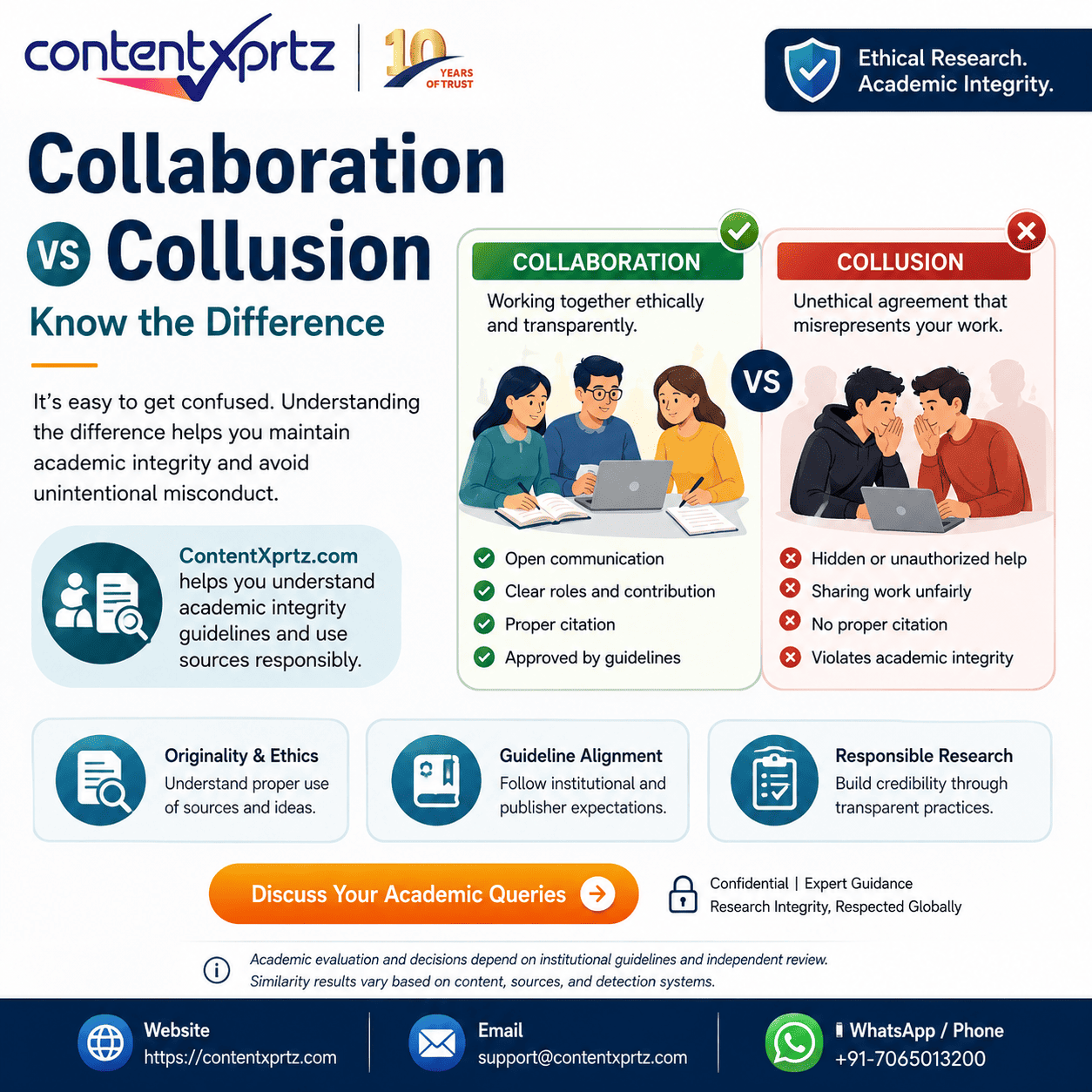
Quick Answer: What Does Turnitin Turnitin Mean?
The repeated query usually means “Explain Turnitin and help me understand my report.” Turnitin compares submitted writing with selected databases and produces a Similarity Report showing matched passages and an overall percentage. It does not independently decide that plagiarism occurred, and no single percentage is universally acceptable.
Open the report, examine the largest and most relevant matches, identify the original sources, and classify each passage. Correctly quoted and cited text may be acceptable. A close paraphrase may need to be rewritten from understanding and cited. An uncited copied passage needs direct correction. A reference list or supplied template may be an expected match, depending on settings.
The correct goal is accurate authorship and transparent source use, not a zero score. Follow the institution’s policy, preserve drafts and notes, and ask the instructor when the report or assignment rules are unclear.
Key Takeaways
- Turnitin reports similarity, not a final finding of plagiarism.
- No universal percentage applies to every assignment, thesis, or manuscript.
- Each important match should be reviewed for quotation, citation, paraphrase, and context.
- A high score can contain legitimate material, while a low score can still conceal poor source use.
- AI-writing indicators are separate from similarity scores and require human judgement.
- Repository storage, student access, exclusions, and resubmissions depend on institutional settings.
- Ethical revision improves attribution and original explanation rather than disguising copied text.
What This Page Covers
- What Turnitin is designed to do and what it cannot decide
- How similarity percentages and match groups should be interpreted
- Why references, quotations, templates, and prior drafts may match
- How to revise a report ethically, step by step
- How AI-writing detection differs from text similarity
- Privacy, repositories, resubmissions, and self-matching
- When self-review is enough and when professional editing may help
Table of Contents
Methodology and Academic Sources
This article uses current official Turnitin guidance on similarity and plagiarism, understanding the similarity score, navigating the enhanced Similarity Report, using the AI Writing Report, and Turnitin data privacy. Publication-related discussion also reflects the principle that human authors remain responsible for originality, accuracy, and disclosure.
Interfaces and assignment settings vary. A student may see a classic or enhanced report, may or may not be allowed to view it, and may have different resubmission or repository options. Always check the specific institution’s academic-integrity policy and assignment instructions. Contentxprtz can support wording, citation consistency, and document clarity, but it cannot set institutional rules or make misconduct determinations.
What Turnitin Means in an Academic Context
Turnitin is best understood as a comparison and feedback system used within an educational or publishing process. A submitted document is processed against the sources enabled for that assignment, and matching strings are highlighted. The report then calculates the proportion of matching text relative to the submission. This creates a map of similarity, not a statement about the writer’s intention or academic honesty.
The distinction between similarity and plagiarism is central. Similarity is observable overlap. Plagiarism is an academic or publication judgement about whether another person’s words, ideas, data, images, or structure have been used without appropriate acknowledgement or in breach of policy. A report can support that judgement, but it cannot replace it.
What may contribute to a similarity score
- Direct quotations, whether cited correctly or incorrectly
- Close paraphrases that retain the source’s wording or structure
- Reference-list entries, bibliographic data, and standard titles
- Common technical phrases, definitions, or methods language
- Assignment questions, cover sheets, or institutional templates
- Text from a prior draft or earlier submission by the same author
- Uncited copying from online, published, or student-paper sources
A percentage therefore has no useful meaning without the source-level details. The same 20% could be distributed across dozens of harmless short phrases, concentrated in one copied section, or dominated by references and a template. Review must be qualitative as well as numerical.
Why Students, PhD Scholars, and Researchers Search for Turnitin Help
People search for Turnitin help because the report arrives at a high-stakes point and is often presented as a single coloured percentage. That design can make the number feel like a grade even when it is not.
Students preparing coursework
Students often need to know whether quotations, paraphrases, and citations are being used correctly. A formative report can show where notes have been copied too closely or where a source has been cited but exact wording still requires quotation marks.
PhD scholars preparing a thesis
Theses contain repeated terminology, literature-review citations, standard methods, ethics statements, and sometimes material developed from published papers. The scholar must separate acceptable necessary overlap from text that requires quotation, attribution, disclosure, or rewriting. University rules about published thesis chapters and editorial support should guide the process.
Researchers preparing journal manuscripts
Journal authors may need to check source integration, text recycling, translated passages, methods wording, and overlap with preprints or conference papers. A similarity report can identify material for review, but the target journal’s author instructions and publication-ethics policies remain controlling.
ESL and multilingual authors
Writers working in an additional language may rely too heavily on source sentence patterns because they are uncertain how to express technical ideas. Ethical language editing can help them produce clearer original prose without changing data, claims, or authorship.
Free, Institutional, and Professional Options
Turnitin is normally encountered through an institution rather than used as a generic public checker. The best option depends on the document, confidentiality, and the stage of work.
| Option | Best use | Strength | Important limitation |
|---|---|---|---|
| Institutional Turnitin draft assignment | Coursework or thesis drafts where authorised | Uses the institution’s configured workflow and report | Access, storage, exclusions, and resubmissions depend on settings |
| Instructor or supervisor review | Interpreting ambiguous matches and policy questions | Adds subject knowledge and academic judgement | Feedback availability may be limited by deadlines |
| Manual source and citation audit | All academic documents | Checks ideas, attribution, quotations, and references beyond a percentage | Requires careful records and enough time |
| Reference manager and writing checklist | Preventing citation omissions and inconsistent references | Improves traceability and formatting consistency | Imported metadata and in-text use still need human review |
| Professional academic editing | Complex theses, manuscripts, and ESL writing | Can improve paraphrasing, source integration, clarity, and consistency | Must remain ethical, permitted, and transparent; no score can be guaranteed |
| Unverified public “Turnitin checker” | Generally unsuitable for confidential or unpublished work | May appear convenient | May not be official, equivalent, private, or governed by institutional settings |
For important unpublished work, do not choose convenience over confidentiality. Confirm who operates the service, what database is used, whether the document is stored, and what rights you retain before uploading.
When Self-Review Is Enough and When Expert Editing Is Safer
Self-review is usually enough when the matches are limited, the sources are familiar, and the corrections are straightforward. For example, you may need to add a missing page number, put an exact sentence in quotation marks, or remove text copied from the assignment prompt.
Expert assistance becomes useful when the report reveals repeated close paraphrasing, inconsistent citation across a long thesis, source-dependent writing that lacks synthesis, translated material, unclear methods wording, or overlap with earlier publications. In those cases, the task is not simply lowering a score. It is reconstructing the prose so the author’s reasoning becomes visible and every borrowed contribution remains traceable.
A practical decision rule
Use self-review for isolated, understandable matches. Seek an instructor, supervisor, librarian, or ethical editor when the issue involves policy, authorship, confidential material, extensive source dependence, or publication disclosure.
How to Review a Turnitin Report Step by Step
The most reliable workflow moves from evidence to correction. Do not begin by replacing words at random.
1. Confirm the assignment rules
Read the academic-integrity policy, citation style, submission instructions, permitted use of AI, and any stated approach to similarity reports. Note whether students can view the report, whether drafts are stored, and whether resubmission is allowed.
2. Preserve the original file and report
Save a dated copy of the document, notes, references, and report. Version history can show how the work developed and helps prevent accidental loss of valid content during revision.
3. Start with the most significant matches
Review long passages, matches in argument-heavy sections, and sources that recur frequently. A long uncited match usually deserves more attention than a common two-word phrase.
4. Open the source information
Identify the matched source and compare it with your text. Check whether the report has selected the most authoritative source; the same phrase may appear on multiple pages, while the original source is elsewhere.
5. Classify the match
- Correctly quoted and cited: normally retain, subject to the assignment’s quotation limits.
- Cited but too close: paraphrase from understanding or quote exactly.
- Quoted but not cited: add the required source attribution.
- Uncited borrowed idea or wording: rewrite and cite, or remove if unsupported.
- Reference or template text: verify whether exclusions are appropriate.
- Previous own work: check authorisation, citation, and disclosure requirements.
- Common terminology: retain necessary technical language without forced synonym changes.
6. Revise the reasoning, not only the vocabulary
Good paraphrasing changes the explanatory structure because the writer understands the source. It may combine several sources, compare findings, state limitations, and connect evidence to the research question. A synonym-by-synonym rewrite usually keeps the source’s sentence design and can remain too close.
7. Repair citation and quotation together
Every revision should answer two questions: “Is the wording genuinely mine?” and “Is the underlying source acknowledged?” Paraphrasing does not remove the need for citation, and citation does not permit copying without quotation marks.
8. Check tables, figures, captions, and appendices
Academic integrity applies beyond prose. Adapted tables and figures may need attribution and permission. Survey instruments, coding frameworks, translated scales, and supplementary materials should be documented according to policy.
9. Re-read for meaning and accuracy
After revision, compare the new text with the source and data. Ensure that the claim has not become stronger, narrower, or different merely to avoid a match.
10. Resubmit only through the authorised route
Use the assignment’s permitted resubmission process. Do not upload confidential work to unknown sites or create additional repository copies without understanding the consequences.
How to Interpret Similarity Scores and Match Groups
A similarity score is the percentage of a submission’s text that matches the selected comparison sources. It should be treated as a navigation aid. The number directs attention to overlap; it does not grade originality, quality, or intent.
| Situation | What it may mean | Responsible next action |
|---|---|---|
| Low overall score with one long uncited match | A concentrated attribution problem may be hidden by the low total | Review and correct the passage immediately |
| Moderate score dominated by references and quotations | Much of the overlap may be legitimate, though quotation use may be excessive | Check exclusions, citation, and whether synthesis can replace unnecessary quotation |
| High score after submitting a revised version | The paper may match an earlier stored draft or template | Confirm repository and assignment settings with the instructor |
| Very low or zero displayed score | Few matches were found or the displayed number may round down | Still audit citations, ideas, data, and permitted assistance |
| Many small technical matches | Common terminology or standard methods language may be involved | Retain necessary precision; cite distinctive borrowed wording or methods |
Using match groups
The enhanced report may organise overlap according to citation and quotation patterns. These categories can reveal teachable issues: text that is neither cited nor quoted, cited text that may need quotation marks, quoted text without a citation, and text with both quotation and citation. The classification is helpful, but it still cannot determine whether a citation is accurate, whether a quotation is justified, or whether the source has been interpreted correctly.
Using filters and exclusions responsibly
Quotes, bibliographies, small matches, or templates may be excluded where the assignment permits. Exclusions refine the view; they should not conceal evidence. Compare the filtered and unfiltered report, document the settings, and avoid presenting a lower recalculated percentage as proof of compliance.
Resubmissions, Self-Matches, Repositories, and Privacy
Turnitin behaviour varies because institutions configure assignments differently. A report may compare against a global repository, an institutional repository, publications, internet sources, or a selected combination. An assignment may store papers, store them privately, or not store them for future matching.
Why self-matching happens
If a draft was submitted to one assignment and stored, a later version can match it. The correct response is to identify the earlier submission and confirm that the reuse is authorised. Students may need an instructor or administrator to resolve repository issues. For published or publicly disseminated work, appropriate citation and disclosure may still be required.
Resubmission is a setting, not a universal right
Some authorised workflows allow revised submissions and overwrite the previous attempt; others limit attempts or delay report generation. Check the assignment dashboard and instructions rather than relying on a general rule found online.
Privacy and confidential material
Before submitting a thesis chapter, unpublished article, patent-related document, client report, or sensitive research material, review the institution’s data policy and the service terms. Remove unnecessary personal identifiers where permitted. Do not upload confidential work to a public checker simply because it claims to provide a Turnitin percentage.
Repository question to ask
Will this file be stored, where will it be stored, who can search against it, who can view a match, and what process applies if the submission must be removed?
Turnitin AI Writing Reports and Human Judgement
The AI-writing report is separate from the Similarity Report and should be interpreted as one signal, not a decision. It estimates whether qualifying prose may have been generated or modified by AI. It does not verify authorship, prove misconduct, or explain how a passage was produced.
Turnitin’s guidance recognises that AI detection may misidentify human, AI-generated, and AI-paraphrased text. A fair review therefore considers drafts, source notes, version history, writing samples, assignment prompts, disclosed tool use, and the student’s ability to explain the work. Institutional policy determines whether specific uses—brainstorming, grammar correction, translation, coding, drafting, or rewriting—are permitted and whether disclosure is required.
Good practice for authors
- Keep dated drafts, notes, prompts, and source records.
- Verify every factual claim, calculation, quotation, and reference.
- Disclose permitted AI assistance according to university or journal rules.
- Do not list an AI system as an author or transfer human responsibility to it.
- Be prepared to explain the argument, methods, and wording in your own terms.
An AI flag should initiate a careful conversation. It should not replace due process or become the sole basis for a penalty.
Ethical Academic Editing and Author Responsibility
Ethical editing improves communication while keeping the author responsible for the intellectual work. An editor may correct grammar, improve sentence structure, identify unclear paraphrasing, check citation consistency, and suggest where evidence or explanation is missing. The editor should not invent data, fabricate references, conceal copied material, or create an argument the author cannot defend.
For a thesis, the permitted level of editing may be defined by university regulations. For a journal manuscript, the author instructions may require disclosure of language editing, writing assistance, or AI use. Authors should retain control of every claim and approve every revision.
Contentxprtz supports scholarly proofreading, thesis editing support, and human review of AI-assisted writing where these services are permitted. The aim is clarity, traceability, and publication readiness—not guaranteed acceptance or an artificial target score.
Common Turnitin Mistakes to Avoid
- Treating the percentage as a plagiarism grade. The source-level context is more important than the colour.
- Chasing zero similarity. References, quotations, and necessary terminology may match.
- Deleting citations to lower the score. This can make attribution worse.
- Using synonym replacement as paraphrasing. Close structure can remain derivative and meaning may change.
- Ignoring a low score. One serious uncited passage may be academically significant.
- Submitting to unknown public checkers. Unpublished work may be stored or reused under unclear terms.
- Assuming an AI flag proves misconduct. Models can make errors and require contextual review.
- Hiding matches with formatting tricks. Manipulated characters or image text undermine integrity and accessibility.
- Forgetting previous versions. Self-matches should be documented and resolved through the institution.
- Editing without checking meaning. A lower match is not an improvement if the scientific claim becomes inaccurate.
Practical Examples: What Ethical Review Looks Like
Example 1: A PhD scholar with a high thesis score
Situation: A doctoral candidate receives a 34% similarity score before final submission. The reference list, university declaration, published article titles, and standard methods wording account for much of the overlap.
Common mistake: The scholar starts replacing technical terminology and deleting citations to push the score below an assumed threshold.
Correct approach: The scholar reviews the unfiltered and filtered report, checks the university’s thesis policy, and focuses on long matches in the literature review. Two paragraphs are too close to source structure even though they contain citations. They are rewritten as a synthesis of several studies, with the citations retained. Published thesis material is disclosed as required.
How expert guidance helps: An ethical thesis editor can check source integration, chapter consistency, and language while leaving the research claims and decisions with the scholar.
Example 2: A first-time student with a low score
Situation: A student sees 8% and assumes the assignment is safe. Most matches are small, but one full paragraph comes from a website and has no citation.
Common mistake: The student ignores the report because the overall number looks low.
Correct approach: The paragraph is removed from the draft notes, the source is read carefully, and the idea is restated in the student’s own analytical structure with a citation. The student also verifies that the source is academically appropriate.
How expert guidance helps: A writing tutor or editor can explain the difference between citation, quotation, and paraphrasing so the student can apply the skill independently.
Example 3: An ESL researcher receives an AI flag
Situation: A researcher uses a permitted grammar assistant on a journal manuscript. An AI-writing indicator marks part of the introduction.
Common mistake: The researcher assumes the score proves wrongdoing and rewrites clear sentences into awkward language.
Correct approach: The researcher keeps drafts, explains the permitted language assistance, checks the journal’s AI policy, and verifies all claims and references. The institution or editor considers the evidence rather than treating the indicator as conclusive.
How expert guidance helps: Human academic editing can improve language transparently and provide a revision record without generating unsupported content.
Turnitin and Academic Integrity Checklist
Before writing
- Record every source while reading.
- Separate copied quotations from personal notes clearly.
- Confirm the required citation style and AI policy.
- Keep versioned drafts and research notes.
Before submission
- Check every quotation for quotation marks, page details, and citation.
- Check every paraphrased idea for original structure and source acknowledgement.
- Verify references against the original publications.
- Review tables, figures, methods, appendices, and translated text.
- Remove comments, tracked data, or personal information that should not be submitted.
When reviewing the report
- Start with long, recurring, and argument-relevant matches.
- Open the source and classify the reason for the match.
- Apply exclusions only when policy permits.
- Do not alter necessary terminology merely to reduce overlap.
- Ask the instructor about self-matches, repositories, or unclear settings.
After revision
- Re-read for accuracy, coherence, and faithful representation of sources.
- Confirm that the author can explain and defend the final text.
- Submit only through the authorised institutional route.
How Contentxprtz Can Help
Contentxprtz can review a thesis, dissertation, research paper, or professional academic document for clarity, source integration, citation consistency, and language quality. The service is most useful when a report reveals a pattern rather than one isolated error: repeated close paraphrasing, excessive quotation, unclear transitions between sources, inconsistent references, or AI-assisted wording that needs accountable human verification.
An ethical review does not promise a particular Turnitin percentage. Editors work from the text, available report, style requirements, and author instructions. Suggested changes should preserve technical meaning, distinguish the author’s contribution from source material, and remain explainable by the author. For publication-focused work, manuscript and publication support can also help align the document with journal requirements without promising acceptance.
Summary: Turnitin Turnitin Explained
The useful meaning behind “turnitin turnitin” is a request for clarity about similarity, plagiarism, and safe revision. Turnitin highlights text that resembles selected sources and calculates an overall similarity percentage. The report does not decide misconduct, set a universal acceptable score, or replace the institution’s policy and human judgement.
Review every important match in context. Preserve accurate quotations and citations, rewrite close paraphrases from genuine understanding, disclose earlier versions where required, and treat AI-writing indicators as one imperfect signal. Free self-review is often enough for isolated corrections. Longer theses, complex source integration, multilingual manuscripts, or publication disclosures may benefit from an instructor, librarian, supervisor, or ethical academic editor.
Frequently Asked Questions
What does the repeated search phrase “turnitin turnitin” usually mean?
The repeated search phrase “turnitin turnitin” usually indicates that a student or researcher is trying to reach Turnitin information quickly, understand a report, or solve a submission problem rather than asking about two separate products. The useful next step is to identify the exact need: accessing an institutional account, opening a Similarity Report, interpreting a percentage, reviewing matched sources, understanding an AI-writing indicator, or checking whether resubmission is allowed. Turnitin access and report visibility are commonly controlled by the university, school, journal, or organisation that created the assignment. Therefore, a general web search cannot confirm the settings applied to a specific submission. Open the assignment instructions, check the learning-management system, and contact the instructor or administrator when a report, score, or resubmission option is missing. Treat third-party websites that promise an “official Turnitin check” cautiously because uploading unpublished work may create privacy, confidentiality, or intellectual-property concerns. The safest interpretation of the query is: use official Turnitin guidance for the tool and institutional guidance for the decision.
Does Turnitin detect plagiarism?
Turnitin detects text similarity; it does not make the final academic judgement that plagiarism has occurred. A Similarity Report highlights passages that resemble material in the comparison sources selected for the assignment, such as internet pages, publications, and previously submitted papers. Some matches are legitimate: a correctly quoted definition, a standard methods phrase, a reference entry, or text supplied in an assignment template may still appear. Conversely, a low score does not prove that the work is original, correctly attributed, or compliant with the institution’s rules. Plagiarism is a contextual judgement involving source use, citation, quotation, paraphrasing, authorship, intent, and the applicable academic policy. Review each meaningful match, open the source, and ask whether the borrowed wording or idea has been represented and acknowledged correctly. Instructors should use subject knowledge and evidence beyond the percentage. Students should use the report as feedback for revision, not as a pass-or-fail certificate. Where a match is unclear, ask the instructor before changing technically necessary wording or removing valid citations.
What Turnitin percentage is acceptable?
There is no universal acceptable Turnitin percentage. Universities, departments, courses, journals, and individual assignments can apply different expectations, and some do not prescribe a numerical threshold at all. The same percentage can represent very different writing. A paper with many correctly quoted primary sources may show a noticeable score but be properly cited, while a paper with one uncited copied paragraph may show a modest overall score and still raise a serious concern. The most useful question is not “How do I get below a number?” but “What is causing each significant match?” Review the source, match length, location, citation status, quotation marks, repeated phrases, reference list, template language, and any previous version of the same work. Follow the written policy for the assignment and ask the instructor whether references, quotations, small matches, or templates are excluded in the report. Ethical revision improves attribution and original explanation; it does not disguise copied text, replace words mechanically, or remove necessary evidence merely to lower the percentage.
How should I read a Turnitin Similarity Report?
Read a Turnitin Similarity Report from the matched passages outward, not from the headline percentage alone. Start with the largest or most consequential matches and open the source information. Determine whether the match is a direct quotation, close paraphrase, common phrase, reference entry, template text, reused material from your own earlier submission, or unexplained copying. Then check whether the source is cited in the text and reference list, whether exact wording is enclosed in quotation marks where required, and whether the surrounding explanation is genuinely your own. In the enhanced report, match groups can help distinguish patterns such as text that is not cited or quoted, text with a citation but missing quotation marks, quoted material without a citation, and text that is both quoted and cited. These groups are prompts for review, not automatic verdicts. Apply exclusions only when they reflect the assignment policy and preserve the unfiltered report when evidence may be needed. Finally, read the document normally to confirm that revisions remain accurate, coherent, and faithful to the source.
How can I reduce Turnitin similarity ethically?
Reduce similarity ethically by correcting source use rather than trying to manipulate the software. First, remove accidental copying from notes and rewrite the idea after reading and closing the source. When exact wording is necessary, use quotation marks or block-quote formatting and provide the required citation. When paraphrasing, change the structure and explanation because you understand the concept; changing a few synonyms is not sufficient. Add citations for borrowed ideas even when no exact words are repeated. Replace excessive quotation with synthesis that compares multiple sources, while preserving specialised terminology that cannot reasonably be changed. Check captions, tables, appendices, methods language, definitions, and translated material for attribution. Review the reference list for completeness and consistency. Do not use text spinners, hidden characters, image-based text, deliberate misspellings, or AI paraphrasers to evade matching. Those approaches can damage meaning and may breach academic rules. A lower score is useful only when it results from clearer original writing, accurate quotation, authentic paraphrasing, and transparent citation.
Why does my paper match my previous submission?
A paper can match a previous submission when an earlier version was stored in a Turnitin repository and the new assignment compares against that repository. The report may identify the earlier document as a student-paper source even though both versions are yours. Whether this happens depends on assignment settings, repository choices, and the resubmission route. In some workflows, a permitted resubmission overwrites the earlier attempt and the versions do not match each other; in other situations, drafts submitted to separate assignments or repositories can create self-matches. Do not delete citations or rewrite accurate material merely to hide legitimate prior use. Instead, confirm where the first version was submitted, whether the work is an authorised revision, and whether reuse is permitted. Contact the instructor or administrator because students may not be able to delete repository submissions themselves. For journal articles, theses, and later publications, disclose and cite earlier dissemination when required, including conference papers, preprints, reports, or thesis material. Reusing one’s own published text without appropriate transparency can raise text-recycling or duplicate-publication concerns even when the words are technically the author’s.
Can students use Turnitin before final submission?
Students can use Turnitin before final submission only when their institution provides a draft assignment, Draft Coach, a student-writing workflow, or another authorised route. Access, report visibility, storage, and resubmission settings are controlled by the institution and assignment. A personal Turnitin account is not normally a substitute for the university’s configured process, and an unofficial third party cannot guarantee that its check uses the same repositories or settings. Before uploading a thesis, manuscript, confidential dataset, unpublished chapter, or client document to any external checker, review privacy terms and institutional policy. Where an authorised draft report is available, use it as a learning tool: inspect meaningful matches, correct citation and quotation, improve paraphrasing, and retain version notes. Do not repeatedly upload simply to chase a lower number, because the report may change with settings and repository treatment. When no draft route exists, use careful source notes, citation software, manual phrase checks, supervisor feedback, and ethical proofreading to reduce avoidable problems before the official submission.
Is Turnitin AI detection the same as the similarity score?
No. Turnitin’s AI-writing indicator and the Similarity Report assess different signals. The similarity score measures how much qualifying text matches sources in the selected comparison databases. An AI-writing report estimates whether qualifying prose may have originated from or been modified by generative-AI systems. A passage can have low similarity and still be flagged by an AI model, or it can have high similarity because of quoted and cited material without being AI-generated. Turnitin’s own guidance states that AI detection may misidentify human-written, AI-generated, or AI-paraphrased text and should not be used as the sole basis for adverse action. Educators should combine the indicator with the student’s drafts, notes, sources, writing history, oral explanation, assignment requirements, and institutional policy. Students should preserve research notes and version history, disclose permitted AI use, verify every claim and reference, and avoid presenting generated text as independent work when rules prohibit it. The correct response to an AI flag is a fair evidence-based review, not an automatic accusation.
Does Turnitin store my paper and who can see it?
Storage and access depend on the institution’s Turnitin licence, account configuration, assignment settings, and applicable privacy arrangements. A submission may be stored in a standard repository, an institutional or private repository, or not stored for future comparison. Repository storage allows later submissions to be checked against the document, but it does not mean that any user can freely read the full paper. Access to matching student work is restricted and may involve institutional controls or a paper-view request. Students should read the submission notice, end-user terms, privacy information, and university policy before uploading, especially when the document contains personal data, confidential research, unpublished findings, sensitive participant information, or third-party material. Questions about deletion, repository status, or data rights should be directed to the institution’s administrator or data-protection contact because they control the educational account and can liaise with Turnitin. Avoid uploading the same confidential manuscript to unverified public checkers; their storage and reuse practices may be less clear and may not match institutional safeguards.
When can Contentxprtz help with a Turnitin-related concern?
Contentxprtz can help when the real problem is academic communication: unclear paraphrasing, inconsistent citation, excessive quotation, awkward source integration, language errors, repetitive phrasing, or a manuscript that needs an ethical pre-submission review. Support should begin with the document, the applicable style guide, and any available report or supervisor feedback. An editor can identify passages that remain too close to sources, improve clarity without replacing the author’s ideas, check that quotations and references are handled consistently, and explain revision choices. Contentxprtz cannot determine institutional misconduct, alter Turnitin settings, guarantee a target percentage, erase repository records, or promise that a future report will contain no matches. The author remains responsible for the research, evidence, citations, permitted use of assistance, and final submission. For theses and journal manuscripts, it is also important to follow university or publisher disclosure rules. The most appropriate services are ethical academic editing, proofreading, and plagiarism-risk reduction guidance—not automated “score reduction” or disguised rewriting.
Conclusion: Use the Report to Improve Scholarship, Not to Chase a Number
A Turnitin report is most valuable when it helps a writer see how evidence enters the document. The practical question is not whether the page is green, blue, yellow, orange, or red. It is whether every borrowed word and idea is used honestly, accurately, and according to the applicable rules.
Self-service review may be enough when matches are limited and easy to explain. Expert-assisted editing is safer when the document contains extensive source synthesis, publication overlap, multilingual wording, or unclear citation patterns. Contentxprtz helps authors improve clarity, structure, ethical source integration, and publication readiness while keeping the research and final decisions with the author.
“At Contentxprtz, we don’t just edit; we help ideas reach their fullest potential.”