Plagiarism Scanner Turnitin: How to Read Similarity Reports Responsibly
Plagiarism scanner Turnitin is a common search phrase used by students, PhD scholars, researchers, instructors, and academic authors who want to know whether a document contains problematic text overlap before submission. The phrase is understandable, but it can create the wrong expectation. Turnitin primarily produces a Similarity Report by comparing submitted text with sources selected for the assignment or account, which may include internet content, academic publications, and previously submitted papers. The report highlights matching or similar text. It does not independently decide that plagiarism has occurred, determine the author’s intent, or replace academic judgment.
This distinction matters because a similarity percentage can be high for legitimate reasons. A thesis may contain correctly cited quotations, a required reference list, standard terminology, a university template, or a methods section that uses conventional wording. A low percentage can also be misleading if an uncited paragraph has been lightly reworded, a source is absent from the comparison database, or the work contains non-textual appropriation such as copied ideas, data, structure, or images. Therefore, the useful question is not simply, “How do I get a lower score?” It is, “Which matches are academically acceptable, which require correction, and what does my university or target journal require?”
For students, access to Turnitin and the ability to view a report usually depend on institutional and instructor settings. Researchers may encounter Turnitin Similarity, Feedback Studio, or iThenticate through a university, publisher, laboratory, or professional workflow. Report settings can also change what contributes to the displayed score, including whether quotations, bibliographies, cited text, small matches, templates, or specific sources are excluded. Two documents with the same percentage may therefore have very different academic risks.
This guide explains how Turnitin similarity checking works, how to interpret matches rather than chase a number, how to prepare and submit a document responsibly, and how to revise paraphrasing, quotations, and citations without disguising copied material. It also explains when self-review is sufficient and when ethical plagiarism and academic-integrity support may help. Contentxprtz can assist with source-aware editing and plagiarism-risk reduction, but authors remain responsible for their ideas, evidence, citations, institutional compliance, and final submission.
Quick Answer: What Does Plagiarism Scanner Turnitin Do?
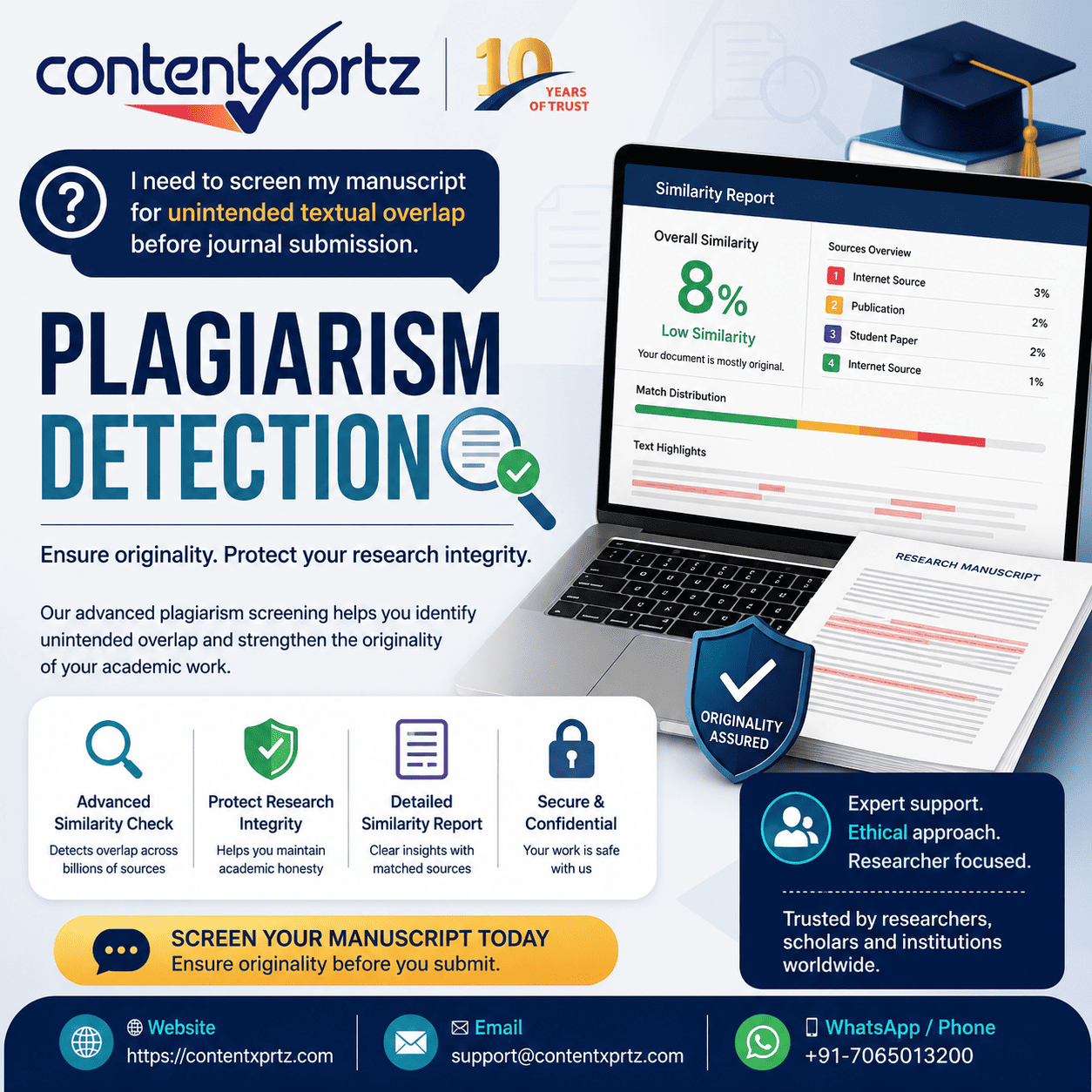
Turnitin compares the text in a submission with selected source repositories and produces a Similarity Report. The report identifies matching passages, links them to possible sources, groups overlaps, and calculates a similarity score representing the proportion of matched text. It supports plagiarism review, but it does not itself prove plagiarism.
Use the report as an evidence map. Open each substantial match, check whether the source has been quoted, paraphrased, summarised, and cited correctly, and decide whether the wording is necessary or overly dependent on the source. Review the assignment settings because quotations, bibliographies, templates, cited text, and small matches may be included or excluded.
There is no universal “safe” Turnitin percentage. The meaning of a score depends on the type of document, the pattern and location of matches, the discipline, the institution’s policy, and the quality of attribution. Correct the underlying writing and citation issue rather than trying to manipulate the number.
Key Takeaways
- Turnitin reports similarity; educators, editors, and institutions determine whether plagiarism may have occurred.
- A high score can contain legitimate matches, while a low score can still contain serious unattributed copying.
- No single percentage is acceptable for every assignment, thesis, manuscript, or institution.
- Read individual source matches and match groups before revising the document.
- Reduce similarity through original synthesis, accurate paraphrasing, quotation, and citation—not through synonym swapping or text manipulation.
- Repository, resubmission, template, bibliography, quotation, and small-match settings can change the report.
- Authors remain responsible for the authenticity of sources, accuracy of citations, and compliance with university or journal rules.
What This Page Covers
- What the phrase “plagiarism scanner Turnitin” means in academic practice
- How Turnitin creates a Similarity Report and similarity score
- How to interpret source matches, overlap patterns, and exclusions
- When institutional Turnitin access, iThenticate, or manual review may be appropriate
- A step-by-step ethical workflow before thesis, assignment, or manuscript submission
- Common mistakes that lower a score without improving academic integrity
- Practical cases, a final checklist, and ten detailed FAQs
Table of Contents
- Meaning and academic context
- Why students and researchers use Turnitin
- Step-by-step similarity review workflow
- How to interpret scores and matches
- Access, submission, and resubmission considerations
- How to evaluate plagiarism risk
- Common mistakes
- Practical examples
- Pre-submission checklist
- Frequently asked questions
Methodology and Academic Sources
This guide uses current official Turnitin materials on Turnitin Similarity, the distinction between similarity and plagiarism, student interpretation of the similarity score, and the use of report filters and exclusions. It also follows the principle reflected in COPE plagiarism guidance that suspected copying requires evidence, context, and proportionate human assessment.
Product interfaces, access rules, repository settings, and institutional policies can change. Always check the current assignment instructions, your university’s academic-integrity policy, the relevant Turnitin guide for your interface, and the target journal’s author instructions. Contentxprtz may support ethical academic editing services and citation review, but it does not replace institutional decisions or author responsibility.
What “Plagiarism Scanner Turnitin” Means in Academic Context
The phrase usually refers to Turnitin’s text-similarity checking functions, not to a machine that makes a final plagiarism verdict. A submission is processed against the repositories and settings available to the institution or account. The resulting report highlights overlap and shows a percentage of matched text. That percentage is a screening signal, not a misconduct grade.
Plagiarism is broader than text similarity. It can involve using another person’s words, ideas, argument structure, data, images, code, or creative work without appropriate acknowledgement. Turnitin is strongest at locating text overlap against material available in its comparison sources. It may not identify every form of plagiarism, and it may highlight text that is entirely legitimate.
Four terms that should not be confused
| Term | Practical meaning | What it does not prove |
|---|---|---|
| Similarity match | A passage resembles text in a source available to the report. | That the passage is plagiarised or intentionally copied. |
| Similarity score | The proportion of submission text identified as matching. | That the document has passed or failed academic-integrity review. |
| Plagiarism | Use of another person’s work without the acknowledgement required by the context. | It cannot be established from a percentage alone. |
| Text recycling | Reuse of an author’s own earlier text, sometimes without adequate disclosure or citation. | That self-authored text is automatically acceptable in every course or journal. |
Responsible interpretation asks three questions for every meaningful match: What is the source? How is the source used? Does the attribution and wording meet the applicable rule? These questions are more reliable than comparing the score with an unofficial internet threshold.
Why Students, PhD Scholars, and Researchers Use Turnitin
Turnitin is used because similarity review can reveal citation and source-integration problems before they become academic-integrity disputes. The value is highest when the report supports learning and revision rather than acting as a simple pass-or-fail gate.
For coursework and student assignments
Students can identify missing quotation marks, incomplete citations, overused source wording, and sections that rely too heavily on one reference. Whether they can see the report, resubmit, or apply exclusions depends on the instructor’s settings.
For theses and dissertations
Long documents naturally contain references, repeated terminology, standard method descriptions, institutional wording, and previously submitted components. A thesis review should therefore examine chapters and source matches in context. Authors may also need to verify whether earlier conference papers, proposals, or deposited chapters are being matched as prior submissions.
For journal manuscripts and research reports
Researchers and publishers may use Turnitin products or iThenticate to identify overlapping language, duplicate publication risks, unattributed reuse, and source-integration problems. The target journal’s policy remains decisive because acceptable reuse in a methods section may be treated differently from overlap in results, discussion, figures, or conclusions.
For academic writing development
A report can reveal patterns: patchwriting, repeated dependence on abstracts, citation without genuine paraphrasing, quotation-heavy sections, and reference-list inconsistencies. Ethical scholarly proofreading can correct language and consistency, while deeper editing may be needed when source synthesis and paragraph logic are weak.
Turnitin, Other Options, and When Each Is Appropriate
The best option depends on who is submitting the document, why the check is needed, and which database coverage and reporting controls are required. Free web tools may be useful for basic phrase searches, but they should not be presented as equivalent to institutional Turnitin access.
| Option | Best suited to | Main advantage | Important caution |
|---|---|---|---|
| Turnitin through a university or LMS | Students, instructors, coursework, and institutional assessment | Integrated assignment workflow and source-matching report | Student report access and resubmission depend on settings |
| Turnitin Similarity or Feedback Studio | Institutions managing academic-integrity and feedback workflows | Match review, exclusions, source comparison, and learning support | It still requires human interpretation |
| iThenticate or publisher workflow | Researchers, journals, publishers, and professional documents | Research-integrity checking within publication workflows | Policies and access differ by organisation |
| Manual phrase searching and citation audit | Authors reviewing small sections or verifying source use | Direct control over context, quotation, and citation | Cannot reproduce Turnitin database coverage |
| Free online similarity checker | Low-stakes preliminary screening | Easy access | Coverage, privacy, storage, and report quality may be unclear |
| Professional source-aware review | Theses, manuscripts, ESL writing, and complex revision | Connects matches with paraphrasing, citation, clarity, and structure | Must remain ethical and preserve author ownership |
Before uploading unpublished research to any third-party service, review its privacy terms, document-retention policy, and repository settings. Confidential data, patent-sensitive material, embargoed findings, and identifiable participant information may require institutional approval or a controlled workflow.
When Self-Service Review Is Enough and When Expert Help Is Safer
Self-review is often enough when the document is short, the sources are familiar, the matches are easy to classify, and the author understands the required citation style. A student may be able to correct a missed quotation mark, add a page number, rewrite a source-dependent sentence, or remove an accidental duplicate reference without outside help.
Expert review becomes more useful when a thesis contains hundreds of matches, an ESL author has patchwriting across several chapters, a manuscript reuses text from related publications, or the report appears inconsistent with the visible source use. Support may also help when a university has specific thesis-editing limits or a journal asks for a detailed explanation of overlap.
Ethical assistance should identify the source-use problem, explain why the wording is risky, preserve the author’s intended meaning, and improve citation traceability. It should not “beat Turnitin,” insert invisible characters, translate text back and forth to hide copying, fabricate references, or rewrite someone else’s ideas as if they were original. For complex doctoral documents, thesis editing support should be aligned with the university’s permitted-assistance policy.
How to Use a Turnitin Similarity Report: Step by Step
1. Confirm the submission and repository rules
Before uploading, check whether the assignment allows drafts, whether students can view the report, whether resubmission is permitted, and whether the paper will be stored in a repository. These settings affect both the workflow and possible self-matches.
2. Prepare the correct document
Upload the intended final draft in a supported, text-readable format. Confirm that headings, tables, equations, references, and quotations are visible correctly. Scanned image-only pages may not produce meaningful text comparison.
3. Read the score only as an overview
Use the percentage to understand scale, not to reach a verdict. Note whether the score includes the bibliography, quotations, template text, or previously submitted versions.
4. Review the largest and most important matches
Open substantial matches and compare the submission with the identified source. Prioritise long passages, unique phrasing, clustered overlap, repeated dependence on one source, and matches in the thesis argument, results, discussion, or conclusion.
5. Classify each match
- Expected and attributed: a correctly quoted passage, reference entry, title, standard instrument name, or required template.
- Acceptable but revisable: conventional wording or a properly cited passage that is longer than necessary.
- Inadequately paraphrased: sentence structure and distinctive phrasing remain too close to the source.
- Unattributed: wording or ideas are used without the acknowledgement required.
- Self-overlap: text matches the author’s earlier work or an earlier submission and may require citation, disclosure, permission, or explanation.
6. Correct the academic issue
Return to the original source. Decide whether to quote, paraphrase, summarise, cite, remove, or fully redevelop the passage. Strong paraphrasing changes the sentence structure and presentation because the author has genuinely understood and re-expressed the source; it is not a word-substitution exercise.
7. Check citations and references together
Every in-text citation should correspond to the correct reference, and every reference should identify an authentic source the author has used. Verify author names, dates, titles, publication details, page numbers, and DOIs where applicable.
8. Review the full paragraph, not only highlighted words
A highlighted sentence may be part of a broader synthesis problem. Ensure the paragraph has a clear author-led claim, uses sources for support rather than replacement, and distinguishes evidence from interpretation.
9. Recheck only within permitted rules
Resubmit only if the assignment or workflow allows it. Keep copies of drafts and reports. Do not upload repeatedly to unknown services, because storage and repository behaviour may create privacy or future matching problems.
10. Complete a human final review
Read the document without the report open. Confirm that the writing is coherent, references are traceable, quotations are exact, paraphrases are accurate, and the final work represents the author’s own intellectual contribution.
How to Interpret a Turnitin Score and Its Matches
A similarity score becomes meaningful only when it is connected to the location, source, length, and purpose of the matched text. Avoid treating colour bands or percentages as universal academic grades.
Look for the pattern, not just the total
- One large source match may indicate copying, an uploaded template, a prior version, or extensive quotation.
- Many tiny matches may come from common terminology, titles, references, or fragmented source dependence.
- Matches concentrated in literature review sections may indicate patchwriting or insufficient synthesis.
- Matches in methods may include standard procedures but still require citation or disclosure.
- Matches in results and conclusions deserve careful review because originality and accurate attribution are central.
Understand what exclusions change
Depending on the interface and permissions, a report may exclude bibliography entries, quoted text, cited text, templates, small matches, or individual sources. Exclusion can make the report easier to interpret, but it does not rewrite the document or fix an attribution problem. A quotation remains academically acceptable because it is accurate, necessary, and cited—not because it has been filtered out.
A practical interpretation matrix
| Observed pattern | Possible explanation | Responsible next action |
|---|---|---|
| High score dominated by references | Bibliography included in comparison | Verify references, then review the report with the permitted bibliography exclusion |
| Moderate score from correctly quoted passages | Quotation text included | Check necessity, quotation accuracy, page details, and citation format |
| Low score with one uncited paragraph | Serious localised overlap | Return to the source and quote, paraphrase, cite, or remove the passage |
| Score rises after a draft submission | Prior version or repository matching | Check assignment settings and ask the instructor or administrator about self-match handling |
| Many sentence-level matches to several sources | Patchwriting or close paraphrasing | Rebuild paragraphs around the author’s own analysis and source synthesis |
| Very low score but sources are not acknowledged | Database gaps or disguised borrowing | Conduct a manual citation and evidence audit; do not assume the work is safe |
Turnitin Access, Submission, and Resubmission Considerations
Most students use Turnitin through a university, school, learning-management system, or assignment created by an instructor. An individual student may not have the same purchasing, report-viewing, or resubmission options as an institution. The practical first step is to ask the instructor or university support team how the assignment is configured.
Before submission
- Confirm whether the upload is a draft or final submission.
- Check whether the file will be stored in a standard, institutional, or no-repository setting.
- Remove tracked changes, comments, hidden text, and accidental duplicate content.
- Keep a dated local copy of the exact file submitted.
- Check confidentiality and data-protection requirements for unpublished research.
After submission
Report availability may be immediate or delayed, especially after resubmission or according to assignment settings. Students may be allowed to see the score but not the full source details, or they may not see a report at all. A report can usually be downloaded only when the relevant access is enabled.
Repository and self-match concerns
Earlier drafts, previous assignments, conference papers, thesis chapters, or institutional deposits can create matches. A self-match is not automatically misconduct, but it must be explained and managed under the applicable rule. Instructors or administrators may need to exclude a prior submission or use a no-repository workflow. Do not assume that deleting a local file removes a submission from an institutional repository.
How to Evaluate Plagiarism Risk Beyond the Percentage
Plagiarism risk should be evaluated through evidence, attribution, and authorship—not through score reduction alone. A responsible review considers the type of material borrowed, the importance of the passage, the quality of citation, and whether the author has made an original intellectual contribution.
Evaluate words, ideas, data, and structure
Turnitin may highlight overlapping words, but reviewers should also check whether the document borrows an argument sequence, table, figure, dataset, coding logic, research instrument, or conceptual model without acknowledgement. Conversely, standard phrases and technical terms may be unavoidable and academically harmless.
Evaluate paraphrasing quality
A valid paraphrase accurately represents the source, uses genuinely independent wording and sentence structure, fits the author’s own argument, and includes citation. Changing a few words while retaining the source’s syntax is patchwriting. It may occur because the author is inexperienced or writing in a second language, but it still requires correction.
Evaluate citation completeness
A citation placed at the end of a paragraph does not automatically clarify which sentences come from the source. Use clear attribution, appropriate page or section details where required, and a reference that readers can trace. For literature-heavy documents, a source matrix can help record each claim, source, paraphrase, quotation, and citation.
Evaluate institutional and publisher rules
Universities vary in the assistance they permit for coursework and theses. Journals vary in their policies on text recycling, preprints, translated publication, methods reuse, and disclosure. The same overlap may therefore require different action in different contexts.
How to Reduce Turnitin Similarity Ethically
Ethical similarity reduction improves the writing rather than hiding its source. The goal is a clearer, more original, and accurately attributed document—not an artificially low percentage.
Start with understanding
Read the original source until you can explain its point without looking at the wording. Note the evidence, limitation, and relevance to your argument. Then write from your understanding and compare the result with the source to ensure accuracy and independence.
Synthesise multiple sources
Instead of writing one paragraph per article, organise the paragraph around a theme, debate, method, or finding. Compare sources, identify agreement and disagreement, and explain what the evidence means for your research question. This makes the author’s analytical voice visible.
Quote selectively
Use quotation when the exact wording is itself important, such as a formal definition, policy statement, participant quotation, or distinctive claim. Keep quotations proportionate, reproduce them accurately, and provide the citation details required by the style.
Cite both paraphrases and summaries
Changing the wording does not remove the need to cite the underlying idea. Cite at the point where the borrowed information is used, and make the boundary between the source’s view and the author’s view clear.
Use editing for clarity, not concealment
Professional AI and human editing review can identify unnatural paraphrasing, citation gaps, and language that is too close to a source. The editor should preserve meaning, flag uncertainty, and avoid inventing evidence or masking copied text.
Common Turnitin and Similarity-Reduction Mistakes to Avoid
- Chasing a universal threshold. A target such as 10%, 15%, or 20% has no meaning unless the institution or journal defines how it should be used.
- Rewriting only highlighted words. This often produces awkward synonym substitution while leaving the source’s structure intact.
- Deleting citations to lower the score. Removing attribution increases academic-integrity risk.
- Assuming quotation marks solve everything. Excessive quotation can still weaken originality and may violate assignment expectations.
- Ignoring a low-score match. One short uncited passage can be more serious than a high score caused by legitimate references.
- Using translation or text-spinning tools to hide overlap. Concealment does not create original scholarship and may distort meaning.
- Uploading confidential research to unknown websites. Privacy, retention, and repository terms may be unclear.
- Submitting the same draft repeatedly without checking settings. This can create delays, self-matches, or confusion about the final version.
- Treating AI detection and similarity as the same report. They are distinct analyses with different limitations and access conditions.
- Accepting fabricated or incomplete references from editing tools. Every reference must be verified against an authentic source.
Practical Examples: Reading Turnitin Reports in Context
Example 1: A PhD thesis shows 28% similarity
Situation: A doctoral scholar receives a 28% score and assumes the thesis will be rejected. The largest matches are the university declaration, reference list, standard questionnaire items, and a methods description adapted from the approved protocol.
Common mistake: The scholar begins changing technical terms and removing references to force the score below 10%.
Correct approach: Review permitted exclusions, verify that reused protocol wording is cited or disclosed as required, and focus on substantive matches in the literature review and discussion. The score may remain above an informal target while the document becomes more defensible.
How ethical guidance helps: A source-aware editor can separate expected matches from patchwriting, improve synthesis, and check citation consistency without altering the research contribution.
Example 2: A student paper shows only 9% similarity
Situation: Most of the paper is original, but one paragraph closely reproduces a website and has no citation.
Common mistake: The student assumes a single-digit score means the paper has passed.
Correct approach: Treat the paragraph as a serious local issue. Read the source, decide whether the information is necessary, paraphrase from understanding or quote the exact wording, and cite it. Then check whether the paragraph contributes to the student’s own argument.
How ethical guidance helps: A tutor or editor can explain source integration and show how to distinguish common knowledge from information that requires attribution.
Example 3: An ESL manuscript has many small matches
Situation: A first-time journal author has 34% similarity spread across dozens of sources. The paper repeatedly follows the sentence patterns of articles used during drafting.
Common mistake: The author uses automated synonyms, creating inaccurate technical language and unreadable sentences.
Correct approach: Rebuild the literature review by themes, write claim-led paragraphs, compare studies, and cite each synthesis accurately. Preserve standard terminology when it is the correct term.
How ethical guidance helps: An academic editor can improve English and paragraph logic while flagging passages that require source-based rewriting. A manuscript assessment can also identify broader structure and publication-readiness issues.
Turnitin and Academic-Integrity Checklist Before Submission
Document and access
- The correct final file has been saved and backed up.
- Assignment, repository, report-viewing, and resubmission rules are understood.
- Confidential or sensitive material is handled under institutional requirements.
- Tracked changes, comments, duplicate text, and hidden content have been reviewed.
Similarity report
- The largest and most important matches have been opened and compared with their sources.
- Bibliography, quotations, templates, cited text, and small-match settings are understood.
- Prior submissions and self-matches have been investigated.
- No decision has been based on the percentage alone.
Writing and citation
- Every paraphrase accurately represents the source and uses independent structure and wording.
- Direct quotations are exact, necessary, marked, and cited.
- Paragraphs are led by the author’s claim rather than by source wording.
- In-text citations and reference-list entries correspond accurately.
- All references are authentic, traceable, and actually used.
Final responsibility
- The document complies with the university, funder, employer, or journal policy.
- Any permitted editorial or AI assistance has been disclosed where required.
- The author has approved every revision and remains responsible for the final submission.
How Contentxprtz Can Help With Plagiarism-Risk Reduction
A Similarity Report identifies where text resembles available sources, but it does not explain every writing problem. Contentxprtz can review the report alongside the manuscript to distinguish expected overlap from missing attribution, close paraphrasing, weak synthesis, citation inconsistency, self-reuse concerns, and language problems.
Support may include source-aware rewriting guidance, academic editing, reference consistency checks, thesis or manuscript proofreading, and publication-readiness review. The process should preserve the author’s ideas, evidence, disciplinary terminology, and intended meaning. Contentxprtz does not promise a particular similarity score, guaranteed thesis approval, or guaranteed journal acceptance because outcomes depend on the document, source use, institutional policy, research quality, and human evaluation.
Summary: Plagiarism Scanner Turnitin and Responsible Similarity Review
Turnitin is best understood as a similarity-checking and review system. It compares submitted text with available sources, highlights overlaps, and calculates a similarity score. The score does not prove plagiarism, and no universal percentage can determine whether a document is academically acceptable.
Responsible review begins with the individual matches. Authors should verify sources, classify each overlap, correct missing attribution, improve close paraphrasing, use quotation selectively, synthesise evidence in their own analytical structure, and follow the relevant university or journal policy. Filters can reduce noise, but they do not fix the underlying writing.
Self-service review is usually enough for clear, local corrections. Expert help is safer when a thesis or manuscript contains complex overlap, extensive patchwriting, self-reuse, ESL language challenges, or publication-policy questions. In every case, the author remains responsible for the final words, claims, data, citations, and submission.
Frequently Asked Questions
What is plagiarism scanner Turnitin?
Plagiarism scanner Turnitin is a common way of referring to Turnitin’s similarity-checking functions. When a document is submitted, Turnitin compares its text with source repositories available to that account or assignment and produces a Similarity Report. The report highlights matching passages, identifies possible sources, and calculates a similarity score. It does not independently decide that plagiarism has occurred. A match may be a correctly quoted sentence, a reference entry, standard terminology, template text, a prior submission, or unattributed copying. The reviewer must examine the source, context, citation, and purpose of the passage. Students should also check whether their instructor allows them to view the full report and whether exclusions or resubmissions are enabled. The best use of Turnitin is formative: identify source-integration problems, correct citations, improve paraphrasing, and strengthen original analysis. It should not be treated as a tool for producing the lowest possible percentage or disguising copied text.
Does Turnitin actually detect plagiarism?
Turnitin supports plagiarism review, but it does not make the final plagiarism determination. Its Similarity Report shows text that matches or resembles material in the sources selected for comparison. Human judgment is then needed to decide whether the overlap is legitimate, incorrectly cited, inadequately paraphrased, self-reused, or potentially plagiarised. A high score can result from extensive quotations, references, templates, or standard phrases. A low score can still contain a serious uncited passage or other forms of borrowing that text matching does not reveal. Reviewers should consider the author’s source use, attribution, context, document type, and institutional policy. They may also need to examine ideas, data, figures, code, or structure that a text-similarity system cannot fully assess. Therefore, describe Turnitin as a similarity checker and evidence source rather than a definitive plagiarism detector. The final academic-integrity decision belongs to the instructor, institution, editor, or publisher under the applicable rules.
What Turnitin similarity percentage is acceptable?
There is no universal acceptable Turnitin percentage. Some institutions set local thresholds for particular assignments, but those numbers should be interpreted with the report, not used as automatic pass-or-fail rules. A 25% score may be largely made up of correctly cited quotations, a reference list, and required template text. A 7% score may include one substantial uncited paragraph. Document type also matters: a literature review, legal analysis, qualitative study, technical method, and short reflective essay naturally use sources differently. Ask your instructor, university, or target journal whether it has a stated policy and whether exclusions should be applied. Then inspect the largest and most important matches, especially those in the argument, results, discussion, and conclusion. Correct missing attribution and close paraphrasing even when the total is low. Do not remove citations, distort technical terms, or use text-spinning methods to meet an informal number. Academic integrity depends on responsible source use, not on a single percentage.
Can students use Turnitin for free?
Students commonly access Turnitin through a school, university, instructor, or learning-management system rather than through a general free individual account. Whether a student can submit a draft, view the Similarity Report, download it, or resubmit depends on the institution’s licence and the instructor’s assignment settings. The practical step is to check the course page or ask the instructor, library, graduate school, or academic-support office. Researchers may also encounter iThenticate through a university, publisher, or research organisation. Free online plagiarism checkers are not necessarily equivalent to Turnitin because their source coverage, privacy terms, storage practices, and reporting controls may differ. Before uploading unpublished or sensitive work anywhere, review how the service stores and uses documents. A manual phrase search and citation audit can help with preliminary checking, but it cannot reproduce Turnitin’s repositories. Use only authorised institutional access and do not purchase or share unofficial accounts that may breach terms or expose confidential work.
Why did my Turnitin score increase after resubmission?
A score can increase after resubmission because the document changed, the report settings changed, additional sources became available, or a previous version is being matched. Assignment and repository settings determine whether earlier submissions are stored and how resubmissions are processed. In some workflows, the prior draft can be excluded automatically or manually; in others, an instructor or administrator may need to investigate a self-match. The new draft may also contain added quotations, references, template material, or source-based revisions that legitimately increase visible overlap. First, compare the two reports and identify which sources caused the change. Check whether bibliography, quotation, cited-text, template, or small-match exclusions are the same. Confirm that you submitted the intended file and that duplicated sections were not introduced accidentally. Do not respond by deleting citations or randomly changing wording. Ask the instructor or Turnitin administrator about repository and resubmission settings when the report appears to match your own earlier submission. The source pattern will usually explain more than the changed percentage.
Can Turnitin detect paraphrasing?
Turnitin may identify some paraphrased or modified text when the wording and structure remain sufficiently similar to a source, but it cannot guarantee detection of every paraphrase or determine whether a paraphrase is academically acceptable. Close paraphrasing, sometimes called patchwriting, often retains the source’s sentence order, distinctive phrases, and logic while replacing a few words. Even when a report does not highlight it, the passage still requires citation and may still be too dependent on the original wording. A strong paraphrase begins with understanding the source, then expresses the relevant point in a genuinely independent structure that fits the author’s argument. It preserves the source’s meaning and includes attribution. Automated synonym replacement, translation loops, and text spinners can introduce errors and do not create original scholarship. Review paraphrases manually against the source, check that technical meaning has not changed, and ensure that the citation clearly identifies the source. The ethical goal is accurate synthesis and authorship, not avoidance of detection.
How can I reduce Turnitin similarity ethically?
Reduce similarity ethically by correcting the source-use problem behind each meaningful match. Open the identified source, decide whether the passage should be quoted, paraphrased, summarised, cited, shortened, or removed, and then revise from genuine understanding. Build paragraphs around your own claim or research question rather than around the sequence of a source. When several studies support a point, synthesise their agreements, differences, methods, and limitations instead of writing one source at a time. Use quotations only when the exact wording is important and provide the citation details required by your style. Cite paraphrases and summaries because the idea still comes from another source. Keep standard technical terms when they are accurate; replacing them with unusual synonyms can damage meaning. After revision, verify the references and read the paragraph for coherence. Do not delete citations, insert hidden characters, translate copied text, or use word-spinning services. Those tactics may change a score without improving academic integrity and can create new misconduct risks.
Should bibliography and quotations be excluded from a Turnitin report?
Bibliography and quotation exclusions can make a Similarity Report easier to interpret, but they should be used according to the assignment or institutional workflow. Reference lists commonly produce expected matches because publication titles, journal names, and bibliographic details are standard. Correctly marked quotations can also match their original sources. Excluding these categories may reduce noise and help reviewers focus on uncited or inadequately paraphrased text. However, exclusion does not prove that the references are accurate or the quotations are appropriate. Verify that every reference is authentic, corresponds with an in-text citation, and follows the required style. Check that quotations are exact, proportionate, clearly marked, and cited with page or location details where required. Do not exclude material merely to reach a target percentage. Some interfaces and roles allow instructors to apply more controls than students, and the terminology can differ between report versions. Follow the current Turnitin guide and your institution’s instructions when using filters.
Is a low Turnitin score proof that my work is original?
No. A low Turnitin score is not proof that the work is original or properly attributed. It only indicates that a relatively small proportion of the text matched sources available under that report’s settings. A document can receive a low score while containing an uncited passage, borrowed ideas, copied structure, translated plagiarism, fabricated sources, reused data, or material from a source that is not in the comparison database. It can also include contract-written or AI-generated material that does not produce substantial text matches. Review the document independently of the percentage. Check whether each factual claim is supported, whether paraphrases are accurate and cited, whether quotations are marked, whether figures and data have permission and attribution, and whether the reference list is authentic. Compare the work with the author’s notes and research process when relevant. A low score can be reassuring only after the source-use and authorship evidence has also been reviewed. Academic integrity is demonstrated by transparent, traceable, author-led scholarship.
When should I seek professional plagiarism-risk review?
Professional review may be useful when a thesis, dissertation, manuscript, or long report contains many complex matches; when the author is unsure about patchwriting, self-reuse, translated text, or citation boundaries; or when a university or journal has raised a specific concern. It can also help ESL authors whose wording remains too close to sources because they drafted directly from notes or abstracts. Ethical review should examine the report alongside the document and, where possible, the original sources. The reviewer may classify matches, flag missing attribution, improve paraphrasing and synthesis, check reference consistency, and explain which issues require the author’s decision. The service should not promise to remove all plagiarism, guarantee a score, hide copying, invent citations, or replace the author’s intellectual work. Students should confirm what editing assistance their institution permits, and journal authors should follow disclosure and authorship rules. Contentxprtz can provide source-aware editing and plagiarism-risk reduction while leaving research claims, evidence, and final approval with the author.
Conclusion: Use Turnitin to Improve Scholarship, Not Just a Score
The central problem is not the colour or percentage shown in a Similarity Report. It is whether the document uses sources transparently, accurately, and in a way that leaves the author’s own contribution clear. Turnitin can help locate overlap, but only a careful human review can distinguish a reference entry from patchwriting, a necessary quotation from overreliance, or a prior submission from unattributed copying.
Self-service review is often enough for straightforward corrections. Expert-assisted academic editing is safer when a thesis or manuscript contains complex source dependence, extensive close paraphrasing, inconsistent citations, self-reuse, or publication-policy questions. Contentxprtz helps improve clarity, structure, citation consistency, academic ethics, and publication readiness without promising a particular score or replacing author responsibility.
Use the report to return to the sources, strengthen your synthesis, correct attribution, and produce a document you can defend on academic grounds. “At Contentxprtz, we don’t just edit; we help ideas reach their fullest potential.”