Plagiarism Detector Online Free: An Ethical Academic Guide
Using a plagiarism detector online free can be a practical first step when you need to check an essay, thesis chapter, research paper, book manuscript, or professional document for unexpected source overlap. The attraction is clear: a free tool is quick, accessible, and may reveal copied phrases, forgotten citations, repetitive boilerplate, or wording that remains too close to a source. Yet the result can also be misleading when the user treats a percentage as a verdict. Similarity is evidence of textual overlap; plagiarism is an academic or publication judgment that depends on attribution, quotation, authorship, context, and the rules applied by an institution or publisher.
Students and researchers often search for a free plagiarism checker shortly before a deadline. They may be worried about accidental plagiarism, patchwriting, citation errors, reuse of their own earlier work, or text suggested by an AI tool. A report can help organise that review, but it cannot decide whether a quotation is appropriate, whether a paraphrase preserves meaning, whether a source is reliable, or whether a reused methods description has been disclosed correctly. Database coverage also varies. A checker may search public webpages yet lack access to subscription journals, institutional repositories, private student-paper collections, books, conference proceedings, or newly published material.
The most responsible workflow combines automated screening with human reading. Each meaningful match should be opened and classified. Some matches are harmless, such as references, standard terminology, titles, legal wording, or correctly formatted quotations. Others may require a clearer citation, a genuine paraphrase, a shorter quotation, permission, or a new explanation written from the author’s own understanding. Privacy matters too: before uploading an unpublished thesis, confidential dataset, patent-sensitive manuscript, or co-authored paper, the user should understand whether the service stores, indexes, shares, or reuses submitted text.
This guide explains how similarity checking works, how to select and use a free tool cautiously, how to interpret a plagiarism report, and how to revise highlighted passages without superficial synonym swapping. It also shows when self-review is enough and when ethical plagiarism and AI integrity support or academic editing services can provide a more thorough review while preserving the author’s ideas, evidence, and responsibility.
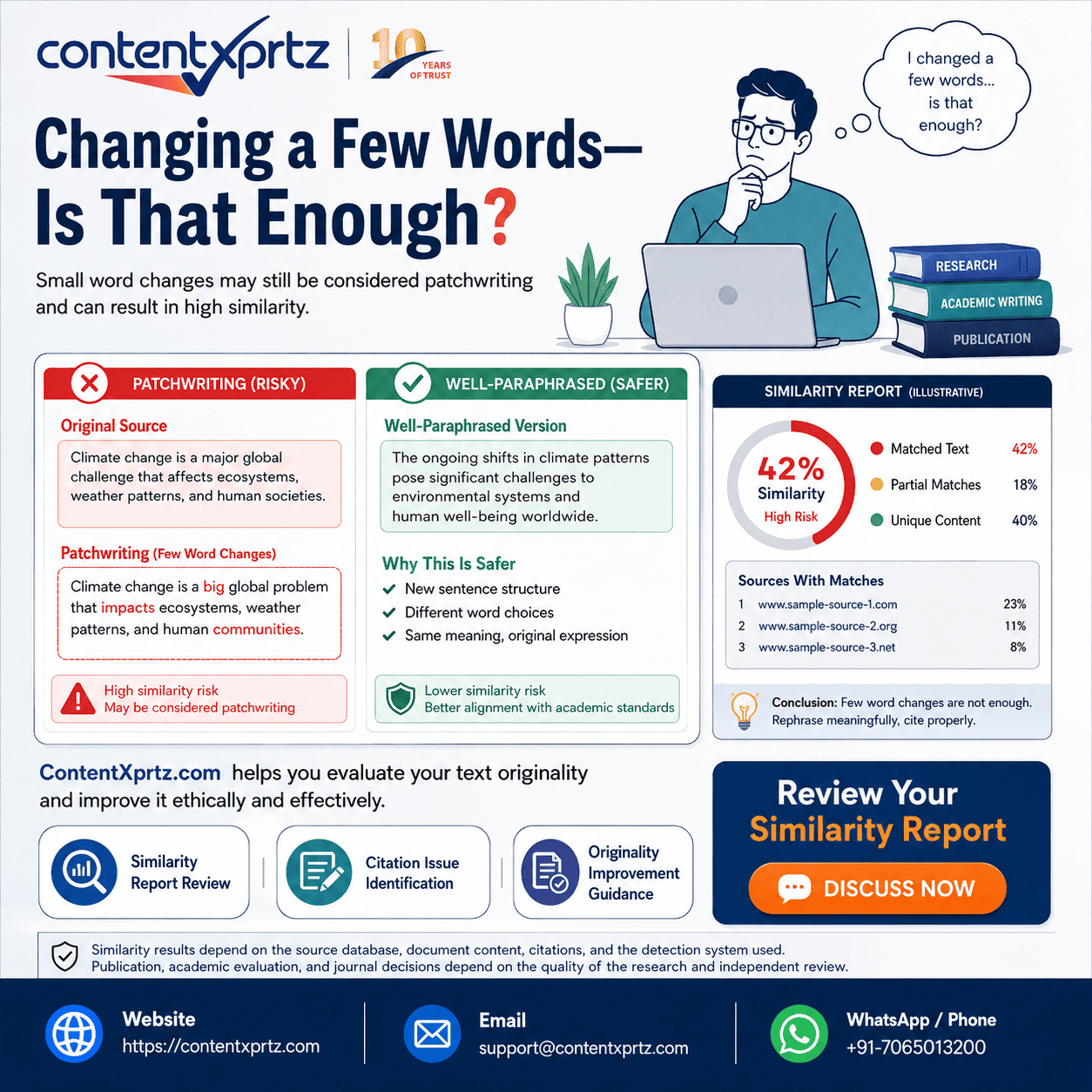
Quick Answer: How Should You Use a Plagiarism Detector Online Free?
A plagiarism detector online free should be used as a screening tool, not as a final academic-integrity decision. Upload or paste only material you are permitted to share, review the service’s privacy terms, run the check, and inspect each substantial match rather than reacting only to the total percentage.
Classify every match as a correct quotation, a properly cited paraphrase, common or technical wording, a reference-list match, reused text, or a passage that needs revision. Correct missing citations, quote distinctive wording, rewrite patchwritten sentences from your own understanding, and verify every reference. Then review the revised document manually.
A low score does not prove originality, and a high score does not automatically prove plagiarism. Institutional and journal rules, the nature of the matched text, and the writer’s attribution practices determine the real significance of the report.
Key Takeaways
- A free plagiarism checker usually measures textual similarity, not intent or misconduct.
- Database coverage, exclusions, and privacy terms differ substantially between tools.
- Every meaningful match should be interpreted in context before revision.
- Quotations require both attribution and appropriate quotation formatting.
- Patchwriting is not solved by changing a few words or using automated synonym tools.
- Confidential or unpublished work should be uploaded only after checking storage and reuse terms.
- For high-stakes work, combine automated screening with human citation and language review.
What This Page Covers
- What free plagiarism and similarity checkers can and cannot detect
- How to choose a tool without ignoring privacy, database, and file limitations
- A step-by-step method for interpreting and acting on a plagiarism report
- The difference between similarity, plagiarism, patchwriting, and self-reuse
- How to revise highlighted text ethically without distorting the source
- Practical examples for students, PhD scholars, and journal authors
- When expert academic editing or plagiarism-risk guidance may be appropriate
Table of Contents
Methodology and Academic Sources
This article is based on common academic-integrity, source-use, editing, and publication-readiness workflows. It distinguishes textual similarity from plagiarism and follows the principle that authors remain responsible for their ideas, evidence, quotations, citations, data, and final submissions. The discussion is supported by the University of Oxford’s plagiarism guidance, the Purdue Online Writing Lab guidance on quoting and paraphrasing, COPE publication-ethics guidance, and the Crossref Similarity Check overview.
Tool coverage, interface features, file limits, and retention terms can change. Check the current terms of the chosen service and follow the exact academic-integrity policy of your university, institution, journal, or publisher. Contentxprtz can assist with ethical editing, proofreading, citation consistency, and plagiarism-risk review, but no service can replace author responsibility or guarantee a particular similarity score.
What a Free Plagiarism Detector Means in Academic Context
A plagiarism detector is more accurately described as a text-matching or similarity-checking system. It divides submitted text into strings or patterns, searches available sources, and identifies passages that resemble content in its comparison database. The system may display an overall percentage, colour-coded highlights, matched sources, or separate categories for quotations and references.
The tool does not directly observe who wrote the text, whether the writer intended to deceive, whether permission was granted, or whether a citation meets a specific style guide. Those questions require context and policy. This distinction matters because the same highlighted sentence can represent a properly quoted definition, a standard methods phrase, an accidental close paraphrase, an uncited copy, or legitimate reuse covered by a publisher’s rules.
Similarity, plagiarism, patchwriting, and text recycling
| Term | Practical meaning | What the writer should check |
|---|---|---|
| Similarity | Text overlaps with material found by the tool. | Source, context, quotation, citation, and necessity of the wording. |
| Plagiarism | Another person’s words, ideas, data, or creative work are presented without appropriate acknowledgment. | Institutional or publisher policy and the complete evidence. |
| Patchwriting | The source’s wording or structure is followed too closely while a few words are changed. | Independent sentence structure, understanding, and citation. |
| Text recycling | An author reuses wording from earlier work without adequate disclosure or permission. | Publisher rules, citation, copyright, and overlap between publications. |
| Common knowledge | Information widely known in the relevant audience and not traceable to one distinctive source. | Disciplinary expectations and whether the claim is genuinely common. |
The table shows why a report cannot be interpreted by percentage alone. The writer must identify the type of overlap and take the action required by the relevant academic setting.
Why Students, PhD Scholars, and Researchers Use Free Similarity Checkers
Academic writers use free checkers because they want a fast indication of where source use may need attention before submission. A postgraduate student may have combined notes from several readings and forgotten which phrases were copied. A PhD scholar may be concerned that a literature-review chapter follows a seminal source too closely. A journal author may need to identify overlap between a conference paper and a new manuscript.
Free tools are also attractive when institutional access is unavailable, a writer is testing a short extract, or a multilingual author wants to check whether technical phrasing mirrors published language. These are reasonable uses when the tool is treated as preliminary support. Problems arise when the user uploads confidential material without reading the terms, assumes the database is comprehensive, or rewrites every highlighted phrase merely to force the score downward.
What a free check can realistically provide
- A quick scan for obvious copied wording and repeated phrases
- Source links for some matched public webpages or documents
- A prompt to inspect quotations, paraphrases, and references
- An early warning about patchwriting in selected sections
- A repeatable check after careful revision
What it cannot reliably guarantee
- Complete coverage of journals, books, theses, repositories, and student papers
- A definitive finding of plagiarism or academic misconduct
- Correct interpretation of every quotation, formula, or technical phrase
- Protection of confidential text unless the terms explicitly provide it
- Guaranteed acceptance by a university, supervisor, journal, or publisher
Free, Institutional, and Professional Review Options
The best option depends on document sensitivity, academic stakes, required database coverage, and the type of guidance the writer needs.
| Option | Useful for | Main limitation | Responsible next step |
|---|---|---|---|
| Free online checker | Short extracts, early drafts, obvious web overlap | Limited databases, file limits, uncertain retention | Read terms and manually review every meaningful match |
| University-provided system | Coursework, theses, institutional procedures | Access and interpretation may be controlled by policy | Follow supervisor or academic-integrity office guidance |
| Publisher or journal screening | Submitted manuscripts and editorial workflows | Usually available only after submission or through participating organisations | Review author guidelines and disclose related publications |
| Human academic editor | Patchwriting, citation consistency, language, source integration | Quality and scope vary; the editor cannot make author decisions | Choose an ethical service with confidentiality and clear boundaries |
A free checker is often enough for a first pass. A thesis, dissertation, grant application, or journal manuscript may need a broader review because the cost of an overlooked citation, confidential upload, or closely paraphrased passage is higher.
When a Free Check Is Enough and When Deeper Review Is Safer
A free check is usually enough when the document is low risk, contains no confidential information, and the writer has time to inspect each match manually. It is particularly useful for a short essay section, a public-facing article, or an early draft where the goal is to find obvious overlap before more detailed editing.
Deeper review is safer when the document contains unpublished research, participant information, commercially sensitive findings, patent-related material, extensive quotations, translated sources, reused conference content, or many passages written from dense notes. It is also appropriate when the writer is unsure how the university distinguishes poor paraphrasing from misconduct or how the target journal handles text recycling.
In those cases, consult the institution’s policy, supervisor, research-integrity office, or target journal. Where permitted, ethical academic proofreading or thesis support can help improve clarity and citation consistency without replacing the author’s research or interpretation.
How to Use a Plagiarism Detector Online Free: Step by Step
1. Check institutional rules before choosing a tool
Universities and journals may specify which systems are permitted, how reports should be interpreted, and whether student work can be uploaded to third-party services. Begin with the applicable policy rather than the tool’s marketing language.
2. Review privacy, storage, and licensing terms
Look for statements about file retention, indexing, model training, data sharing, deletion, copyright, and the service’s right to reuse submissions. Do not upload sensitive material when the terms are unclear.
3. Prepare a clean but complete document
Use the version you intend to review. Keep quotations, citations, and references visible unless the task is specifically to test the main text separately. Removing them may create a lower number without improving the document.
4. Record the tool and settings
Note the date, document version, exclusions, minimum-match length, and whether quotations or bibliography were ignored. This record helps explain why later reports may differ.
5. Run the check and save the report
Download or capture the report where permitted. Do not rely only on the headline percentage. The source-level detail is needed for interpretation and revision.
6. Review the largest matches first
Open each source and compare the full context. Determine whether the overlap comes from a quotation, a reference, standard wording, a template, an uncited copy, a close paraphrase, or reused text.
7. Correct attribution before changing style
Add missing citations, quotation marks, page numbers, permissions, or disclosure. Attribution problems should be fixed directly rather than hidden through word substitution.
8. Rewrite patchwritten passages from understanding
Read the source, take brief concept notes, close it, and explain the idea in a structure that serves your own argument. Reopen the source to verify accuracy and add the citation.
9. Check references and source traceability
Confirm that every in-text citation has a matching reference and that authors, years, titles, pages, and identifiers are accurate. A detector cannot validate bibliographic accuracy.
10. Recheck selectively and complete a manual read
Run a second check on revised sections if appropriate, then read the document for logic, evidence, quotations, citations, figures, tables, and consistency. Do not continue rewriting harmless matches simply to reach a lower score.
How to Interpret a Plagiarism or Similarity Report
Interpretation should move from the source-level evidence to the total score, not the other way around. Start with the longest matches and the sources that account for the largest portion of the report. A 20% result composed mainly of correctly quoted definitions and references can require less revision than a 5% result containing one uncited paragraph.
Classify each meaningful match
- Correct quotation: Confirm quotation marks, page details, citation, and relevance.
- Close paraphrase: Rewrite from understanding and preserve the citation.
- Uncited copied text: Quote or rewrite appropriately and add attribution.
- Common or technical wording: Retain when necessary; avoid forced distortion.
- Reference or title match: Usually harmless, but verify formatting.
- Template language: Check whether the institution requires the wording.
- Self-overlap: Review disclosure, citation, permission, and publisher policy.
- False or weak match: Record why no change is required.
Read beyond the coloured highlight
A detector may highlight only the shared words while the real issue lies in the surrounding structure or borrowed sequence of ideas. Conversely, it may highlight a common phrase that has no distinctive authorship. Open the source, read the complete passage, and consider how your sentence functions in the argument.
Do not interpret all disciplines identically
Methods-heavy sciences, law, technical standards, and qualitative humanities can produce different patterns of legitimate similarity. The correct response depends on disciplinary convention, document type, and the policy applied by the evaluating institution.
Privacy, Database Coverage, and the Limits of “Free”
A free interface does not reveal what the service can search or what happens to uploaded text. Before using a similarity checker for unpublished academic work, review three areas: comparison coverage, data treatment, and practical limits.
Database coverage
Some tools compare only against publicly accessible webpages. Others may include licensed publications, institutional repositories, or user submissions. A tool with a smaller database can miss relevant overlap and create false confidence. The absence of a match may mean that the original source is not indexed.
Data treatment
Read whether submitted text is stored, indexed, used for product improvement, shared, retained after account deletion, or governed by a particular jurisdiction. Co-authored and sponsored research may require consent before any third-party upload.
Operational limits
Free plans may restrict word count, file type, number of checks, source details, downloadable reports, exclusions, or language coverage. Splitting a document into fragments can hide repeated patterns across chapters and make the overall assessment less reliable.
Before uploading unpublished work
- Confirm that you have authority to upload the document.
- Remove personal, confidential, or participant-identifying information where possible.
- Check whether the text will be indexed or retained.
- Keep the terms, report, date, settings, and document version.
- Use an institution-approved system when policy requires it.
How to Revise Highlighted Text Ethically
Ethical revision improves attribution and independent expression; it does not disguise copying. The correct method depends on why the passage matched.
Use quotation when the exact wording matters
Quote a concise passage when its wording is distinctive, authoritative, or directly analysed. Use the required quotation format and citation details. Excessive quotation can weaken the writer’s own voice, so retain only what the argument needs.
Paraphrase ideas, not sentences
A strong paraphrase begins with understanding. Identify the core claim, evidence, limitation, and relevance to your argument. Then write a new sentence structure with a different emphasis and vocabulary that fits your own paragraph. Cite the source because the idea remains borrowed.
Synthesise multiple sources
Instead of paraphrasing one paper at a time, compare several sources around a theme, method, disagreement, or gap. Synthesis makes the writer’s analytical contribution visible and reduces dependence on one source’s structure.
Handle reused text transparently
When reusing a methods description, conference abstract, thesis passage, or earlier publication, check copyright and text-recycling rules. Cite or disclose the earlier work and ask the journal when overlap is substantial.
Verify references and quotations
Check that the quoted words match the original, the page or section is correct, and the citation style meets institutional or journal requirements. For broader language and structure review, dissertation editing support can help identify close source dependence while preserving the author’s meaning.
Ethical Academic Editing and Author Responsibility
Academic editing should improve clarity, organisation, grammar, tone, citation consistency, and reader comprehension without replacing the author’s intellectual contribution. An editor may point out that a passage is too close to a source, ask for missing citation details, or suggest a clearer synthesis. The author must decide what the evidence means, verify the source, approve the revision, and ensure that assistance complies with institutional or publisher rules.
Responsible support does not manufacture references, invent data, rewrite a thesis to conceal copied material, or promise guaranteed publication. It also does not treat a similarity score as a marketing threat. The purpose is to strengthen transparent authorship and help the document communicate original analysis accurately.
Common Mistakes to Avoid When Using a Free Plagiarism Checker
- Chasing a zero score. References, quotations, common phrases, and technical wording can create legitimate matches.
- Changing synonyms only. The sentence structure and borrowed reasoning may remain patchwritten.
- Deleting citations before checking. This makes the report less representative and does not improve integrity.
- Uploading confidential material without reading the terms. Privacy and intellectual-property risks may be more serious than the similarity score.
- Assuming the database is complete. Unmatched text may still come from a source the tool cannot access.
- Treating every highlighted phrase as misconduct. Context determines whether revision is needed.
- Ignoring self-overlap. Reuse of your own published wording may require citation, disclosure, or permission.
- Trusting automated citations. Verify every bibliographic detail against the original source.
- Using paraphrasing software to hide matches. It can distort meaning and does not establish original authorship.
- Submitting without a final human review. Tools cannot evaluate argument quality, evidence, permissions, or policy compliance.
Practical Examples: Interpreting Free Plagiarism Reports
Example 1: A PhD scholar reviews a literature-review chapter
Situation: The report shows 24% similarity, with many short matches to definitions and a few long matches to one review article. Common confusion: The scholar assumes the whole chapter must be rewritten. Correct approach: The definitions are checked for quotation and citation, while the long passages are identified as patchwriting because they follow the review article’s structure. The scholar returns to the primary studies, reorganises the section by themes, rewrites from concept notes, and cites the relevant sources. Ethical expert role: An editor can flag residual source dependence and improve flow, but the scholar chooses and interprets the evidence.
Example 2: A student checks an essay the night before submission
Situation: A free tool reports only 6% similarity, but one match is an uncited paragraph copied from a webpage. Common confusion: The student believes the low overall percentage means the essay is safe. Correct approach: The paragraph is removed or rewritten after reading the source, the underlying idea is cited, and the reference is added accurately. The student then checks notes for other uncited material the tool may not have found. Ethical expert role: A writing adviser can explain paraphrasing and citation, but should not simply rewrite the passage for submission.
Example 3: A journal author reuses conference material
Situation: The manuscript matches the author’s published conference abstract and parts of a previous methods section. Common confusion: The author believes self-authored text never requires disclosure. Correct approach: The author checks the journal’s policy, cites the conference output, rewrites unnecessary duplicate wording, explains the relationship between the works, and contacts the editor if overlap is substantial. Ethical expert role: Manuscript assessment can help map overlap and improve transparency, but the author and journal decide what reuse is permissible.
Example 4: An ESL researcher receives many phrase-level matches
Situation: The checker highlights conventional expressions throughout a technical paper. Common confusion: The researcher changes accurate terminology into awkward alternatives. Correct approach: Standard technical phrases are retained where necessary, distinctive source wording is quoted or paraphrased, and the surrounding explanation is strengthened. Ethical expert role: Language editing can improve natural academic expression without changing scientific meaning or hiding source use.
Plagiarism Detector and Academic Integrity Checklist
Before the check
- The university, journal, or publisher policy has been reviewed.
- The tool’s storage, indexing, deletion, and reuse terms are understood.
- Permission exists to upload co-authored, confidential, or sponsored material.
- The document version and checking settings are recorded.
During interpretation
- Every substantial match is opened and read in context.
- Quotations, paraphrases, references, templates, and technical terms are distinguished.
- The total percentage is not treated as a verdict.
- Self-overlap and related publications are reviewed separately.
During revision
- Missing citations and quotation marks are corrected first.
- Patchwritten text is rewritten from understanding, not through synonym substitution.
- Distinctive wording is quoted only when necessary.
- Tables, figures, datasets, and translated material are attributed appropriately.
Before submission
- In-text citations and the reference list match.
- References are authentic and traceable.
- The final document has been read manually for evidence, meaning, and permissions.
- Required disclosure of editing, AI assistance, or prior publication has been completed.
- The author approves and accepts responsibility for the final submission.
How Contentxprtz Can Help
A similarity report often identifies where to look but not how to resolve the underlying writing problem. Contentxprtz can support authors who need ethical classification of matches, clearer paraphrasing, stronger source synthesis, citation and reference consistency, language polishing, or a structured review of thesis and manuscript sections.
Relevant support includes plagiarism-risk and AI-integrity guidance, academic editing, and manuscript assessment. The work should clarify attribution and improve communication without fabricating sources, replacing the author’s analysis, or promising a particular score or publication result.
Summary: Plagiarism Detector Online Free
A plagiarism detector online free can reveal source overlap, but its usefulness depends on careful interpretation. The score reflects matches found within a particular database under particular settings. It does not establish intent, verify every citation, detect every source, or determine whether academic misconduct occurred.
The responsible process is to check policy and privacy first, inspect meaningful matches, correct attribution, rewrite patchwriting from understanding, verify references, and complete a final human review. For important academic work, automated checking should be one part of a broader integrity and editing workflow.
Frequently Asked Questions
What does a plagiarism detector online free actually check?
A plagiarism detector online free usually compares submitted text with material available in its own database, public web pages, publications, or previously indexed documents. It then highlights matching or similar passages and may provide a percentage or source list. The result is a similarity report, not a final judgment that plagiarism occurred. Correctly quoted text, reference lists, standard terminology, assignment instructions, and common phrases can all increase similarity without representing misconduct. Conversely, a low score does not prove that every idea has been cited correctly, because the tool may not have access to the original source or may miss translated, heavily altered, or offline material. Use the report as a screening aid: open each match, identify why it appears, check whether quotation marks and citations are present, and revise only where attribution, paraphrasing, or originality genuinely needs improvement. Your university, journal, or publisher makes the final academic-integrity decision under its own rules.
Is a free plagiarism checker accurate enough for a thesis or research paper?
A free plagiarism checker can be useful for an early screening pass, but it is rarely sufficient as the only review for a thesis, dissertation, or journal manuscript. Accuracy depends on database coverage, access to subscription publications, institutional repositories, previously submitted student work, language support, file limits, and the matching settings applied. Two tools may return different percentages for the same document because they compare against different sources or exclude quotations and bibliographies differently. For important academic work, first use a free check to find obvious copied wording, forgotten citations, or repeated boilerplate. Then review the full document manually for source attribution, patchwriting, quotation accuracy, reference consistency, and reuse of your own earlier work. Where institutional policy permits, a university-provided similarity system or an ethical professional review may offer broader context. The author remains responsible for every claim, citation, quotation, table, figure, and reused passage.
What similarity percentage is acceptable in academic writing?
There is no universal similarity percentage that is automatically acceptable or unacceptable. A report must be interpreted passage by passage and according to the rules of the university, journal, funder, or publisher. A methods section may legitimately contain established technical language, while a short essay with one uncited copied paragraph may present a serious problem even if the overall score is low. Bibliographies, standard declarations, titles, quotations, templates, and commonly used phrases can also raise the total. Instead of chasing a target number, examine the largest and most meaningful matches. Ask whether the wording is quoted where necessary, whether the source is cited, whether the paraphrase is genuinely independent, and whether previously published material has been disclosed. Check the institution’s policy and the target journal’s author instructions. A responsible review focuses on attribution and authorship, not merely on reducing a percentage.
Can a plagiarism detector tell whether text was written by AI?
A plagiarism detector and an AI-writing detector address different questions. A plagiarism or similarity checker searches for overlap with existing sources, while an AI detector estimates whether patterns in the text resemble machine-generated writing. Original AI-generated text may produce little source overlap, and human-written text may still resemble published material. AI-detection results can also be uncertain, especially for edited text, short passages, technical prose, or writing by multilingual authors. Do not treat either output as definitive evidence of authorship or misconduct. Follow the university or journal policy on permitted AI assistance, keep records of drafts and sources, verify every factual statement and reference, and disclose tool use when required. The safest approach is to maintain author control over ideas, analysis, evidence, and final wording. Similarity review, source verification, and human editorial judgment remain necessary even when AI-related checks are available.
How should I revise text highlighted by a plagiarism report?
Start by identifying why each passage was highlighted. If the words are an exact quotation, keep only the necessary wording, add quotation marks or block-quote formatting, and provide the required citation. If the match reflects a close paraphrase, return to the source, understand the idea, set the source aside, and explain the point in a new sentence structure using your own analytical emphasis; then cite the source. If the passage contains standard terminology that cannot reasonably be changed, retain it and ensure the surrounding explanation is original. If a match comes from your own earlier work, check the rules on text recycling or self-plagiarism and cite or disclose the prior publication where appropriate. Do not simply replace words with synonyms or use automated “humanizer” tools, because the underlying structure and borrowed logic may remain. Recheck the revised section, but evaluate meaning and attribution rather than aiming for cosmetic score reduction.
What is patchwriting, and why can a free similarity checker miss it?
Patchwriting occurs when a writer follows a source too closely by retaining its sentence structure, sequence of ideas, or distinctive phrasing while changing only a few words. It is common when students are learning academic language or when researchers write under time pressure, but it can still create an attribution problem. A free similarity checker may identify some overlapping phrases, yet heavily substituted wording or translated text may escape matching even though the passage remains dependent on the source. Prevent patchwriting by reading the source for meaning, taking brief concept notes instead of copying sentences, closing the source, and drafting the explanation from those notes. Compare the new passage with the original afterward, add the citation, and quote any distinctive wording that must be retained. Academic editing can improve clarity, but it should not conceal borrowed language or replace the author’s responsibility to understand and attribute the source.
Is it safe to upload an unpublished thesis to a free online checker?
Uploading an unpublished thesis to a free online checker requires a privacy and intellectual-property review before submission. Read the service terms to learn whether files are stored, indexed, used to improve systems, shared with third parties, retained after deletion, or incorporated into a comparison database. Avoid uploading confidential participant information, patent-sensitive material, commercially restricted data, unpublished datasets, examination papers, or manuscripts covered by a co-author or sponsor agreement unless permission is clear. Where possible, use an institution-approved system, upload only the section that needs checking, remove identifying or sensitive information, and keep a local copy of the terms that applied at the time. A tool labelled “free” may be supported through data collection or usage limits. Privacy risk is separate from similarity accuracy, so both issues must be assessed before uploading valuable academic work.
Can I avoid plagiarism by adding a citation to every matched sentence?
Adding a citation does not automatically make copied wording acceptable. A citation acknowledges the source, but exact or distinctive wording generally also requires quotation marks or block-quote formatting. A close paraphrase can remain problematic even when cited if it mirrors the source’s syntax, progression, or phrasing. Academic writing should combine accurate attribution with an independent explanation of the evidence. Use quotations selectively, paraphrase after understanding the source, and show how the evidence supports your own argument. Also distinguish common knowledge from source-specific claims and follow the required citation style. Tables, figures, images, instruments, datasets, and translated material may require permissions or specific acknowledgments in addition to a citation. Review the policy of your university or publisher because expectations vary by discipline and document type. The goal is transparent intellectual contribution, not simply placing a reference after highlighted text.
Why do different plagiarism detectors give different results?
Different detectors often produce different results because they search different databases and apply different matching rules. One system may include subscription journals, institutional repositories, student submissions, or archived web pages that another system cannot access. Settings may exclude quotations, small matches, bibliographies, templates, or specific sources. File conversion, language detection, document length, and the date on which online material was indexed can also affect the output. Therefore, percentages should not be compared as though they are laboratory measurements made under identical conditions. Record the tool and settings used, inspect the matched passages and source links, and explain any exclusions when a formal process requires transparency. For a thesis or manuscript, combine the report with manual review of citations, quotations, paraphrases, tables, figures, and previously published material. The quality of interpretation matters more than the apparent precision of the number.
When should I seek professional plagiarism-risk or academic editing support?
Professional support is useful when the document is high stakes, the report contains many complex matches, the writer is unsure about paraphrasing or self-reuse, or the manuscript must meet a specific university or journal policy. Ethical support can help classify matches, improve source integration, check quotation and citation consistency, identify patchwriting, refine academic language, and explain where author decisions are still required. It should not fabricate references, rewrite research to hide copying, promise a guaranteed score, or certify that misconduct is impossible. Before engaging a service, confirm its confidentiality practices, scope, subject expertise, and approach to author responsibility. Contentxprtz offers ethical plagiarism-risk guidance and academic editing that focuses on clarity, attribution, and publication readiness while preserving the writer’s ideas. Final responsibility for sources, data, claims, permissions, and submission remains with the author.
Conclusion: Use Similarity Checking to Improve Attribution, Not Hide It
The central problem is not the existence of matched text. It is whether the document communicates sources, quotations, reused material, and original contribution transparently. A free checker can help locate passages that deserve attention, especially in an early draft or short extract. It becomes less reliable when users assume complete database coverage, ignore privacy terms, or chase a numerical target without understanding the matches.
Self-service review may be enough for low-risk work when the writer can inspect every source and follow clear institutional guidance. Expert-assisted academic editing or plagiarism-risk support is safer when a thesis, dissertation, research paper, or manuscript contains complex paraphrasing, confidential content, extensive source integration, or uncertain text recycling. In every case, academic integrity depends on author responsibility for the research, claims, data, citations, permissions, and final submission.
Contentxprtz helps improve clarity, structure, citation consistency, ethical source use, and publication readiness while preserving the author’s ideas and decisions. “At Contentxprtz, we don’t just edit; we help ideas reach their fullest potential.”