Plagiarism Checker: How to Read Similarity Reports
A plagiarism checker can be valuable before an assignment, thesis, dissertation, research paper, journal article, book chapter, or professional report is submitted. Yet the result is often misunderstood. The percentage shown on screen is usually a similarity score: it indicates how much wording matches material available to the system. It does not, by itself, prove plagiarism, identify the writer’s intention, or decide whether the matched use is academically acceptable. A report may highlight a properly quoted sentence, a reference entry, a standard method description, a common phrase, or a section of text that was copied without attribution. Human review is therefore essential.
This distinction matters because students and researchers are often under pressure to achieve a particular number. A doctoral candidate may be told informally that a thesis should remain below a certain percentage. A first-time author may worry that a journal will reject any manuscript with visible matches. An ESL researcher may keep replacing accurate technical terms until the writing becomes less clear. These reactions treat the score as the goal, when the real goal is original reasoning, transparent source use, accurate citation, ethical paraphrasing, and a document that can withstand academic review.
A responsible check begins long before a file is uploaded. It starts with trustworthy note-taking, clear separation of quotations from summaries, complete source records, independent drafting, careful paraphrasing, and citation in the style required by the institution or publisher. The report is then used as a diagnostic map. Long matches, repeated phrases, missing quotation marks, source-dependent sentence structures, recycled passages, and unusual clusters deserve attention. References, templates, titles, declarations, and other legitimate matches should be interpreted in context rather than removed automatically.
This guide explains how similarity systems work, what their scores can and cannot tell you, how to review a report step by step, and how to reduce plagiarism risk without distorting meaning. It also covers privacy, AI-generated text, self-reuse, patchwriting, citation accuracy, and situations where a supervisor, librarian, integrity officer, or ethical plagiarism and AI integrity review may be helpful. Contentxprtz support is presented as a way to improve clarity and source handling, never as a promise to erase plagiarism, guarantee a score, or replace the author’s responsibility.
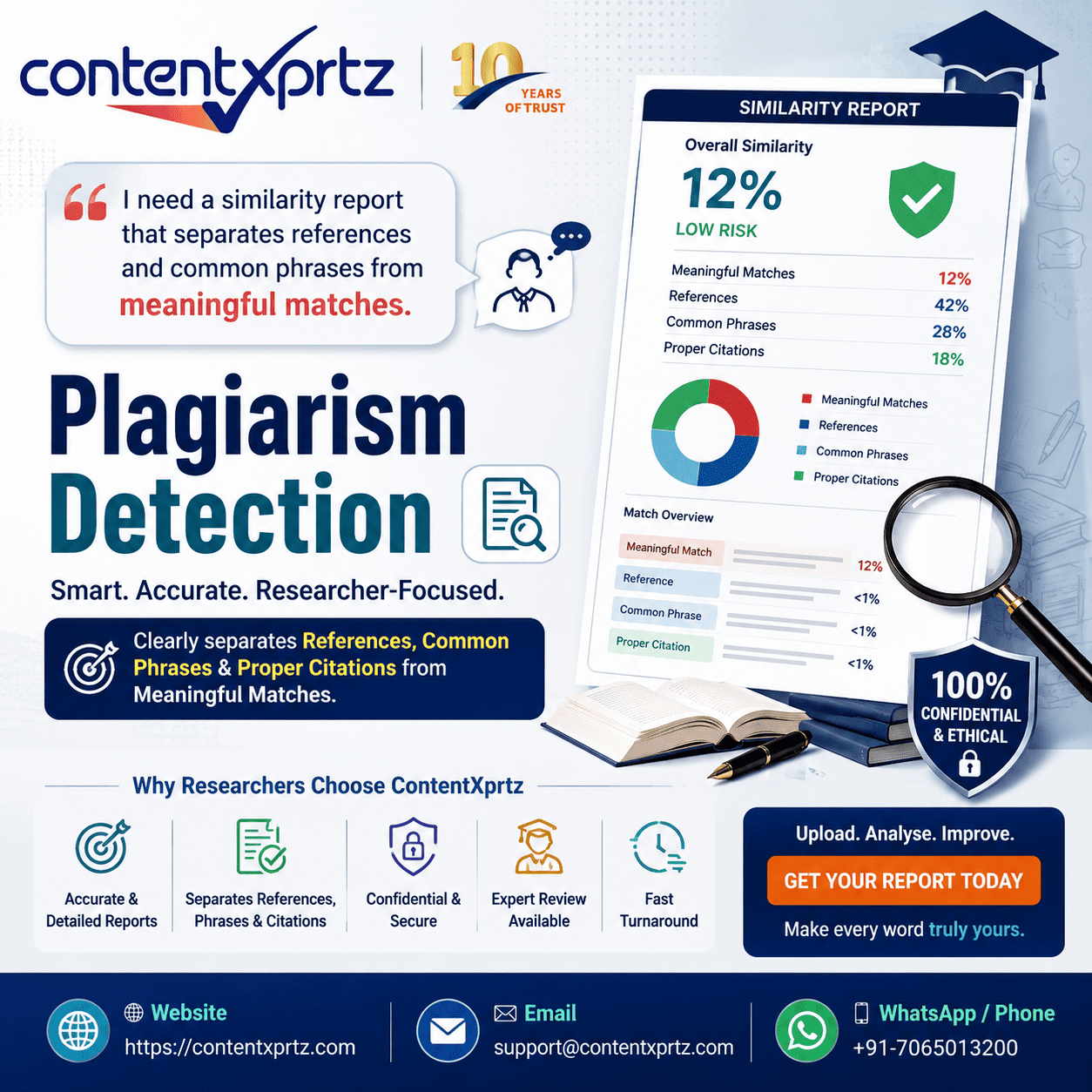
Quick Answer: How Should You Use a Plagiarism Checker?
A plagiarism checker should be used to locate matching language and review whether each match is quoted, cited, paraphrased independently, or in need of revision. Upload the correct document, wait for the full report, open the most substantial matches, and compare them with the original sources. Correct missing citations, add quotation marks where exact wording is necessary, and rewrite patchwriting from genuine understanding.
Do not assume that a high score proves misconduct or that a low score proves originality. Similarity can come from references, standard terminology, templates, and legitimate quotations. Plagiarism can also involve ideas, data, images, translations, or source structure that a text matcher may not identify. The report supports judgment; it does not replace it.
The safest next step is to follow the rules of your university, course, publisher, or employer. Preserve drafts and source notes, protect confidential material, verify every reference, and ask an authorized person when the policy is unclear.
Key Takeaways
- A similarity percentage is not a plagiarism percentage.
- Every important match must be interpreted in context.
- Quotations, references, templates, and standard phrases can create legitimate similarity.
- Low similarity does not rule out unattributed ideas, translated copying, or fabricated sources.
- Good paraphrasing changes structure and expression while preserving meaning and citing the source.
- Confidential manuscripts should be uploaded only to institutionally approved or clearly governed systems.
- Authors remain responsible for their ideas, evidence, citations, disclosures, and final submission.
What This Page Covers
- What plagiarism checkers compare and what a similarity score means
- How to interpret matches, filters, exclusions, and source groups
- A practical pre-submission workflow for students and researchers
- How quotation, paraphrasing, citation, and self-reuse affect reports
- Privacy and responsible use of free online checkers
- The difference between similarity checking and AI detection
- When self-review is enough and when expert guidance may be appropriate
Table of Contents
Methodology and Academic Sources
This article is based on common academic-integrity, editing, citation, and publication-readiness workflows. It also uses official guidance that distinguishes textual similarity from a plagiarism judgment, including the Turnitin explanation of similarity scores. Publication ethics is informed by the COPE discussion of plagiarism, while citation and paraphrasing principles are supported by APA Style guidance on plagiarism.
AI-related recommendations are aligned with UNESCO guidance for generative AI in education and research. Policies differ by institution, discipline, publisher, assignment type, and jurisdiction. Readers should therefore verify current local rules and target-journal author instructions. Contentxprtz can assist with ethical editing, citation consistency, and document review, but the author remains responsible for sources, claims, data, interpretation, and submission.
What a Plagiarism Checker Means in Academic Work
A plagiarism checker is best understood as a text-comparison system. It looks for language in a submitted document that is identical or similar to language in the material available to its search databases. Depending on the system, those sources may include public web pages, books, journals, conference papers, repositories, previously submitted student work, and institution-specific collections.
The system then produces a report that links matched passages to possible sources. Some reports group matches, assign colours, display an overall percentage, or categorize material that appears uncited, unquoted, or insufficiently paraphrased. These features help a reviewer navigate the evidence. They do not establish intention, authorship, permission, fair use, or academic misconduct on their own.
Plagiarism is an ethical and evaluative concept, while similarity is a measurable text relationship. A sentence can be similar and acceptable because it is quoted and cited. An idea can be plagiarized without producing a strong text match because the wording was changed or translated. Images, tables, code, data, argument structure, and unpublished material may require separate review.
Why database coverage changes the result
Two checkers can produce different scores for the same file because they search different databases, process quotations and references differently, or apply different matching thresholds. A tool that cannot access a paywalled article, local thesis repository, book, or unpublished submission may miss overlap. For this reason, never compare scores from unrelated systems as though they were directly equivalent.
How Plagiarism Checkers Work
Most systems break the document into searchable units, compare those units with indexed sources, and identify sequences that meet their similarity rules. The report may consolidate overlapping sources so that one passage does not appear as many independent matches. Filters can sometimes exclude quotations, bibliographies, citations, or small matches, but the exact controls depend on the product and institutional setup.
What the system can identify
- Exact copied wording available in the comparison databases
- Close or rearranged wording that meets the similarity threshold
- Repeated passages from earlier submissions when those are stored
- Commonly matched sources and overlapping source groups
- Potentially uncited or unquoted text when the platform supports match categories
What the system may not identify reliably
- Copied ideas expressed in completely different wording
- Translations from sources not available in the checked language or database
- Fabricated references and invented evidence
- Unauthorized collaboration that produces new wording
- Misuse of data, images, code, tables, or research methods
- AI-generated content that does not match indexed text
The checker therefore provides a starting point for an originality review. It cannot evaluate research quality, novelty, the accuracy of a citation, the permission to reuse a figure, or the intellectual contribution of each author.
How to Read a Similarity Report Step by Step
Read the report from the most meaningful matches to the least meaningful ones. Avoid reacting only to the headline score.
- Confirm the file. Check that the uploaded document is the correct and complete version, including appendices or supplementary material if required.
- Check processing settings. Note whether references, quotations, small matches, or repository sources were excluded automatically.
- Open the largest match. Compare the highlighted text with the source and identify whether it is quoted, paraphrased, standard language, or copied.
- Review concentrated clusters. Several matches in one paragraph can indicate patchwriting even when each individual match is small.
- Trace the original source. The report may point to a secondary source that copied an earlier publication. Cite the source you actually consulted and verify priority where it matters.
- Check citation mechanics. Confirm author, year, page number, quotation marks, reference entry, DOI, and required style.
- Revise for genuine independence. Reorganize the passage around your own point rather than swapping words inside the source sentence.
- Re-read the entire section. A local revision should not alter technical meaning or break argument flow.
| Match type | Possible explanation | Responsible action |
|---|---|---|
| Long uncited passage | Copied or closely reproduced wording | Quote selectively or rewrite independently and cite |
| Quoted and cited passage | Legitimate direct quotation | Check necessity, accuracy, page number, and length |
| Reference-list match | Bibliographic details naturally match | Verify accuracy; exclude only if permitted |
| Methods-language match | Standard or source-derived procedure description | Cite the method and rewrite distinctive expression where possible |
| Many small matches in one paragraph | Patchwriting or formulaic language | Rebuild the paragraph from understanding and synthesis |
| Match to the author’s earlier paper | Text recycling or legitimate reuse | Cite the earlier work and follow publisher rules |
| Low score with weak citations | Unmatched sources or idea-level borrowing | Conduct a manual citation and evidence audit |
After reviewing the table, remember that the correct action depends on context. A formula, survey item, legal clause, or validated instrument may require exact wording and a specific permission or citation practice. The report cannot decide that context for you.
Why There Is No Universal “Safe” Similarity Percentage
A universal threshold would ignore differences among disciplines, genres, languages, document lengths, and checking settings. A systematic review contains many source names and technical terms. A legal paper may quote statutes. A laboratory manuscript may use standardized methods language. A short reflective essay should normally contain more original prose. The same percentage can therefore represent very different source-use patterns.
Institutions may still use thresholds as administrative screens. When they do, check which material is excluded and what happens after the threshold is exceeded. The percentage should trigger review, not automatic rewriting. Lowering the number by removing citations, changing technical terms, or breaking clear sentences can make the work worse and may create new integrity problems.
Focus on the quality of each match: whether it is necessary, transparent, proportionate, accurate, and compliant with the relevant rules. A well-cited document with legitimate matches can be academically stronger than a low-score document with unsupported claims.
Paraphrasing, Quotation, Citation, and Patchwriting
Paraphrasing is not the replacement of selected words. It is the accurate restatement of a source idea in a new sentence structure and in the writer’s own analytical context, followed by citation. The source still deserves attribution because the idea did not originate with the writer.
A reliable paraphrasing method
- Read the complete source passage and identify the central claim, evidence, and limits.
- Set the source aside and explain the idea as it relates to your research question.
- Change the organization of information, not merely the vocabulary.
- Compare the new passage with the source for accuracy and excessive closeness.
- Add the required citation and page number where the style or context calls for one.
- Integrate your interpretation so the paragraph advances your argument.
Patchwriting occurs when the writer follows the source sentence closely while substituting, deleting, or rearranging a few words. It is common among developing academic writers and ESL authors, but it still requires revision. Ethical academic editing services can identify passages that remain source-dependent and improve clarity without replacing the author’s ideas.
When quotation is better
Use a direct quotation when the exact wording is itself important, unusually authoritative, contested, legally significant, or the subject of analysis. Keep quotations selective. Introduce the source, reproduce the wording accurately, provide the required location detail, and explain why the quotation matters. A quotation should support your reasoning, not substitute for it.
Self-Plagiarism, Text Recycling, and Reuse of Earlier Work
Authors can create problems by reusing their own previously submitted or published text without transparent citation or permission. The term “self-plagiarism” is widely used, although publication policies may instead discuss text recycling, redundant publication, duplicate submission, salami slicing, or prior dissemination.
Reusing a methods description may be treated differently from reproducing results, discussion, or a complete article. A thesis chapter later developed into a journal paper may be acceptable when the university and publisher permit it and the earlier version is disclosed. A conference abstract, preprint, repository manuscript, or funded report may also affect the journal’s originality declaration. Always check the target journal’s author instructions and tell the editor about relevant prior versions.
A similarity report can reveal overlap with your earlier work only when that work is available in the databases being searched. It cannot determine whether the reuse is permitted. Cite your prior publication where relevant, use quotation or fresh wording as required, obtain permission for copyrighted material, and provide transparent disclosure.
Plagiarism Checking and AI-Generated Text Are Not the Same
AI-generated text may be original at the string level while still raising questions about authorship, accuracy, disclosure, privacy, and permitted assistance. A low similarity score does not show that AI use complied with an assignment or journal policy. Similarly, an AI-detection score is an estimate, not conclusive proof of machine authorship.
Before using generative AI, check whether it is allowed for brainstorming, language support, coding, data analysis, translation, or drafting. Do not upload confidential participant data, unpublished findings, peer-review material, or proprietary information without authorization. Verify every factual statement and reference because generated citations can be inaccurate or nonexistent. Keep records of prompts and revisions when disclosure is required.
Where AI-assisted language has been permitted, a human editor can still review logic, evidence, terminology, references, and consistency. Contentxprtz offers AI and human editing support focused on verification and responsible communication rather than concealment of tool use.
Free, Institutional, and Professional Plagiarism-Review Options
The right option depends on document sensitivity, academic stakes, access, and the type of help needed.
| Option | Best use | Strength | Main caution |
|---|---|---|---|
| Manual source audit | Checking citations, quotations, notes, and source boundaries | Directly evaluates author workflow | Time-consuming and may miss forgotten sources |
| Free online checker | Short, non-confidential passages | Accessible for preliminary screening | Database, privacy, storage, and accuracy may be unclear |
| University-licensed checker | Assignments, theses, and institutional workflows | Integrated policy and repository access | Student access and exclusions depend on settings |
| Publisher or journal check | Editorial screening after submission | Applied within publication review | Authors may not see the complete configuration |
| Supervisor or librarian review | Policy, citation, and source-use questions | Contextual academic guidance | Availability varies |
| Professional integrity and editing review | Patchwriting, ESL clarity, complex citations, manuscript readiness | Human interpretation and language revision | Must remain ethical and cannot guarantee outcomes |
For an unpublished thesis or confidential manuscript, the privacy policy should be treated as a core selection criterion. For a routine assignment, the university’s authorized platform and instructions should take priority over a random public tool.
Common Plagiarism-Checker Mistakes to Avoid
- Treating the score as a verdict: the percentage must be interpreted source by source.
- Trying to reach zero similarity: references, quotations, titles, and standard language can match legitimately.
- Using synonym replacement: patchwriting remains dependent on the source and can distort meaning.
- Deleting citations to lower the score: this makes source use less transparent and increases risk.
- Ignoring low scores: idea plagiarism, translated copying, and fabricated sources may not generate large matches.
- Uploading confidential work to an unknown service: storage or reuse may compromise unpublished research.
- Excluding matches without reading them: filters can conceal passages that need revision.
- Citing the checker’s matched source automatically: verify the original source you actually used.
- Assuming AI detection is certain: detector outputs require cautious human review.
- Submitting immediately after revision: re-read the full document for accuracy, flow, and reference consistency.
Practical Examples: From Similarity Match to Ethical Revision
Example 1: A PhD scholar with a high methods-section match
A doctoral candidate receives a 28% similarity score, with much of the overlap concentrated in instrument descriptions, ethics wording, and a method adapted from a published study. The common mistake would be to rewrite every technical term. Instead, the candidate checks which language is standardized, cites the original method, places necessary exact wording in quotation marks where appropriate, and rewrites distinctive explanatory sentences. The final report may still contain legitimate matches, but the source use is clearer and the method remains accurate.
Example 2: An ESL researcher using patchwriting
An early-career researcher has cited every source but follows several source paragraphs sentence by sentence, changing only vocabulary. The score is moderate, yet the report shows dense clusters from the same articles. The correct approach is to return to the research question, group evidence from several studies, and write a synthesis organized by findings rather than source order. Ethical professional proofreading can improve grammar after the ideas and source relationships have been rewritten independently.
Example 3: A journal author reusing an earlier conference paper
An author develops a conference paper into a journal manuscript and reuses parts of the introduction and discussion. The checker identifies matches to the proceedings. Hiding the earlier paper would be risky. The author reviews the journal’s prior-publication policy, cites the conference version, expands the study substantially, rewrites repeated expression, and discloses the relationship in the cover letter. The editor then has the information needed to assess originality according to the journal’s rules.
Plagiarism Checker and Academic-Integrity Checklist
Before checking
- Every source is recorded with complete bibliographic details.
- Direct quotations are clearly marked in notes and drafts.
- Paraphrases were written from understanding rather than synonym replacement.
- Figures, tables, data, code, and instruments have appropriate attribution.
- The selected checker is approved for the document’s confidentiality level.
While reading the report
- The uploaded file and report settings are confirmed.
- Large matches and concentrated clusters are reviewed first.
- The original source is opened and verified.
- References and quotations are excluded only when policy permits.
- Matches to earlier work are checked for disclosure and publisher rules.
During revision
- Copied wording is quoted selectively or rewritten independently.
- Citations are added where ideas, evidence, or wording came from a source.
- Technical meaning remains accurate after language changes.
- The paragraph structure reflects the author’s own argument.
- Every in-text citation has a matching reference entry.
Before submission
- The full revised document has been proofread.
- Institutional or journal rules have been checked.
- AI or editorial assistance is disclosed when required.
- Confidential information has not been uploaded improperly.
- The author approves and accepts responsibility for the final version.
How Contentxprtz Can Help After a Similarity Check
A similarity report often identifies symptoms rather than causes. Repeated matches may arise from weak note-taking, patchwriting, unclear quotation boundaries, inconsistent citations, copied structure, language limitations, or undisclosed reuse. Contentxprtz can provide a human review focused on those specific problems.
Relevant support may include professional editing for sentence independence and logical flow, manuscript assessment for structure and publication readiness, or thesis support aligned with university requirements. The service should be selected according to the actual document and problem rather than promoted as a universal solution.
Ethical support does not fabricate citations, conceal copied work, rewrite an entire academic contribution without disclosure, or promise a guaranteed score. Editors improve clarity and source handling while preserving the author’s meaning and responsibility.
Need help interpreting a difficult similarity report?
Request a focused review of paraphrasing, citation consistency, source boundaries, and academic clarity before submission.
Summary: Plagiarism Checker Use in Academic Writing
A plagiarism checker is a comparison tool, not a misconduct judge. Its report is most useful when the writer examines the sources behind the score, distinguishes legitimate quotation and reference matches from copied or source-dependent writing, and revises with attention to meaning and citation.
Free checking may be enough for short, non-confidential text, while a university-licensed system is usually safer for assessed work. Complex theses, multilingual manuscripts, journal submissions, and documents with extensive patchwriting or self-reuse may benefit from supervisor, librarian, integrity-office, or ethical editing support.
The strongest protection against plagiarism is a transparent research workflow: authentic sources, careful notes, independent reasoning, accurate paraphrasing, complete citations, privacy awareness, and final author verification.
Frequently Asked Questions
What is a plagiarism checker and what does it actually detect?
A plagiarism checker compares submitted text with material available in the databases or sources that the system can search and then highlights identical or closely similar wording. It may compare against web pages, publications, institutional repositories, student-paper archives, or other collections, depending on the product and account settings. The resulting matches are evidence for review, not an automatic verdict that plagiarism occurred. A correctly quoted sentence, a reference entry, a standard method description, or a commonly used phrase can create a match even when the writing is properly attributed. Conversely, copied ideas expressed with changed wording may produce a low score while still raising an academic-integrity concern. The responsible next step is to open each important match, identify the source, examine whether quotation marks and citations are present, and decide whether the wording is genuinely original. Students should also follow the rules of their university or course because access settings, acceptable collaboration, and required citation practices vary.
Is a similarity score the same as a plagiarism percentage?
No. A similarity score measures how much text matches material found by the checker; it is not a percentage of the document that has been proven plagiarized. A high score may include correctly quoted passages, a bibliography, a template, legal wording, technical terminology, or a methods section that resembles standard descriptions. A low score may still conceal unattributed ideas, translated copying, poor paraphrasing, fabricated citations, or reuse from sources outside the database. Turnitin’s current guidance explicitly distinguishes matching text from a plagiarism judgment. Therefore, do not chase an arbitrary number without reading the report. Review the largest matches first, then examine clusters of smaller matches, citation quality, quotation formatting, and the originality of the argument. Where an institution sets a threshold, treat it as a screening rule rather than a universal definition of acceptable scholarship. The final academic judgment normally belongs to the instructor, supervisor, editor, or institution applying its own policy.
What is an acceptable plagiarism checker score for a thesis or research paper?
There is no universal acceptable score for every thesis, dissertation, assignment, or journal manuscript. Institutions and publishers may use different systems, filters, exclusions, and review practices, and some do not publish a numerical threshold at all. A thesis with extensive quotations, a standard declaration, a long reference list, or reused methods language may show more similarity than a short conceptual essay, yet the matched material may be legitimate. The more useful question is whether every significant match is ethically handled and whether the central analysis, interpretation, structure, and wording are the author’s own. Check your university handbook, departmental guidance, supervisor instructions, or target journal policy before submission. Then inspect the report source by source, excluding references or quoted material only when the official workflow permits it. Do not rewrite clear technical language merely to lower a number. Revise passages that copy distinctive expression, rely too closely on source structure, omit attribution, or reproduce earlier work without transparent citation.
How should I use a plagiarism checker before submitting an assignment?
Use the checker as the final stage of a writing-and-citation workflow, not as a machine for repeatedly changing words until the score falls. First complete the paper, verify every source, and format quotations and references according to the required style. Upload the correct version and review the report after it finishes processing. Start with long or concentrated matches because they are more likely to reveal copied wording or source-dependent structure. Open the original source, compare the passages, and decide whether to quote, paraphrase more independently, add a citation, or remove unnecessary borrowed material. Next, examine recurring small matches, reference-list entries, headings, templates, and standard phrases. Use exclusions only when your institution permits them and keep a record of what was excluded. After revision, read the complete paper again for meaning, argument flow, and citation accuracy. A clean-looking report cannot compensate for weak sources, inaccurate claims, or undisclosed assistance.
Can a plagiarism checker detect paraphrasing?
Some checkers can identify close paraphrasing when the sentence structure, sequence of ideas, or distinctive wording remains similar to a source, but no checker can reliably judge every paraphrase. A writer may replace several words with synonyms and still preserve the source’s syntax and logic; this is often called patchwriting and may remain visible as a match. At the other extreme, a heavily transformed passage may avoid text matching while still using another author’s idea without attribution. Ethical paraphrasing requires understanding the source, setting it aside, explaining the idea in a genuinely new structure and voice, checking that the meaning remains accurate, and citing the source. Compare your paraphrase with the original before submission. If many sentences follow the source in the same order, reorganize the discussion around your own research question rather than around the source paragraph. Academic editing can improve clarity and sentence independence, but the author must retain responsibility for interpretation and citation.
Do plagiarism checkers detect AI-generated writing?
Text-similarity checking and AI-writing detection are different processes. A similarity system looks for matching language in searchable sources, while an AI detector estimates whether linguistic patterns resemble machine-generated text. AI-generated wording can receive a low similarity score because the exact sentences may not exist in the comparison database. At the same time, human writing can be misclassified by an AI detector, particularly when it is formulaic, highly edited, written by an English-language learner, or based on standard academic conventions. Do not treat either output as conclusive proof. Follow your institution’s current AI policy, disclose permitted assistance when required, protect confidential research data, and verify every claim and reference. UNESCO’s guidance on generative AI in education and research emphasizes human-centred governance, privacy, and institutional validation. The safest practice is to preserve drafts and notes that demonstrate authorship, use AI only within explicit rules, and ensure that the final reasoning and decisions remain your own.
Can I use a free plagiarism checker for confidential research?
Use caution. A free checker may be adequate for a short, non-confidential passage when its privacy terms clearly explain storage, reuse, deletion, and third-party access. It may be inappropriate for an unpublished thesis, patent-related work, sensitive interview data, commercial research, examination material, or a manuscript under confidential peer review. Before uploading, read the service’s privacy policy and terms rather than relying on a “free” label. Confirm whether the document is stored, added to a searchable repository, used to train systems, shared with vendors, or deleted after processing. University-licensed systems generally operate under institutional contracts, but students should still follow local instructions. When confidentiality matters, ask a supervisor, research office, journal, or data-protection contact which tool is approved. You can also check selected non-sensitive excerpts manually and conduct a citation audit without uploading the entire document. Never expose participant identities, restricted data, or unpublished intellectual property merely to obtain a similarity number.
Why does properly cited text still appear in a similarity report?
Properly cited text can appear because a similarity checker identifies matching wording before a human evaluates whether the use is legitimate. Direct quotations are expected to match their sources. Reference lists, article titles, legal language, standard definitions, institutional declarations, and conventional methods descriptions can also produce matches. Citation does not automatically make unlimited copying acceptable, however. A long quoted passage may be accurately attributed yet still overwhelm the author’s own analysis or breach an assignment rule. Review whether the quotation is necessary, correctly marked, precisely cited, and integrated into your argument. For paraphrases, a citation is essential but may not be sufficient when the wording and structure remain too close to the source. Use report filters only according to institutional guidance, and inspect the underlying matches before excluding quoted material or references. The purpose is not to hide legitimate similarity; it is to distinguish transparent source use from unattributed or overly dependent writing.
How can I reduce plagiarism risk without changing the meaning?
Reduce plagiarism risk by improving the research and writing process rather than mechanically replacing words. Keep detailed source notes that separate quotations, paraphrases, summaries, and your own observations. Record page numbers and publication details while reading. When drafting, synthesize several sources around a claim or theme, then explain how the evidence relates to your question. Quote only language that must remain exact. For paraphrasing, read the source, close it, write from understanding, compare for accuracy, and cite. Check that every borrowed idea, dataset, figure, table, and distinctive method receives appropriate attribution. Use the required citation style consistently and verify that each in-text citation has a matching reference. A plagiarism checker can then identify remaining text overlap, while professional proofreading or ethical academic editing can help locate unclear attribution, patchwriting, and inconsistent references. Editors should improve expression without inventing sources or replacing the author’s intellectual contribution.
When should I seek expert help after receiving a similarity report?
Expert help is useful when the report contains extensive patchwriting, repeated citation problems, unclear source boundaries, translated text that closely follows an original, self-reuse across publications, or conflicting university and journal requirements. It can also help when an ESL researcher understands the evidence but struggles to express it independently in academic English. Begin with your supervisor, instructor, librarian, research-integrity office, or journal editor when the issue concerns policy or possible misconduct. For language and document quality, ethical Contentxprtz support can review paraphrasing, citation consistency, structure, and clarity while preserving the author’s ideas. Share the assignment or journal rules and the full source list so the review is contextual. No editor can guarantee a particular similarity score, acceptance decision, grade, or integrity outcome. The author remains responsible for checking sources, approving revisions, disclosing assistance where required, and submitting work that accurately represents their own contribution.
Conclusion: Use Similarity Evidence to Strengthen Original Work
The main problem is not the presence of a percentage. It is uncertainty about what the matched text means and what should be changed. A plagiarism checker helps by making overlap visible, but responsible academic decisions require the original sources, the document’s purpose, citation rules, institutional policy, and the author’s intellectual contribution.
Self-service checking is often sufficient when the document is short, the sources are well organized, the material is not confidential, and the writer can interpret every match. Expert-assisted review is safer when a thesis or manuscript contains extensive patchwriting, complex reuse, inconsistent citations, ESL language challenges, confidential material, or publication-policy questions.
Contentxprtz helps improve clarity, structure, source boundaries, citation consistency, ethics, and publication readiness while preserving the author’s ideas and decisions. Academic integrity remains a shared process, but final responsibility belongs to the author. “At Contentxprtz, we don’t just edit; we help ideas reach their fullest potential.”