Paperpal Plagiarism Checker: How It Works and How to Use It Responsibly
The Paperpal plagiarism checker is designed to help students, PhD scholars, researchers, educators, and academic authors identify textual similarity before submission. It compares uploaded writing with a large database and highlights passages that resemble existing sources. That can reveal an overlooked citation, an overly close paraphrase, repeated wording from an earlier publication, a quotation missing quotation marks, or a harmless match caused by standard academic language. The report is therefore a starting point for judgment, not a final accusation of plagiarism.
Paperpal currently states that its checker compares text with 99 billion webpages, including 200 million open-access research articles. Its free plan allows up to 7,000 words per calendar month and provides a standard report showing an overall similarity range and the top three sources. Paid Prime and Pro plans currently offer larger monthly allowances and fuller reports with source-level detail, colour-coded matches, and side-by-side comparisons. These limits and features can change, so any student planning a thesis check or researcher preparing a long manuscript should confirm the live terms on the official Paperpal pages.
The main academic challenge is not obtaining a percentage. It is interpreting each match correctly. A high similarity score does not automatically prove plagiarism, and a low score does not guarantee originality. Properly cited quotations, bibliographies, standard method descriptions, templates, and common phrases may increase similarity. At the same time, copied ideas, translated plagiarism, fabricated references, or misuse of unpublished work may not appear as obvious text matches. Responsible use requires source-by-source review, accurate citation, independent paraphrasing, and compliance with the rules of the university, journal, funder, or employer.
This guide explains what Paperpal checks, what its free and paid reports include, how to read the results, how to revise flagged passages ethically, and when a self-service tool is sufficient. It also explains privacy considerations, the difference between similarity and plagiarism, and when plagiarism and AI integrity guidance or academic editing services may help without replacing the author’s responsibility.
Quick Answer: Is the Paperpal Plagiarism Checker Useful?
Yes, Paperpal can be useful as a pre-submission similarity screen for essays, research papers, theses, dissertations, proposals, and journal manuscripts. It highlights overlapping text and links the user to likely sources, helping identify missed citations, close paraphrasing, copied wording, and possible self-plagiarism.
The free plan currently checks up to 7,000 words each calendar month and provides a standard report. Paperpal states that the comparison database contains 99 billion webpages, including 200 million open-access research articles. A full paid report adds more detailed match information, colour coding, and side-by-side source comparisons.
The key caution is that Paperpal reports similarity, not misconduct. Review the passage, source, quotation marks, citation, paraphrase, and relevant policy before changing anything. Do not rewrite solely to reduce a number. Revise to make the writing genuinely original, accurate, properly attributed, and consistent with institutional or publisher requirements.
Key Takeaways
- Paperpal is a similarity checker for academic writing, not an automatic plagiarism judge.
- The free plan currently allows 7,000 words per calendar month and provides a standard report.
- Paperpal says its database includes 99 billion webpages and 200 million open-access research articles.
- A similarity percentage must be interpreted at passage and source level.
- Correctly cited quotations, references, templates, and common phrases can create legitimate matches.
- Ethical revision means accurate citation and independent writing, not synonym swapping to evade detection.
- University and journal rules take priority over any general percentage target.
What This Page Covers
- What the Paperpal plagiarism checker does and does not do
- Current free, Prime, and Pro word allowances and report types
- How to interpret similarity percentages and source matches
- A responsible step-by-step checking and revision workflow
- Privacy, confidentiality, and manuscript-upload considerations
- Common mistakes made by students and researchers
- When professional academic editing can add value
Table of Contents
Methodology and Academic Sources
This guide uses current information from the official Paperpal plagiarism checker page, Paperpal help-centre documentation on monthly word limits, report content, database coverage, feature access, and data security, and recognised academic-integrity guidance. Paperpal’s live pages were reviewed for product details because features, limits, and plans can change.
For ethical interpretation, the article also follows the principle that text-matching software supports human review rather than deciding misconduct. The Committee on Publication Ethics discussion document on plagiarism and the ICMJE guidance on AI use by authors reinforce author responsibility for originality, attribution, accuracy, and disclosure. University and journal rules may be stricter or more specific, so users should always check the policy that governs their actual submission.
What the Paperpal Plagiarism Checker Means in an Academic Context
The Paperpal plagiarism checker is best understood as a text-similarity screening tool. It compares the words and phrasing in a submitted document with material in its source database and identifies areas of overlap. The report can help locate passages that deserve closer review, but it cannot know the author’s intent, whether a quotation is permitted, whether a citation is sufficient, or whether a particular reuse is acceptable under a university or journal policy.
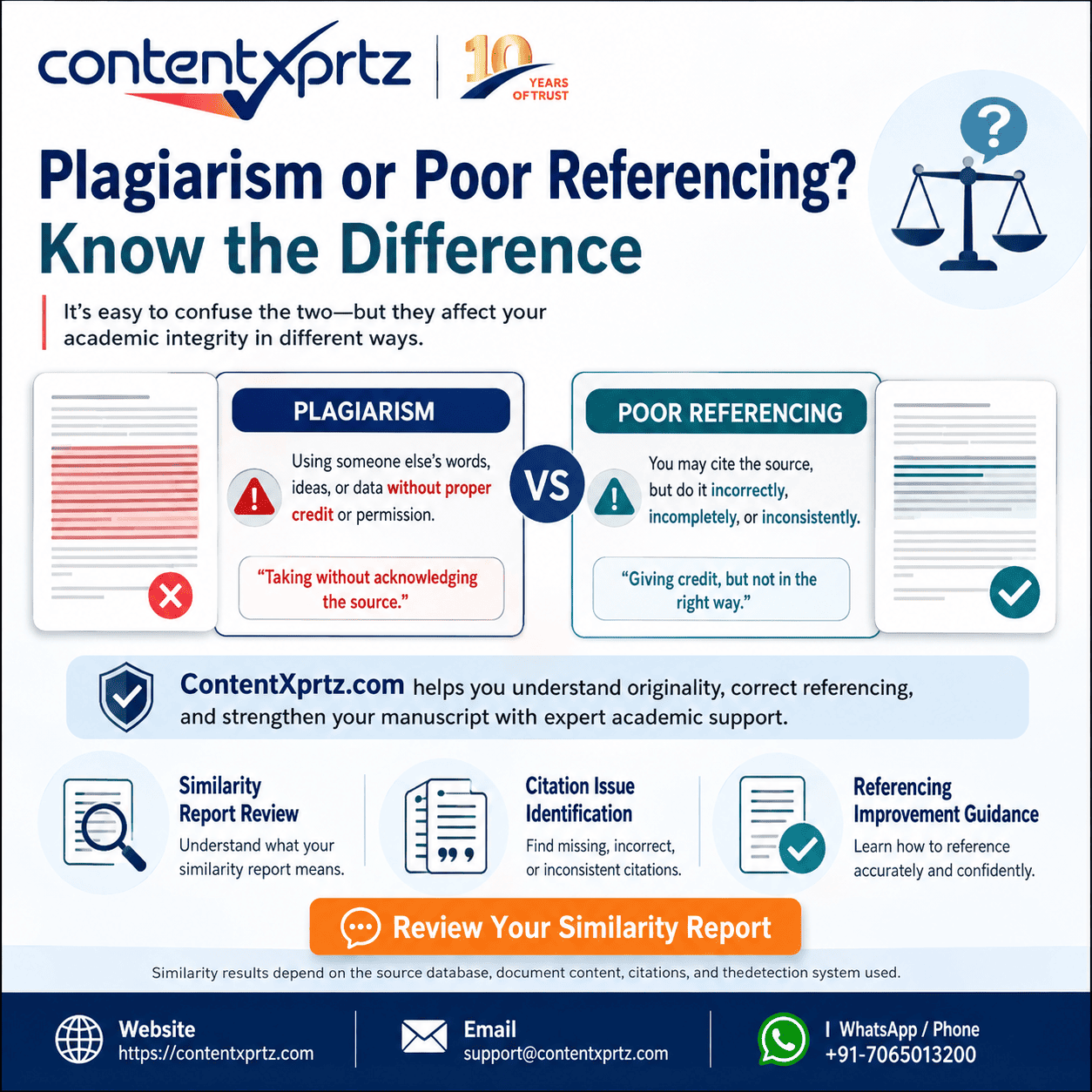
Similarity describes textual overlap. Plagiarism involves presenting another person’s words, ideas, data, images, or intellectual contribution without appropriate acknowledgment. The two concepts overlap, but they are not identical. A properly quoted sentence can be highly similar without being plagiarised. An uncited idea can be plagiarised even when the wording is different enough to escape a text match.
What the checker may help identify
- Exact or near-exact wording from a published source
- Close paraphrases that retain the source sentence structure
- Missing quotation marks around copied text
- Overlooked citations in literature reviews and background sections
- Text recycled from the author’s earlier publications
- Repeated wording across web pages and open-access research articles
- Sources contributing a large share of the overall similarity
What the checker cannot decide alone
- Whether the author intended to deceive
- Whether a common phrase requires rewriting
- Whether a quotation or method description is acceptable under a specific policy
- Whether an idea has been taken without textual copying
- Whether a source outside the comparison database has been misused
- Whether the institution will accept a particular similarity percentage
Why Students, PhD Scholars, and Researchers Search for Paperpal
Academic writers use Paperpal because they want an early warning before an assignment, thesis, dissertation, or manuscript reaches an official originality check. The tool can reduce uncertainty by showing where wording overlaps and which sources appear to contribute to the match.
For coursework and student assignments
Students often worry about accidental plagiarism after taking notes from several sources. A similarity report can reveal copied note language, missing quotation marks, or a paraphrase that remains too close to the original. It is most helpful when used before the final deadline, leaving enough time to reread sources and revise thoughtfully.
For theses and dissertations
Doctoral and postgraduate writers may need to review long literature reviews, methods chapters, published-paper chapters, and appendices. A checker can identify repeated wording, but university rules on article-based theses, prior publication, and acceptable editing remain decisive. Large documents may also exceed monthly plan limits.
For journal manuscripts
Researchers may use Paperpal to review overlap before submission, especially in introductions, literature reviews, methods, and previously presented conference material. This can support cleaner citation and disclosure, but it cannot predict a journal editor’s decision or guarantee that another system will produce the same report.
For ESL academic writing
Writers working in a second language may unintentionally preserve source syntax because they rely on model sentences. A report can identify those areas. The best revision is not random synonym replacement; it is a fresh explanation based on the writer’s understanding, followed by language editing that preserves meaning and attribution.
Free, Paid, and Institutional Similarity-Checking Options
Paperpal offers a self-service route, but the right option depends on document length, report depth, confidentiality, and the rules of the submitting institution. The following comparison uses Paperpal’s current official limits and should be verified before purchase or submission.
| Option | Current monthly allowance | Report | Best suited to | Main caution |
|---|---|---|---|---|
| Paperpal Free | Up to 7,000 words | Standard report with overall similarity range and top three sources | Short papers, selected chapters, preliminary checks | Limited detail and monthly quota |
| Paperpal Prime | Up to 10,000 words | Full report | Longer papers and regular academic writing | May still be insufficient for a complete thesis |
| Paperpal Pro | Up to 30,000 words | Full report | Large manuscripts and frequent checking | Plan terms and add-on rules can change |
| Institutional system | Defined by institution | Institution-specific report and repository coverage | Official assignment, thesis, or journal submission | May produce different matches and percentages |
| Human academic review | Not percentage-based | Contextual assessment of citation, paraphrase, and originality | Ambiguous or high-stakes cases | Requires qualified, ethical support and author involvement |
A free check is often enough for a short draft or targeted review. A paid report can provide more detail, but it does not replace the official system required by a university or journal. Human review becomes important when the report contains complex self-overlap, translated material, repeated methods, multiple related publications, or policy-sensitive reuse.
When a Self-Service Check Is Enough and When Expert Help Is Safer
A self-service Paperpal check is usually enough when the document is short, the matches are easy to understand, the sources are accessible, and the writer knows how to quote, paraphrase, and cite correctly. For example, a student may find two sentences copied from notes and fix them by returning to the source, rewriting independently, and adding the required citation.
Expert help is safer when the report shows extensive overlap across a thesis, repeated text from the author’s prior publications, unclear ownership of collaborative material, inconsistent citations, or language that remains too close to sources despite revision. A supervisor, librarian, research-integrity officer, or qualified editor can help distinguish acceptable similarity from a substantive attribution problem.
The roles should remain clear. An editor can improve clarity, structure, and citation consistency. The author must decide what the evidence means, verify every source, disclose related work, and approve the final wording. Contentxprtz professional proofreading and academic editing can support ethical revision without disguising copied content or taking over authorship.
How to Use the Paperpal Plagiarism Checker Step by Step
1. Confirm that external checking is permitted
Before uploading unpublished work, review university, journal, funder, employer, and co-author rules. Sensitive clinical data, peer-review manuscripts, confidential reports, and embargoed findings may require special approval or removal of identifying information.
2. Prepare the correct document version
Use the version you actually plan to submit. Remove tracked changes, hidden comments, duplicate appendices, and obsolete text. Decide whether references, quotations, and small matches should be included or excluded according to the purpose of the check and the settings available.
3. Upload the document in the web editor
Paperpal’s current help documentation states that the plagiarism check itself is available through the Paperpal web editor. Other Paperpal writing features may be available through Word, Google Docs, Chrome, and Overleaf, but users should verify where the plagiarism function is currently enabled.
4. Review the overall score without reacting immediately
The percentage is a navigation signal. It tells you how much text appears similar, not why. Avoid deleting citations, shortening the bibliography, or mechanically rewriting valid quotations just to lower the number.
5. Open the largest and most concentrated source matches
Start with sources responsible for substantial blocks of overlap. A small number of long matches may be more important than many isolated common phrases. Check whether one source dominates a section and whether the source is actually the original.
6. Classify each flagged passage
Mark the passage as direct quotation, acceptable common language, close paraphrase, missing citation, self-overlap, template text, reference-list match, or uncertain. This classification prevents unnecessary rewriting and focuses attention on genuine risks.
7. Correct the academic problem, not only the wording
Add quotation marks where exact words are intentionally used. Add citations for borrowed ideas and data. Rewrite close paraphrases from understanding. Disclose related publications and reused material where required. Remove copied text that does not add value.
8. Verify the source and citation details
Open the original source rather than relying only on the matched snippet. Confirm author names, title, year, page or paragraph location, DOI, and the exact citation style required by the institution or journal.
9. Recheck selectively
After substantive revision, recheck the sections that changed if quota and policy permit. Repeated checks can consume monthly words, so keep a clean master file and avoid running minor drafts unnecessarily.
10. Save the report and document decisions
For a thesis or manuscript, keep the report, date, settings, and notes explaining major matches. This record can support a discussion with a supervisor, editor, or research-integrity office if questions arise later.
How to Interpret a Paperpal Similarity Report
Interpretation should begin with the matched passage, not the headline percentage. The same score can represent very different academic situations. The table below shows common match types and the action that usually follows.
| Match type | What it may mean | Responsible action | Do not |
|---|---|---|---|
| Exact quotation with citation | Legitimate quoted material | Check quotation marks, page number, accuracy, and permitted length | Rewrite solely to lower the score |
| Exact wording without quotation marks | Potential direct plagiarism | Quote and cite, or rewrite independently and cite | Replace a few words with synonyms |
| Close paraphrase | Source structure and wording remain too similar | Return to the idea, close the source, and explain it in a new structure with citation | Use automated spinning |
| Reference-list match | Bibliographic entries resemble other documents | Verify accuracy and use report exclusions where appropriate | Delete required references |
| Methods or standard phrase | Conventional wording or necessary technical language | Check discipline norms and cite the original method where needed | Distort technical meaning |
| Match to your earlier publication | Possible text recycling or duplicate publication | Cite, rewrite, disclose overlap, and check permissions | Assume self-authorship removes all obligations |
| Template or institutional wording | Required standard text | Confirm that reuse is authorised and document the source | Hide required declarations |
Look at source concentration
A document with 18% similarity from one uncited article may present a more serious problem than a document with 22% distributed across references, common phrases, and properly quoted sources. Review the length, location, and purpose of each match.
Check whether the linked source is the original
A checker may link to a page that copied the same wording from an earlier source. Trace the idea or quotation back to the authoritative publication and cite the source you actually used.
Distinguish language overlap from idea appropriation
Text matching is strongest at detecting wording. It is weaker at detecting uncited concepts, translated plagiarism, data reuse, image reuse, or a copied argument expressed in new language. Ethical review must go beyond the coloured highlights.
Paperpal Report Types, Limits, and Feature Access
Paperpal’s current official information distinguishes a free standard report from fuller paid reports. Free users can check up to 7,000 words per calendar month. The standard report provides the overall similarity range and the top three similarity sources. Prime currently provides 10,000 words per month, while Pro provides 30,000 words per month, with full reports and the option to purchase additional words.
Paperpal describes the full report as including an overall similarity score, colour-coded results, match groups, source lists, and side-by-side comparisons. These details help users see which exact wording matches and how much each source contributes. The official help centre also states that the plagiarism function is currently available in the web editor rather than the Chrome or Edge extensions.
Do not build a deadline plan around remembered limits. Check the current Paperpal monthly plagiarism-check allowance and report description before uploading a large thesis or multiple manuscripts. Quotas reset according to plan terms, and repeated checks may use additional words.
Ethical Academic Editing and Author Responsibility After a Match
The correct response to a similarity match is to repair attribution and expression while preserving the author’s actual meaning. Editing should improve clarity, not manufacture a lower score or conceal copied work.
Use quotation when the original wording matters
Quote sparingly, reproduce the source accurately, add the required citation and locator, and explain why the quotation matters. Long quotations may still be unsuitable even when cited, depending on copyright and assignment rules.
Paraphrase from understanding
Read the source until the idea is clear, set it aside, and explain the point using your own conceptual structure. Compare the new text with the original, correct any distortion, and add a citation. Changing individual words while retaining syntax is not a strong paraphrase.
Cite ideas, data, methods, images, and tables
Attribution is not only about copied sentences. Credit the source of an argument, dataset, measurement instrument, figure, table, image, taxonomy, or distinctive method. Obtain permission where copyright or licence terms require it.
Handle prior publications transparently
When reusing your own text or data, cite the earlier work, disclose overlap to the journal, and follow policy on redundant publication and text recycling. The ICMJE scientific-misconduct recommendations identify plagiarism as a serious publication issue, while journals may apply additional rules to duplicate or overlapping publication.
Retain human accountability for AI-assisted text
Authors should verify AI-generated or AI-rewritten language, disclose use where required, and ensure that quotations and citations are authentic. AI tools cannot be authors and cannot take responsibility for originality, accuracy, or integrity.
Common Paperpal Plagiarism Checker Mistakes to Avoid
- Treating the percentage as a verdict. Review the actual passages and sources.
- Chasing a universal “safe” score. Institutions and journals apply different policies.
- Deleting references or quotations to lower similarity. Required attribution should remain.
- Using synonym replacement as paraphrasing. Rebuild the explanation from understanding.
- Ignoring self-overlap. Earlier work may require citation, permission, and disclosure.
- Assuming a low score guarantees originality. Ideas, images, data, and translated content can be misused without a strong text match.
- Uploading confidential material without permission. Check institutional and journal restrictions first.
- Assuming Paperpal will match an institutional report. Databases and settings differ.
- Rechecking every minor draft. Repeated scans may consume monthly quota.
- Letting an editor “remove plagiarism” without source review. Ethical revision requires author involvement and accurate attribution.
Practical Examples: Using Paperpal in Real Academic Situations
Example 1: A PhD scholar checks a literature-review chapter
Situation: A doctoral candidate uploads a 6,500-word chapter and receives a moderate similarity result. Several long matches point to review articles used during note-taking.
Common confusion: The student assumes that adding citations at the end of each paragraph is enough, even though multiple sentences retain the source order and phrasing.
Correct approach: The scholar returns to the primary studies, reorganises the section by themes rather than source order, paraphrases from understanding, uses direct quotations only where necessary, and verifies every citation. The final chapter becomes a synthesis rather than a chain of lightly rewritten summaries.
Ethical expert help: Contentxprtz thesis editing support can improve structure, transitions, citation consistency, and language while the scholar retains the analysis and source decisions.
Example 2: A first-time researcher sees a high methods-section match
Situation: A researcher preparing a journal article finds that the methods section closely matches the laboratory’s earlier paper because the same protocol was used.
Common confusion: The author believes methods wording never needs citation because the procedure is standard.
Correct approach: The author cites the original protocol and the laboratory’s earlier application, keeps necessary technical terminology, rewrites explanatory text where possible, and discloses any shared dataset or sample. The cover letter identifies related work if the target journal requires it.
Ethical expert help: A manuscript editor can make the wording concise and verify that the overlap is described transparently, but cannot decide disclosure obligations without the author and journal policy.
Example 3: An ESL author uses an automated paraphraser
Situation: An early-career researcher paraphrases several source sentences with an automated tool. Paperpal still flags the passages because the structure remains similar and some technical meaning has changed.
Common confusion: The author thinks different vocabulary automatically makes the passage original.
Correct approach: The researcher rereads the studies, writes a new explanation based on the argument being made, restores the correct technical meaning, and cites the sources. The paragraph is then edited for grammar and academic tone without changing the author’s interpretation.
Ethical expert help: AI-human editing can identify awkward machine rewrites and improve clarity while preserving traceable sources and the writer’s own voice.
Example 4: A student checks a quotation-heavy essay
Situation: A humanities essay receives a high similarity score because it contains several accurately quoted primary-source passages and a long bibliography.
Common confusion: The student starts removing quotation marks and references to reduce the percentage.
Correct approach: The student keeps correct attribution, shortens quotations that do not need to be reproduced, adds more analysis between quotations, and checks the institution’s report settings for reference and quotation exclusions. The essay becomes more original in argument rather than cosmetically lower in similarity.
Paperpal Plagiarism Check and Academic Integrity Checklist
Before uploading
- The correct submission version is ready and tracked changes are removed.
- External upload is permitted by the university, journal, funder, employer, and co-authors.
- Sensitive data and confidential appendices are removed when not needed.
- The current Paperpal word allowance and report type have been verified.
While reviewing the report
- The overall percentage is treated as a screening signal, not a verdict.
- Long and concentrated matches are reviewed first.
- Each match is classified as quotation, paraphrase, citation issue, self-overlap, common phrase, method text, reference, or uncertain.
- The original source is opened and verified.
During revision
- Exact wording is quoted and cited where appropriate.
- Paraphrases use new structure and preserve the source meaning.
- Ideas, data, images, tables, instruments, and methods are attributed.
- Prior publications and related manuscripts are disclosed where required.
- References are authentic, traceable, and formatted correctly.
Before submission
- University or journal originality rules have been checked.
- Ambiguous matches have been discussed with a supervisor or integrity adviser.
- AI-assisted text has been verified and disclosed where required.
- The report, settings, and major revision decisions are saved.
- All authors approve the final text and remain accountable for it.
How Contentxprtz Can Help After a Paperpal Check
Contentxprtz can help when a similarity report reveals deeper writing and attribution problems rather than isolated citation errors. Relevant support may include plagiarism-risk reduction guidance, ethical academic editing, scholarly proofreading, and manuscript assessment.
The service should match the actual problem. Citation review is relevant when attribution is inconsistent. Language editing is relevant when close paraphrasing reflects limited control of academic English. Structural editing is relevant when the literature review follows sources one by one instead of synthesising evidence. Publication support may be relevant when earlier papers, conference abstracts, or overlapping datasets must be disclosed.
Contentxprtz does not promise guaranteed plagiarism removal, journal acceptance, grades, or supervisor approval. Authors remain responsible for the research, data, claims, citations, permissions, disclosures, and final submission.
Summary: Paperpal Plagiarism Checker
The Paperpal plagiarism checker is a practical academic similarity-screening tool that can identify overlapping wording and likely source matches before submission. Its current free plan provides a limited monthly scan and standard report, while paid plans offer higher limits and fuller source comparisons. The service can be helpful for essays, theses, dissertations, proposals, and manuscripts, but the result is not a plagiarism verdict.
Use the report to inspect passages, verify sources, correct quotation and citation problems, rewrite close paraphrases from understanding, and disclose self-overlap where required. Do not chase a universal percentage or use automated rewriting to conceal copied text. The governing university or journal policy, together with human academic judgment, determines what is acceptable.
For complex reports, confidential work, article-based theses, repeated methods, ESL writing, or publication overlap, seek guidance from a supervisor, librarian, integrity office, or qualified academic editor. The strongest outcome is not merely a lower score; it is a clearer, traceable, ethically written document that the author can defend.
Frequently Asked Questions
What is the Paperpal plagiarism checker?
The Paperpal plagiarism checker is an academic similarity-checking feature designed for students, researchers, educators, and scholarly authors. It compares uploaded text with a large source database and produces a report showing where wording overlaps with existing material. Paperpal describes its database as 99 billion webpages, including 200 million open-access research articles. The output is best understood as a similarity report, not an automatic verdict that plagiarism has occurred. A matched passage may be an uncited quotation, a close paraphrase, repeated wording from an author’s earlier work, a standard method description, a reference entry, or a common phrase. The user must inspect the source, context, citation, quotation marks, and institutional rules before deciding what needs correction. The free plan currently allows a limited monthly scan and provides a standard report, while paid plans provide higher word allowances and a fuller report. Because feature limits and plan terms can change, users should verify the current details on Paperpal’s official product and help pages before relying on a specific allowance for a thesis, dissertation, or journal manuscript.
Is Paperpal plagiarism checker free?
Paperpal currently offers a free plagiarism-checking allowance, but the free version is limited. According to Paperpal’s official product and help pages, free users can scan up to 7,000 words per calendar month and receive a standard report. That report shows an overall similarity range and the top three sources of similarity. Paperpal Prime currently provides up to 10,000 words per month with a full report, while Paperpal Pro provides up to 30,000 words per month with a full report. Additional words may be purchased through add-ons, and the official help centre states that add-on packs are shared across plagiarism and reference checks and remain valid for a limited period. These terms may change, so check the live pricing and support pages before planning a large submission. For a short assignment, article draft, or one chapter, the free allowance may be sufficient. A complete thesis or dissertation can exceed the monthly limit, so users may need to check selected sections, wait for a reset, use a paid plan, or follow the originality-checking service specified by their university. A free report should still be reviewed carefully; a lower-cost scan does not remove the author’s responsibility to cite and paraphrase ethically.
How accurate is the Paperpal plagiarism checker?
Accuracy depends on what the user expects the tool to do. Paperpal can identify textual overlap with sources contained in its comparison database and can show likely source matches, but no similarity checker can determine academic misconduct by itself. It may flag correctly quoted material, bibliographies, common technical expressions, institutional wording, or standard descriptions of methods. It may also miss material that is unavailable to its database, expressed in another language, contained in a private repository, heavily transformed, or copied conceptually rather than textually. Therefore, the most accurate use is as a screening aid: examine every important match, open the source, compare meaning and wording, and decide whether to quote, cite, paraphrase more independently, or leave an acceptable phrase unchanged. Researchers should also follow the similarity system and thresholds required by their institution or target journal because different systems have different source coverage and exclusions. The final judgment must consider intent, attribution, context, discipline, and policy. Paperpal itself states that using its tools does not guarantee that content will be plagiarism-free or will not be flagged elsewhere.
What does a Paperpal similarity score mean?
A Paperpal similarity score indicates the proportion of submitted text that appears to overlap with content in the tool’s source database. It does not directly measure dishonesty, originality of ideas, or the quality of the paper. A high score may deserve investigation, but it can contain legitimate material such as properly quoted text, reference lists, templates, common terminology, or repeated methods. A low score is also not proof of ethical writing because a paper may misuse ideas without closely copying wording, cite fabricated sources, or reproduce material not present in the database. Interpret the score by moving from the percentage to the matched passages and sources. Identify whether the match is concentrated in one source or spread across many. Check whether quotation marks and citations are present, whether the paraphrase is genuinely independent, and whether text from the author’s previous publication has been disclosed and cited. Also review the settings used for references, quotations, and small matches. Institutions and journals differ in how they interpret reports, so do not rely on a universal acceptable percentage. The strongest approach is passage-level review combined with the applicable academic-integrity policy.
Can Paperpal detect self-plagiarism?
Paperpal may flag wording that overlaps with an author’s earlier publicly available work, which can help identify potential text recycling or self-plagiarism. However, it can only detect prior material that is available in the sources it checks, and a match still requires human interpretation. Reusing a few standard phrases in a methods section is different from republishing substantial text, data, tables, images, or conclusions without transparent attribution. Authors should not assume that ownership of the earlier work removes the need to cite it. Copyright may belong to a publisher, and journals may have specific policies on redundant publication, duplicate submission, or acceptable text recycling. When a match points to your previous paper, compare the exact passage, cite the earlier work where relevant, rewrite in a genuinely new way when possible, and disclose related manuscripts or overlapping datasets to the journal. For theses built from published papers, follow university rules on incorporated publications and permissions. A similarity checker can highlight overlap, but the author, supervisor, editor, and institutional policy determine whether the reuse is acceptable and how it should be reported.
Does Paperpal store or publish uploaded manuscripts?
Paperpal states that it does not publish uploaded manuscripts or use users’ documents to train its AI models. Its current data-security page says users can delete uploaded files, that data is encrypted in transit and at rest, and that its information-security management system is certified to ISO/IEC 27001:2022. Its help centre also states that uploaded manuscripts are not made discoverable to third-party plagiarism services. These are useful assurances, but researchers should still apply institutional confidentiality rules before uploading unpublished, sensitive, proprietary, clinical, peer-review, or embargoed material to any external platform. Check whether your university, funder, employer, co-authors, ethics board, or journal permits the use of cloud-based writing and checking tools. Remove unnecessary personal data and confidential appendices when possible. For a manuscript under peer review, remember that journal confidentiality rules may prohibit uploading the document to external AI or checking services without permission. Privacy statements and technical controls can change, so review the current terms, data-security documentation, retention information, and deletion options before using the service for high-stakes or restricted material.
Can Paperpal remove plagiarism automatically?
No tool can ethically “remove plagiarism” with one automatic rewrite. Paperpal can identify similarity and may offer language or rewrite features, but the author must decide why the passage matched and correct the underlying issue. If wording is copied exactly, use quotation marks and a citation when direct quotation is appropriate, or rewrite from understanding without looking at the source sentence. If the idea, data, image, table, or method comes from another work, citation may still be required even after paraphrasing. If a match comes from the author’s earlier publication, assess text recycling, copyright, and disclosure requirements. Simply replacing words with synonyms can preserve the original sentence structure and may create an inaccurate or awkward paraphrase. It can also hide rather than resolve improper attribution. A responsible revision process includes reading the source, closing it, explaining the idea in your own conceptual structure, checking accuracy, adding the correct citation, and comparing the new wording with the original. Professional academic editing can improve clarity and flag citation risks, but it should not disguise copied work or invent originality.
Can I use Paperpal for a thesis or dissertation?
Yes, Paperpal can be used as a preliminary similarity check for thesis or dissertation writing, provided the student follows university rules and understands the limits of the report. A full thesis often exceeds the free or monthly paid word allowance, so plan the check by chapter, use the plan that fits the document length, or rely on the institution’s approved originality system for the final submission. Check front matter, literature review, methods, published-paper chapters, appendices, and references separately because each section can create different types of matches. Methods may contain standard language, literature reviews can show close paraphrasing, and article-based theses may legitimately overlap with the student’s published work but still require citation, permissions, and disclosure. Do not chase a single target percentage without examining the source and context of each match. Before uploading unpublished research, verify confidentiality and data-protection requirements. After revising, run a final check if permitted, preserve the report, and discuss ambiguous matches with a supervisor or research-integrity office. Contentxprtz can support ethical thesis editing, citation consistency, and language clarity, while the student remains responsible for the research, interpretation, and final submission.
Is Paperpal the same as an institutional plagiarism system?
Paperpal is not necessarily the same system used by a university, publisher, or journal. Different similarity services have different source databases, private repositories, report settings, exclusion rules, matching algorithms, and access to student submissions or subscription content. As a result, the same document can receive different percentages and source matches across systems. Paperpal can be useful for an early self-check, especially for publicly available web and open-access research overlap, but it should not be treated as a guaranteed preview of an institutional report. A university may require its own approved platform, prohibit external uploads, exclude references or quotations differently, or evaluate matches under a formal academic-misconduct process. Journals may use publisher-integrated tools and apply editorial judgment rather than a fixed threshold. Use Paperpal to identify passages that deserve attention, then follow the official submission procedure. Keep citations accurate, write independently, document permissions for reused material, and avoid trying to optimize only for a percentage. Ethical writing should remain defensible even when checked by a different system.
When should I use professional editing after a Paperpal check?
Professional editing is useful when the Paperpal report reveals problems that cannot be solved by correcting a few citations or quotations. Examples include repeated close paraphrasing, unclear synthesis in a literature review, inconsistent terminology, weak transitions between sources, copied sentence structure caused by second-language writing pressure, or uncertainty about how to acknowledge previously published material. An ethical editor can help distinguish language improvement from substantive authorship, strengthen the writer’s own voice, improve paragraph logic, check citation placement, and identify where a claim needs a source. The editor should not fabricate references, rewrite copied text solely to evade detection, alter data, or make unsupported claims. Before hiring support, check university and journal policies on permitted editing and disclosure. Provide the similarity report, source list, style guide, and instructions, but retain responsibility for verifying every source and approving every change. Contentxprtz offers plagiarism-risk reduction guidance, academic editing, and proofreading designed to improve clarity and attribution while preserving the author’s ideas and accountability.
Conclusion: Use Similarity Checking as a Review Process, Not a Shortcut
The practical value of Paperpal lies in helping writers see where their text resembles existing sources before a formal submission. A free or self-service check may be enough when the matches are simple and the writer can verify quotations, citations, and paraphrases independently. More complex cases—especially thesis chapters, prior-publication overlap, confidential manuscripts, extensive close paraphrasing, or unclear journal policy—benefit from expert review.
Academic integrity depends on more than a percentage. It requires original analysis, accurate representation of sources, transparent reuse, authentic references, careful AI verification, and author responsibility. Contentxprtz can help improve clarity, structure, citation consistency, and publication readiness through ethical support that preserves the author’s ideas and accountability.
“At Contentxprtz, we don’t just edit; we help ideas reach their fullest potential.”