Good Plagiarism Checker: How to Choose and Use One Wisely
A good plagiarism checker should do more than return a percentage. For students, PhD scholars, researchers, and academic authors, the useful result is a report that helps distinguish legitimate quotation and citation from wording that is too close to a source, uncited borrowing, accidental duplication, or overlap with earlier work. That distinction matters because academic integrity is judged in context. A similarity tool can show where text matches; it cannot automatically decide whether misconduct has occurred.
This becomes especially important near a thesis deadline or journal submission. A researcher may have hundreds of citations, repeated methodological phrases, a long reference list, and several chapters built from earlier conference papers. A first-time author may assume that a “low similarity” number guarantees originality. An ESL scholar may over-paraphrase sentence by sentence and unintentionally keep the source structure. Someone using a free web checker may not know whether the service searches scholarly databases or stores the uploaded manuscript. These are practical academic risks, not merely software questions.
The best plagiarism checker for a particular document therefore depends on database coverage, report transparency, privacy, citation handling, institutional acceptance, and how carefully the writer interprets the results. Turnitin’s own guidance explains that its Similarity Report identifies matching text and that the similarity score is not itself a verdict of plagiarism. Likewise, Oxford University’s plagiarism guidance emphasizes that close paraphrasing without proper acknowledgement can still be plagiarism even when wording has been changed.
This guide shows how to evaluate plagiarism-detection tools, understand similarity reports, choose between free and institutional options, protect unpublished research, and revise matched text ethically. Where a report exposes citation, paraphrasing, or source-integration problems, Contentxprtz can provide plagiarism and academic-integrity support or focused academic editing services without replacing the author’s ideas or responsibility.
Quick Answer: What Is a Good Plagiarism Checker?
A good plagiarism checker is a similarity-detection tool that provides clear source matches, useful database coverage, transparent reporting, sensible exclusions, and strong privacy controls. For academic work, it should help you inspect why text matches a source rather than encouraging you to chase the lowest possible percentage.
Choose a checker that fits the stakes of the document. A free checker may be enough for a short draft or an early wording check. A thesis, dissertation, funded report, or journal manuscript usually deserves an institution-approved system or another service with documented scholarly coverage and privacy safeguards. Before uploading unpublished work, confirm whether the file will be stored or added to a repository.
Most importantly, interpret every report manually. Turnitin’s guidance on similarity scores states that matched text can include correctly quoted and referenced material and that the score is a measure of matching text, not a plagiarism decision. That is the right mindset for any tool.
Key Takeaways
- A plagiarism checker usually detects text similarity; it does not independently prove plagiarism.
- Database coverage and source-level reporting matter more than a flashy percentage.
- There is no universal “safe” similarity score for every thesis, university, journal, or assignment.
- A low score can still hide poor attribution, while a higher score can include legitimate quotations and references.
- Free tools are useful for preliminary checks, but privacy and scholarly coverage require careful review.
- Matched passages should be revised through genuine paraphrasing, correct quotation, citation, or transparent disclosure—not synonym swapping.
- Authors remain responsible for originality, references, data, claims, and compliance with institutional or journal rules.
What This Page Covers
- How plagiarism checkers and similarity reports actually work
- Features that distinguish a good academic plagiarism checker from a weak one
- Free, institutional, and expert-assisted options
- How to interpret similarity percentages and individual matches
- Privacy questions to ask before uploading an unpublished thesis or manuscript
- A step-by-step ethical review workflow and practical mini cases
- A pre-submission checklist for students, PhD scholars, and journal authors
Table of Contents
Methodology and Academic Sources
This article treats plagiarism checking as part of an academic-integrity workflow rather than as a score-reduction exercise. It draws on current similarity-report guidance from Turnitin, university guidance on plagiarism and paraphrasing, and publication-ethics expectations for authors. Tool interfaces and institutional policies can change, so students and researchers should verify the rules that apply to their own course, university, funder, or target journal.
Two principles guide the advice below. First, similarity is evidence for review, not an automatic misconduct label. Second, plagiarism risk is reduced through original writing, transparent source use, accurate citations, and careful paraphrasing. For journal authors, the ICMJE recommendations on overlapping publication also show why disclosure of related prior work matters when a new manuscript overlaps with an earlier publication.
What “Good Plagiarism Checker” Means in Academic Context
In academic work, a good checker is best understood as a diagnostic similarity tool. It compares your text with material available to its databases and highlights overlapping passages. The report may show a total percentage, individual matched sources, colored passages, and options to exclude quotations, references, or small matches. Different tools use different databases and algorithms, so two services can return different results for the same document.
That difference is not necessarily evidence that one result is wrong. One checker may search public webpages but not student repositories. Another may have access to journal content, archived pages, institutional submissions, or publisher databases. A tool may also treat quoted material or bibliographies differently. This is why a meaningful evaluation looks at what was matched, not only at the headline score.
Similarity is not the same as plagiarism
Turnitin explicitly explains that its system compares submissions against a database and highlights similar text; the instructor or reviewer must decide whether the match is acceptable. A correctly cited quotation can contribute to similarity. So can a long reference list, a common method description, a standard declaration, or a title copied exactly because titles cannot be paraphrased. On the other hand, a writer may closely imitate an argument while changing enough words to produce only a small match.
Plagiarism is an academic judgement about unattributed or misleading use of another person’s words, ideas, structure, data, or creative work. A checker helps locate possible signals. It does not replace reading, policy, disciplinary context, or expert judgement.
Seven Features That Make a Plagiarism Checker Good
The best academic checker is not necessarily the tool with the most aggressive marketing. Evaluate it against practical criteria that affect the quality and safety of your review.
| Feature | Why it matters | What to look for |
|---|---|---|
| Database coverage | Matches can only be found in content the system can compare against. | Public web, scholarly publications, repositories, and institutional content where appropriate. |
| Source transparency | You need to understand why a passage matched. | Clickable or clearly identified sources and passage-level matching. |
| Report controls | References and quotations can inflate raw similarity. | Clearly explained filters, exclusions, and match grouping. |
| Privacy and retention | Unpublished research may be confidential or commercially sensitive. | Readable terms covering storage, reuse, deletion, and repository submission. |
| Document support | Long theses and formatted manuscripts can fail in basic tools. | Adequate word limits, file formats, and stable handling of long documents. |
| Institutional fit | Your university may use its own interpretation and repository settings. | Approved access, policy alignment, and clear instructions from the institution. |
| Actionable reporting | A percentage alone does not teach better source use. | Enough detail to revise paraphrases, citations, quotations, and duplicated text responsibly. |
Database breadth matters, but transparency matters too
A checker can claim a large database and still be difficult to use if it does not show where matches came from. Students and authors should be able to inspect each source and understand the matched wording. For scholarly work, coverage of academic publications and repositories can be valuable because plagiarism risk is not limited to ordinary websites.
Privacy is part of quality
If you are checking an unpublished thesis, research proposal, patent-related manuscript, confidential case study, or paper containing participant information, do not upload it casually. Read the provider’s data terms first. A useful checker should explain whether submissions are stored, indexed, shared, used to improve models, or eligible for deletion. Where your institution provides a supported service, that may be the safer route.
Free, Low-Cost, Institutional, and Professional Options
Different plagiarism-checking routes solve different problems. The right option depends on document length, academic stakes, privacy, and whether you need only detection or also help correcting the underlying writing.
| Option | Best for | Main strength | Main caution |
|---|---|---|---|
| Free web checker | Short drafts and preliminary self-checks | Fast and accessible | Coverage, word limits, report detail, and privacy vary widely |
| Writing-suite similarity feature | Routine essays and working drafts | Convenient within the writing workflow | May not match university databases or institutional settings |
| University-approved checker | Coursework, theses, dissertations | Aligned with institutional access and policy | Students may have limited draft attempts or report visibility |
| Publisher or journal workflow | Manuscripts under editorial review | Designed for publication screening | Authors may not see the same report before submission |
| Expert academic review | Complex similarity, citation, or paraphrasing issues | Combines report interpretation with human editing | Must remain ethical and preserve author responsibility |
A free checker can be useful when the question is simply, “Did I accidentally repeat wording from a webpage?” It is less reassuring when the document is a 70,000-word dissertation and the service does not explain its scholarly coverage or retention policy. If your university gives students access to a checker, start there and read its local instructions.
Professional assistance becomes relevant when the report identifies a writing problem rather than a software problem. For example, an author may know which paragraph matches but not how to paraphrase a technical definition without distorting meaning. In that situation, ethical proofreading and academic language review can support clarity, while the author remains responsible for the sources and claims.
How to Interpret a Similarity Score Without Chasing a Magic Number
There is no universal similarity percentage that makes a paper automatically safe or unsafe. Turnitin’s student guidance states that there is no fixed score that applies to every institution or assignment. A university may still specify its own administrative threshold, but that threshold should not be confused with a definition of plagiarism.
Why a high score may be explainable
- A long bibliography or reference list is included in the comparison.
- Direct quotations are correctly marked and cited.
- A methods section uses standard wording required by a protocol.
- The manuscript contains a published instrument, questionnaire, or statutory wording that cannot be freely rewritten.
- An earlier draft has already been stored in an institutional repository and the final version is self-matching.
Why a low score can still be risky
- A paragraph follows a source’s argument and structure too closely but uses synonyms.
- An idea, table, image, or dataset is reused without attribution.
- Translated material is presented as original without citation.
- A writer cites the source at the end of a long paragraph but leaves unclear which ideas are borrowed.
- Contract cheating or unauthorized authorship may not create obvious textual similarity.
Oxford’s guidance on plagiarism is especially helpful here: close paraphrasing can still be problematic when the writer merely changes words or their order without proper acknowledgement. The practical goal is not “zero similarity.” The goal is that every match has an understandable academic explanation and that every borrowed contribution is represented transparently.
When Free Support Is Enough—and When Expert Review Is Safer
Free support is usually enough for early drafting when you understand citation rules and are checking a short, non-confidential text. You can compare suspicious wording manually, use your university writing centre, consult style guides, and run an approved checker if available.
Expert review becomes more valuable when a document is long, technically dense, multilingual, close to submission, or contains complicated overlap with prior work. A PhD scholar may need help separating literature-review voice from source language. A journal author may need to disclose reuse from an earlier conference paper. An ESL researcher may need language editing that changes wording without changing scientific meaning. These situations require judgement that a percentage cannot provide.
Professional support should never be used to “beat” a checker by disguising copied text. The safer purpose is to improve paraphrasing, citation clarity, source integration, and manuscript readability while maintaining the author’s original contribution.
Ethical Academic Editing and Author Responsibility
Academic integrity depends on authorship being honest and traceable. Editing can improve clarity, grammar, sentence structure, reference consistency, and the distinction between source material and the author’s argument. It should not fabricate references, invent data, conceal unattributed copying, or replace the researcher’s intellectual work.
For publication, overlap with your own earlier work also deserves attention. The ICMJE recommendations on scientific misconduct include plagiarism among publication-integrity concerns, while its overlapping-publication guidance emphasizes disclosure of related material. Journals and disciplines vary, so authors should read the target journal’s instructions before reusing text from earlier articles, preprints, theses, conference proceedings, or reports.
AI-assisted writing creates a similar need for verification. A checker may detect some forms of textual overlap but cannot guarantee factual accuracy, authentic citations, or compliant authorship. Authors must verify references, inspect claims against original sources, and follow the institution’s or publisher’s AI policy.
Step by Step: How to Use a Good Plagiarism Checker Properly
- Choose the correct tool for the document. For coursework or a thesis, prioritize your institution-approved checker. For an early draft, a reputable self-service tool may be adequate if its privacy terms are acceptable.
- Prepare the file. Use the version you actually intend to review. Remove confidential appendices only if policy allows, and keep a secure copy of the original.
- Check privacy before upload. Confirm whether the submission will be stored, indexed, shared, or added to a repository. This is especially important for unpublished research.
- Run the comparison and open the detailed report. Do not stop at the overall percentage. Examine the largest matches and the passages connected to each source.
- Classify each match. Decide whether it is a direct quotation, reference entry, standard phrase, common terminology, legitimate reuse, close paraphrase, or uncited borrowing.
- Verify citations. Make sure direct quotations are clearly marked and that paraphrased ideas include the required citation. Cross-check source details against the original publication.
- Rewrite only where necessary. If a passage is too close to the source, read the source for meaning, set it aside, explain the idea independently, then compare again and add citation. Avoid mechanical synonym replacement.
- Review self-overlap. If the checker matches your previous thesis chapter, article, preprint, conference paper, or report, determine whether disclosure or citation is required.
- Rerun selectively if permitted. A second report can confirm that problematic passages were corrected. Do not keep rewriting legitimate quotations merely to lower the number.
- Apply the governing policy. Before final submission, check your department, university, supervisor, or journal requirements. The applicable academic rule is more important than a generic web threshold.
Common Plagiarism-Checker Mistakes to Avoid
1. Treating the percentage as a grade
A similarity score is not a quality score. A lower number does not make weak research stronger, and a higher number does not automatically prove misconduct. The report must be interpreted.
2. Rewriting every highlighted phrase
Some text should remain exactly as written, including quotations, titles, proper names, formal definitions where quotation is appropriate, and certain technical terms. Fix attribution problems, not legitimate language.
3. Using synonym swapping as paraphrasing
Replacing words one by one often preserves the original sentence structure. It can produce awkward prose and still constitute close paraphrase. Genuine paraphrasing starts with understanding the source and rebuilding the idea in your own structure.
4. Ignoring references and source accuracy
A checker may help identify copied wording, but it does not guarantee that a DOI, author, year, quotation, or citation is correct. Verify bibliographic information against the original source.
5. Uploading confidential research without checking terms
Convenience is not enough. If the manuscript contains unpublished results, personal data, or commercially sensitive material, confirm how the checker handles files before uploading.
6. Assuming the checker sees everything
No database contains every source. A “no match” result means the system did not find relevant overlap in the material it searched; it does not prove that every idea and phrase is original.
Practical Examples: What a Similarity Report Really Means
Mini Case 1: The PhD Scholar With a 28% Thesis Similarity Score
A doctoral candidate runs a final thesis check and sees 28% similarity. The first reaction is panic, followed by an attempt to rewrite every highlighted sentence. A closer review shows that much of the score comes from the reference list, previously approved terminology, correctly quoted policy language, and a methods section that necessarily uses standardized instrument names.
The real problem is smaller: two literature-review paragraphs follow a source too closely and one quotation lacks quotation marks. The correct academic response is to repair those passages, not to mutilate valid references to hit an arbitrary target. An editor can help distinguish legitimate technical wording from paraphrases that need stronger independence, while the candidate verifies the citations and follows the university’s thesis policy.
Mini Case 2: The First-Time Journal Author Reusing Conference Text
A researcher turns a conference paper into a journal manuscript. The checker highlights several pages because parts of the earlier paper are publicly available. The author assumes that self-written text cannot create an integrity issue and ignores the matches.
The safer approach is to check the journal’s policy on prior publication, conference proceedings, preprints, and text recycling. Where overlap is permissible, it may still require citation or disclosure. ICMJE guidance illustrates why transparent handling of related prior publications matters. Editorial support can help the author rewrite repetitive sections and clearly explain what is new in the journal manuscript, but the disclosure decision belongs to the author and journal.
Mini Case 3: The ESL Researcher With a Low Score but Close Paraphrasing
An ESL researcher receives an 8% similarity score and assumes the manuscript is safe. During manual review, however, several paragraphs are found to follow the structure of review articles very closely. The writer changed individual words but retained the source’s sentence order and argument sequence.
This is why a low percentage is not a substitute for source-aware editing. The researcher should reread the original sources, identify the underlying claims, synthesize across more than one source where appropriate, write the interpretation independently, and cite each contribution correctly. Ethical language editing can improve fluency while ensuring the author’s meaning remains distinct from the source wording.
Mini Case 4: The Student Using a Free Checker on an Unpublished Proposal
A postgraduate student pastes a research proposal into a free checker without reading the privacy policy. The result looks useful, but the student later realizes the proposal includes an original research idea and sensitive project information.
The better process is to assess privacy before uploading. For unpublished academic work, especially material covered by ethics, confidentiality, or intellectual-property concerns, an institution-approved system is often preferable. A good plagiarism checker is not only accurate enough to be useful; it must also be appropriate for the sensitivity of the document.
Academic Plagiarism-Check and Submission Checklist
Before choosing a checker
- The tool’s database coverage is described clearly enough for my purpose.
- I understand its file limits, report detail, and exclusion settings.
- I have checked privacy, storage, repository, and deletion terms.
- If my university provides an approved system, I know whether I should use it instead.
Before running the report
- The document is the correct version and contains no material I am prohibited from uploading.
- Every direct quotation is visibly marked.
- In-text citations and references are present where sources are used.
- I have not relied on paraphrasing software to disguise source wording.
While reviewing matches
- I inspect individual sources rather than reacting only to the overall percentage.
- I distinguish legitimate quotations, references, common phrases, and technical language from problematic overlap.
- I compare close paraphrases against the original source.
- I identify overlap with my own previous work and check whether disclosure is required.
Before submission
- All questionable passages have been quoted, cited, rewritten, or disclosed appropriately.
- References are authentic, traceable, and consistent with the required citation style.
- I have checked the relevant university, supervisor, or journal policy.
- The final manuscript reflects my own analysis, argument, conclusions, and responsibility.
How Contentxprtz Can Help After a Similarity Check
A similarity report often identifies the location of a problem but not the best scholarly correction. Contentxprtz can support authors who need to improve source integration, paraphrasing quality, citation consistency, or manuscript clarity after reviewing a report.
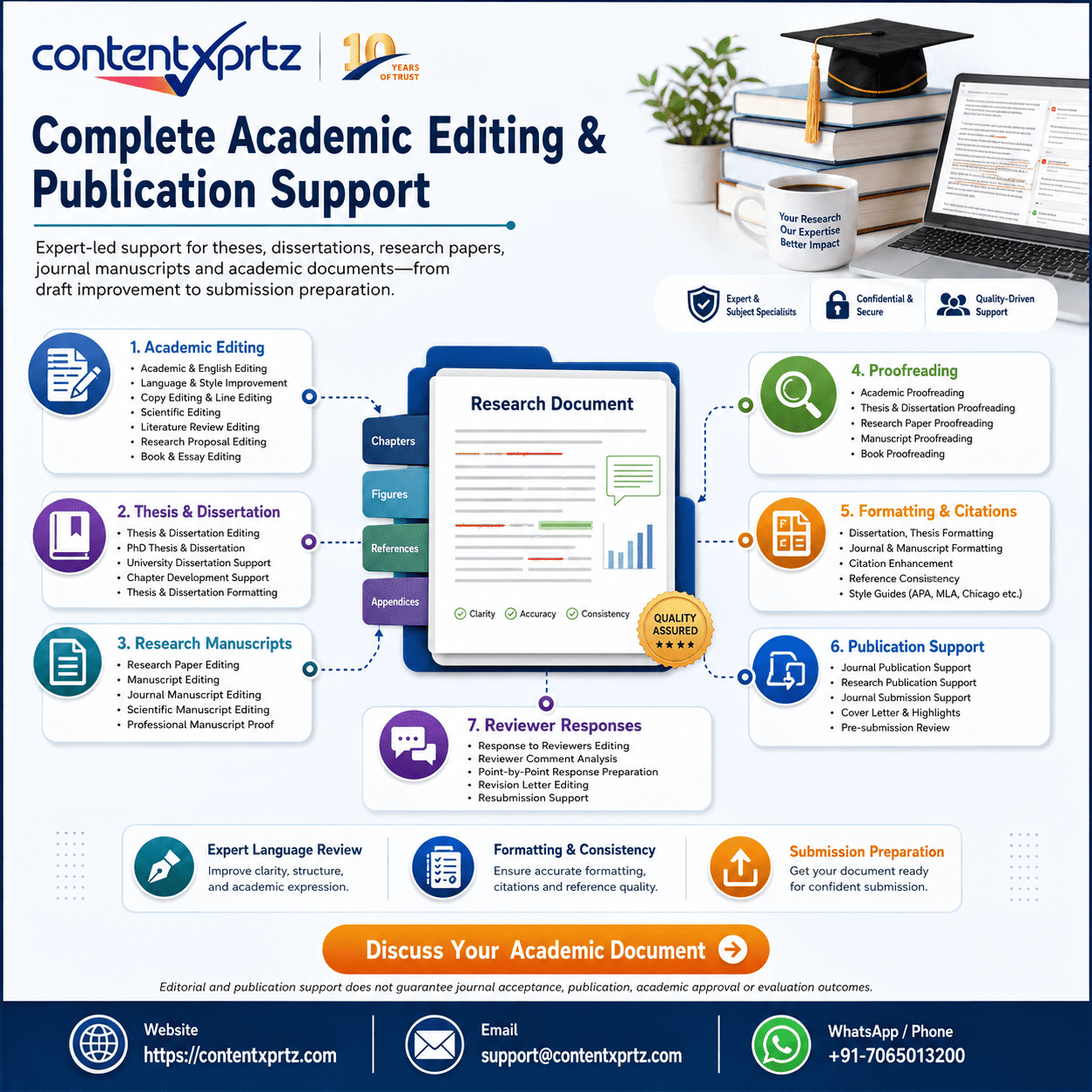
For plagiarism-related concerns, the most directly relevant service is plagiarism and publication support. Depending on the document, a researcher may also benefit from focused thesis editing support or manuscript assessment. The aim should be ethical correction: clearer attribution, stronger original wording, consistent references, and publication-ready presentation.
Professional editing does not guarantee a particular similarity score, journal acceptance, thesis approval, or publication outcome. Those outcomes depend on the quality of the research, the applicable rules, the manuscript itself, and the judgement of supervisors, editors, reviewers, or institutions.
Summary: Good Plagiarism Checker
A good plagiarism checker is one that helps you understand text overlap accurately and safely. For academic work, the essential features are meaningful database coverage, source-level reporting, transparent filters, appropriate file handling, privacy protection, and enough detail to support responsible revision.
Do not treat a similarity percentage as a verdict. Review each significant match, decide whether it is legitimate or problematic, verify citation and paraphrasing, and apply the policy that governs your submission. A free tool may be enough for a short early draft. High-stakes work such as a dissertation, thesis, research manuscript, or confidential proposal benefits from an institution-approved system and careful human review.
The most reliable originality process combines software with academic judgement: write independently, cite authentic sources, paraphrase from understanding rather than word substitution, disclose relevant prior work, and verify the final document before submission.
Frequently Asked Questions
What makes a good plagiarism checker for academic work?
A good plagiarism checker for academic work should show the exact passages that match other sources, identify those sources clearly, and let the reader inspect context instead of relying only on one percentage. Coverage matters: a checker that searches only public web pages can miss material found in journals, books, institutional repositories, or previously submitted student papers. It should also handle references and quotations sensibly, explain filters and exclusions, and protect uploaded documents through clear privacy and retention terms. For students and researchers, the most important quality is not a promise of a low score; it is a report detailed enough to support responsible revision. Review every match, distinguish properly quoted or cited material from problematic borrowing, and follow the rules of your university, supervisor, or target journal. A plagiarism checker is a screening aid, not a final judge of misconduct.
Is a plagiarism checker the same as a similarity checker?
Not exactly. Many tools commonly called plagiarism checkers technically detect text similarity by comparing a document with material in their databases. They identify matching or closely similar passages and calculate a similarity score, but the software usually cannot determine by itself whether a match is legitimate quotation, common terminology, a correctly cited phrase, poor paraphrasing, duplicate publication, or actual plagiarism. Turnitin, for example, states that its Similarity Report highlights matching text and that academic judgement is still required. This distinction matters because a 20% score can contain serious unattributed copying, while a higher score can be inflated by quotations, references, templates, or previously submitted drafts. The useful question is therefore not only “What is my percentage?” but “What are the matches, why are they present, and have I attributed and paraphrased sources correctly?”
What similarity percentage is acceptable in a thesis or research paper?
There is no universal similarity percentage that guarantees a thesis or research paper is acceptable. Institutions, departments, supervisors, journals, and assignment types may apply different rules, and some do not use a single threshold at all. A similarity percentage also changes depending on the database, settings, exclusions, document length, references, quoted material, and whether an earlier draft is stored in a repository. The safest approach is to follow the written policy that applies to your submission and then review the report source by source. Concentrated matching in an uncited paragraph can be more serious than a larger overall percentage created by legitimate references and quotations. If your institution specifies a numerical threshold, treat it as an administrative rule rather than proof that anything below it is automatically original. Correct citation, genuine paraphrasing, transparent reuse, and original analysis remain essential.
Can a free plagiarism checker be reliable for a dissertation?
A free plagiarism checker can be useful for an early self-check, but it may not be sufficient for a dissertation or other high-stakes academic document. Free tools often differ in database breadth, maximum word count, report detail, privacy protections, document retention, citation handling, and the number of scans allowed. Some may compare only against openly accessible web pages, which means they can miss subscription literature or institutional content. Use a free checker to spot obvious duplicated wording, then manually review paraphrases, quotations, citations, and repeated phrases. Before uploading unpublished research, read the service’s terms to understand whether your text is stored, reused, or shared. For final submission, use the system approved by your university whenever one is available, and ask your supervisor or research office how similarity reports are interpreted in your programme.
Can a plagiarism checker detect bad paraphrasing?
A plagiarism checker may flag close paraphrasing when the wording and sentence structure remain similar to a source, but it cannot reliably judge every form of inadequate paraphrase. A writer can change enough words to avoid a strong text match while still following the source’s structure or ideas too closely and failing to acknowledge it. Oxford University’s plagiarism guidance specifically warns that changing a few words or rearranging them can still be plagiarism when the original source is not properly acknowledged. Good paraphrasing requires understanding the source, restating the idea in genuinely new language and structure, preserving the meaning accurately, and citing the source when the idea is not your own. Therefore, use a similarity report as one layer of review and then conduct a human citation and paraphrasing check. If you are unsure, compare the source and your sentence side by side and ask whether both wording and intellectual attribution are clear.
Should I remove every highlighted match from a plagiarism report?
No. You should not remove every highlighted match simply to force the similarity score downward. Some matches are expected and legitimate, including correctly quoted passages, article titles, references, standard methodological language, institutional names, or unavoidable technical terminology. The purpose of reviewing a report is to understand each match and decide whether it is acceptable in context. If a quotation is correctly marked and cited, deleting it may weaken the paper. If a reference list creates a large block of matching text, the relevant system may allow references to be excluded for analysis, depending on your institution’s settings. Focus revision on passages that copy wording without quotation, paraphrases that remain too close to the source, missing citations, recycled text that is not transparently disclosed, or repeated language that could be written more independently. Quality matters more than chasing a particular percentage.
Can plagiarism checkers detect self-plagiarism or duplicate publication?
They can sometimes identify overlap with your earlier work when that work is present in the tool’s comparison database, but detection depends on what the system can access. A previous student submission, published article, conference paper, repository manuscript, or public webpage may generate matches. In journal publishing, substantial undisclosed overlap with previously published work can raise duplicate-publication or text-recycling concerns. The ICMJE recommends transparency about related prior publications and states that substantially overlapping publication without clear reference can be problematic. Researchers should therefore cite or disclose earlier work where required, avoid presenting old material as entirely new, and check the target journal’s policy on preprints, conference versions, methods reuse, and secondary publication. A similarity tool can reveal overlap, but the ethical decision depends on context, policy, and proper disclosure.
How should I check a paper before submitting it to a journal?
Start with a human review before relying on software. Confirm that every borrowed idea, quotation, figure, table, dataset, and distinctive phrase is attributed correctly. Check that paraphrases are genuinely rewritten rather than created by swapping synonyms. Then run the manuscript through an approved similarity checker if your institution, co-authors, or journal workflow permits it. Review the report by source, not just by percentage, and correct questionable passages. Next, verify the reference list, cross-check in-text citations, and examine any overlap with your own previously published or submitted material. Finally, read the target journal’s author instructions and publication-ethics policies, because rules on preprints, text recycling, methods sections, and related manuscripts can differ. Ethical manuscript editing or proofreading can help identify unclear attribution and citation inconsistencies, but authors remain responsible for the originality and accuracy of the submission.
Is it safe to upload an unpublished thesis to an online plagiarism checker?
It can be safe, but only after you review the service’s privacy, storage, retention, ownership, and deletion terms. An unpublished thesis may contain original findings, personal data, confidential interviews, patent-sensitive material, or research that has not yet been publicly disclosed. A convenient free checker is not automatically appropriate for such material. Find out whether the provider stores submissions, adds them to a comparison repository, uses them to train systems, shares them with third parties, or allows permanent deletion. If your university provides an approved checker, use that route because institutional contracts may include specific data protections and repository settings. Where a thesis contains sensitive or restricted content, consult your supervisor, ethics office, or information-security guidance before uploading it anywhere. Privacy is an essential criterion when deciding whether a plagiarism checker is genuinely good for academic use.
When can Contentxprtz help after a plagiarism check?
Contentxprtz can help when a similarity report shows problems that require careful academic editing rather than mechanical word replacement. Examples include passages that need genuine paraphrasing while preserving technical meaning, inconsistent or missing citations, excessive reliance on quotations, unclear source integration, repetitive language, and manuscript sections where the author’s own argument is difficult to distinguish from the literature. Ethical support should improve clarity and attribution without inventing sources, disguising copied material, or replacing the researcher’s intellectual contribution. Authors should still verify every citation, confirm all facts and data, and follow their university or journal policy. Contentxprtz’s plagiarism and academic-integrity support can be used as a review layer before submission, particularly for theses, dissertations, research papers, and manuscripts where originality, citation accuracy, and transparent source use need to be checked together.
Conclusion: Choose a Checker for Better Academic Decisions, Not Just a Lower Score
The real problem behind the search for a good plagiarism checker is rarely the software alone. Students and researchers want confidence that their thesis, dissertation, assignment, or manuscript represents their own work, credits sources correctly, and will withstand academic or editorial scrutiny. A useful checker supports that goal by showing where similarity occurs and giving the writer enough information to review it intelligently.
Self-service checking is often enough for short drafts, routine coursework, and writers who understand the relevant citation rules. Expert-assisted review becomes safer when the document is long, publication-bound, technically complex, multilingual, or affected by difficult paraphrasing, citation inconsistencies, self-overlap, or unclear source integration. In those situations, the objective is not to conceal matches; it is to correct the academic writing responsibly.
Contentxprtz supports researchers with ethical editing, plagiarism-risk review, citation checking, thesis and manuscript preparation, and publication-readiness work that preserves author responsibility. The final decisions, sources, research claims, data, and submission remain with the author.
“At Contentxprtz, we don’t just edit; we help ideas reach their fullest potential.”