How to Detect Plagiarism Free Online: An Academic Integrity Guide
To detect plagiarism free online, most students and researchers paste text into a browser-based checker and wait for a percentage. That can be a useful first step, but it is not the whole academic-integrity process. A free plagiarism checker usually searches for matching strings in sources it can access. It may highlight copied wording, close paraphrases, repeated phrases, or material that resembles public webpages. It does not automatically decide whether a match is plagiarism, whether a citation is correct, whether an idea has been borrowed without acknowledgment, or whether an unpublished source is missing from its database.
This distinction matters for coursework, dissertations, PhD theses, research papers, journal manuscripts, book chapters, grant proposals, and professional reports. Writers often want a quick originality check because deadlines are close, institutional software is unavailable, or a commercial report is too expensive. Free online plagiarism detection can help locate obvious overlap before submission. Yet free systems may impose word limits, show incomplete sources, exclude subscription literature, store uploaded text, or produce different results when filters change. A low score can create false confidence, while a high score can be caused by correctly quoted material, references, standard methods, or unavoidable terminology.
Academic integrity requires more than changing words. Authors must understand their sources, distinguish quotations from paraphrases, cite ideas and evidence accurately, acknowledge reused material, and protect confidential or unpublished work. The University of Oxford plagiarism guidance emphasizes full acknowledgment of material from other sources, while publication-ethics guidance also addresses duplicate publication and text recycling. These principles apply whether overlap was intentional, accidental, introduced during collaboration, or generated through an AI-assisted workflow.
This guide shows how to use a free checker responsibly, interpret a similarity report, audit citations, improve genuine paraphrasing, review self-plagiarism, and decide when institutional or professional support is safer. Contentxprtz appears only where ethical plagiarism and AI integrity support, academic editing, or proofreading can help clarify source use without replacing the author’s ideas. The goal is not to chase a zero. It is to produce transparent, traceable, original academic communication that you can defend. It also helps you explain review decisions to supervisors, coauthors, editors, or examiners.
Quick Answer: How to Detect Plagiarism Free Online
You can detect plagiarism free online by choosing a checker with clear privacy terms, testing a non-sensitive draft, reviewing every matched passage, and verifying each result against the original source. Use the report to find possible problems, not to declare a document “plagiarism-free.”
Check direct quotations, paraphrases, citations, references, tables, figures, translated material, and reused text from your earlier work. Correct copied wording with quotation and citation where appropriate, rewrite genuine paraphrases from understanding, and add missing attribution. For an unpublished thesis or manuscript, use an institution-approved system or a confidential review process rather than uploading the entire file to an unknown website.
The most reliable outcome combines similarity screening with a manual source audit and the policy that governs your submission. A percentage is only a signal; academic judgment determines whether the overlap is acceptable, needs correction, or represents misconduct.
Key Takeaways
- A free plagiarism checker detects text similarity, not intent or academic misconduct.
- No single score is universally acceptable for every university, journal, or document type.
- Review each match in context and verify it against the complete original source.
- A citation does not excuse copied wording that should be quoted or rewritten.
- Do not upload confidential or unpublished research before checking storage and privacy terms.
- Self-plagiarism, translated copying, images, data, and AI-assisted text require separate review.
- Institutional screening and ethical expert review are safer for high-stakes submissions.
What This Page Covers
- What free online plagiarism detection can and cannot find.
- How similarity differs from plagiarism and academic judgment.
- A step-by-step workflow for checking a draft without chasing a zero score.
- Privacy, confidentiality, source coverage, and database limitations.
- How to repair quotation, paraphrasing, citation, and text-recycling problems.
- Practical cases for students, PhD scholars, researchers, and ESL authors.
- When self-service checking is enough and when expert support is appropriate.
Table of Contents
Methodology and Academic Sources
This article is based on common academic-integrity, source-review, editing, and publication-readiness workflows. It draws on official guidance about plagiarism, paraphrasing, similarity-report interpretation, text recycling, duplicate publication, and author responsibility.
Policies vary by university, discipline, journal, publisher, assignment type, and country. Always check the rules governing your specific submission. Useful references include Oxford guidance on interpreting text-matching reports, Purdue OWL guidance on paraphrasing, the COPE position on text recycling, and the ICMJE recommendations on author responsibility for AI-assisted content.
Contentxprtz can assist with ethical editing, proofreading, citation consistency, and plagiarism-risk review. The author remains responsible for the research, claims, data, references, permissions, and final submission.
What “Detect Plagiarism Free Online” Means in Academic Context
In practical terms, the phrase means using a no-cost web service to compare a document or text sample with material in the service’s accessible databases. The output is usually a similarity percentage, highlighted passages, and links or labels for possible source matches.
Similarity detection is a technical comparison. Plagiarism is the unattributed or misleading use of another source and requires human interpretation. A checker can identify matching words, but it may not know whether the match is a properly formatted quotation, a cited definition, a standard method, a reference entry, licensed text, common knowledge, or an unacceptable copy.
| Question | What a checker can show | What a human must decide |
|---|---|---|
| Is wording repeated? | Matching strings and source candidates | Whether the wording is quoted, cited, permitted, or too close |
| Is an idea borrowed? | Sometimes, when wording also overlaps | Whether the idea needs attribution even when wording differs |
| Is the score acceptable? | A percentage calculated under chosen settings | Whether each match complies with the relevant policy |
| Is the source authentic? | A link or database record may be displayed | Whether the original source is accurate, complete, and correctly cited |
| Is the work original? | Only overlap within the checker’s coverage | Whether the argument, analysis, evidence, and contribution belong to the author |
This is why a “100% unique” label should not be treated as proof. The tool may have limited coverage, and originality also includes ideas, data, images, structure, translations, and responsible authorship.
Why Students, PhD Scholars, and Researchers Use Free Plagiarism Checkers
Academic writers use free checkers because they need an accessible screening step before formal submission. A student may not have access to institutional software from home. A PhD scholar may want to test a revised chapter before sending it to a supervisor. An early-career researcher may need to inspect overlap between a conference paper and a journal manuscript. An ESL author may be uncertain whether a paraphrase is sufficiently independent from the source.
These are reasonable needs, but the result must be interpreted according to the document. An undergraduate assignment, a doctoral thesis, a systematic review, and a journal article do not carry identical expectations. Standard equations, legal language, clinical descriptions, survey instruments, and methods can produce legitimate matching. Literature reviews and introductions often require more careful paraphrasing and source attribution because they synthesize many published ideas.
Free screening is most helpful when it prompts questions: Which passage matches? Is the original source cited? Is the wording exact? Does the citation support this claim? Is the source a primary study or a secondary summary? Has the same text appeared in my earlier work? Those questions improve academic practice even when the final score changes only slightly.
Free, Institutional, Manual, and Professional Checking Options
Choose the checking method according to the sensitivity and consequences of the document. The cheapest option is not always the safest, and the largest database is not always necessary for an early draft.
| Option | Best use | Main strength | Main limitation |
|---|---|---|---|
| Free browser-based checker | Short, non-sensitive drafts and initial screening | Fast and accessible | Coverage, privacy, and report depth may be limited |
| Search-engine phrase check | Testing a distinctive sentence or suspicious passage | Useful for public web matches | Not a complete document or scholarly database check |
| University-licensed checker | Assignments, dissertations, and theses | Institutional settings, repositories, and support | Access and configuration depend on the institution |
| Manual citation audit | Ideas, paraphrases, figures, data, and references | Finds problems a text matcher may miss | Requires time and subject understanding |
| Professional confidential review | High-stakes, multilingual, or complex manuscripts | Combines report interpretation with editing and source checks | Cannot replace author verification or guarantee an outcome |
A blended method is strongest: use screening to locate possible overlap, then complete a manual source audit. For confidential or publication-bound material, confirm that the review service protects files and does not add the manuscript to a public repository.
When a Free Check Is Enough and When Expert Review Is Safer
A free check is often enough for a short practice essay, a public blog draft, an early outline, or a small passage that contains no sensitive information. It can also help teach quotation and paraphrasing by showing how closely a draft follows a source.
Institutional or expert review is safer when the document is a final thesis, dissertation, journal manuscript, confidential report, patent-related draft, clinical study, funded project, book manuscript, or response to an academic-integrity concern. These documents may contain unpublished ideas, private data, multiple authors, reused material, discipline-specific conventions, and higher consequences if a match is interpreted incorrectly.
Expert support becomes particularly useful when the report contains many fragmented matches, translated material, citations that do not align with claims, text reused from earlier outputs, or language that must be revised without changing technical meaning. Ethical academic editing can improve clarity and source integration, but it must preserve the author’s intellectual contribution and allow the author to verify every change.
How to Detect Plagiarism Free Online: Step by Step
1. Identify the policy before checking
Read the university handbook, assignment instructions, thesis policy, journal author guidelines, or publisher ethics statement. Note rules for quotations, permitted editing, AI use, translated material, preprints, conference papers, and reuse from earlier work. A checker cannot apply a policy it does not know.
2. Prepare a safe copy
Remove personal identifiers and confidential data when possible. Keep the original document locally. For an unknown service, test a short non-sensitive section first and read the privacy, storage, deletion, and licensing terms before uploading more.
3. Choose a suitable checker
Look for clear source links, understandable filters, a privacy statement, file-deletion controls, supported languages, and a report that lets you inspect individual matches. Avoid services that make unrealistic “100% accurate” or guaranteed-removal claims.
4. Run the initial scan without aggressive exclusions
Begin with the default settings so you can see references, quotations, and small matches. Later, use exclusions only to reduce noise, not to conceal meaningful overlap. Save the report settings with the date and version of the document.
5. Review the largest and most meaningful matches
Open the source, compare the full passage, and identify whether the overlap is a quotation, paraphrase, common phrase, reference, template, or copied text. Check whether the cited source is the original source rather than a secondary page that copied it.
6. Audit ideas and non-text material manually
Review tables, figures, images, data, software, questionnaires, translations, argument structure, and distinctive concepts. Text-matching systems may not reliably identify these forms of source use.
7. Correct the source use
Add quotation marks and locators for exact wording, rewrite paraphrases from understanding, cite borrowed ideas, obtain permission where necessary, and disclose related publications. Do not merely replace words with synonyms.
8. Recheck the revised version
Run a second scan using the same settings and compare reports. Confirm that revisions improved attribution and clarity rather than just reducing the percentage. Keep a change log for coauthored or high-stakes work.
9. Complete a final human review
Read the document without the colored highlights. Confirm that every claim has the correct source, every reference is authentic, and the writing accurately represents your contribution.
How to Read a Similarity Report Without Misinterpreting It
Read a similarity report at passage level. The total score is useful for orientation, but it cannot tell you which matches matter most. A single long uncited passage may be more serious than dozens of short reference or terminology matches.
Review the source, not only the highlighted sentence
Open the full source and determine whether it is the original publication. Matching websites sometimes reproduce content from a book, journal article, government report, or another student’s document. Cite the authoritative source you actually consulted.
Separate legitimate overlap from source-use problems
- Correct quotation: exact words are visibly quoted and cited.
- Close paraphrase: wording or sentence structure remains too similar even when a citation appears.
- Uncited idea: the language differs, but the concept, model, or interpretation is borrowed without acknowledgment.
- Reference or template match: overlap comes from bibliographic data or required wording.
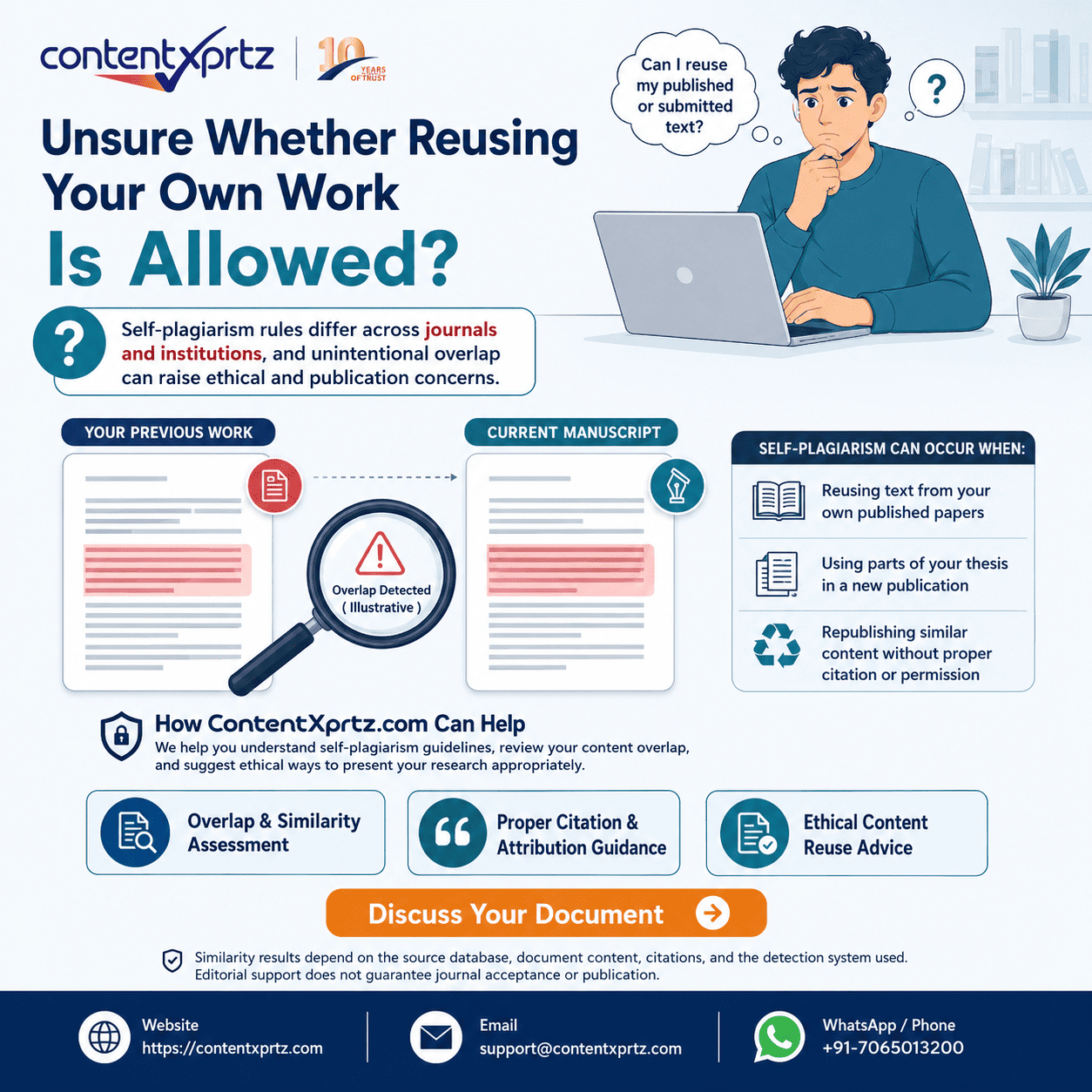
- Text recycling: wording or findings are reused from the author’s earlier output without appropriate citation or disclosure.
- False or weak match: the tool links common language to an irrelevant source.
Use filters transparently
Excluding the bibliography, quoted material, or very small matches may improve readability, but record the settings. A report with exclusions cannot be compared fairly with a report that includes everything. Never tune filters only to reach a preferred score.
Look for fragmented patchwriting
Patchwriting may appear as many small matches from one or several sources. The sentences can look changed because words have been substituted, yet the structure and sequence remain dependent on the source. Rewrite from understanding and retain the citation.
Privacy and Database Questions to Ask Before Uploading Your Work
A free checker is only appropriate when its handling of your document matches the risk of the material. Before uploading, answer the following questions.
Data and retention
- Does the provider store the text or file after the report is created?
- Can you delete the submission permanently?
- Is the document added to a searchable repository?
- Does the provider use submissions for model training or product development?
Ownership and sharing
- Do the terms grant the service a broad licence to use uploaded content?
- Are files shared with analytics, advertising, or subcontractor services?
- Is data transferred across countries or legal jurisdictions?
Source coverage
- Does the checker compare public webpages only, or also journals, books, repositories, and student submissions?
- Can you open the matched source and verify it?
- Are results available for the language and discipline of the document?
Research sensitivity
- Does the document include personal data, confidential interviews, unpublished findings, commercial information, or patentable ideas?
- Would uploading violate an ethics approval, data-management plan, nondisclosure agreement, journal policy, or coauthor agreement?
When any answer is uncertain, do not upload the complete file. Use an approved institutional platform, compare a short non-sensitive passage, or arrange a confidential review. A free report is not worth compromising research participants, intellectual property, or publication priority.
How to Correct Plagiarism Risk Without Damaging Academic Meaning
Correct the underlying source-use problem rather than hiding the match. Each type of overlap requires a different response.
| Finding | Appropriate correction | What to avoid |
|---|---|---|
| Exact copied wording | Quote and cite, or rewrite only after understanding the source | Synonym replacement without structural change |
| Accurate paraphrase without citation | Add the correct in-text citation and reference entry | Assuming changed words remove the need for attribution |
| Close paraphrase or patchwriting | Set the source aside, explain the idea independently, then compare and cite | Automated spinning that changes meaning |
| Incorrect or incomplete citation | Verify author, year, title, source, DOI, pages, and citation placement | Citing a secondary page as the original evidence |
| Reused author text | Cite and disclose the earlier work; revise repeated discussion where needed | Assuming authors can reuse published text without limits |
| Table, figure, or instrument | Attribute, seek permission, or follow the licence and adaptation rules | Changing colors or layout and claiming originality |
| AI-assisted passage | Verify facts and sources, rewrite as needed, cite underlying evidence, disclose use where required | Treating a low similarity score as proof of reliability |
For paraphrasing, read the source until you can explain it accurately, close the source, write from your understanding, and then compare. Preserve qualifications, uncertainty, and technical relationships. Add the citation because the idea remains borrowed even when the language is new.
After correcting source use, academic proofreading can help identify citation inconsistencies, unclear antecedents, accidental quotation errors, and language changes that distorted the original meaning.
Ethical Academic Editing and Author Responsibility
Ethical editing improves communication while preserving the author’s ideas, evidence, and decisions. An editor may clarify grammar, strengthen transitions, identify unsupported claims, flag close paraphrases, and check whether citations are placed consistently. The editor should not fabricate references, invent findings, conceal copied material, or rewrite a document to misrepresent authorship.
Authors remain responsible for authentic sources, accurate data, permissions, declarations, and compliance with institutional or publisher rules. This responsibility also applies to AI-assisted content. A checker may find overlap in generated text, but the author must verify claims and references, ensure proper attribution, and disclose tool use where required.
Publication ethics also covers duplicate submission and overlapping publication. A manuscript derived from a thesis, preprint, conference paper, or earlier article may be legitimate, but the relationship must be transparent. Consult the journal before submission when substantial material has appeared elsewhere.
Common Mistakes When Trying to Detect Plagiarism Free Online
- Believing the overall percentage is the verdict. It is a starting point for review, not proof of misconduct or originality.
- Uploading a confidential thesis to the first free website. Read storage, retention, and licensing terms before sharing unpublished work.
- Deleting citations to lower the score. Removing acknowledgment makes source use less transparent and can increase risk.
- Using a paraphrasing spinner. Automated rewriting can preserve copied structure, distort technical meaning, and create unnatural academic language.
- Ignoring ideas because the wording is different. Concepts, data, images, and argument structures may require attribution even when no text match appears.
- Excluding every short match. Small fragments can reveal patchwriting when they cluster around one source.
- Citing the matched website instead of the original work. Trace evidence to the authoritative publication you read.
- Assuming your own published text is free to reuse. Text recycling and copyright may require citation, disclosure, permission, or substantial revision.
- Checking only the final PDF. Review source use during drafting so citations and paraphrases develop with the argument.
- Chasing a zero score. Proper quotations, references, and standard language can create legitimate matches.
Practical Examples: Free Plagiarism Checking in Academic Work
Example 1: A PhD scholar checking a literature-review chapter
Situation: A doctoral scholar scans a 12,000-word chapter in several free tools and receives scores ranging from 9% to 31%. The scholar assumes the lowest score is correct.
Common confusion: The tools have different databases, limits, and exclusion settings. The chapter also contains many cited definitions and repeated phrases from the field.
Correct approach: The scholar uses the university-approved system, reviews matches by source, rewrites several close paraphrases, adds missing page locators for quotations, and checks the thesis policy. Legitimate reference and terminology matches are documented rather than hidden.
How expert guidance helps: A confidential thesis support review can flag patchwriting, citation-placement problems, and unclear synthesis while leaving the research interpretation with the scholar.
Example 2: A first-time researcher adapting a conference paper
Situation: A researcher turns a conference paper into a journal manuscript and sees large matches with the earlier paper.
Common confusion: The researcher believes self-authored text cannot create a publication-ethics issue.
Correct approach: The researcher cites the conference version, explains the relationship in the cover letter, substantially expands the analysis, checks copyright, and asks the target journal whether the earlier dissemination is acceptable. Results and conclusions are not presented as entirely new when they overlap.
How expert guidance helps: A manuscript assessment can map reused sections, distinguish necessary method overlap from repeated interpretation, and improve transparency before submission.
Example 3: An ESL author using an automatic paraphraser
Situation: An ESL researcher uses a rewriting tool to reduce matches in the introduction. The score falls, but several sentences become scientifically inaccurate.
Common confusion: Lower similarity is treated as better scholarship.
Correct approach: The author returns to the original studies, writes each point from understanding, restores important qualifications, and cites the sources. A few exact terms remain because they are technically necessary.
How expert guidance helps: Academic editing improves grammar and flow while preserving scientific meaning, and the author verifies every revision against the sources.
Example 4: A student checking a short assignment
Situation: A student pastes a public, non-sensitive essay into a free checker and receives a 14% match, mostly from the title, assignment wording, quotations, and references.
Common confusion: The student starts removing citations to lower the score.
Correct approach: The student restores the citations, confirms quotation marks, rewrites one uncited paraphrase, and follows the lecturer’s instructions. The final percentage remains above zero but the source use is transparent.
How expert guidance helps: For a routine assignment, a writing center or instructor may be enough. Professional support is not necessary unless the source-use problem is complex or institutional rules permit it.
Academic Originality and Plagiarism-Review Checklist
Before using an online checker
- The applicable university, journal, publisher, or client policy has been read.
- The file contains no confidential data that the service is not authorized to process.
- The provider’s storage, deletion, licence, and privacy terms are understood.
- A local versioned copy of the document is retained.
While reviewing the report
- Every substantial match is opened and compared with the original source.
- Quotations, paraphrases, references, methods, and common phrases are classified separately.
- Filters and exclusions are recorded.
- Ideas, images, tables, data, instruments, translations, and structure are checked manually.
While revising
- Exact words are quoted and cited where appropriate.
- Paraphrases are written from understanding and still attributed.
- References are authentic, complete, and placed at the correct claim.
- Reused material from earlier work is cited and disclosed.
- Automated rewriting has not altered technical meaning.
Before submission
- The revised document is rechecked using transparent settings.
- Coauthors approve source-use and overlap decisions.
- AI use, editing support, preprints, conference papers, and related outputs are disclosed when required.
- The author can explain every remaining match and takes responsibility for the final work.
How Contentxprtz Can Help
Contentxprtz supports authors who need more than a raw similarity percentage. Ethical plagiarism-risk review can help classify matches, identify close paraphrasing, locate missing attribution, examine text recycling, and improve the clarity of revisions. The service can be combined with academic editing services or proofreading when language and source integration need attention.
Support is most appropriate when the author provides authentic sources, understands the governing policy, and remains involved in every decision. Editors can flag a problem and propose clearer wording, but they cannot determine research truth, invent evidence, guarantee a score, guarantee acceptance, or take responsibility for submission.
For a high-stakes manuscript, a structured review should cover confidentiality, report settings, matched-source verification, quotation and paraphrasing, citation consistency, reused material, tables and figures, and a final author check. This produces a more defensible result than automatic “plagiarism removal.”
Summary: Detect Plagiarism Free Online Responsibly
You can detect plagiarism free online by using a transparent checker as a screening tool, protecting sensitive drafts, opening each matched source, and reviewing source use manually. The similarity score helps prioritize passages, but it does not decide whether plagiarism has occurred.
Correct problems according to their type: quote exact wording, cite borrowed ideas, rewrite close paraphrases from understanding, verify references, disclose related publications, and review images, data, translations, and AI-assisted text. A legitimate final document may still contain similarity because references, quotations, standard language, and required templates can match.
Free tools are suitable for low-risk preliminary checks. Institutional systems, supervisors, librarians, or confidential professional review are safer for theses, manuscripts, sensitive research, and complex publication histories. The final standard is accountable authorship and traceable evidence, not a manufactured zero.
Frequently Asked Questions
Can I detect plagiarism free online accurately?
You can use a free online plagiarism checker as an initial screening tool, but no free result should be treated as a final academic judgment. Accuracy depends on the checker’s source coverage, indexing, matching method, word limit, language support, and ability to compare against subscription journals, books, repositories, and previously submitted student papers. A tool may find copied wording from public webpages yet miss a passage taken from a paywalled article or an unpublished thesis. It may also flag correctly quoted material, references, technical phrases, or standard methodology language. Review every match in context, open the original source, and decide whether quotation marks, citation, permission, or rewriting are needed. For a thesis, dissertation, grant, or journal manuscript, compare the free report with your university or publisher requirements and use an institutional checker when available. The safest goal is not a perfect percentage. It is transparent authorship, authentic sources, accurate attribution, and wording that genuinely reflects your understanding.
What is the difference between plagiarism and a similarity score?
A similarity score measures text overlap; plagiarism is an academic or editorial judgment about unattributed use of another person’s words, ideas, data, images, or structure. The two are related but not identical. A document can have a noticeable similarity score because it contains a properly quoted passage, a reference list, a standard questionnaire, a legal phrase, or unavoidable technical terminology. Conversely, a document can receive a low score while still presenting another author’s idea without acknowledgment, translating copied material, reusing an unpublished source, or applying patchwriting that a database does not recognize. Treat the score as a map that shows where to inspect, not as a verdict. Open each matched source, compare the wording and idea, check whether the citation appears at the correct point, and review your institution’s policy. Academic judgment is required because context, purpose, discipline, document type, and permitted reuse all matter. A responsible review explains why each match is acceptable, needs revision, or requires formal attribution.
Are free plagiarism checkers safe for an unpublished thesis or manuscript?
They may be safe for low-risk text, but you should not upload confidential, sensitive, commercially valuable, or unpublished research until you understand the provider’s privacy and retention terms. Check whether the service stores submissions, uses them to improve models, shares content with third parties, creates a public page, claims a licence over uploaded material, or allows permanent deletion. Pay particular attention to patient information, interview transcripts, proprietary datasets, patent-related content, embargoed findings, peer-review material, and a manuscript that a journal has not yet received. Removing names does not always remove research risk because data, methods, or unique wording may still identify a project. When the terms are unclear, use a short non-sensitive sample, a university-approved system, an offline comparison method, or professional support covered by a confidentiality agreement. Keep a clean local copy and never assume that a “free” service provides the same data protections as an institutional platform. Privacy is part of research integrity, not a separate technical detail.
How should I interpret matched text in a plagiarism report?
Start with the matched passages, not the overall percentage. Classify each match as a correctly quoted extract, a cited paraphrase, an uncited paraphrase, copied wording, common terminology, a reference-list entry, template language, your own earlier text, or an uncertain case. Then open the source and compare the complete context. A citation alone does not make copied sentences acceptable; direct wording normally needs quotation marks or block-quote formatting unless the relevant style and document type allow another treatment. A paraphrase must change both wording and sentence structure while preserving the original meaning and still crediting the source. Excluding the bibliography or small matches can make a report easier to read, but those settings should not be used to hide meaningful overlap. Record important decisions when reviewing a thesis or manuscript with coauthors. If the report comes from an institution, ask how its repository, filters, and thresholds are configured because results can change with settings. The purpose is to resolve source-use problems, not simply lower a number.
What plagiarism percentage is acceptable for a thesis or research paper?
There is no universal acceptable plagiarism or similarity percentage for every university, journal, discipline, and document type. Institutions may set local screening thresholds, but those thresholds do not replace examination of the matches. A low score can contain one serious uncited passage, while a higher score may come from references, methods, quotations, institutional wording, or a required template. Before submission, check the official thesis handbook, academic-integrity policy, supervisor guidance, and target journal instructions. Review the report section by section, especially the introduction, literature review, methods, tables, figures, and reused conference or preprint material. Explain legitimate overlap when required and cite your own earlier publications where text recycling or duplicate publication could be a concern. Do not use automatic paraphrasing merely to reach a number; that can damage meaning and create new citation problems. The defensible standard is that every borrowed word, idea, data point, figure, and reused passage has an appropriate scholarly reason and acknowledgment.
Can paraphrasing tools remove plagiarism from academic writing?
A paraphrasing tool can alter wording, but it cannot by itself establish originality, accurate meaning, or proper attribution. Academic paraphrasing requires you to understand the source, restate the idea in a genuinely new structure, preserve technical accuracy, and cite the source. Automated rewriting may substitute incorrect terms, change the strength of a claim, remove important qualifications, invent awkward phrases, or produce patchwriting that remains too close to the original. It can also obscure where an idea came from, making citation less reliable. A better process is to read the source, close it, write the point from your understanding, compare your version with the original, add the citation, and verify that you have not copied a distinctive phrase. Use direct quotation when exact wording is necessary and permitted. For specialist theses and manuscripts, an academic editor can improve language while preserving meaning, but the author must still verify the source, interpretation, and citation. Rewriting without acknowledgment is not an ethical solution to plagiarism.
Does cited text still count as plagiarism?
Cited text can still be problematic when the form of acknowledgment does not match how the source was used. When you copy exact wording, a citation normally needs quotation marks or block-quote formatting, and some styles require a page or paragraph locator. When you paraphrase, you still need a citation because the underlying idea belongs to the source. Listing a work only in the bibliography is usually insufficient if readers cannot identify which sentence or claim came from it. Images, tables, instruments, software, datasets, and translated passages may also require attribution, permission, or a specific licence statement. The correct treatment depends on the citation style, copyright status, publisher policy, and university rules. Common knowledge may not require citation, but what counts as common knowledge varies by field and audience. When uncertain, identify the source clearly and ask a supervisor, librarian, editor, or journal office. Good attribution helps readers trace evidence and shows where your contribution begins.
How can I check self-plagiarism or text recycling?
Compare the new document with your earlier assignments, thesis chapters, conference papers, preprints, reports, and published articles, then examine repeated language and duplicated findings. Self-plagiarism, often discussed as text recycling, is not simply a percentage problem. Editors consider how much material is reused, where it appears, whether the earlier work is cited, whether data or conclusions are duplicated, and whether readers could be misled about novelty. Limited repetition in a standard method may be treated differently from reusing a literature review, results section, image, or dataset. Cite related work, explain the relationship between outputs, obtain permission where required, and disclose prior dissemination to the journal. Do not submit substantially the same manuscript to multiple journals at the same time. Free web checkers may not contain your earlier unpublished work, so manual comparison and author records are essential. For complex publication histories, prepare a source map showing which passages, data, tables, and figures originated in each output and seek editorial guidance before submission.
Can an online checker detect plagiarism in AI-generated text?
An online checker may detect passages in AI-generated text when they match sources in its database, but it cannot guarantee that AI-assisted writing is original, accurate, or properly attributed. Generative systems can reproduce familiar phrasing, combine ideas without citations, produce false references, or state common claims as if they were verified facts. A low similarity score does not validate the text. Human authors should verify every factual statement, locate and read authentic sources, add citations at the point of use, check quotations, and disclose AI assistance when institutional or publisher policies require it. Do not cite a fabricated reference or an AI system as the original source of a scholarly claim. Also avoid uploading confidential drafts or data to unapproved AI or checking platforms. The author remains responsible for the final words, evidence, permissions, and declarations. Use similarity detection as one part of a broader review that includes source verification, reasoning, authorship, and compliance with the specific university or journal policy.
When should I use professional plagiarism-risk and academic editing support?
Professional support is useful when a high-stakes document contains complex source use, extensive similarity, multilingual writing, reused material, inconsistent citations, or confidential research that should not be placed in an unknown free tool. Ethical support can classify matches, identify missing citations, distinguish quotation from paraphrase, flag possible text recycling, check reference consistency, and improve clarity without inventing sources or replacing the author’s ideas. It is especially relevant before a thesis submission, journal resubmission, book delivery, grant review, or institutional investigation response. The service should explain confidentiality, scope, and author responsibilities, and it should never promise a guaranteed zero score, guaranteed acceptance, or automatic removal of plagiarism. Contentxprtz can provide plagiarism-risk guidance, academic editing, and proofreading that preserve meaning and authorship. The researcher must approve every revision, confirm each source, follow the applicable policy, and make the final submission decision. Expert review is a quality-control layer, not a substitute for original scholarship.
Conclusion: Use Free Detection as a Review Tool, Not a Shortcut
The main problem is not simply copied wording. It is unclear ownership of words, ideas, evidence, images, data, and earlier work. Free online detection can reveal possible text overlap, but responsible academic practice requires you to understand each source, acknowledge it accurately, and explain your own contribution.
Self-service checking may be sufficient for a short, non-sensitive draft when the writer can evaluate the matches confidently. Expert-assisted academic editing or plagiarism-risk review is safer when the document is confidential, publication-bound, multilingual, extensively cited, or affected by text recycling and complex policy requirements.
Contentxprtz helps improve clarity, structure, citation consistency, ethical source use, and publication readiness while preserving author responsibility. The author remains accountable for the research, claims, data, sources, permissions, declarations, and final submission.
“At Contentxprtz, we don’t just edit; we help ideas reach their fullest potential.”