Writing Center: Practical Academic Writing Support for Researchers
A writing center is a support resource where writers can improve ideas, organization, argument, evidence use, sentence clarity, and revision habits through guided feedback. In universities, a writing center commonly helps students and researchers become more effective writers rather than simply correcting a document for them. For PhD scholars, postgraduate students, first-time authors, ESL researchers, and professionals, the most useful support is usually collaborative: the writer remains responsible for the research and final text while a tutor, editor, or writing specialist helps identify problems and workable revision strategies.
The term can also describe an online writing center, a university writing lab, or a broader academic support service. The exact scope varies. Some centers focus on one-to-one tutoring, some provide handouts and citation guidance, and some offer workshops or specialist support for theses, dissertations, research papers, applications, or multilingual writers. This guide explains what writing centers do, what they normally do not do, how to prepare for a session, and when professional academic editing may be appropriate after self-service support.
Quick Answer: What Is a Writing Center?
A writing center is a place—physical or online—where writers receive guidance on their writing process. A typical session may address a thesis statement, argument structure, paragraph logic, evidence integration, clarity, grammar patterns, citation practices, or revision priorities. Strong writing-center practice is developmental: it helps the writer understand how to improve the current document and transfer that learning to future work.
For students and researchers, the best first step is to arrive with a clear goal, the assignment or journal instructions, and the most recent draft. Ask for help with one or two high-priority concerns rather than requesting a complete rewrite. If the document needs intensive line editing, journal-specific formatting, or publication-ready language work beyond the center's scope, an ethical professional editing service may be a suitable next step.
Key Takeaways
- A writing center supports writers through feedback, discussion, resources, and revision strategies; it is not simply a proofreading desk.
- You can usually seek help at any stage, from understanding the task and planning an outline to revising a complete draft.
- Bring the prompt, rubric, supervisor comments, journal instructions, and your draft so advice can be tied to the real requirements.
- Prioritize higher-order issues such as purpose, argument, structure, evidence, and coherence before sentence-level polishing.
- University policies and writing-center practices differ, especially for theses, take-home exams, assessed work, and permitted editing.
- Professional academic editing can complement a writing center when a manuscript needs sustained language, consistency, formatting, or submission-readiness work.
- Authors remain responsible for their ideas, data, sources, claims, citations, and final submission.
What This Page Covers
- What a writing center is and how it differs from proofreading or professional editing
- What help students, PhD scholars, researchers, and ESL writers can reasonably expect
- How to prepare for a productive tutoring or consultation session
- Which writing problems should be addressed first
- Common mistakes that reduce the value of writing support
- Practical examples for coursework, thesis writing, and journal manuscripts
- When self-service resources are enough and when expert academic editing may help
Table of Contents
- Meaning and purpose of a writing center
- Who can benefit and what support looks like
- How to prepare for and use a writing-center session
- Writing center versus editing and proofreading
- Online writing centers and self-service resources
- How to evaluate feedback and revise responsibly
- Common writing-center mistakes
- Practical examples
- Preparation and revision checklist
- Frequently asked questions
Methodology and Academic Sources
This article is based on common academic writing-center, tutoring, editing, and publication-readiness workflows. Writing-center policies vary by institution, course, discipline, manuscript type, and local academic-integrity rules, so writers should check the requirements that apply to their own work.
For comparison and further reading, this guide refers to established academic resources including the Purdue Online Writing Lab, the Harvard College Writing Center, and Harvard's Strategies for Essay Writing. Writers preparing research for publication should also follow their target journal's author instructions and applicable publication-ethics policies.
What a Writing Center Means in an Academic Context
A writing center is best understood as a learning environment for writers. The aim is not only to improve one paper but also to help a writer recognize patterns, make informed choices, and develop a repeatable revision process. That distinction matters because academic writing is not merely error-free prose. It requires a clear purpose, a defensible line of reasoning, appropriate evidence, reader-aware organization, accurate attribution, and language that communicates the author's meaning.
Writing support is usually collaborative
In a collaborative session, a tutor may ask what the assignment requires, what the writer wants readers to understand, where the argument feels weak, or which feedback from a supervisor is difficult to interpret. The tutor may read a section aloud, identify where the logic becomes unclear, ask the writer to explain a claim in simpler language, or suggest a strategy for reorganizing paragraphs. The writer then makes the decisions and revisions.
A writing center is not the same as a correction service
Many institutional centers deliberately avoid silently rewriting or proofreading an entire paper. Harvard's public tutoring guidance, for example, frames its work around helping students develop as writers and states that tutors do not simply proofread or edit the student's work. That approach reflects a core educational principle: feedback should support learning and preserve the writer's authorship. A center may still discuss grammar and sentence structure, but the discussion often focuses on recurring patterns and strategies rather than making every correction.
Support can begin before a draft exists
Writers often wait until a deadline is close and a draft feels “bad.” In practice, a writing center can be useful much earlier. A researcher may discuss how to narrow a topic, turn a broad interest into a research question, map an argument, understand an unfamiliar genre, or decide how to structure a literature review. Early support is especially valuable when the writer is moving into a new discipline or writing in a second or additional language.
Who Uses a Writing Center and What Help Can They Get?
Writing centers can serve writers at many levels, but the most useful support depends on the task and the writer's stage. A first-year student may need help understanding argumentative writing, while a doctoral researcher may need a discussion about chapter coherence, literature synthesis, or how to respond to supervisory feedback.
Undergraduate and postgraduate students
Students commonly seek help with assignment interpretation, thesis statements, essay organization, paragraph development, evidence use, transitions, and citation. A tutor can help a student distinguish between describing sources and analyzing them, or identify where paragraphs contain several unrelated ideas. The student should still make the academic decisions and ensure the work complies with course rules.
PhD scholars and dissertation writers
Doctoral writing creates a different set of challenges. A thesis may be hundreds of pages long, and the writer must maintain conceptual continuity across chapters, explain methods precisely, distinguish findings from interpretation, and respond to several layers of feedback. A writing center may help with planning, argument clarity, chapter-level structure, and recurring writing problems. For intensive thesis language polishing, writers may also consider specialist thesis editing support if it is permitted by their university.
Researchers and journal authors
Researchers may use writing support to sharpen an abstract, clarify the research gap, improve the logical flow between introduction and discussion, or make a manuscript easier for an international readership to follow. Writing-center feedback is particularly useful before submission because a fresh reader can reveal assumptions that the author no longer notices. If a manuscript needs systematic sentence-level editing, consistency checks, or journal-ready language, professional research paper editing may be a more appropriate service.
ESL and multilingual academic writers
Multilingual researchers may have strong subject expertise yet still struggle with article use, sentence boundaries, academic tone, idiomatic phrasing, or the rhetorical conventions of English-language journals. Effective support does not erase the writer's voice. Instead, it helps the writer identify patterns, understand why a sentence may be difficult to process, and choose revisions that preserve the intended meaning. Repeated sessions can be more useful than a single last-minute correction pass because they create opportunities for transfer and practice.
Writing Center, Proofreading, and Professional Editing: What Is the Difference?
The terms overlap in everyday use, but they describe different levels of intervention. Understanding the distinction helps writers choose the right support and avoid paying for a service that does not match the problem.
| Support option | Best for | Typical focus | Main limitation |
|---|---|---|---|
| University writing center | Learning, planning, feedback, revision strategy | Purpose, argument, organization, clarity, writing habits | Usually limited session time; may not edit every sentence |
| Online writing lab resources | Self-service learning and quick reference | Grammar, citation, genre guidance, examples | Cannot diagnose the specific draft in context |
| Proofreading | Late-stage surface correction | Spelling, punctuation, grammar, typographical consistency | Does not usually solve major structural or argument problems |
| Academic editing | Substantial manuscript language and coherence work | Clarity, flow, consistency, style, sentence structure | Must respect academic-integrity and authorship boundaries |
| Publication support | Journal-readiness and submission preparation | Formatting, journal requirements, response documents, submission checks | Cannot guarantee editorial or peer-review outcomes |
If you are unsure which level is appropriate, start by identifying the main problem. If you cannot explain your argument clearly, sentence polishing is premature. If the argument and evidence are stable but language errors distract the reader, proofreading or editing may be efficient. If the target journal has returned detailed reviewer comments, the need may be a combination of author-led revision and structured reviewer response support.
When Self-Service Writing Support Is Enough and When Expert Help May Be Useful
Self-service resources are often enough when the task is limited, the writer understands the problem, and there is time to revise carefully. A style guide can answer how to format a reference; a writing-center handout can explain paragraph structure; a tutor can help a student test whether an argument is coherent.
Expert assistance may be useful when the document is long, technically complex, high-stakes, or being prepared for an external audience. A doctoral thesis with recurring language problems, a journal manuscript written under strict word limits, or a multi-author paper with inconsistent terminology may require more sustained attention than a short tutoring appointment can provide. The important boundary is ethical: an editor can improve communication and consistency, but should not fabricate evidence, invent citations, alter results, or replace the author's intellectual contribution.
How to Use a Writing Center Effectively: Step by Step
1. Identify the real writing problem
Before booking a session, write one sentence explaining what is difficult. “My paper is bad” is hard to act on. “My literature review summarizes studies but does not show the research gap” is specific. “My supervisor says the discussion is descriptive” is also useful. The clearer the problem, the more productive the consultation can be.
2. Bring the assignment, rubric, or journal instructions
Advice without context can be misleading. A tutor needs to know whether the task is a critical essay, lab report, dissertation chapter, systematic review, research proposal, case study, or journal article. Bring the prompt, assessment criteria, supervisor comments, target journal instructions, or any other rules that define success.
3. Bring the most recent draft
Do not spend time making the draft look perfect before asking for help. Mark places where you are unsure. If the document is long, identify the section that matters most. For a thesis, a 45-minute session is unlikely to cover an entire chapter line by line, but it can diagnose a representative section and create a revision plan.
4. Set one or two priorities
Writers often want feedback on everything at once: argument, grammar, references, formatting, flow, tone, and word count. That usually produces shallow advice. Start with higher-order concerns. Is the purpose clear? Does the central claim answer the question? Are paragraphs arranged logically? Does each important claim have appropriate evidence? After those issues are stable, move to sentence-level clarity and proofreading.
5. Explain your own intention
When a paragraph is confusing, tell the tutor what you intended it to do. This helps distinguish a thinking problem from a wording problem. If your spoken explanation is clearer than the paragraph, that explanation often contains the seeds of a better revision.
6. Take notes and ask for a revision plan
A good session should leave you with actions, not just comments. At the end, list the top three revisions to make next. For example: rewrite the thesis so it takes a position; move the conceptual definition before the case analysis; combine two repetitive paragraphs; then check citation consistency.
7. Revise before seeking another round of feedback
Apply the advice thoughtfully rather than mechanically. If a suggestion conflicts with your disciplinary conventions or supervisor instructions, investigate the difference. Return for another session after you have revised enough to create new questions. Repeated cycles of drafting, feedback, revision, and reflection are more valuable than treating the writing center as an emergency repair service.
How a Writing Center Approaches Argument, Structure, and Sentence Clarity
Strong academic feedback moves from global issues to local ones. This prevents a common waste of effort: polishing sentences that may later be deleted because the section itself is not doing useful work.
Start with purpose and argument
Ask what the document is trying to accomplish and what the reader should believe, understand, or be able to evaluate by the end. In argumentative writing, the thesis should be specific enough to organize the paper but flexible enough to be developed through evidence. In empirical research, the central problem may be the alignment among research question, methods, results, and interpretation.
Then examine structure
Harvard's writing resources recommend strategies such as breaking a thesis into the points needed to support it and creating a reverse outline from a draft. A reverse outline is especially useful for long academic writing. Write one short phrase beside each paragraph describing its function. If two paragraphs do the same job, or if a paragraph contains several unrelated jobs, the structure probably needs revision.
Then test paragraph logic
Each paragraph should have a recognizable function in the larger argument. Topic sentences, evidence, interpretation, and transitions should work together. A paragraph that opens with one claim, presents evidence for a second, and concludes with a third forces the reader to reconstruct the relationship. A tutor can help the writer see where that reconstruction is becoming too demanding.
Finally, work at sentence level
Sentence-level revision asks whether the subject and action are clear, whether technical terms are defined when needed, whether pronouns have obvious referents, and whether long sentences contain too many logical relationships. For multilingual writers, patterns matter more than isolated errors. If article use, verb tense, or prepositions recur as problems, choose a small sample and study the pattern rather than correcting hundreds of instances without understanding why.
Online Writing Centers and Free Academic Writing Resources
An online writing center can mean synchronous tutoring, asynchronous feedback, or a public collection of writing resources. Free resources are particularly useful for questions that have stable, teachable answers: how to build an outline, how to integrate quotations, how to format citations, how to revise a paragraph, or how different citation systems work.
The Purdue OWL provides extensive open-access materials on academic, professional, and creative writing as well as major citation styles. The Harvard College Writing Center resources include guides on essay organization, thesis development, introductions, paragraphs, transitions, and conclusions. Such resources can solve many routine questions without paid help.
However, generic guidance cannot see your specific argument. If you know what a thesis statement is but cannot decide whether your thesis actually answers your research question, individualized feedback may be more useful. Likewise, a citation guide can show correct formatting, but it cannot determine whether the cited source genuinely supports the claim you have made.
How to Evaluate Writing-Center Feedback and Revise Responsibly
Feedback is evidence about the reader's experience, not an automatic command. When a tutor says a section is unclear, the underlying signal is important even if you do not adopt the exact proposed wording. Ask why the reader became confused and what information was missing at that point.
Check advice against authoritative requirements
Course rubrics, thesis handbooks, supervisor instructions, and target-journal guidelines outrank generic preferences. If a tutor suggests first-person avoidance but the journal explicitly permits or prefers first person, follow the relevant guideline. If your institution has rules about permitted thesis editing, confirm them before using external support.
Preserve authorship and intellectual responsibility
Ethical editing improves communication without replacing the author's scholarly contribution. The author remains responsible for research design, data, interpretation, claims, citations, and approval of the final text. If generative AI or automated tools are used, outputs should be checked carefully for invented references, distorted paraphrases, unsupported statements, and disclosure obligations that may apply.
Keep a revision record for complex projects
For a dissertation or journal article, maintain a simple log: comment received, issue identified, action taken, and location changed. This is especially useful when responding to supervisors or peer reviewers because it forces the writer to connect each change to a reason.
Ethical Academic Editing and Author Responsibility
Academic support should make a writer's own work clearer, not create a false impression of authorship or competence. The acceptable level of assistance depends on context. A university may permit language editing of a thesis but prohibit substantive rewriting. A journal may allow professional editing but require disclosure in the acknowledgements. An assessed take-home examination may prohibit outside help entirely.
Before using a writing center, editor, proofreader, or AI tool, check the applicable rules. Keep authentic references and verify that every source exists and supports the statement attached to it. Do not ask a support provider to fabricate data, rewrite results to appear stronger, invent reviewer responses, or disguise copied material. Academic integrity is not a formatting exercise; it is the relationship between who did the intellectual work, what evidence supports the claims, and how transparently that work is represented.
Common Writing Center Mistakes to Avoid
- Waiting until the final hour. A useful consultation usually creates revision work. Leave enough time to apply it.
- Asking for “grammar only” when the argument is unstable. Fix purpose and structure before polishing sentences that may disappear.
- Arriving without instructions. A tutor cannot reliably judge whether a draft meets requirements they have not seen.
- Expecting the tutor to rewrite the paper. Developmental support works best when the writer participates actively in decisions.
- Trying to cover an entire thesis in one session. Select a chapter, section, or recurring pattern and use it diagnostically.
- Accepting every suggestion mechanically. Evaluate feedback against disciplinary conventions and your intended meaning.
- Ignoring source accuracy. Elegant prose does not compensate for incorrect citations, weak evidence, or unsupported claims.
- Using editing to conceal authorship problems. Assistance should be compatible with university, journal, and professional rules.
Practical Examples: How Writers Use a Writing Center
Example 1: A master's student with a descriptive literature review
Situation: The student has summarized 25 sources but the chapter reads like a sequence of article notes. Writing-center focus: The tutor asks the student to group studies by debate, method, or finding and identify where the literature agrees, conflicts, or leaves a gap. Together they reverse-outline two pages. Next action: The student creates thematic headings and rewrites topic sentences so each paragraph makes a synthesis claim rather than introducing one author at a time.
Example 2: A PhD scholar responding to supervisor feedback
Situation: The supervisor says, “Your discussion needs more analysis,” but the scholar does not know what that means. Writing-center focus: The session compares a descriptive paragraph with an analytical one and asks what the findings mean relative to the research question and prior literature. Next action: The scholar labels sentences as result, interpretation, comparison, implication, or limitation, then strengthens paragraphs that contain results without interpretation.
Example 3: An ESL researcher preparing a journal manuscript
Situation: The science is sound, but reviewers in a previous submission found the prose difficult to follow. Writing-center focus: The tutor identifies recurring sentence patterns—very long openings, unclear pronoun reference, and several ideas joined by “which.” Next action: The researcher revises a sample and applies the pattern across the manuscript. Because the full paper still requires sustained language work, the author then considers specialist manuscript editing.
Example 4: A first-year student confused by an assignment prompt
Situation: The student begins researching immediately but cannot tell what “critically evaluate” requires. Writing-center focus: The tutor helps unpack the instruction into tasks: identify the claim, establish evaluation criteria, compare evidence, consider limitations, and reach a reasoned judgment. Next action: The student creates an outline before collecting more sources, preventing a large amount of unfocused reading.
Writing Center Preparation and Revision Checklist
Before the session
- Bring the assignment, rubric, thesis handbook, or journal instructions.
- Bring the current draft, even if incomplete.
- Mark supervisor, instructor, or reviewer comments that you do not understand.
- Write down one or two specific questions.
- Identify your deadline and how much revision time remains.
During the session
- Explain the intended audience and purpose.
- Ask the tutor to prioritize issues rather than comment on everything.
- Take notes in your own words.
- Ask why a section is unclear, not only how to rewrite it.
- Check any advice that depends on disciplinary or institutional rules.
After the session
- Revise higher-order issues before proofreading.
- Apply repeated feedback across similar sections.
- Verify all citations and factual claims independently.
- Keep a short change log for thesis or journal revision.
- Seek another feedback round only after you have acted on the first one.
How Contentxprtz Can Help Beyond a Writing Center
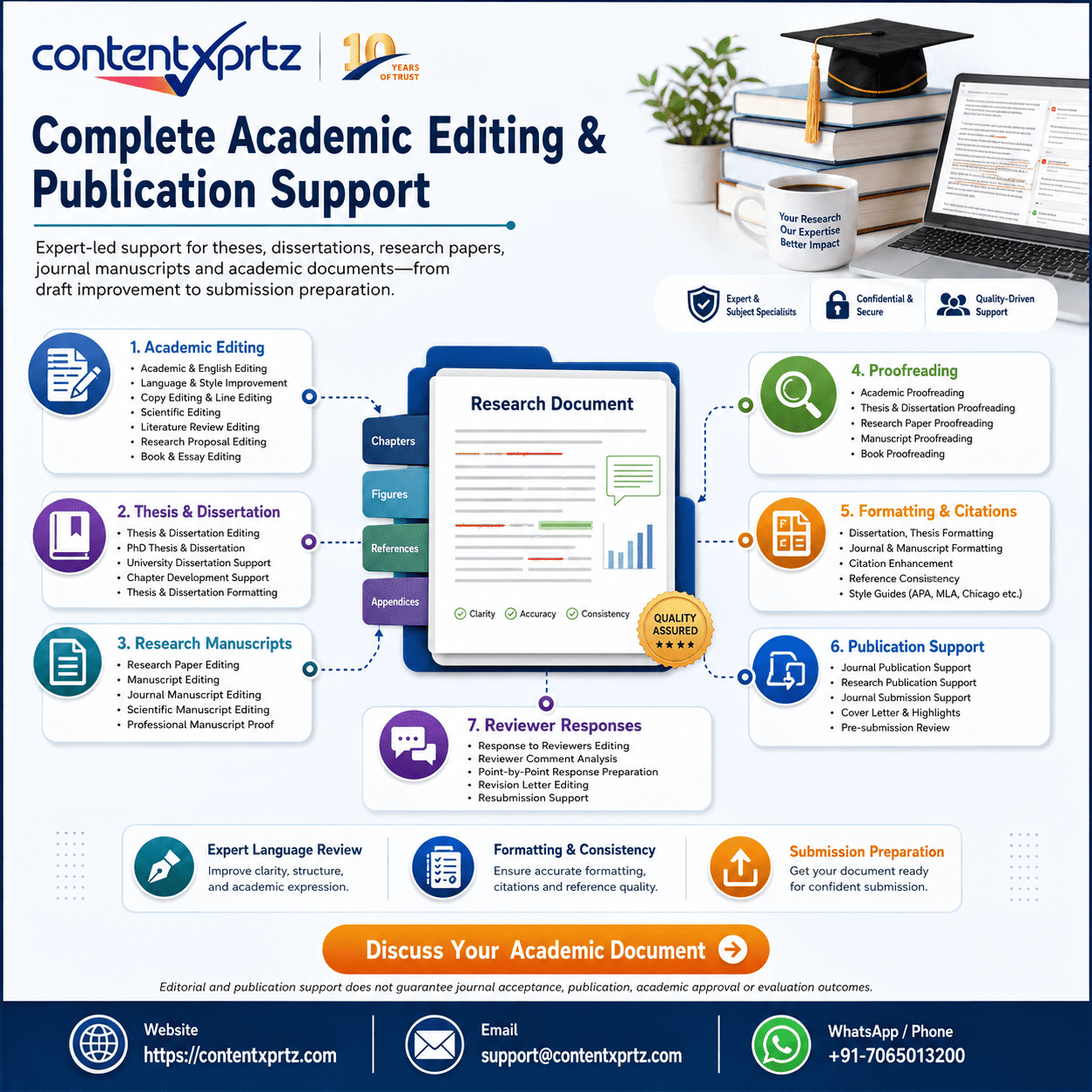
A writing center is an excellent starting point for learning, diagnosis, and revision strategy. Some documents, however, need more sustained attention than a tutoring appointment can provide. Contentxprtz offers ethical academic editing and research communication support for writers who need detailed work on clarity, sentence structure, consistency, organization, and publication readiness while preserving the author's meaning and responsibility.
For a research manuscript, the most relevant next step is often research paper editing. The service can help when the draft is already intellectually complete but needs a consistent scholarly presentation before submission. Writers should still verify every source, approve every change, and ensure the assistance complies with institutional or publisher requirements.
Summary: Writing Center Support for Academic Writers
A writing center helps writers improve the process and quality of academic communication through guided feedback. It can support brainstorming, assignment interpretation, thesis development, organization, evidence integration, paragraph logic, revision, grammar awareness, and citation practice. The strongest sessions are collaborative and problem-focused: the writer brings the requirements and draft, identifies priorities, discusses the reader's experience, and leaves with a clear revision plan.
Free writing resources and university tutoring are often enough for focused learning needs. Professional academic editing may be useful when a thesis or manuscript requires sustained line-level work, consistency, formatting, or publication-readiness support. In every case, the author remains responsible for the research, ideas, data, sources, claims, and final submission.
Frequently Asked Questions
What is a writing center?
A writing center is a support service that helps writers improve how they plan, draft, revise, and communicate. In an academic setting, writers may bring essays, research papers, theses, dissertations, applications, proposals, or other documents for discussion. A tutor typically helps diagnose problems with purpose, argument, organization, evidence, clarity, or recurring language patterns. The goal is usually developmental rather than corrective: the writer should leave understanding both what to revise and why. Policies vary by institution. Some centers offer in-person appointments, some use video consultations, and others provide workshops or online resources. A writing center should not be assumed to provide full-document proofreading or rewriting. Before a session, check what kinds of work the center accepts and whether your course, university, or assessment rules place limits on outside help. Bring the instructions and your current draft so the feedback can be tied to the actual task.
Can a writing center proofread my whole paper?
Usually, a writing center is not designed to proofread every line of a paper for you. Many centers focus on helping writers become more independent by discussing patterns in grammar, clarity, style, and organization and then asking the writer to apply those lessons across the draft. This is different from professional proofreading, where the service may systematically correct surface errors. If you have a short passage with recurring sentence-level problems, a tutor may review it with you and explain what to watch for. If you need a 10,000-word dissertation chapter corrected line by line, the center may not have enough appointment time or may consider that outside its educational role. In that case, check your institution's editing policy and consider permitted proofreading or academic editing. Even with professional support, you should review all changes, preserve your intended meaning, and remain responsible for the final text.
When should I visit a writing center?
You can visit a writing center at almost any stage of the writing process, and earlier is often better. Before drafting, a tutor can help you unpack an assignment, narrow a topic, clarify a research question, or test an outline. During drafting, the session may focus on thesis development, paragraph sequence, evidence integration, or how to move from source summary to analysis. After you have a full draft, feedback can identify gaps in reasoning, unclear transitions, repetitive sections, and sentence-level patterns. Leave time after the appointment to revise; a consultation immediately before submission is less useful because you cannot act on the feedback. For a thesis or journal article, schedule support around meaningful milestones rather than waiting until the final document is complete. Bring your deadline, instructions, feedback from supervisors or reviewers, and a prioritized question so the session can focus on the work that will make the biggest difference.
Can a writing center help with a thesis or dissertation?
Yes, many writing centers support thesis and dissertation writers, although the scope differs by institution. Useful topics include chapter planning, argument coherence, literature-review synthesis, paragraph structure, transitions, maintaining a consistent line of reasoning, and responding to supervisor feedback. Some centers also run dissertation groups or specialist appointments. Because a thesis is long, a single session rarely covers the whole document. A better strategy is to choose a representative section and use the session to identify patterns that you can apply elsewhere. If you need intensive language editing across an entire thesis, the writing center may recommend other approved resources. Before using an external editor, check your university's rules on permitted assistance and disclosure. Editing should improve clarity and consistency without creating original arguments, fabricating content, or changing the scholarly contribution. The doctoral researcher remains responsible for the research, interpretation, citations, and final submitted thesis.
Is a writing center useful for research papers and journal manuscripts?
Yes. A writing center can be valuable when a research paper is difficult to follow even though the underlying work is sound. A tutor may help test whether the abstract reflects the paper, whether the introduction establishes a clear gap, whether paragraphs build a logical argument, or whether the discussion explains the meaning of the findings rather than repeating results. The session can also identify places where an expert author has assumed too much background knowledge for the intended reader. However, journal manuscripts often require specialized conventions, detailed language consistency, and adherence to target-journal instructions. A general writing center may not provide a complete submission-readiness review. After the author resolves conceptual and structural issues, professional manuscript or research-paper editing may be useful for sustained language work. No tutor or editor can guarantee acceptance because journal decisions depend on fit, research quality, methodology, novelty, editorial judgment, and peer review.
How should I prepare for a writing center appointment?
Bring three things: the requirements, the draft, and a priority. The requirements may be an assignment prompt, grading rubric, thesis handbook, supervisor feedback, reviewer report, or journal author instructions. The draft can be incomplete; you do not need to polish it first. Mark the places where you are uncertain. Then choose one or two questions, such as whether the argument is clear, whether the literature review synthesizes sources, or why the discussion feels repetitive. If the document is long, identify the section that best represents the problem. During the meeting, explain what you intended the section to accomplish and take notes on the reasons behind the tutor's feedback. At the end, write a short revision plan in priority order. This preparation turns a general conversation into a focused problem-solving session and gives you actions you can carry into the rest of the document.
What is the difference between a writing center and academic editing?
A writing center is usually an educational service focused on dialogue, feedback, and writer development, while academic editing is a more sustained review of the text itself. A tutor may help you recognize why the argument is unclear, show you how to reverse-outline a section, or identify a recurring sentence pattern. An academic editor may work through the manuscript systematically to improve clarity, flow, consistency, grammar, and scholarly style. The appropriate option depends on the problem. If you are still deciding what you want to argue, editing is not a substitute for intellectual development. If your argument and evidence are settled but the language is inconsistent across a long manuscript, professional editing may be efficient. In both settings, ethical boundaries matter. The author should retain control of ideas and interpretation, and any external support must comply with university, funder, employer, or journal rules.
Can international or ESL students use a writing center?
Yes. Writing centers can be particularly useful for international and multilingual writers because a tutor can address both rhetorical expectations and recurring language problems in context. Academic English involves more than grammar. Writers may be learning how directly to state a claim, how to signal a research gap, how to structure paragraphs, how to use cautious language, or how to integrate sources without losing their own analytical voice. A productive session should respect the writer's linguistic identity rather than trying to make every sentence sound identical to one standardized model. Ask the tutor to identify patterns and explain the reason a construction is difficult for readers. Then practice revising similar examples yourself. If a complete thesis or journal manuscript requires detailed language polishing beyond the center's scope, ethical ESL academic editing may be considered, subject to the rules that apply to the work.
Can a writing center help with citations and plagiarism concerns?
A writing center can often explain citation principles, help you distinguish quotation from paraphrase, show how sources should be integrated into your own argument, and direct you to the citation style required by your course or journal. It can also help you understand why changing a few words is not enough to create an acceptable paraphrase. However, a writing center cannot make an unsupported source authentic or guarantee that a document is free of plagiarism. You remain responsible for checking every reference against the original source and ensuring that the source actually supports the claim. If you use automated citation or AI tools, verify the bibliographic details because generated references can be incomplete or fabricated. When plagiarism concerns involve formal misconduct procedures, follow your institution's policy and seek the appropriate academic adviser rather than relying only on general writing support.
When should I choose professional editing after using a writing center?
Professional editing may be useful after a writing-center session when the core ideas, evidence, and structure are stable but the document still needs sustained language and consistency work. Typical situations include a long thesis with recurring sentence-level problems, a multi-author manuscript with inconsistent terminology, a journal article that must be tightened to a strict word limit, or a research paper that needs a systematic pre-submission language review. Choose a service that states its ethical boundaries and does not promise guaranteed publication, grades, or approval. Provide the target journal or institutional requirements and explain what kind of intervention is permitted. Contentxprtz can support research-paper editing and related academic communication needs, but authors remain responsible for checking sources, approving revisions, preserving accurate meaning, and making the final submission decision.
Conclusion: Use a Writing Center to Build Better Revision Decisions
The main value of a writing center is not that someone else “fixes” your writing. It is that a skilled reader helps you see what the draft is doing, where readers may struggle, and which revision should come first. That makes writing support useful for students learning academic argument, PhD scholars managing long projects, researchers preparing manuscripts, and multilingual writers navigating disciplinary conventions.
Free resources and self-service support may be enough when the problem is focused and you can apply the guidance independently. When a manuscript is long, technically complex, or close to submission and needs sustained language, consistency, or formatting work, expert-assisted academic editing may be the more efficient next step. The safest support preserves the author's ideas, maintains authentic citations, follows institutional and journal rules, and keeps responsibility with the author.
If your research paper needs detailed academic editing after you have resolved the core argument and evidence, explore Contentxprtz research paper editing support.
At Contentxprtz, we don’t just edit; we help ideas reach their fullest potential.