A Broad Search Term Can Hide a Very Specific Submission Decision
If you searched for world journal, you may be trying to find an international journal, check whether a journal with “World Journal” in its title is legitimate, identify the right publication venue, or understand how to prepare a paper for global readership. The difficulty is that the phrase does not point to one universal scholarly publication. Many independent journals use “World,” “Global,” or “International” in their names, and journals with similar titles can differ greatly in discipline, publisher, peer-review model, indexing, fees, visibility, and editorial standards. The first task is therefore not to submit quickly; it is to identify exactly which journal you are evaluating and why it fits your work.
For a PhD scholar or first-time researcher, this matters because journal choice affects much more than formatting. A paper can be technically sound yet still be unsuitable for a journal whose aims, audience, article types, or methodological expectations do not match the study. At the same time, researchers face practical pressure: supervisors may expect publication, institutions may require particular indexing, funders may set open-access conditions, and authors working in a second language may worry that grammar or structure will distract from the research. Those pressures can make a broad “international journal” promise look attractive, especially when a website emphasizes rapid review, impressive-looking metrics, or worldwide reach.
A safer approach combines journal selection, verification, and manuscript readiness. Confirm the exact journal title and ISSN, examine its publisher and editorial policies, verify indexing claims independently, read recent articles, understand all fees, and compare the author instructions with your manuscript. Then review the paper itself for clarity, logical flow, reporting completeness, citation accuracy, figures, tables, and journal-specific formatting. Free tools and peer feedback can help with surface-level checks, but complex manuscripts often need deeper editorial judgment.
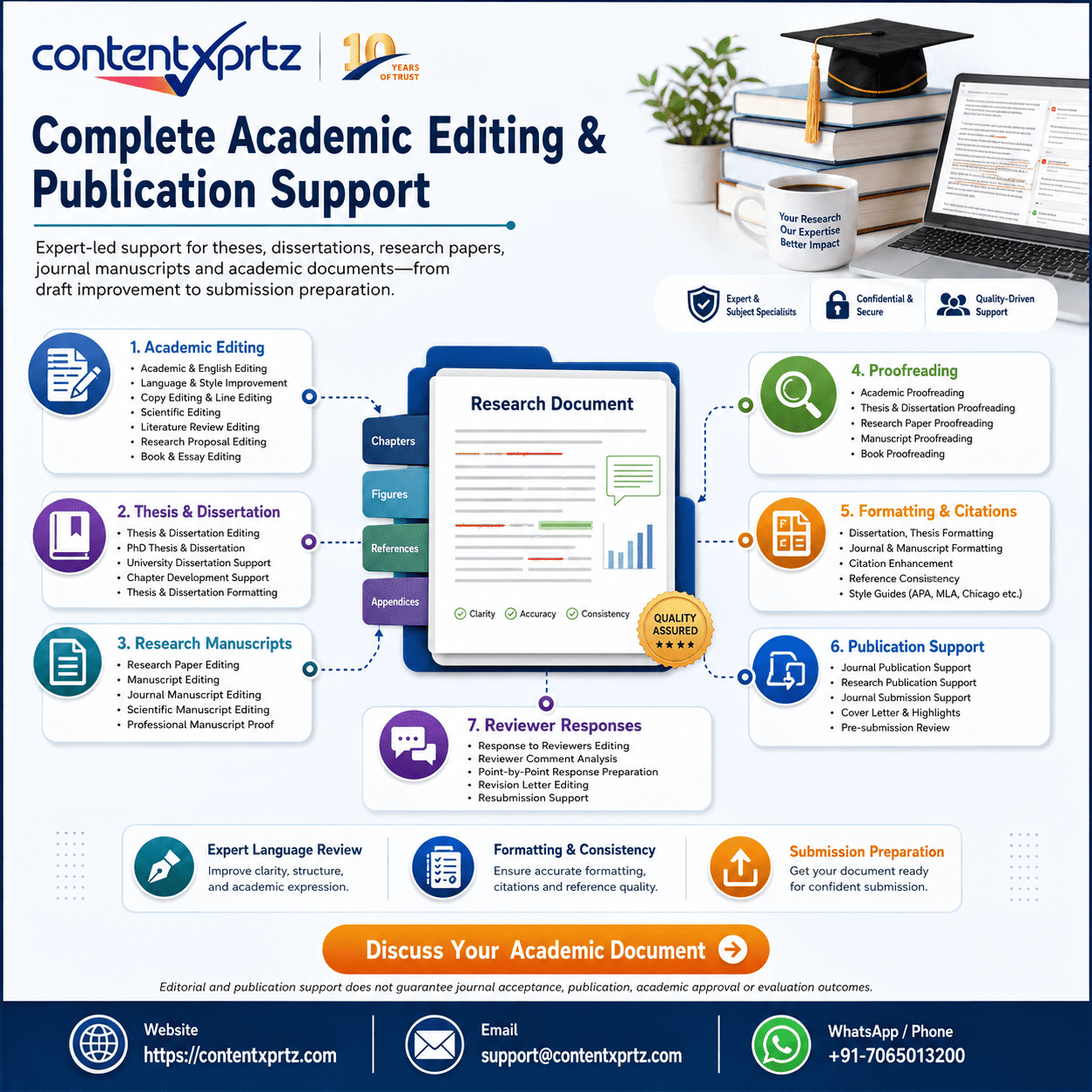
Contentxprtz supports researchers with ethical academic editing services and journal manuscript preparation when language, organization, or submission requirements need an independent review. The goal is not to promise acceptance or choose a journal on the author’s behalf. It is to help authors present their own research clearly while keeping responsibility for data, claims, citations, ethics, and the final submission where it belongs: with the authors.
Quick Answer: What Should You Check About a World Journal?
Treat “world journal” as a search phrase, not a quality label. First identify the exact journal title, ISSN, publisher, official domain, discipline, and article type. Then verify claims about indexing, peer review, fees, metrics, and editorial policies through independent or official sources.
Before submission, read recent papers and the journal’s author instructions. Your manuscript should fit the journal’s scope and audience, meet its reporting and formatting requirements, and remain your own scholarly work. If the journal’s identity, indexing, fees, or editorial process cannot be verified, pause before submitting or paying.
Key Takeaways
- “World journal” is not proof that a publication is international, indexed, peer reviewed, or suitable for your manuscript.
- Verify the exact journal identity using its complete title, ISSN, publisher, official website, and independent records.
- Confirm indexing in the database itself rather than relying on logos or claims displayed on the journal website.
- Scope fit, audience, editorial standards, peer review, fees, rights, and author instructions matter alongside metrics.
- Never treat guaranteed acceptance, guaranteed indexing, or unusually fast publication promises as normal evidence of quality.
- Manuscript editing can improve clarity and readiness, but authors remain responsible for research, data, citations, ethics, and submission decisions.
What This Page Covers
- What “world journal” can mean
- Journal identity and trust checks
- Indexing and metric verification
- Scope and audience matching
- Submission-readiness workflow
- Ethical editing and author responsibility
Methodology and Academic Sources
This guide uses common journal-selection, manuscript-preparation, editorial-quality, and publication-ethics workflows. It emphasizes checks that researchers can repeat themselves: confirming journal identity, reading author instructions, verifying indexing claims at the source, reviewing published articles, understanding fees and rights, and comparing the manuscript against submission requirements.
Because journal policies vary by publisher, discipline, article type, and research design, the journal’s current instructions should always take priority. Researchers can also use the Think. Check. Submit. journal checklist when evaluating a venue, consult COPE publication-ethics resources, and review the ICMJE recommendations when biomedical publication standards are relevant. For open-access journals, the Directory of Open Access Journals can be one useful verification source, while institutional libraries and research offices can help interpret local requirements.
What “World Journal” Means in an Academic Context
The phrase is ambiguous, so journal identity comes before journal evaluation. A researcher may use “world journal” to mean a globally oriented scholarly journal, or may be searching for a specific publication whose title begins with those words. Those are different tasks. In either case, the words in the title do not establish quality, reach, indexing, or editorial rigor.
Journal identity
The exact title, ISSN/eISSN, publisher, official domain, ownership, and contact information that distinguish one publication from similarly named journals.
Scope fit
The degree to which your research question, method, discipline, article type, and intended audience match what the journal actually publishes.
Peer review
The journal’s stated process for evaluating manuscripts with editorial and expert review. Models vary, so read the publication’s own policy.
Indexing
Coverage by a named bibliographic or discovery database. Indexing should be verified in that database using the journal’s exact identity.
A good journal-selection decision is therefore evidence based. Start by asking: Which exact journal is this? What does it publish? Who publishes it? Who reads it? What does my institution require? Can I verify the claims that matter? This reframes the search from “Is this a world journal?” to “Is this specific journal a credible and appropriate venue for this specific manuscript?”
How to Identify the Right “World Journal” Search Result
Use stable identifiers and publication details to separate similarly named journals. Search results can surface publishers, archives, indexing pages, article pages, aggregators, and unrelated journals. Before you interpret quality, make sure all the details refer to the same publication.
| Check | What to confirm | Why it matters | What not to rely on |
|---|---|---|---|
| Exact title | Full journal name and title history, if relevant | Prevents confusion with similar or copied names | A shortened search-result title |
| ISSN/eISSN | Identifier shown by the journal and independent records | Helps distinguish publications accurately | A logo or journal acronym alone |
| Publisher | Legal or organizational publisher identity | Clarifies ownership and responsibility | An email signature or generic “editorial office” label |
| Official domain | Website linked by trusted records or publisher pages | Reduces risk of using a copied or hijacked site | Ads, redirects, or unsolicited email links |
| Archive | Recent and older issues with stable article details | Shows publishing continuity and editorial practice | A single “current issue” page |
| Indexing | Current record in the claimed official database | Confirms coverage relevant to your requirements | Badges or screenshots on the journal homepage |
Step-by-Step: Evaluate a World Journal Before Submission
A structured check is faster and safer than deciding from reputation-like language. Use the following sequence for a new or unfamiliar journal.
- Identify the publication. Record the full title, ISSN/eISSN, publisher, website domain, country or organizational base where stated, and contact information.
- Read the aims and scope. Compare your research problem, method, article type, and discipline with the journal’s stated scope and its recently published papers.
- Check the audience. Ask whether the readers of this journal are the people who should encounter your findings. Relevance can matter more than a broad “international” label.
- Review peer-review and editorial policies. Look for a clear description of manuscript handling, reviewer roles, conflicts of interest, corrections, retractions, and research-integrity expectations.
- Verify indexing independently. Search the official database using the exact title and ISSN. Confirm current status and coverage rather than relying on a homepage badge.
- Verify metrics at the source. If a metric affects your decision, identify the provider and confirm the value there. Do not treat every number called an “impact factor” as equivalent.
- Understand fees and rights. Check submission fees, APCs, page or color charges, waivers, copyright terms, licenses, and payment timing before committing.
- Read the author instructions. Note word limits, manuscript structure, abstract format, references, tables, figures, supplementary files, anonymization, data statements, and reporting checklists.
- Assess manuscript readiness. Review argument flow, methods reporting, results presentation, discussion logic, citation accuracy, language, terminology, tables, figures, and journal formatting.
- Document your decision. Save the journal details, verification date, relevant database records, fee information, and reasons for fit so co-authors or supervisors can review the choice.
This process also helps when you are comparing several possible venues. Create a shortlist instead of forcing one paper into the first journal that appears in search. If two journals seem equally relevant, compare audience, article type, editorial policies, indexing required by your institution, open-access options, reasonable turnaround information, and author experience.
Common Mistakes and Warning Signs to Avoid
Most poor journal decisions come from skipping verification or giving one signal too much weight. A polished website, familiar words, a fast publication promise, or an impressive metric badge may feel reassuring, but each needs context.
Do not equate the word “World” with worldwide reputation
A journal may have an international editorial board and readership, or it may simply use a broad title. Judge international relevance from actual authorship, readership, scope, publisher information, and discoverability—not the name alone.
Do not verify indexing through the journal’s own indexing page
A journal’s website can tell you what it claims, but the official database tells you whether that claim is currently supported. Match title and ISSN carefully. If your university requires a specific index, ask the library which official record should be used.
Do not confuse every metric with Journal Impact Factor
Many organizations publish journal-level numbers with different methods and names. A metric can be legitimate within its own system yet still not be the metric your institution means. Identify the provider, methodology, and source before using the number in an academic decision.
Do not submit because of a personalized invitation email
Editorial invitations can be genuine, but unsolicited messages are not evidence that a journal is appropriate. Evaluate the journal from scratch. Check whether the email domain matches the publisher, whether the editor is verifiable, and whether your research truly fits the scope.
Do not mistake language polish for scientific readiness
A manuscript can be grammatically clean and still have an unclear research question, incomplete reporting, weak alignment between methods and results, unsupported interpretation, or poor journal fit. Editing should improve communication, but it cannot substitute for valid research design or author judgment.
Prepare the Manuscript for the Journal You Actually Chose
Journal selection and manuscript preparation should converge before you submit. Once you have verified a credible venue and confirmed scope fit, use the current author instructions as a production checklist. Avoid formatting a paper for a generic “international journal” template when the target journal has specific requirements.
Start with article structure. Check whether the journal expects a structured abstract, specific heading sequence, highlights, graphical abstract, data-availability statement, ethics statement, funding disclosure, conflict-of-interest declaration, author-contribution statement, or reporting guideline. Then review word limits, tables, figures, captions, supplementary files, reference style, and file formats.
Next, assess readability at the level of ideas rather than sentences alone. The introduction should establish a clear problem and rationale. Methods should allow readers to understand what was done. Results should report findings without drifting into interpretation. The discussion should explain meaning, limitations, and implications without overstating what the data support. Terminology, abbreviations, units, and citations should remain consistent across co-author contributions.
Free grammar checkers, reference managers, and peer feedback can be useful for routine cleanup. They are often enough when the manuscript is already well structured and the author can interpret every suggestion. Deeper professional editing for researchers is more useful when language obscures the argument, multiple authors have created inconsistent style, the paper needs structural refinement, or the journal’s formatting and response requirements are complex.
Need an independent manuscript-readiness review?
Contentxprtz can help refine academic language, structure, consistency, and journal-specific presentation while preserving author ownership of the research.
Ethical Academic Editing and Author Responsibility
Editing should improve communication without replacing the author’s scholarly contribution. Authors remain responsible for the accuracy of data, analyses, claims, references, permissions, disclosures, and final submission. An editor can point out unclear logic, inconsistent terminology, missing transitions, reference inconsistencies, or ambiguous wording, but should not manufacture findings or conceal limitations.
Publication ethics also applies to journal selection. A researcher should not knowingly use misleading indexing claims, fabricated affiliations, purchased authorship, manipulated citations, or duplicate submission to accelerate publication. Likewise, journal requirements for authorship, conflicts of interest, ethics approval, informed consent, data sharing, preprints, and AI-assisted writing should be read before submission. The COPE guidance collection is a useful reference point for publication-integrity questions.
If AI tools were used during drafting, editing, translation, coding, image preparation, or analysis, authors should check the target journal’s current policy. AI-generated references, quotations, statistics, and factual statements require verification. A fluent sentence is not evidence that a source exists or that an interpretation is correct. The same principle applies to human editing: the author must understand and approve the final text.
Practical Examples: Turning a “World Journal” Search Into a Sound Decision
Real publication decisions are easier to understand when the verification steps are applied to a concrete situation. These examples show how common confusion can be resolved without assuming that a journal title or metric tells the whole story.
A Broad Journal Name Looks Like a Perfect Fit
Situation: A doctoral researcher finds a multidisciplinary journal after searching “world journal” and sees several claims about international indexing.
Common mistake: The researcher assumes the title and indexing logos are sufficient proof and starts reformatting the thesis chapter immediately.
Better approach: The researcher records the ISSN, publisher, and exact title; verifies the required indexing independently; reads recent papers; and discovers that the journal rarely publishes the study’s methodology.
Role of expert support: An academic editor can help compare manuscript structure with shortlisted journal instructions and polish the eventual submission, while the researcher and supervisor make the journal-selection decision.
A Fast Publication Promise Creates Deadline Pressure
Situation: A first-time researcher receives an email promising rapid peer review and publication in a journal with a global-sounding name.
Common mistake: The author focuses on speed because an appraisal deadline is approaching and does not check fees or the journal’s official records.
Better approach: The author pauses, verifies the domain and ISSN, checks the journal in the required index, reads its fee policy, and asks the institutional library to review the venue.
Role of expert support: A publication consultant can help organize a credible shortlist and prepare the paper for a suitable journal, but cannot ethically guarantee acceptance or bypass peer review.
The Journal Is Credible, but the Manuscript Is Hard to Follow
Situation: An ESL researcher has verified a suitable international journal, but co-authors disagree about whether the English is ready.
Common mistake: The team runs a grammar checker and assumes all remaining issues are solved.
Better approach: They review the argument at paragraph and section level, standardize terminology, check results-to-discussion alignment, and compare every submission item with the author instructions.
Role of expert support: Ethical scholarly proofreading or manuscript editing can improve clarity without changing the underlying research or inventing claims.
World Journal Selection and Manuscript-Readiness Checklist
Use this checklist before clicking “submit.” It separates journal verification from manuscript preparation so that a polished paper does not end up at the wrong venue and a suitable journal does not receive an avoidably weak submission.
Journal identity and trust
- I confirmed the complete journal title and ISSN/eISSN.
- I confirmed the publisher and official website rather than relying on an email link.
- I read the aims, scope, peer-review policy, ethics policies, and editorial information.
- I independently verified any indexing status that matters to my institution or funder.
- I checked important metrics at the named provider rather than accepting a badge at face value.
- I understand all stated fees, waivers, payment timing, copyright terms, and open-access options.
Manuscript fit
- The research question, method, article type, and audience fit the journal.
- I read several recent articles to understand what the journal actually publishes.
- The title and abstract describe the study accurately without overclaiming.
- Methods, results, discussion, limitations, tables, and figures are internally consistent.
- References are authentic, traceable, relevant, and formatted according to the required style.
Submission package
- I followed the latest author instructions for structure, word limits, files, figures, tables, and references.
- Required ethics, consent, funding, conflict, data, and author-contribution statements are present where applicable.
- All co-authors have reviewed the final manuscript and approved the target journal.
- I have not submitted the same manuscript simultaneously to another journal unless explicitly permitted under an applicable policy.
- I saved a final version and a record of the journal information I verified.
How Contentxprtz Can Help With Journal Manuscript Readiness
Contentxprtz can support the parts of publication preparation that benefit from editorial expertise while keeping academic decisions with the author. For a verified target journal, support can include language editing, paragraph-level clarity, logical flow, terminology consistency, reference presentation, table and figure language, and checks against journal formatting instructions.
Researchers who are earlier in the process may use manuscript assessment support to identify presentation weaknesses before intensive editing. Authors preparing a journal submission can use journal manuscript editing for a focused language and readiness review. For revision rounds, publication support can help authors organize responses to reviewer comments and improve the clarity of revisions.
Improve the manuscript, not the promise
Ethical support does not manufacture novelty, guarantee publication, fabricate citations, or make unverifiable claims about journal acceptance. The useful goal is narrower and more defensible: make the author’s real work easier to understand, make the document consistent with stated requirements, and reduce preventable presentation problems before editorial review.
Summary: World Journal Selection for Researchers
A search for world journal should lead to verification, not assumptions. The phrase may describe an international publication or appear in the title of many different journals. Identify the exact journal through its full title, ISSN, publisher, and official website; then evaluate scope, recent content, peer review, ethics policies, fees, rights, and audience.
Verify important indexing and metric claims at the original source. Compare the target journal’s author instructions with your manuscript, and review both scientific communication and technical formatting before submission. Free tools and peer feedback are useful for many routine tasks; expert editing becomes more helpful when language, organization, co-author consistency, or journal-specific requirements are complex. Whatever support you use, authors remain responsible for the research and the final submission.
Questions Researchers Ask About World Journals
These answers focus on journal identity, trust checks, indexing, fees, manuscript fit, and ethical publication support.
What does “world journal” mean in academic publishing?
The phrase “world journal” does not identify one universal academic journal. It can be used informally to describe an international scholarly journal, and it also appears in the titles of many unrelated publications. For that reason, you should not make a submission decision from the words “world journal” alone. Identify the journal’s complete title, publisher, ISSN or eISSN, official website, subject scope, editorial board, publication model, and indexing claims before you upload a manuscript or pay a fee.
A reliable evaluation starts with the exact journal identity. Compare the title and ISSN shown on the journal website with trusted records, then read the aims and scope and several recent articles. Check whether the journal explains peer review, author fees, copyright or licensing, corrections, retractions, conflicts of interest, and contact details. If a search result uses a broad or similar title, confirm that you are on the official journal site rather than a copied, misleading, or hijacked page. The safest approach is to treat “world journal” as a starting search phrase, not as evidence of quality, indexing, or suitability.
How can I check whether a world journal is legitimate?
Check the journal systematically instead of relying on a logo, an impact-style number, or a claim that it is “international.” Start with the complete title, ISSN, publisher name, domain, editorial contact information, and archive. Then examine the journal’s aims and scope, author instructions, peer-review description, publication schedule, fees, licensing terms, correction policy, and research-ethics statements. A credible journal should make these details reasonably clear and internally consistent.
Next, verify important claims independently. If the journal says it is indexed in a database that matters to your university or funder, search that database directly rather than trusting a badge on the journal’s website. Use resources such as the Think. Check. Submit. journal checklist to review trust signals. For biomedical work, compare relevant policies with ICMJE recommendations; for publication ethics, consult COPE guidance. Also inspect several recent papers for editorial quality, coherent scope, real author affiliations, transparent dates, and functioning DOI links where applicable. No single check proves legitimacy, but a consistent pattern of verifiable information is much stronger than promotional language alone.
Is a journal with “World Journal” in its title automatically international or indexed?
No. A journal title is a name, not proof of geographic reach, peer-review quality, database coverage, or scholarly influence. Words such as “world,” “global,” “international,” “universal,” and “advanced” can appear in legitimate journals, weak journals, new journals, and deceptive publications alike. You should evaluate the publication using verifiable evidence rather than assumptions created by the title.
If international reach matters, look at the journal’s actual editorial board, authorship, readership information, publisher, and recent issues. If indexing matters, verify the exact journal title and ISSN in the official database required by your institution. Be careful with vague claims such as “indexed in many databases” when the listed services are search engines, repositories, social networks, or metrics sites rather than the indexing service you need. Similarly, an “impact factor” label should be traced to its named provider. Before submission, write down the checks you completed so that you can explain your journal-selection decision to a supervisor, co-author, department, or research office.
How do I verify the indexing status of a world journal?
Use the official source for the index you care about. First copy the journal’s exact title and ISSN or eISSN from its website. Then search the relevant database or official title list directly and compare the journal name, publisher, ISSN, coverage years, subject category, and current status. Do not rely only on screenshots, badges, cached search results, or a journal’s own statement that it is indexed.
Your required index depends on your research context. A university may require a specific database, a funder may define acceptable venues differently, and a discipline may use specialist databases. If your decision depends on Scopus, Web of Science, MEDLINE, PubMed, DOAJ, or another service, confirm status in that service and save the date of your check. Coverage can change, and some databases index selected content rather than every item. If the record is unclear, ask your library or research office before paying fees or transferring copyright. Journal indexing is only one selection factor; scope fit, editorial standards, peer review, ethics policies, fees, and audience still matter.
What should I compare before submitting a manuscript to a world journal?
Compare six things before submission: scope fit, article type, editorial standards, peer review, costs and rights, and manuscript requirements. Read the journal’s aims and scope, then scan recent issues to see whether it actually publishes work like yours. Confirm that your article type is accepted and that the audience is appropriate. Review the peer-review model, research-ethics policies, authorship rules, data or reporting expectations, and correction or retraction policies.
Then check practical submission details. Note word limits, abstract structure, figure and table requirements, reference style, supplementary files, reporting checklists, anonymization rules, cover-letter requirements, and any publication or open-access charges. Record whether fees are stated before submission and whether waivers are available. Finally, compare your manuscript against the author instructions line by line. A technically strong paper can still be returned before peer review when it is out of scope or poorly prepared for the journal. Professional manuscript editing can help with language, structure, consistency, and formatting, but the authors remain responsible for the research, data, claims, citations, journal choice, and final submission.
How can I spot warning signs of a questionable journal?
Look for patterns rather than one isolated imperfection. Warning signs can include unclear ownership, a website that imitates another journal, inconsistent journal names or ISSNs, an unusually broad scope with little explanation, hidden fees, unrealistic promises of acceptance, extremely short guaranteed review times, invented or unverifiable metrics, and editorial-board information that cannot be confirmed. Repeated language errors, broken policies, fake indexing logos, or pressure to pay quickly also deserve scrutiny.
At the same time, avoid assuming that a new journal, a regional journal, or a modest website is automatically untrustworthy. Verify claims. Search the ISSN, publisher, editorial board, DOI information, and indexing status independently. Read published articles and inspect whether peer-review and ethics policies are specific rather than copied boilerplate. Think. Check. Submit. provides a useful checklist for this evaluation. If several material details remain unverifiable, pause the submission and ask a librarian, supervisor, co-author, or research-integrity office for a second opinion. It is easier to verify a venue before submission than to resolve authorship, fee, or withdrawal problems afterward.
Does a high impact factor or metric mean a world journal is the right choice?
Not by itself. A journal metric can provide context about citation patterns, but it does not prove that the journal is appropriate for your manuscript, trustworthy in every respect, or likely to accept the work. First verify who produces the metric and whether the value is listed in the provider’s official source. Be cautious when a journal displays an unfamiliar “impact factor” without a clear methodology or when the number cannot be independently verified.
For manuscript selection, scope fit and audience are usually more actionable than one headline metric. Consider whether the journal publishes your research question, method, article type, and disciplinary conversation. Review editorial quality, peer-review transparency, ethics policies, indexing that matters to your institution, open-access or subscription model, fees, turnaround information, and discoverability. A specialist journal with a smaller metric may reach the exact readers who need your work. Conversely, a higher-metric journal may be a poor fit. Build a shortlist using several criteria, then choose the venue that best aligns with the manuscript and your legitimate academic requirements.
Should I pay an article processing charge before a journal accepts my paper?
Usually, you should first understand exactly when and why a fee is charged. Reputable open-access and hybrid journals commonly publish their article processing charge, waiver rules, currency, taxes, and payment timing in their author information. Many journals request payment only after acceptance, although legitimate publishing models can vary. A payment request should match the journal’s stated policy and come through a verifiable publisher process.
Do not pay simply because an unsolicited email says a deadline will expire or because a journal promises publication after payment. Confirm the journal identity, acceptance decision, invoice details, publisher, fee policy, and any institutional or funder agreement. If you were not expecting a charge, stop and verify before paying. Also distinguish submission fees, page charges, color charges, optional open-access fees, and article processing charges; they are not the same. If your institution has a library open-access team, it may be able to confirm publisher agreements or waiver eligibility. Keep copies of fee information and correspondence as part of your submission record.
Can Contentxprtz guarantee acceptance in a world journal?
No. Ethical editing or publication support cannot guarantee journal acceptance. Editors and peer reviewers make decisions based on factors such as scope, research question, methodology, originality, evidence, reporting quality, ethical compliance, interpretation, and the journal’s editorial priorities. Even a well-written manuscript can be rejected because it does not fit the journal or because reviewers identify substantive scientific issues.
Contentxprtz can assist with areas that authors can responsibly improve before submission, such as academic language, clarity, logical flow, consistency, formatting, reference presentation, journal-instruction checks, and response-to-reviewer wording. That support should preserve the author’s ideas and should not invent data, fabricate citations, conceal limitations, or replace the author’s responsibility for the research. If you are selecting among journals, an expert can also help you compare scope and manuscript-readiness requirements, but indexing claims and journal credentials should still be verified through the relevant official sources. Treat professional support as quality preparation, not as a shortcut around editorial judgment.
When should I use professional journal manuscript editing?
Professional journal manuscript editing is most useful when the research is complete but the presentation may prevent readers or reviewers from understanding it efficiently. Common situations include complex arguments, inconsistent terminology, unclear transitions between results and discussion, English-language difficulties, journal-specific formatting problems, a manuscript rewritten by several co-authors, or a resubmission that needs careful alignment with reviewer comments.
You may not need professional editing for every paper. If co-authors can review the document effectively, the journal requirements are straightforward, and the writing is already clear and consistent, a structured self-edit may be enough. Use a checklist and allow time between drafting and final review. Expert support becomes more valuable when language or organization is obscuring the research, when the manuscript is high stakes, or when you need an independent quality-control pass before submission. The editor should improve communication without changing the underlying scholarly contribution. Authors must review every edit, verify citations and facts, disclose assistance where required, and make the final submission decision themselves.
Choose the Journal With Evidence, Then Prepare the Manuscript With Care
The main problem behind a “world journal” search is uncertainty: which publication is this, can its claims be verified, does it fit the research, and is the manuscript ready for that venue? A reliable answer comes from separating the decision into two parts. First verify the journal’s identity, policies, indexing, fees, audience, and scope. Then prepare the paper according to the current author instructions and the standards of your discipline.
Self-service support can be enough when your manuscript is already clear, co-authors can review it carefully, and the journal requirements are straightforward. Expert-assisted editing becomes more useful when language, structure, consistency, or submission formatting is creating avoidable risk of misunderstanding. In either case, academic integrity matters: the author must remain in control of data, claims, citations, interpretations, disclosures, and the final version.
Preparing a manuscript for a verified target journal?
Use ethical journal manuscript editing to strengthen clarity, structure, consistency, and submission readiness without replacing author responsibility.
“At Contentxprtz, we don’t just edit; we help ideas reach their fullest potential.”