A Publishing Choice That Changes How You Prepare the Manuscript
A strong research project can be poorly served by the wrong publication route. An article designed for a specialist journal may become unfocused when stretched into a book proposal, while a book-length argument can lose its logic when forced into a short journal format. The practical issue is not whether one route is more prestigious. It is whether the form, evidence, readership, and scholarly contribution of the work match the publication venue.
In everyday academic language, a press usually refers to a publisher that produces books, monographs, edited collections, textbooks, and other long-form works. A journal is a serial scholarly publication that publishes individual articles, reviews, short communications, or other defined article types. Some organizations operate both presses and journals, which is one reason the terminology can feel confusing.
For researchers, the difference affects almost every stage of publication: what you submit first, how editors assess fit, how peer review is organized, what revisions are expected, which permissions may be needed, how previously published material is handled, and how the final work is cited and discovered.
Quick Answer: What Are the Press and Journal in Academic Publishing?
An academic press generally publishes book-length scholarly work, while a scholarly journal publishes individual articles within a recurring publication. Both may use expert review and editorial oversight, but they assess different kinds of manuscripts and ask different publication questions.
If your work is a focused study that can stand alone in article form, a journal is usually the natural starting point. If the argument needs multiple chapters, extensive context, a sustained narrative, or a book-length contribution, an academic press may be more suitable. Always check the specific publisher or journal instructions before preparing the submission package.
Key Takeaways
- A scholarly journal publishes individual articles; an academic press usually publishes books and other long-form works.
- Journal editors evaluate article-level fit, contribution, method, evidence, and compliance with author guidelines.
- Press editors evaluate the whole book project, its sustained argument, audience, structure, comparable titles, and fit with the publisher’s list.
- Peer review can appear in both routes, but the questions, stages, and decision process are not identical.
- Previously published journal material may be reusable in a book only when rights, permissions, disclosure, and publisher policy allow it.
- Choose a venue by scholarly fit and transparency, not by unsolicited invitations or promises of rapid acceptance.
- Editing should improve clarity, structure, consistency, and presentation without replacing the author’s ideas, evidence, or responsibility.
What This Page Covers
- Press vs journal definitions
- Which route fits your research
- Peer-review differences
- Submission packages
- Rights and prior publication
- Publication-readiness checks
Methodology and Academic Sources
This guide is based on common scholarly publishing workflows for journal articles and academic books. Specific requirements vary by discipline, publisher, journal, manuscript type, funding arrangement, research method, and institution, so authors should treat the target venue’s own instructions as the final operational source.
For publication ethics and reporting, researchers can consult the Committee on Publication Ethics and, where relevant to biomedical research, the International Committee of Medical Journal Editors. Researchers evaluating open-access journals can also review the Directory of Open Access Journals. Citation and persistent-identifier practices can be checked through organizations such as Crossref.
What “The Press and Journal” Means in a Research Context
The easiest way to understand the phrase is to separate the publisher from the publication format. A press is typically the publishing organization or imprint responsible for developing, producing, and distributing long-form scholarly works. A journal is a recurring scholarly title with an editorial scope that accepts article-length submissions.
Academic Press
A scholarly publisher, often associated with a university, society, institution, or specialist publishing house, that develops books, monographs, edited volumes, textbooks, and related works.
Scholarly Journal
A serial publication organized around a defined field or scope that publishes individual articles and other article types through an editorial and often peer-reviewed process.
Acquisitions Editor
An editor who evaluates book ideas and proposals for fit with a press’s list, audience, publishing program, and development priorities.
Journal Editor
An editor who screens article submissions for scope, quality, ethics, completeness, and suitability for peer review or editorial decision.
The terms should not be treated as simple synonyms. A press can publish journals, and a journal can be owned by a scholarly society but produced by a commercial or university press. What matters to an author is the specific submission pathway attached to the work.
Academic Press vs Scholarly Journal: The Practical Differences
The strongest distinction is the unit of publication. A journal usually evaluates one self-contained article; a press usually evaluates a larger, book-length intellectual project. That difference changes the submission package, editorial conversation, review criteria, and revision strategy.
| Publishing factor | Academic press | Scholarly journal | What the author should prepare |
|---|---|---|---|
| Typical output | Monograph, edited book, textbook, scholarly book | Research article, review, brief report, commentary, other article type | Match the scale of the argument to the format |
| First submission | Often a proposal, prospectus, sample chapters, or full manuscript depending on policy | Usually the complete article plus required declarations and files | Read the exact submission instructions before drafting the package |
| Editorial fit | Subject list, readership, sustained contribution, comparable books, teaching or professional relevance where applicable | Aims and scope, article type, research question, method, novelty, literature contribution | Explain fit in the language used by the target venue |
| Review focus | Whole-project coherence, chapter architecture, audience, scholarship, originality, feasibility | Article-level evidence, method, interpretation, contribution, reporting, ethics | Revise at the level the venue is actually evaluating |
| Reuse of prior work | May include revised prior material subject to rights and disclosure | Duplicate or redundant publication can be restricted | Disclose prior publication and check agreements |
| Final preparation | Long-form consistency, permissions, notes, bibliography, illustrations, index planning where needed | Journal formatting, references, tables, figures, supplementary files, reporting checklists | Run a venue-specific production-readiness check |
Neither route is automatically more rigorous. Rigour depends on the specific publisher, journal, field, review process, editorial standards, and the quality of the work. A researcher should therefore avoid prestige shortcuts such as assuming that every university press has the same process or that every indexed journal provides the same editorial experience.
Should You Submit to a Press or a Journal?
Choose the route that allows the research contribution to be expressed without artificial compression or unnecessary expansion. The key question is not “Where can I publish fastest?” but “What publication form lets readers evaluate this work properly?”
A journal is usually appropriate when:
- You have one focused research question or tightly connected set of questions.
- The method, results, and discussion can be communicated within the journal’s article limits.
- The contribution addresses a defined specialist literature.
- You need a citable article that can enter a field’s ongoing research conversation.
- Your data or argument is complete enough to stand independently.
An academic press may be appropriate when:
- The argument requires several chapters to develop responsibly.
- The work combines multiple case studies, archives, periods, theories, or datasets into one sustained contribution.
- You are revising a dissertation into a substantially reworked scholarly book.
- The audience extends across several related subfields or includes advanced teaching and professional readers.
- The book form itself is necessary for the intellectual architecture of the project.
How the Scholarly Journal Publication Process Usually Works
A journal submission is article-centered. Although every journal has its own workflow, the author normally moves from venue selection to manuscript preparation, editorial screening, peer review where applicable, revision, final decision, and production.
- Select the journal by scope. Read recent articles and the aims-and-scope page. Confirm that your manuscript type and topic genuinely belong.
- Prepare the manuscript to author instructions. Follow word limits, reference style, section order, anonymization requirements, declarations, and file specifications.
- Submit all required components. These may include a cover letter, title page, conflict-of-interest statement, data-availability statement, reporting checklist, figures, supplementary files, or ethics information.
- Respond to editorial screening. A journal may decline the article before external review if the fit, quality, reporting, ethics, or basic preparation is insufficient.
- Address peer-review comments systematically. Distinguish changes you can make from points you need to explain respectfully. A response letter should show exactly where revisions were made.
- Complete production checks. After acceptance, review proofs carefully because formatting or copyediting does not remove the author’s responsibility for accuracy.
For authors who need language, formatting, and response support, journal manuscript editing can help improve clarity and consistency before submission. Ethical editing should not fabricate findings, rewrite unsupported claims, or create references that the author has not verified.
How an Academic Press Submission Is Different
A press often evaluates the book project before it evaluates a final production-ready manuscript. The proposal therefore has to explain not only what the book says, but why the book should exist, who will read it, how it differs from related titles, and whether the chapter plan can sustain the promised contribution.
Common elements of a scholarly book proposal
- A concise project overview and central argument.
- A clear description of the intended scholarly and professional readership.
- A chapter-by-chapter outline showing progression rather than a list of topics.
- An explanation of the book’s contribution in relation to comparable or competing titles.
- The status of the manuscript, approximate length, illustration needs, and any special features.
- Relevant author background and prior work that establishes subject competence.
- Sample chapters or a full manuscript when the press requests them.
The acquisitions editor may be the first key reader. That editor is deciding whether the project fits the press’s publishing list and whether it should move into external review or further editorial discussion. This means a book proposal should be written for an intelligent publishing professional, not only for specialists who already know the narrowest literature.
A generic proposal often fails because it describes the topic but not the book. Stronger proposals explain the project’s organizing argument, the reader’s reason to continue across chapters, and the gap between the proposed book and existing scholarship.
How Peer Review Differs Between a Journal and a Press
Peer review in both settings asks whether knowledgeable readers find the work credible and valuable, but the unit of evaluation changes the questions reviewers ask. Journal reviewers concentrate on a single article. Press reviewers often consider a book proposal, sample chapters, or the complete manuscript as a coherent project.
| Area | Journal article review | Academic book review |
|---|---|---|
| Contribution | Does this article add something clear to the journal’s field? | Does this book make a sustained contribution worth developing at book length? |
| Evidence | Are data, methods, sources, and interpretations sufficient for the article’s claims? | Is the evidence strong and balanced across chapters and the larger argument? |
| Structure | Does the article move efficiently from question to method, evidence, discussion, and conclusion? | Does each chapter advance the central argument, and does the whole book have a compelling architecture? |
| Audience | Will the journal’s readers find the article relevant? | Is there a viable scholarly readership for the book, and is the framing accessible to that readership? |
| Revision | Often focused on specific methodological, analytical, reporting, or interpretation issues. | Can involve large-scale restructuring, reframing, chapter changes, cuts, additions, or audience repositioning. |
Reviewer disagreement is normal. Authors should not assume that every comment must be accepted literally. The better approach is to understand the concern behind each comment, revise when the evidence supports a change, and explain respectfully when the manuscript takes a different reasoned position.
Can a Journal Article Become Part of a Book?
It can be possible, but authors must separate scholarly development from rights management. A journal article may contain material that later belongs in a book chapter, especially when a broader project grows from earlier research. However, the author must check the publishing agreement, the license applied to the article, any embargo or reuse terms, and the press’s policy on previously published content.
Substantive revision matters too. A book chapter should normally do book-level work: connect to the wider argument, remove article-specific repetition, integrate other chapters, update evidence where necessary, and serve the book’s readership. Simply copying the journal PDF or substantially identical text into a manuscript can create editorial and permissions problems.
A safe reuse workflow
- Identify exactly what material was previously published.
- Read the journal agreement and applicable license terms.
- Tell the press where earlier versions appeared.
- Ask whether permission, acknowledgment, or adaptation is required.
- Revise the material so it genuinely serves the book’s new argument and structure.
- Keep written records of permissions and editorial guidance.
How to Evaluate a Journal or Academic Press Before You Submit
A reputable venue should make it possible for authors to understand who publishes the work, what the editorial process is, what fees or access conditions apply, and how decisions are made. Researchers should verify these elements rather than relying on logos, unsolicited invitations, or rankings mentioned without context.
For a journal, check:
- Aims and scope that clearly match your manuscript.
- Named editorial leadership and understandable contact information.
- Transparent peer-review, ethics, corrections, retractions, and conflict-of-interest policies.
- Clear fees or article-processing charges where applicable.
- Author instructions that explain submission, licensing, data, and reporting expectations.
- A publication history you can verify independently.
For a press, check:
- A real catalog in your subject area and identifiable recent titles.
- Clear proposal or manuscript submission instructions.
- Relevant acquisitions editors or subject contacts where listed.
- Transparent information about the editorial, review, production, distribution, and rights process.
- A professional publishing agreement that authors can review carefully before signing.
Be cautious when a venue promises guaranteed acceptance, guaranteed indexing, or publication regardless of editorial evaluation. Legitimate scholarly publishing involves selection, fit, quality control, and author responsibility. No editing service can ethically guarantee a journal’s or press’s final decision.
Practical Examples: Choosing Between the Press and Journal Route
A PhD Scholar Has One Strong Empirical Chapter
The chapter contains a complete dataset, a focused research question, and a finding that can stand alone. The scholar wants the result to enter the disciplinary literature before completing a larger book project.
Better route: Develop the chapter into a journal article with a self-contained literature review, method, results, and discussion. Remove thesis-specific framing that readers do not need, while preserving the study’s evidence and limitations.
A Historian Has a Multi-Archive Argument
The research spans several archives, decades, and geographic regions. The argument depends on relationships between chapters and cannot be reduced to one article without losing the central contribution.
Better route: Consider an academic press. Prepare a proposal that explains the book’s intervention, audience, chapter architecture, comparative titles, and manuscript status.
An Author Wants to Reuse a Published Article
A previously published article now forms part of a broader book argument. The author assumes the article can simply become Chapter 4.
Better route: Check rights and publisher policy first. Disclose the prior publication to the press, obtain any permissions needed, and revise the chapter so it performs a new role in the book rather than reproducing the article unchanged.
Another Common Case: When a Researcher Is Unsure About “Prestige”
An early-career researcher may be told that a book is always better than an article, or that a journal article is always more useful than a book. Neither claim works across all disciplines. Hiring, promotion, funding, and research evaluation practices vary significantly. The better decision starts with disciplinary norms and the type of contribution the work actually makes.
For example, a humanities researcher may build a career-defining monograph from years of archival work, while a laboratory researcher may communicate major contributions primarily through journal articles. A professional field may value both journal scholarship and practitioner-oriented books. Authors should therefore discuss venue strategy with supervisors, mentors, research offices, or experienced colleagues who understand the discipline.
Press and Journal Submission Readiness Checklist
Before choosing a venue
- Define the central research contribution in one or two sentences.
- Decide whether the contribution is naturally article-length or book-length.
- Identify the real scholarly audience rather than a generic “academic audience.”
- Review comparable publications to understand the conversation your work is entering.
Before a journal submission
- Confirm aims and scope, article type, word limit, reference style, and formatting instructions.
- Check that the abstract, title, keywords, tables, figures, and supplementary files match the final manuscript.
- Verify every citation and reference entry.
- Confirm ethics, authorship, funding, conflicts, data, and permissions declarations where required.
- Proofread the submission files after final formatting.
Before approaching a press
- Read the press’s proposal guidance and subject-list information.
- Write a project overview that explains the book rather than repeating the dissertation abstract.
- Create a chapter outline that shows intellectual progression.
- Identify genuinely comparable titles and explain your project’s difference.
- Prepare sample chapters at the level of polish requested by the press.
- Disclose material that has appeared previously and flag permissions questions early.
How Contentxprtz Can Help With Journal or Press Preparation
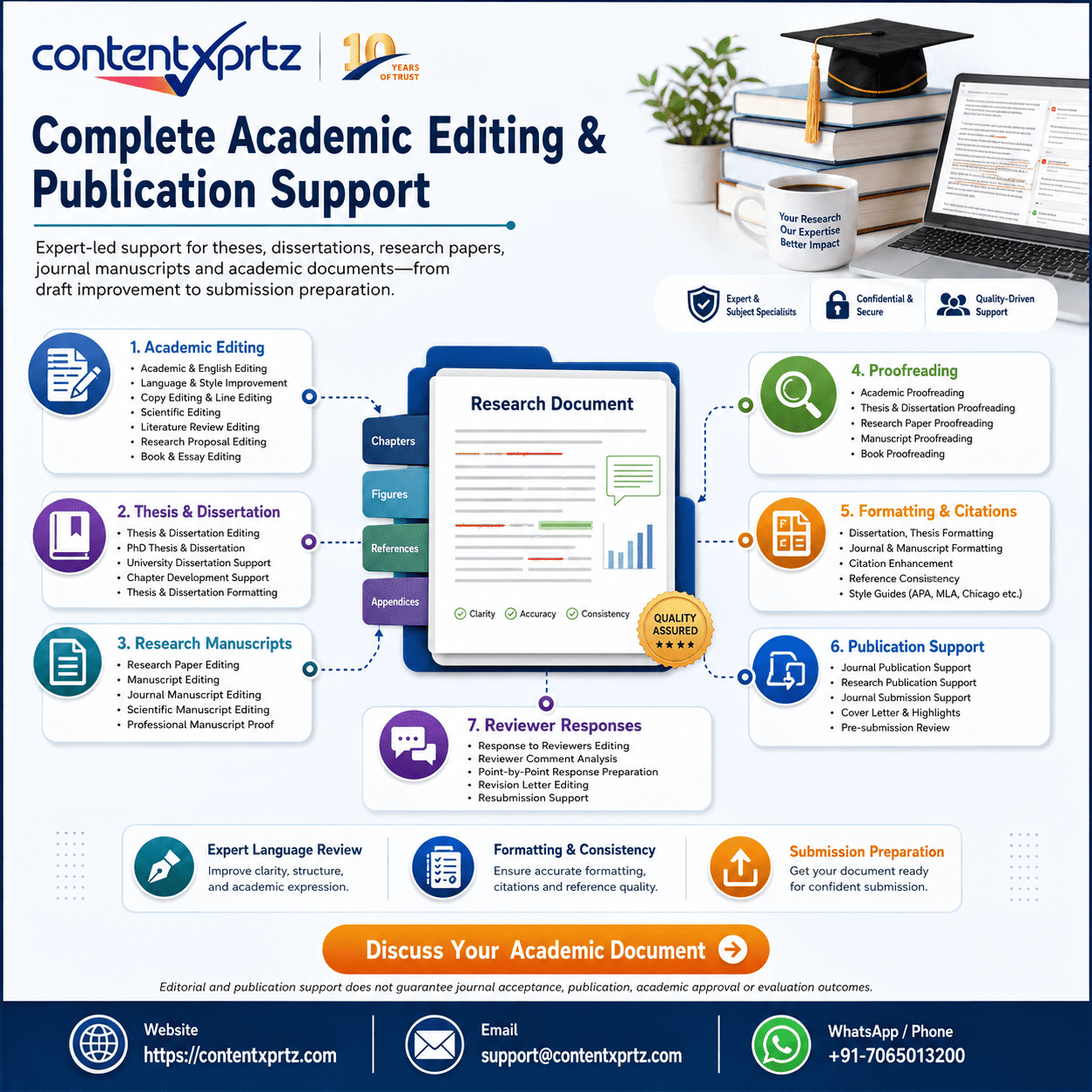
Professional editing is most useful when it improves the manuscript the author has actually created. For journal articles, that can include sentence-level clarity, logical flow, terminology consistency, reference alignment, journal formatting, cover-letter refinement, and reviewer-response editing. For book projects, it can include proposal clarity, chapter coherence, long-form consistency, language editing, and presentation of the scholarly argument.
Contentxprtz supports researchers with journal manuscript editing and related academic editing when those services match the project. Editing should preserve the author’s intellectual ownership. The author remains responsible for research design, data, interpretation, claims, references, permissions, ethical approvals, disclosure, and final submission decisions.
Preparing a Manuscript for Journal Submission?
Get focused editing support for clarity, structure, language, references, and journal-readiness without promises of guaranteed acceptance.
Summary: The Press and Journal in Academic Publishing
The press and journal represent two different scholarly publishing routes. Journals are built around article-level contributions; academic presses are commonly built around book-length projects. Both may use editors, external experts, revisions, ethical checks, and production workflows, but the submission package and the questions being evaluated are different.
Researchers make stronger publishing decisions when they begin with the scale of the contribution, the intended readers, and the standards of the specific venue. Self-service preparation may be enough when the manuscript is already clear and the author simply needs to follow formatting instructions. Expert editing can be useful when language, structure, reference consistency, proposal presentation, or reviewer responses need careful improvement. In either route, author responsibility remains central.
Questions About the Press and Journal in Academic Publishing
These answers address common decisions researchers face when comparing academic presses, scholarly journals, and publication preparation.
What does “the press and journal” mean in academic publishing?
In academic publishing, a press usually refers to a book-publishing organization, often a university press or scholarly publisher, while a journal is a serial publication that publishes individual research articles on a recurring schedule. The two routes overlap in scholarly standards but differ in manuscript scale, editorial workflow, review process, rights arrangements, and the way readers discover the work. Researchers should first decide whether their project is best suited to a book-length argument, an edited volume, or a journal article before preparing the submission.
What is the difference between an academic press and a scholarly journal?
An academic press primarily publishes books, monographs, textbooks, edited collections, and sometimes reference works, whereas a scholarly journal publishes individual articles within periodic issues or continuous online volumes. Press proposals are often assessed for the value of the entire book project and its audience, while journal submissions are evaluated as standalone articles against the journal’s scope, methods, contribution, and author guidelines.
Should I submit my research to a press or a journal?
Choose a journal when your research can be communicated as a focused article with a specific research question, method, result, or scholarly argument. Consider a press when the work needs book-length development, multiple chapters, a broad historical or theoretical arc, or an integrated treatment that cannot be compressed responsibly into one article. In some disciplines, a dissertation may eventually produce both journal articles and a substantially revised scholarly book, but the versions should be planned carefully to avoid duplicate publication concerns.
Do university presses use peer review?
Many university and scholarly presses use expert review, but the exact process varies by publisher, discipline, book type, and stage of the project. A proposal may first be screened by an acquisitions editor, followed by external review of sample chapters or a full manuscript, editorial-board consideration, and contract discussion. Authors should follow the press’s proposal and manuscript instructions rather than assume that journal-style peer review procedures apply unchanged.
How does journal peer review differ from book peer review?
Journal peer review usually evaluates one article against the journal’s aims, methodological expectations, originality, evidence, and contribution to a focused literature. Book review for a press considers a larger project, including chapter architecture, sustained argument, audience, comparable titles, market or course relevance where appropriate, and the manuscript’s contribution across the full work. Both may involve revisions, but the editorial questions and decision timeline are often different.
Can I publish a journal article and later use it in a book?
Sometimes, but authors must check the journal’s publishing agreement, copyright or license terms, and the press’s policy on previously published material. A book chapter that substantially reuses a journal article may require permission, acknowledgment, adaptation, or a different licensing approach. Authors should disclose prior publication to the press and avoid presenting substantially identical text as entirely new work.
How should I choose a reputable journal or academic press?
Start with scope, editorial fit, transparent author information, recognizable editorial contacts, clear peer-review or proposal-review procedures, publication ethics policies, and verifiable publication history. For journals, researchers can also consult resources such as the Directory of Open Access Journals and relevant indexing databases when applicable. For presses, examine the publisher’s catalog, subject lists, recent comparable books, distribution information, and proposal requirements. Avoid making a decision based only on unsolicited emails, rapid-acceptance promises, or vague claims about indexing and prestige.
What should I prepare before submitting to a journal?
Prepare a manuscript that follows the target journal’s author guidelines, including article type, word limit, structure, references, tables, figures, declarations, and anonymization rules where required. Confirm that the research question, contribution, method, evidence, and discussion are internally consistent. Then proofread carefully, verify citations, check permissions, and prepare any cover letter or reporting checklist requested by the journal.
What should I prepare before approaching an academic press?
A press commonly expects a book proposal or prospectus rather than an unsolicited final book sent without context. The proposal may include the project overview, argument, intended readership, chapter outline, comparable titles, manuscript status, author background, and sample material, although requirements vary. Researchers should study the acquisitions page for the relevant subject area and tailor the proposal to the press instead of sending a generic package to many editors.
How can Contentxprtz help with press or journal submission preparation?
Contentxprtz can support ethical manuscript editing, proofreading, structure review, citation and reference consistency, journal-format alignment, cover-letter refinement, reviewer-response editing, and publication-readiness checks when these services match the author’s needs. For book projects, support can also focus on proposal clarity, chapter coherence, language, and presentation. Authors remain responsible for the research, claims, data, permissions, citations, choice of publisher, and final submission decisions.
Choose the Publication Form That Serves the Research
The central problem behind the press-versus-journal decision is fit. A focused article should not be expanded simply to resemble a book, and a book-length argument should not be compressed until its evidence and logic become thin. The publication form should help readers evaluate the research fairly and understand its contribution.
For a well-prepared article, self-service submission can be enough when the author understands the target journal’s requirements and the manuscript is already clear, consistent, and ethically complete. A press proposal can likewise be prepared independently when the author can articulate the book’s argument, audience, chapter structure, and position in the scholarly literature. Expert-assisted academic editing or publication support becomes useful when language barriers, complex structure, inconsistent references, proposal positioning, or reviewer-response demands make the preparation process difficult.
Contentxprtz helps improve clarity, structure, language, ethics-aware presentation, and publication readiness while keeping the author in control of the research and final decisions. No editor can guarantee acceptance, publication, indexing, grading, or peer-review outcomes; those depend on the quality of the work, venue fit, editorial judgment, reviewer feedback, and the applicable academic standards.
“At Contentxprtz, we don’t just edit; we help ideas reach their fullest potential.”