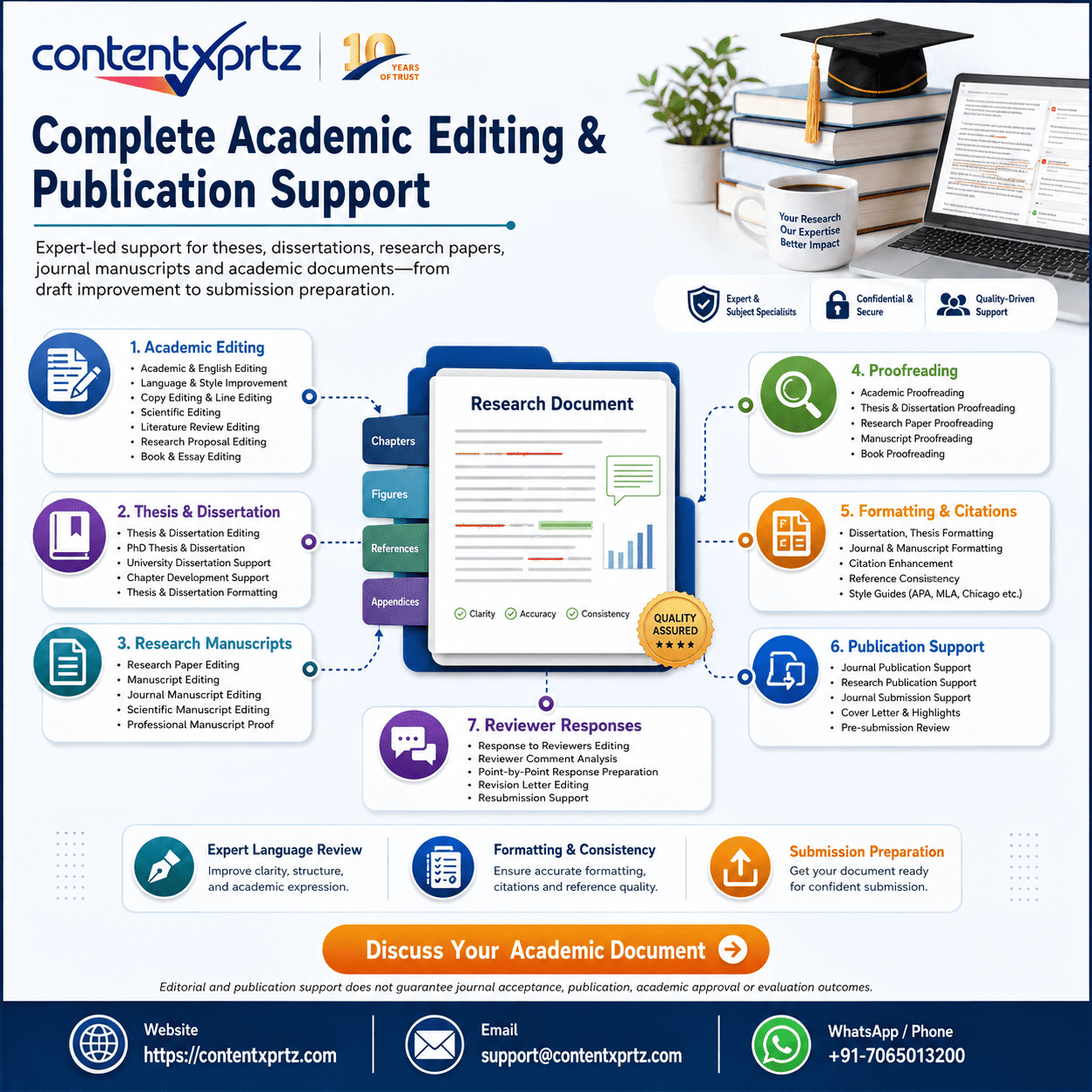
Why “The Journal” Becomes a High-Stakes Academic Decision
The journal is often the shorthand researchers use for the scholarly publication they are reading, targeting, submitting to, or waiting to hear from. That sounds simple until a real manuscript is involved. A PhD scholar may have a complete study but be unsure whether a journal’s scope truly matches the research. A first-time author may assume formatting is the main obstacle when the deeper issue is article type, audience, or the strength of the argument. An ESL researcher may have sound methods and useful findings but struggle to present them in clear academic English. A professional author may be deciding whether a journal is reputable, whether an invitation is credible, or what peer review will require after submission.
These decisions matter because journal publishing is not a single formatting exercise. It is a sequence of scholarly choices: identifying a suitable audience, understanding the publication’s aims and scope, preparing the manuscript around its instructions, checking citations and declarations, communicating the research clearly, submitting through the correct channel, and responding to editorial or reviewer feedback without compromising the evidence. Language, grammar, structure, citation accuracy, ethical editing, and journal-specific presentation all affect how easily editors and reviewers can understand what the research actually contributes.
Cost also enters the picture. Some journals charge no author fee, some have optional open-access routes, and some require article processing charges for specific publication models. A fee by itself does not establish quality or legitimacy. Authors should verify the publisher, peer-review process, policies, and fee information from official sources before making decisions. Likewise, free grammar or writing tools can be helpful for obvious sentence-level problems, but they do not reliably judge scope fit, methodological reporting, cautious interpretation, reference accuracy, or compliance with a target journal’s current author instructions.
The best approach is therefore practical and layered. First, define what the target journal publishes and who reads it. Next, compare your manuscript with recent work in that journal. Then check the author instructions, ethics policies, article type, reporting expectations, and submission files. Finally, review the manuscript for clarity and consistency at the level your paper actually needs. Contentxprtz can provide academic editing services and focused journal manuscript support when an author needs human review of language, structure, formatting, or submission readiness. The author, however, remains responsible for the research, data, claims, citations, authorship, and final submission.
Quick Answer: What Does “The Journal” Mean for a Researcher?
In academic publishing, the journal usually means the scholarly periodical that may publish your manuscript. The right journal is one whose aims, scope, readership, article types, methods, and editorial expectations align with the work you actually completed.
Your next step is not simply to “find a journal.” Shortlist credible journals, read recent articles, verify official author instructions and publication policies, compare practical requirements, and prepare the manuscript for the best-fitting option. If the paper is already academically sound but difficult to read or inconsistent with journal style, targeted manuscript editing or proofreading may help.
Key Takeaways
- A scholarly journal is a recurring academic publication; the best target is determined by research fit, not by a title, invitation, or metric alone.
- Read the journal’s aims and scope and several recent articles before spending time on detailed reformatting.
- Journal manuscript editing is broader than proofreading when clarity, flow, terminology, section coherence, or journal-specific presentation need attention.
- Authors should verify peer review, publisher identity, fees, ethics policies, editorial information, and indexing claims from reliable sources.
- Reviewer comments should be answered point by point with evidence and clear explanations; revision is a scholarly process, not a wording contest.
- AI and grammar tools can assist with limited language tasks, but authors must verify all changes and follow current journal and institutional policies.
- No ethical editor can guarantee publication or acceptance; outcomes depend on research quality, scope, methods, novelty, reviewers, and editorial judgment.
What This Page Covers
- What an academic journal is
- How to shortlist the right journal
- Journal credibility checks
- Manuscript readiness
- Submission steps
- Peer review and revision
Methodology and Academic Sources
This guide follows common academic manuscript preparation, peer-review, editing, and publication-readiness workflows. It also reflects the principle that journal requirements vary by discipline, publisher, article type, and editorial policy, so authors should always verify the current instructions on the target journal’s official website.
For publication ethics, authors can consult the Committee on Publication Ethics guidance. For authorship and reporting responsibilities in biomedical publishing, the ICMJE Recommendations are an important reference. Major publishers also maintain author resources, including Elsevier author guidance and Springer Nature author resources. These sources support the general workflow here but do not replace the specific rules of the journal you choose.
What “The Journal” Means in an Academic Context
An academic journal is a recurring scholarly publication that communicates research and expert analysis to a defined community. The phrase “the journal” can refer to the publication as a whole, its editorial process, or the specific journal selected for a manuscript. Understanding that distinction helps authors interpret instructions correctly.
Journal Scope
The topics, questions, disciplines, audiences, methods, and article types a journal intends to publish.
Journal Article
An individual scholarly work published within a journal, such as an original research paper, review, case report, or methods article.
Peer Review
Evaluation by independent subject experts who provide comments that inform editorial decisions. Models and procedures vary by journal.
Journal Manuscript Editing
Language and presentation support designed to improve clarity, consistency, academic tone, and journal readiness while preserving author meaning and responsibility.
A journal is therefore more than a website that accepts files. It is a publication community with an editorial purpose. A technically compliant paper can still be rejected if it falls outside scope or offers the wrong kind of contribution. Conversely, a manuscript with strong relevance may still struggle if its abstract is unclear, methods are poorly explained, the discussion overstates conclusions, or references and declarations are incomplete.
How to Choose the Right Journal for Your Manuscript
The most reliable journal-selection method starts with scholarly fit and then adds credibility and practical constraints. Avoid beginning with mass email invitations or a single journal metric. Start from your paper: what question does it answer, who needs the result, what kind of evidence does it provide, and what conversation does it join?
| Factor | What to Check | Why It Matters | Common Mistake |
|---|---|---|---|
| Aims and scope | Topics, audience, article types, disciplinary boundaries | Editors assess fit before detailed review | Choosing by journal title alone |
| Recent articles | Similar questions, methods, populations, debates | Shows the journal’s actual publishing pattern | Reading only the homepage description |
| Credibility | Publisher, editorial board, peer review, policies, fees, archives | Protects the integrity and visibility of the work | Trusting unsolicited invitations |
| Author requirements | Word limits, files, references, data, declarations, reporting standards | Prevents avoidable technical returns | Formatting before confirming article type |
| Access and cost | Subscription/open access model, APCs, waiver information | Affects budget and funder compliance | Assuming all fees are predatory or all no-fee journals are better |
| Assessment needs | Relevant indexing, institutional or funder rules, responsible metrics | May affect reporting or career requirements | Treating one metric as proof of fit or quality |
After building a shortlist, compare two or three journals using the same criteria. This reduces the temptation to rationalize a weak fit. You can also discuss the shortlist with coauthors, a supervisor, a subject librarian, or your research office.
Step-by-Step: Prepare a Manuscript for the Journal
Once you have selected the best-fitting journal, move from selection to submission readiness in a controlled order. Reformatting too early can waste time if the journal or article type changes, so resolve high-level fit before polishing details.
Step 1: Read the Current Author Instructions
Open the journal’s official author guidance and confirm the article type. Note word limits, abstract format, title-page requirements, figures, tables, supplementary data, reporting checklists, reference style, declaration statements, and file formats. Save or record the date you checked the instructions because journal policies can change.
Step 2: Compare Your Manuscript With Recent Articles
Read several recent papers in the same article category. Compare how they frame the research problem, structure abstracts, report methods, present results, qualify claims, and organize discussions. Do not imitate language; use the comparison to understand the journal’s scholarly conversation and reader expectations.
Step 3: Strengthen the Manuscript Before Surface Formatting
Confirm that the title reflects the study accurately, the abstract contains the essential information, the introduction leads to a clear research objective, methods are sufficiently transparent, results are separated from interpretation where appropriate, and conclusions do not exceed the evidence. If you need an external language review, professional editing for researchers can be useful at this stage because structural clarity and sentence-level polish can be addressed together.
Step 4: Verify Citations, References, and Research Statements
Check every in-text citation against the reference list and the original source. Confirm names, years, titles, journals, pages, identifiers, and the correct citation style. Never accept a reference suggested by an AI system or reference manager without verifying that the source exists and supports the claim you attach to it.
Step 5: Prepare Ethics and Submission Declarations
Depending on the study and journal, you may need statements about author contributions, conflicts of interest, funding, ethics approval, consent, data availability, preregistration, clinical trials, AI use, or acknowledgements. Follow the journal’s current requirements and your institution’s policy. In biomedical contexts, ICMJE guidance can help clarify authorship and disclosure expectations, but the target journal’s instructions control the actual submission.
Step 6: Run a Final Quality-Control Pass
Proofread the final version, verify table and figure callouts, check numbering, confirm abbreviations are defined consistently, compare manuscript files with submission-system metadata, and make sure a clean version is ready. If the document only needs surface correction, scholarly proofreading may be more appropriate than deeper editing.
Common Journal Submission Mistakes and How to Avoid Them
Most avoidable journal problems come from a mismatch between what the manuscript is and what the journal expects. Some mistakes are technical, but many begin earlier with scope, evidence, or communication.
| Problem | Why It Happens | Better Approach |
|---|---|---|
| Paper is outside scope | The title of the journal looked relevant | Read scope plus recent articles before formatting |
| Abstract feels generic | It describes the topic but not the study | State the problem, approach, key result, and cautious implication as appropriate |
| Claims are too strong | Authors try to make findings sound more important | Match causal or general claims to the actual design and evidence |
| References are inconsistent | Sources were added over many draft rounds | Verify each citation and reconcile the final list systematically |
| Journal invitation seems suspicious | Email creates urgency or flatters the author | Independently verify the journal, publisher, peer review, policies, and fees |
| Revision letter is hard to follow | Responses are written as one narrative | Answer reviewer comments point by point with manuscript locations |
When Free Tools Are Enough
Free spelling, grammar, reference-management, and checklist tools can be enough when the manuscript is already well structured, the journal fit is clear, and the remaining issues are mechanical. They are also useful for creating a first-pass list of possible inconsistencies that the author then verifies manually.
When Human Review Is Safer
Human academic editing is more useful when meaning is being lost in complex sentences, terminology varies across sections, an ESL author needs careful language support, reviewer responses must stay precise, or the manuscript needs a journal-specific clarity review. The key difference is judgment: a human editor can ask whether a change preserves the scientific meaning instead of merely improving grammatical smoothness.
Need a Careful Manuscript Readiness Review?
Contentxprtz can help improve journal-facing clarity, language, structure, and presentation while keeping the research decisions with the author.
What Happens After You Submit to the Journal?
Submission begins an editorial evaluation process; it does not guarantee external peer review or acceptance. The exact stages vary, but authors should be prepared for technical screening, editorial assessment, reviewer invitations, peer-review reports, revision decisions, and potentially more than one revision round.
At each stage, keep a clean record of manuscript versions, decision letters, response files, supplementary material, and correspondence. If the editor requests a revision, read the full decision before making changes. Separate comments into scientific, analytical, reporting, presentation, and editorial categories. Then work through them systematically.
Build a Point-by-Point Reviewer Response
Quote or identify each reviewer comment, explain the change, and give the manuscript location. If you disagree, explain why with evidence. Avoid dismissive phrases. A reviewer may be mistaken, but the fact that the reader misunderstood something can still reveal a clarity problem worth fixing.
Re-read the Whole Paper After Revision
Local changes can create new inconsistencies. A revised method may require a change to the abstract; a new limitation may affect the conclusion; a terminology change may need to appear in tables and figures. After the response is complete, read the manuscript as one document again before resubmission.
Journal Publishing, Ethical Editing, and Author Responsibility
Ethical academic support improves communication without replacing authorship. Authors must remain responsible for the study design, data, analysis, claims, citations, contributor decisions, disclosures, and final submission. Editing should make the author’s work clearer; it should not fabricate, conceal, or strategically distort the research.
What Responsible Editing Can Do
- Improve grammar, syntax, academic tone, and readability while preserving technical meaning.
- Flag unclear logic, inconsistent terminology, weak transitions, or places that need author clarification.
- Check journal formatting, headings, reference consistency, tables, figures, and required declarations.
- Help organize a reviewer-response letter so the author’s reasoning is transparent and easy to follow.
- Identify statements that appear stronger than the evidence so the author can reassess them.
What Responsible Editing Should Not Do
An editor should not invent references, create data, rewrite results to change their meaning, impersonate an author, guarantee acceptance, or hide plagiarism through superficial paraphrasing. Where AI tools are involved, authors should check the target journal’s policy and verify the output carefully. Publisher rules on AI use, disclosure, and confidentiality are evolving, so current journal guidance matters more than generic assumptions.
Practical Examples: How Researchers Make Better Journal Decisions
A First-Time Researcher Chooses by Impact Factor Alone
Situation: A researcher with a narrow regional public-health study targets a broad international journal because its metric is high. Confusion: the author assumes prestige automatically means fit. Better approach: compare scope, study populations, article types, and recent papers across several credible journals. A specialized journal may reach the relevant readership more directly. Expert help: a manuscript assessment can flag whether the abstract, framing, and discussion are aligned with the chosen audience, but the author should make the final journal decision.
An ESL Author Has Strong Data but Dense Writing
Situation: The methods and results are sound, but long sentences make the argument difficult to follow. Confusion: grammar software marks few errors, so the author assumes the manuscript is ready. Better approach: review paragraph logic, sentence structure, terminology, abstract clarity, and cautious interpretation. Expert help: journal manuscript editing can improve readability while preserving meaning, especially when the editor raises queries rather than silently changing technical claims.
A Researcher Receives Major Revision
Situation: Reviewer comments include new analysis requests, unclear wording, and questions about limitations. Confusion: the author replies emotionally and changes every sentence the reviewers mention. Better approach: separate substantive and presentation issues, decide which changes are justified, and respond point by point with evidence. Expert help: reviewer-response support can improve organization and clarity, while the authors retain responsibility for analytical choices and scientific arguments.
Academic Journal Readiness Checklist
Use this checklist as a final control after the journal has been selected. It is designed to catch mismatches that are easy to miss when authors focus only on formatting.
Journal Fit
- The manuscript topic matches the journal’s aims and scope.
- The article type is explicitly accepted.
- You read recent related articles and understand the target audience.
- You independently verified the journal’s official site, publisher, policies, and fee information.
Manuscript Quality
- The title and abstract accurately represent the study.
- The research objective is clear and the methods support the claims.
- Results and conclusions are consistent with the evidence.
- Language, terminology, figures, tables, and abbreviations are consistent.
- Every citation and reference has been verified against the source.
Submission Package
- All required files and declarations are prepared.
- Author names, affiliations, contributions, and contact details are accurate.
- Ethics, consent, funding, conflicts, data, and AI-use statements are included where required.
- Submission-system metadata matches the manuscript.
- All authors have reviewed and approved the version being submitted.
How Contentxprtz Can Help With Journal Manuscript Readiness
Contentxprtz supports researchers who need help communicating their work clearly before or after journal submission. The most relevant support for this topic is journal manuscript editing and publication support, including language polishing, clarity review, consistency checks, journal formatting, and reviewer-response presentation where appropriate.
For a manuscript that needs evaluation beyond sentence-level language, manuscript assessment can help identify presentation and readiness issues for the author to address. The service should be selected according to the actual problem: proofreading for surface accuracy, editing for deeper language and coherence, and publication support for journal-facing preparation. None of these replaces the author’s responsibility or guarantees an editorial outcome.
Prepare the Manuscript for the Right Reader
Get focused help with language, structure, consistency, and journal-facing presentation without outsourcing the scholarly decisions that belong to you.
Summary: The Journal and Your Publication Decision
The journal is the scholarly publication you are trying to understand, read, target, or submit to. Choosing it well requires more than finding a familiar title or attractive metric. Start with research fit, verify credibility, read current author instructions, compare recent articles, and prepare the manuscript around the journal’s real audience and requirements.
Free tools are useful for mechanical checks when the manuscript is already strong. Human academic editing becomes more valuable when clarity, ESL language, terminology, structure, reviewer responses, or journal-specific presentation require judgment. In every case, authors remain responsible for their research, references, disclosures, and final submission, while editors and tools should support rather than replace that responsibility.
Questions About The Journal, Manuscript Preparation, and Submission
These answers cover the questions researchers most often need to resolve before journal selection, submission, peer review, and ethical editing.
What does “the journal” mean in academic research?
In academic research, “the journal” usually means the scholarly journal that publishes research in a defined field, although the phrase can also refer to a journal article or to a publication a researcher is targeting. A scholarly journal is a recurring publication that contains research articles, reviews, editorials, methods papers, case reports, or other discipline-specific content. Many journals use peer review, in which independent experts evaluate a manuscript before an editorial decision is made.
For a researcher, the practical meaning depends on context. If a supervisor says “choose the journal,” they normally mean select an appropriate publication outlet. If a coauthor says “check the journal guidelines,” they mean the journal’s instructions for authors, scope, article types, formatting, ethics, data, and submission requirements. If someone asks whether “the journal accepted the paper,” the phrase refers to the editorial organization and decision process. The safest approach is to identify the journal by its full title and verify its official website, scope, publisher, editorial information, and author instructions before preparing or submitting a manuscript.
How do I choose the right journal for my research paper?
Choose a journal by matching your manuscript’s subject, research question, article type, audience, methodological fit, and contribution to the journal’s stated aims and scope. Start with journals that publish work similar to yours, then read several recent articles to see whether your topic and approach belong there. Check the accepted article types, word limits, reference style, data or reporting requirements, open-access options, fees, and expected submission materials.
Do not choose only by a single metric or by the fastest promised decision. A strong match between manuscript and journal matters more than superficial prestige. Also verify that the journal is transparent about peer review, editorial leadership, publisher identity, fees, and publication ethics. The Committee on Publication Ethics provides useful principles for responsible scholarly publishing, while major publishers provide author guidance on journal selection and manuscript preparation. If you are comparing several legitimate journals, create a short fit matrix covering scope, audience, article type, practical requirements, and your reasons for choosing each one. That makes the final decision more evidence-based and easier to discuss with coauthors or supervisors.
What should I check before submitting to the journal?
Before submitting to the journal, confirm that the manuscript fits the journal’s aims and scope and that you are using the current instructions for authors. Check the article type, title-page requirements, abstract structure, keyword limits, word count, headings, figure and table rules, reference style, supplementary files, reporting checklists, data statements, conflict-of-interest declarations, funding information, author contributions, and any required cover letter.
Then perform a content-level review. Make sure the research question is clear, the methods are described well enough for the discipline, the results support the conclusions, and the discussion does not overstate what the study proves. Verify every citation and reference against the source. Confirm that all listed authors meet the journal’s authorship expectations and that everyone has approved the final version. Finally, review language, consistency, file names, and submission-system fields. A technically correct upload cannot compensate for a manuscript that is outside scope or unclear. Conversely, a strong manuscript can be delayed unnecessarily when required declarations or files are missing. Treat the journal checklist as a submission control, not as a last-minute formatting chore.
Is journal manuscript editing the same as proofreading?
No. Journal manuscript editing and proofreading overlap, but they address different levels of a document. Proofreading focuses mainly on surface errors such as grammar, spelling, punctuation, typographical problems, basic consistency, and formatting slips. It is most useful when the argument, organization, and scholarly presentation are already stable.
Journal manuscript editing can go further. Depending on the service and the author’s needs, it may improve sentence clarity, paragraph flow, academic tone, terminology consistency, transitions, abstract readability, alignment between sections, and compliance with journal style while preserving the author’s meaning. A deeper review may also flag unclear logic, unsupported transitions, missing definitions, inconsistent terminology, or places where claims appear stronger than the evidence. Ethical editing should not invent data, rewrite results to change the research meaning, fabricate references, or take over authorship decisions. Authors remain responsible for the research, interpretations, citations, and final submission. When choosing support, ask what level of editing is included and whether the editor will distinguish language corrections from substantive scholarly queries.
How can I tell whether a journal is legitimate or potentially predatory?
Evaluate the journal using multiple signals rather than one directory, badge, email, or metric. Start from the journal’s official site and check whether the publisher, editorial board, peer-review process, contact information, author fees, copyright terms, archiving arrangements, and ethics policies are clearly stated. Look at recent articles: do they fit the stated scope, identify authors and affiliations, use credible references, and show normal editorial quality? Search for the journal through recognized indexing or library resources relevant to your field, but remember that indexing status can change and should be verified directly.
Be cautious when a journal sends aggressive invitations unrelated to your expertise, guarantees acceptance, hides fees until late in the process, claims implausibly fast peer review, uses misleadingly similar titles, or lists editorial-board members without clear evidence. COPE’s guidance and the cross-sector Think. Check. Submit. initiative offer practical evaluation questions. If you are uncertain, ask a subject librarian, supervisor, research office, or experienced colleague to review the evidence. The goal is not to label a journal based on appearance alone, but to verify transparent scholarly practices before sharing a manuscript or paying a fee.
Does a high-impact journal automatically mean it is the best journal for my paper?
No. A high-impact journal can be influential in its field, but it is not automatically the best destination for every manuscript. Journal-level citation indicators describe patterns across a publication; they do not guarantee the quality, relevance, or future citation performance of an individual article. A manuscript that fits a specialized journal closely may reach the right readers more effectively than one submitted to a broader journal with a stronger headline metric.
Evaluate fit first: topic, audience, article type, methods, novelty expectations, geographic or disciplinary scope, and the kinds of claims the journal publishes. Then consider practical factors such as access model, publication fees, review process, editorial policies, data requirements, and funder or institutional obligations. You may also consider reputation and indexing where these are genuinely relevant to your career or reporting needs. A sensible journal-selection decision combines scholarly fit and practical constraints rather than chasing one number. If your institution uses metrics in evaluation, check its policy and use metrics responsibly, because responsible research assessment discourages using journal-level indicators as a substitute for reading and evaluating the actual research.
What happens after I submit a manuscript to the journal?
After submission, the manuscript usually passes through several editorial stages, although the exact workflow varies by journal. The submission system first records your files and metadata. Editorial staff or an editor may conduct technical checks for completeness, file format, declarations, ethics documentation, and basic compliance. The editor then assesses whether the manuscript fits the journal’s scope and threshold for further consideration. Some manuscripts are declined at this stage without external peer review.
If the paper proceeds, the editor may invite peer reviewers with relevant expertise. Reviewers evaluate aspects such as importance, methods, analysis, interpretation, clarity, and literature context, then provide comments and recommendations. The editor uses those reports along with independent judgment to decide whether to reject, invite revision, or in some cases accept. A revision request is not an acceptance promise; authors normally need to respond point by point and show where changes were made. Further review rounds may follow. Throughout the process, keep version control, preserve reviewer correspondence, avoid changing data or claims merely to appease a comment without scholarly justification, and explain respectfully when you do not adopt a suggestion.
How should I respond to reviewer comments from the journal?
Respond to reviewer comments systematically, respectfully, and with evidence. Create a point-by-point response document that reproduces or clearly identifies each comment, explains what you changed, and gives the exact location in the revised manuscript. When a reviewer identifies a genuine problem, acknowledge it directly and revise the paper. When you disagree, explain the scholarly reason calmly and support it with methods, data, literature, or scope rather than defensive language.
Keep the response easy for the editor and reviewers to follow. Distinguish major scientific changes from language edits, and make sure the revised manuscript actually matches what the response letter claims. If two reviewers give conflicting advice, do not try to satisfy both blindly. Explain the conflict, state the approach you chose, and show why it better fits the evidence or study design. Also check whether the journal asks for tracked changes, highlighted revisions, clean files, or a specific response format. Ethical reviewer-response support can help authors improve clarity and organization, but the authors must make and approve the substantive decisions because they remain responsible for the research and final claims.
Can AI or grammar tools prepare my article for the journal?
AI and grammar tools can assist with limited tasks, but they should not be treated as a substitute for author judgment, subject expertise, or journal-specific review. They can help detect spelling problems, awkward sentences, repetition, or basic consistency issues. However, automated systems can misunderstand technical meaning, flatten disciplinary nuance, alter cautious claims, introduce inaccurate phrasing, or generate references and factual statements that do not exist.
If you use an AI-assisted tool, verify every suggested change against your data, sources, and intended meaning. Check the target journal’s current policy on generative AI, disclosure, confidentiality, and authorship because policies vary across publishers and may change. Never upload confidential, unpublished, personal, or sensitive research material to a tool unless your institution and the tool’s terms permit it. Authors remain accountable for the final text and all citations. Human academic editing can be especially useful when the problem is not just grammar but argument flow, scholarly tone, section coherence, terminology, or journal-specific presentation. The safest workflow treats technology as an aid and keeps a qualified human author in control.
When should I use professional journal manuscript editing support?
Professional journal manuscript editing is most useful when the research is complete enough to evaluate as a manuscript but the presentation is limiting readability or submission readiness. Common situations include an ESL author who wants to preserve technical meaning while improving academic English, a first-time researcher who is unsure whether the abstract and discussion are clear, a multidisciplinary paper with inconsistent terminology, or a revised manuscript that needs careful alignment with reviewer comments and journal instructions.
Before engaging an editor, decide what you need: proofreading, language editing, substantive clarity review, formatting, reference consistency, manuscript assessment, or reviewer-response support. Share the target journal’s instructions and explain any institutional limits on external editing. A responsible editor should preserve your authorship, flag uncertainties instead of inventing solutions, and avoid guarantees of acceptance or publication. Contentxprtz provides journal manuscript editing and publication support where the need is genuinely related to language, structure, formatting, or submission preparation. The author should still verify every change, approve the final manuscript, and retain full responsibility for the research, data, claims, citations, declarations, and submission decisions.
Choose the Journal Deliberately, Then Prepare the Manuscript for It
The practical challenge behind “the journal” is not simply knowing what a scholarly journal is. Researchers need to identify a publication that genuinely fits the work, verify that it is credible, understand its author requirements, and present the manuscript so editors and reviewers can judge the research without being distracted by avoidable language or submission problems.
Self-service tools can be enough when the manuscript is already coherent and the remaining work is basic proofreading, reference management, or checklist verification. Expert-assisted editing is safer when the paper needs deeper clarity, ESL language support, structural consistency, journal-specific formatting, or a carefully organized response to reviewer comments. Contentxprtz helps improve clarity, structure, ethics, and publication readiness while keeping the author in control of scholarly decisions.
Academic integrity remains central throughout the process. Authors should verify sources, protect confidential research, follow journal and institutional policies, disclose what is required, and accept responsibility for the final text, data, claims, citations, and submission. Publication outcomes depend on research quality, scope, methodology, novelty, reviewer comments, and editorial judgment—not on editing alone.
“At Contentxprtz, we don’t just edit; we help ideas reach their fullest potential.”