Why Scholarly Journal Articles Matter to Researchers
Scholarly journal articles are one of the main ways researchers communicate original findings, critical analyses, methods, reviews, and evidence-based arguments to other specialists. If you are a postgraduate student, PhD scholar, early-career researcher, or first-time academic author, learning how these articles work helps you do two different jobs better: read research critically and write manuscripts that fit scholarly expectations.
The phrase can sound simple, but it covers several article types and several stages of quality control. An original research article may report a study with a methods section, results, and discussion. A review article may synthesize prior literature. A theoretical or conceptual article may develop or challenge an explanatory framework. Some journals also publish brief reports, case reports, methods papers, perspectives, registered reports, data papers, or replication studies. The target journal determines what forms it accepts and how each should be organized.
For readers, the important question is not merely whether an article appears in a journal. You need to ask who published it, whether the journal uses a transparent editorial process, what evidence supports the claims, whether the methods are appropriate, whether limitations are acknowledged, and whether citations are authentic and relevant. Peer review can improve a manuscript, but it does not make every published statement automatically correct. Critical reading remains essential.
For authors, publication pressure can make the process feel fragmented: choose a journal, shape the research question, write a title and abstract, organize the manuscript, format references, respond to reviewers, and check ethical requirements. These tasks are connected. A manuscript becomes easier to evaluate when its argument, methods, evidence, limitations, and contribution are presented coherently from the beginning.
Language quality matters too, especially for researchers writing in an additional language. Clear academic English can help editors and reviewers focus on the research rather than deciphering sentences. However, ethical academic editing services should improve clarity, consistency, grammar, and presentation without inventing findings, changing data, or replacing the author’s intellectual responsibility.
This guide therefore treats scholarly journal articles as both reading objects and publication documents. It explains what they are, how to recognize their parts, how to judge their reliability, how to prepare one for submission, and where professional manuscript editing or journal publication support may be useful without promising an outcome that ultimately depends on research quality, journal scope, editorial judgment, and peer review.
Quick Answer: What Are Scholarly Journal Articles?
Scholarly journal articles are formal publications written by researchers or subject specialists to communicate research, analysis, theory, methods, or evidence to an academic audience. They normally include citations to prior scholarship, follow the conventions of a discipline, and are published in journals with an editorial review process; many research journals also use peer review.
When reading one, evaluate the research question, evidence, methods, limitations, references, authorship information, journal context, and whether the conclusions match the results. When writing one, start with the target journal’s author instructions and make sure the manuscript’s contribution, structure, reporting, citations, ethical disclosures, and language all align with that journal.
The safest next step is to treat peer review and publication as quality-control stages rather than guarantees of truth. Authors remain responsible for the accuracy of their work, while editors and reviewers assess fit, rigor, clarity, and contribution.
Key Takeaways
- Scholarly journal articles communicate research or expert analysis using discipline-specific evidence, citations, and academic conventions.
- Not every journal article is an original research paper; common forms include research articles, reviews, methods papers, case reports, perspectives, and brief communications.
- Peer review is an important editorial process, but readers should still evaluate methods, evidence, conflicts of interest, limitations, and the strength of conclusions.
- Authors should choose a target journal before final formatting because structure, word limits, reporting rules, reference style, and submission requirements vary.
- A strong manuscript makes the research question, contribution, methods, results, limitations, and relationship to prior literature easy to follow.
- Ethical editing can improve clarity and presentation, but the author must retain responsibility for ideas, data, analysis, citations, and the final submitted version.
What This Page Covers
- Meaning and features of scholarly articles
- Common journal article types
- How to read and evaluate credibility
- Typical manuscript structure
- Submission and peer-review preparation
- Ethics, authorship, citations, and editing
Methodology and Academic Sources
This guide is based on common scholarly writing, manuscript editing, peer-review, and publication-readiness workflows. Because conventions differ across disciplines and journals, the target journal’s current author instructions should always take priority over general advice.
For publication ethics and authorship, researchers can consult the ICMJE recommendations on roles and responsibilities, especially where biomedical standards are relevant. For manuscript preparation, publisher education resources such as Elsevier Researcher Academy’s manuscript preparation guidance and Springer Nature’s article publishing guide illustrate common submission-stage expectations.
What “Scholarly Journal Articles” Means in Academic Context
A scholarly journal article is a formal contribution to an academic or professional literature. Its defining characteristics are usually the purpose of advancing or synthesizing knowledge, an identifiable author or author group, engagement with prior scholarship through citations, a structured argument or research report, and publication within a journal that has editorial policies and quality-control procedures.
That definition is broader than “peer-reviewed research paper.” Many scholarly journals publish content that is not an original empirical study, and not every item in a peer-reviewed journal undergoes the same form of external review. Editorials, letters, book reviews, corrections, commentaries, and news-like front matter may follow different processes. When your assignment or literature review requires “peer-reviewed scholarly articles,” verify the article type rather than relying only on the journal title.
Original research article
Reports a research question, methods, data or evidence, results, interpretation, limitations, and contribution to the field.
Review article
Synthesizes existing studies. Systematic reviews usually use explicit search and selection methods; narrative reviews may be broader and more interpretive.
Methods or protocol article
Explains a research method, technical procedure, protocol, instrument, or study design in sufficient detail for evaluation and use.
Perspective or conceptual article
Develops an argument, theoretical interpretation, framework, or expert viewpoint grounded in relevant scholarly literature.
Scholarly articles also differ from popular articles. A newspaper or magazine article may summarize research for a general audience, while a scholarly article normally gives readers enough detail to examine the reasoning, evidence, sources, and methods directly. That does not mean academic writing should be unnecessarily complicated. Strong scholarly writing is precise, transparent, and readable.
| Source type | Primary purpose | Typical evidence | Editorial review | Best use in research |
|---|---|---|---|---|
| Original scholarly article | Report new research | Methods, data, analysis, references | Often peer reviewed | Primary evidence and current research findings |
| Scholarly review article | Synthesize a body of research | Published studies and structured interpretation | Often peer reviewed | Understanding themes, debates, gaps, and evidence patterns |
| Professional or trade article | Inform practitioners | Practice examples, industry data, expert commentary | Usually editorial | Professional context and applied developments |
| Popular media article | Explain or report for general readers | Interviews, summaries, public information | Editorial, not scholarly peer review | Context, public communication, recent events |
The distinctions matter because the right source depends on the question. A literature review usually needs direct engagement with scholarly research, while a public-facing discussion may also use policy documents, datasets, or reputable journalism for context.
Which Types of Scholarly Journal Articles Should You Use or Write?
The right article type depends on the research objective, available evidence, disciplinary convention, and target journal. Before reading deeply or drafting a manuscript, identify what kind of contribution the article is trying to make.
Original empirical research
Use original research articles when you need evidence generated through a defined study. In quantitative research, this may involve datasets, experiments, surveys, or statistical models. In qualitative research, it may involve interviews, observations, documents, fieldwork, or interpretive analysis. Mixed-methods papers combine approaches when the question requires them.
Review and evidence-synthesis articles
Review articles help readers understand what a body of literature collectively shows. A systematic review uses explicit eligibility criteria and a documented search and selection process. A scoping review maps the breadth and characteristics of evidence. A meta-analysis statistically combines compatible quantitative results. Narrative or integrative reviews may offer broader conceptual synthesis but should still explain how literature was selected and interpreted.
Conceptual, theoretical, and perspective papers
These articles contribute through reasoning rather than a new dataset. Their strength depends on conceptual clarity, engagement with relevant literature, coherent argumentation, and the usefulness of the proposed framework or interpretation.
Methods, data, protocols, and replication studies
Methods papers explain tools or procedures; data papers document valuable datasets; protocol papers describe planned research; replication studies test whether prior findings can be reproduced under comparable conditions. Their structures vary substantially, so journal-specific instructions are especially important.
How to Read and Evaluate Scholarly Journal Articles Step by Step
Critical reading is easier when you separate relevance, credibility, method, evidence, and interpretation instead of trying to judge the entire paper at once.
- Start with the research question and purpose. Read the title, abstract, introduction, and stated aims. Ask what problem the authors are addressing and whether the article is relevant to your own question.
- Identify the article type and study design. An experiment, cohort study, qualitative interview study, systematic review, and conceptual paper require different criteria. Do not criticize a paper for lacking a feature that its design does not require.
- Examine the methods before trusting the conclusion. Look at sampling, measurement, data sources, procedures, analysis, inclusion criteria, comparison groups, and any reporting guideline relevant to the field.
- Read the results independently of the discussion. Distinguish what the data show from how the authors interpret them. Check tables and figures, uncertainty measures, effect sizes, themes, quotations, or other evidence appropriate to the design.
- Compare conclusions with the actual evidence. Strong claims should be supported by the study design and findings. Watch for causal language in observational research, overgeneralization from narrow samples, or conclusions that ignore uncertainty.
- Check limitations, transparency, and disclosures. Look for limitations, ethics approval where relevant, funding, conflicts of interest, data availability, protocol registration, and author contributions when provided.
- Trace important references. For a claim central to your own work, open the cited source rather than repeating a second-hand interpretation. Confirm that the reference actually supports the statement.
- Place the article within a body of evidence. One paper rarely settles a complex question. Compare it with other studies, reviews, guidelines, or replications and note where findings agree or conflict.
A practical credibility test
| Area | Question | Why it matters |
|---|---|---|
| Journal and article | Is the journal identifiable, transparent, and appropriate to the topic? | Helps distinguish genuine scholarly publishing from misleading or poorly governed outlets. |
| Research question | Is the question clear and answerable with the chosen design? | Weak alignment between question and design undermines interpretation. |
| Methods | Can you understand how evidence was collected and analyzed? | Transparency supports evaluation and, where relevant, reproducibility. |
| Results | Do the data, tables, figures, or themes support the reported findings? | Prevents relying only on persuasive discussion language. |
| Limitations | Are important weaknesses and uncertainty acknowledged? | Shows the boundaries of what the study can reasonably claim. |
| Citations | Are key claims connected to relevant, traceable sources? | Supports scholarly accountability and further verification. |
Common Mistakes When Using Scholarly Journal Articles
Most problems come from treating “published” as a substitute for evaluation. A scholarly appearance is useful, but it is not enough on its own.
Mistake 1: Assuming peer reviewed means unquestionably true
Peer review can identify weaknesses, improve reporting, and help editors judge fit and rigor. It cannot eliminate all errors, methodological limitations, disputed interpretations, or later corrections. Read the article as evidence to evaluate, not as an authority to obey.
Mistake 2: Citing the abstract without reading the paper
Abstracts compress complex methods and findings. They may omit limitations, subgroup results, uncertainty, or important conditions. If a claim matters to your argument, inspect the full article and cite the point in context.
Mistake 3: Using review articles when primary evidence is required
Reviews are excellent for mapping a field, but assignments, systematic reviews, and research discussions may require direct examination of original studies. Use a review to discover key literature, then retrieve and evaluate the primary sources where appropriate.
Mistake 4: Confusing journal prestige with study quality
A journal’s reputation or citation metrics do not replace article-level appraisal. Evaluate the actual study. Conversely, a specialist journal with a narrower audience may publish highly relevant work for your question.
Mistake 5: Ignoring retractions, corrections, or expressions of concern
Before relying heavily on a paper, especially an older or controversial one, check the journal page and bibliographic record for post-publication notices. If a correction changes an important result, use the corrected version and explain the issue where necessary.
How to Prepare a Scholarly Journal Article for Submission
A publication-ready manuscript begins with alignment: the research question, article type, journal scope, reporting structure, and ethical requirements must fit one another.
1. Choose the target journal before final drafting
Read the journal’s aims and scope, recent articles, accepted article types, word limits, reference style, figure requirements, data policies, and submission checklist. A strong paper can still be unsuitable for a journal if the topic or article type falls outside scope.
2. Make the contribution explicit
Editors need to understand what is new, useful, or clarifying about the manuscript. State the problem, gap, question, and contribution accurately. Avoid exaggerated novelty claims. A modest but well-supported contribution is stronger than an inflated claim the evidence cannot sustain.
3. Build a structure that matches the study
Many empirical papers use an Introduction–Methods–Results–Discussion pattern, often called IMRaD, but this is not universal. Humanities articles may use thematic argument sections. Qualitative papers may integrate findings and interpretation differently. Reviews have their own reporting conventions. Follow disciplinary and journal expectations rather than forcing every manuscript into the same shape.
4. Write the abstract after the main argument is stable
The abstract should accurately represent the manuscript: background or problem, objective, methods or approach, key findings, and main conclusion where the journal format permits. Do not introduce claims or results that do not appear in the paper.
5. Audit tables, figures, references, and supplementary files
Check that every table and figure is cited in the text, labels are consistent, abbreviations are defined, permissions are handled where necessary, and reference entries match in-text citations. Verify identifiers such as DOIs against authoritative records rather than guessing them.
6. Conduct a language and logic edit
Editing should move beyond spelling. Check paragraph purpose, transitions, terminology, tense, unnecessary repetition, ambiguous pronouns, unsupported statements, and whether the discussion separates findings from speculation. Researchers who want an independent language and presentation review may use professional editing for researchers or a focused journal manuscript editing service.
7. Complete ethical and disclosure requirements
Confirm authorship, acknowledgements, conflicts of interest, funding, ethics approval or consent statements where applicable, data availability, trial or protocol registration where required, and any journal policy on AI-assisted tools. Authors remain accountable for the submitted content.
Publication Ethics, Authorship, and Author Responsibility
Ethical scholarly publishing requires transparent responsibility for the work. Editing, software, statistical consultation, translation, and other support can assist authors, but they do not remove the authors’ duty to understand and stand behind the manuscript.
Authorship is more than name placement
Authorship generally carries both credit and accountability. In fields that follow ICMJE-style standards, authorship is tied to substantive contribution, critical drafting or revision, approval of the final version, and accountability for the work. Practices vary by discipline, so research teams should agree roles early and follow the target journal’s policy.
Editing should not become hidden authorship
Language editing may correct grammar, improve sentence clarity, reduce repetition, strengthen transitions, and apply a style guide. More substantive editing may identify logical gaps or suggest reorganizing material. The author should decide whether to accept those changes and must verify that revisions preserve the intended meaning and evidence. Where a journal requires disclosure of editorial or AI assistance, disclose it accurately.
Citations must be verified
Reference managers save time but do not guarantee bibliographic accuracy. Check authors, year, title, journal, volume, pages or article number, DOI, and the actual relationship between source and claim. AI-generated references can be fabricated or mismatched, so they require direct verification before inclusion.
Peer review should be answered transparently
A reviewer response is not a contest. Prepare a point-by-point document, quote or summarize each comment, state what changed, identify the manuscript location, and explain respectfully when you do not adopt a suggestion. If revisions affect analysis or interpretation, ensure the abstract and conclusion remain consistent. Authors needing help with language and response organization can consider contextual journal publication support while retaining full control over scientific decisions.
Practical Examples: How Researchers Use and Prepare Scholarly Articles
Turning a thesis chapter into a journal article
Situation: A doctoral researcher has a 12,000-word thesis chapter and assumes it can be submitted unchanged.
Common mistake: The chapter contains extensive background and thesis-specific signposting but does not clearly frame a standalone journal contribution.
Better approach: Select one focused research question, identify a suitable journal, rewrite the introduction around the article-level gap, compress methods to the necessary detail, foreground the key results, and reshape the discussion around the journal audience.
Ethical support: An editor can help with compression, organization, language, and consistency while the researcher controls claims, data, and interpretation.
Improving language without changing scientific meaning
Situation: A researcher has sound analyses, but reviewers repeatedly describe the manuscript as difficult to follow.
Common mistake: The author tries to make the paper sound “more academic” by adding longer sentences and technical words.
Better approach: Shorten overloaded sentences, define terminology once, use consistent labels, make paragraph purposes explicit, and distinguish results from interpretation.
Ethical support: Scholarly proofreading or manuscript editing can improve readability without adding data or inventing arguments.
Using a highly cited article carefully
Situation: A student finds a famous paper cited hundreds of times and assumes its conclusion is settled fact.
Common mistake: The paper is cited without checking its design, limitations, or subsequent research.
Better approach: Read the methods and results, check later replications and reviews, note any corrections, and explain how the study fits within the broader evidence base.
Ethical support: Research support can help organize sources and citation consistency, but evaluation of evidence remains the researcher’s responsibility.
Scholarly Journal Article Readiness Checklist
Before you submit a manuscript
- The target journal’s scope and accepted article type match the manuscript.
- The research question, purpose, and contribution are explicit and proportionate to the evidence.
- The manuscript structure follows disciplinary and journal requirements.
- Methods are described transparently enough for readers to evaluate the work.
- Results and discussion are clearly distinguished, and conclusions do not overstate findings.
- Limitations and uncertainty are acknowledged where relevant.
- Every citation has been checked against an authentic, traceable source.
- Tables, figures, captions, supplementary files, and in-text references are consistent.
- Authorship, funding, conflicts, ethics, data availability, and other required disclosures are complete.
- Language, terminology, abbreviations, tense, grammar, and formatting have received a final consistency review.
- The title and abstract accurately reflect the manuscript and do not make claims beyond the paper.
- All authors have reviewed and approved the version intended for submission.
If the manuscript is conceptually sound but language or presentation problems make it hard to assess, a focused manuscript assessment can help identify revision priorities before a deeper edit.
How Contentxprtz Can Help With Scholarly Journal Articles
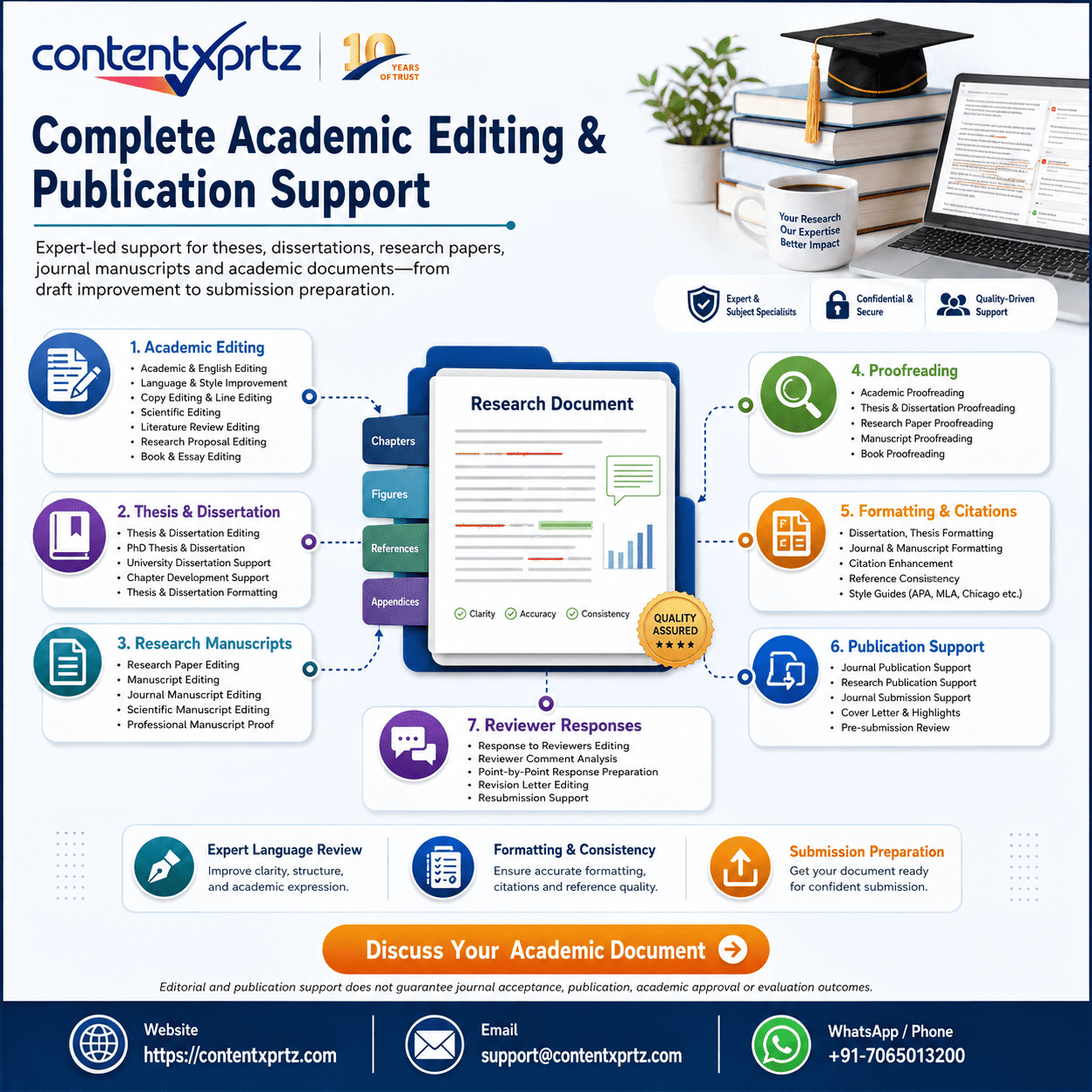
Contentxprtz supports researchers who already own and understand their work but want an independent review of how clearly that work is communicated. The most relevant support for this topic is journal manuscript editing: language correction, academic tone, paragraph flow, consistency, terminology, formatting, and presentation checks aligned with the author’s target journal.
For a manuscript approaching submission, editorial support can also flag unclear transitions, duplicated explanation, inconsistent terminology, weak signposting, citation-format inconsistencies, and places where a claim appears stronger than the wording around the evidence. These are editorial observations, not replacements for scientific judgment.
Researchers retain responsibility for the research design, data, analysis, citations, ethical approvals, disclosures, intellectual contribution, and final submission. Contentxprtz does not promise journal acceptance or publication. The goal is to help authors present their own work as clearly, consistently, and professionally as possible.
Preparing a journal manuscript for submission?
Get focused editing support for clarity, structure, consistency, and journal-ready presentation while keeping authorship and research decisions in your hands.
Summary: Scholarly Journal Articles
Scholarly journal articles are structured contributions to academic knowledge. They may report original research, synthesize existing evidence, present methods, develop theory, or offer specialist analysis. Their credibility depends on more than publication status: readers should examine the article type, research question, methods, evidence, limitations, references, disclosures, and the relationship between findings and conclusions.
For authors, successful manuscript preparation begins with journal fit and research integrity. Choose the target journal, match the article type to the contribution, make the argument and methods transparent, verify citations, complete ethical disclosures, and edit for clarity. Professional manuscript editing can be useful when language or presentation is masking otherwise strong work, but authors remain responsible for every claim and submission decision.
Frequently Asked Questions About Scholarly Journal Articles
Clear answers to common questions from students, researchers, and first-time journal authors.
What are scholarly journal articles?
Scholarly journal articles are formal publications written by researchers or subject specialists to communicate research findings, evidence syntheses, methods, theoretical arguments, or expert analysis to an academic audience. They usually cite prior scholarship, use discipline-specific terminology and structure, identify authors and affiliations, and appear in journals with stated editorial policies. Many research journals use peer review, although the exact review process can vary by journal and article type. For readers, the practical value of a scholarly article is that it normally provides enough information to evaluate how a claim was developed: what question was asked, what evidence was used, how it was analyzed, what limitations apply, and which earlier sources support the argument. For authors, a scholarly article is a publication format with defined expectations for structure, citations, ethics, disclosures, and journal fit. Do not assume every item on a journal website is the same kind of scholarly evidence; editorials, letters, corrections, reviews, and original studies can serve different purposes.
How can I tell whether a journal article is scholarly and peer reviewed?
Start by checking the article and the journal separately. A scholarly article usually has named authors, affiliations, an abstract, citations or references, discipline-specific discussion, and a clear research or analytical purpose. The journal website should explain its editorial policies, article types, peer-review process, publisher, editorial board, fees where applicable, and contact information. To confirm peer review, do not rely only on a database label or the word “journal” in the title. Open the journal’s author or editorial information and identify how the specific article type is reviewed. Some journals peer review research papers but handle editorials, letters, or invited commentary differently. You can also check the article page for submission, revision, and acceptance dates when these are provided. If your university assignment specifically requires peer-reviewed sources, use your library database filters as a starting point, then verify the journal and article type before citing the source.
What is the difference between a scholarly article and a research paper?
“Research paper” is a broad term, while a scholarly journal article is a specific publication format. A student research paper may summarize and analyze sources for a course without reporting new research or going through journal peer review. An original scholarly research article usually reports a defined research question, methods, results, and interpretation and is submitted to a journal for editorial assessment. The terms overlap when people use “research paper” to mean a published original research article. Context matters. If an instructor asks for scholarly journal articles, they are normally asking you to use published academic sources rather than student papers, websites, or general summaries. If a journal asks for a research article, it means a manuscript that matches that journal’s research-paper format. Before writing or citing, identify whether the source is original research, a review, a methods paper, a perspective, or another article type because each supports different kinds of academic claims.
What sections do scholarly journal articles usually include?
Many empirical scholarly articles use an Introduction–Methods–Results–Discussion structure, often shortened to IMRaD. The introduction explains the problem, prior research, gap, and objective. The methods describe how the study was designed and conducted. Results present the findings. The discussion interprets those findings, relates them to earlier literature, and addresses implications and limitations. Most papers also include a title, abstract, references, author information, and required disclosures. However, this is not a universal template. Humanities papers may be organized around thematic or argumentative sections. Review articles use structures suited to evidence synthesis. Qualitative studies may combine findings and discussion. Methods, protocols, case reports, and perspectives can have different required headings. The correct structure is the one that fits the study design, discipline, and target journal. Authors should therefore read the journal’s instructions and several recent articles of the same type before finalizing section order.
Are scholarly journal articles always reliable?
No. Scholarly publication and peer review are important quality-control mechanisms, but they do not make every article automatically correct. Reliability must be judged at the article level. Examine whether the research question is clear, the design is appropriate, methods are transparent, the sample or evidence is suitable, analysis is justified, limitations are acknowledged, and conclusions stay within what the findings support. Also consider funding, conflicts of interest, missing data, selective reporting, statistical uncertainty, and whether later studies replicate or challenge the findings. Check for corrections, retractions, or expressions of concern when a paper is central to your work. A highly cited article can still have important limitations, and a newer or less famous article may offer stronger methods for a particular question. Good academic practice is to compare multiple credible sources and explain the strength and limits of the evidence rather than treating publication status as a guarantee.
How do I critically read a scholarly journal article without reading every word first?
Use a layered reading process. First, read the title and abstract to judge relevance. Next, identify the research question, article type, and main conclusion. Then inspect the methods, key tables or figures, and limitations before spending time on every paragraph. This helps you decide whether the paper deserves deeper reading for your purpose. On the second pass, read the introduction to understand the gap and prior literature, then examine the methods carefully enough to judge whether the evidence can answer the question. Read the results separately from the discussion so you can distinguish findings from interpretation. Trace important citations and note any assumptions or limitations. Finally, summarize the paper in your own words: question, design, main finding, strongest limitation, and relevance to your research. This approach is faster and more critical than highlighting every sentence from beginning to end.
How do I write a scholarly journal article for the first time?
Begin with the research contribution, not with formatting. Define the question your paper answers, identify what evidence supports that answer, and choose a target journal whose scope and article types fit the work. Read the journal’s author instructions and several recent papers of the same type. Then build an outline that makes the problem, methods or analytical approach, findings, and contribution easy to follow. Draft the core sections before polishing the title and abstract. Verify every citation, label tables and figures consistently, and keep conclusions proportionate to the evidence. Complete required statements on authorship, ethics, funding, conflicts, data availability, and other disclosures. After the research content is stable, edit for paragraph logic, terminology, grammar, concision, and journal formatting. If language makes the work difficult to assess, professional manuscript editing can help with presentation, but you should review every change and retain responsibility for the manuscript.
Can professional editing help with a scholarly journal article ethically?
Yes, professional editing can be ethical when it improves communication without replacing the author’s intellectual contribution. Appropriate support may include grammar correction, sentence clarity, academic tone, consistency, terminology, paragraph flow, formatting, reference-style checks, and comments that identify unclear reasoning or missing transitions. More substantive suggestions should be reviewed and decided by the author. The editor should not fabricate data, create false citations, invent results, conceal plagiarism, or make scientific decisions the author does not understand. Authors remain responsible for the research, claims, analysis, sources, approvals, disclosures, and final submitted version. Some journals or institutions ask authors to disclose language editing, writing assistance, or AI-assisted tools, so follow the specific policy. Ethical editing is best treated as transparent communication support rather than hidden authorship or a way to guarantee acceptance.
How do I cite scholarly journal articles correctly?
Use the citation style required by your university, discipline, or target journal and verify the bibliographic information against the article’s official record. Typical elements include author names, publication year, article title, journal title, volume, issue where applicable, page range or article number, and DOI. The exact order, punctuation, capitalization, and use of italics depend on styles such as APA, MLA, Chicago, Vancouver, Harvard, or a journal-specific format. Citation software can automate much of the formatting, but imported metadata can contain errors. Check every reference against the publisher page or trusted bibliographic database, and make sure each in-text citation has a matching reference-list entry. More importantly, confirm that the cited article actually supports the claim you attach to it. Avoid citing a source based only on its title or an AI-generated summary. Accurate citation is both a formatting task and an evidence-integrity task.
When should I seek journal manuscript editing or publication support?
Consider expert support when the research and core argument are yours but presentation problems are making the manuscript difficult to evaluate. Common signs include repeated reviewer comments about language, unclear paragraph flow, inconsistent terminology, excessive repetition, problems meeting the journal’s style, or uncertainty about how to present revisions professionally. First-time authors and researchers writing in an additional language may also benefit from an independent editorial pass before submission. Editing is not a substitute for missing research, weak methodology, unsupported conclusions, or a poor journal fit. Those issues need scientific or supervisory attention. A responsible manuscript editor should preserve your meaning, flag uncertainties, and avoid promising publication. If you use Contentxprtz or another provider, review all revisions yourself, verify every technical statement and citation, and follow the target journal’s disclosure rules. The final manuscript should remain a work you understand and are prepared to defend.
Read Critically, Write Transparently, and Prepare for the Right Journal
Scholarly journal articles are valuable because they make research and expert reasoning available for examination, citation, debate, and further study. Their value increases when readers evaluate evidence rather than relying on labels, and when authors make methods, reasoning, limitations, and sources as transparent as possible.
Self-editing, supervisor feedback, writing-centre support, and careful use of journal instructions may be enough for many manuscripts. Expert-assisted editing becomes useful when language, structure, consistency, or formatting is obscuring the author’s own research. The support should strengthen communication without replacing authorship or research responsibility.
If your manuscript is ready for an independent editorial review, Contentxprtz journal manuscript editing focuses on clarity, organization, academic language, consistency, and publication-ready presentation while leaving research decisions with the author.
“At Contentxprtz, we don’t just edit; we help ideas reach their fullest potential.”