Peer reviewed journal articles are among the most important source types used in university research, doctoral work, evidence-based professional practice, and scholarly publishing. Yet many students and early-career researchers are told to “use peer reviewed sources” without being shown how to verify them, how peer review actually works, or how much trust to place in a paper once it has passed review. That gap matters. A database filter can help you locate academic material, but responsible research still requires you to examine the journal, article type, methods, evidence, citations, limitations, and relevance to your own question.
The practical challenge is that scholarly publishing contains many legitimate document types. Original research articles, systematic reviews, meta-analyses, methods papers, brief reports, editorials, letters, commentaries, conference material, corrections, and preprints can all appear academic. Some are peer reviewed; others may follow a different editorial route. Even within peer reviewed journals, review models vary. This means that a polished PDF, a DOI, or inclusion in a scholarly search engine should not be treated as automatic proof that a particular item underwent external expert review.
For thesis and dissertation writers, the issue goes beyond source identification. You need to judge whether a study is strong enough to support a claim, whether it is current enough for your field, whether its population or context matches your research problem, and whether its findings agree or conflict with the wider literature. First-time authors face a related challenge from the other side: they must prepare a manuscript that can withstand editorial screening and critical evaluation by reviewers. Clear language, coherent structure, accurate citations, transparent methods, and appropriately cautious conclusions help reviewers understand a study, although editing can never substitute for sound research.
This guide therefore approaches peer reviewed literature as both a reader and author problem. It explains how expert review works, how to recognize peer reviewed material, how to search and read efficiently, how to evaluate credibility, how to synthesize articles without simply summarizing them one by one, and how ethical academic editing services can support manuscript clarity when professional help is genuinely useful. The aim is not to treat peer review as a badge of certainty, but to help you use it as one meaningful layer in a larger process of scholarly judgment.
Quick Answer: What Are Peer Reviewed Journal Articles?
Peer reviewed journal articles are scholarly papers evaluated by independent or external subject experts as part of a journal’s editorial process before publication. Reviewers typically assess the research question, methods, evidence, reporting, originality, significance, and fit with the journal. The editor then makes the publication decision, often after one or more rounds of revision.
To verify an article, check the journal’s official peer-review policy and the article type, not just the presence of references or a database label. Then read the paper critically. Peer review can improve quality control, but it does not prove that every claim is correct.
If you are preparing your own article, follow the target journal’s author instructions and make the manuscript easy to evaluate: clear question, transparent methods, accurate results, restrained conclusions, complete references, and consistent academic language.
Key Takeaways
- Peer review is expert evaluation within a journal’s editorial process; it is not a guarantee of permanent correctness.
- Verify the journal’s review policy and the specific article type before describing a source as peer reviewed.
- Use library databases and scholarly indexes to discover papers, then verify important details on the journal or publisher record.
- Critical reading should examine methods, evidence, limitations, conflicts, citations, and the fit between results and conclusions.
- A strong literature review synthesizes patterns, agreements, disagreements, methods, and gaps across multiple studies.
- Authors preparing for peer review should prioritize research integrity, transparent reporting, journal fit, and readable academic presentation.
- Ethical manuscript editing can improve clarity and consistency while leaving the research, claims, and final decisions with the author.
What This Page Covers
- What peer review means
- How to verify article status
- Where to search for papers
- How to read critically
- How to synthesize evidence
- How authors prepare for review
Methodology and Academic Sources
This article is based on common scholarly publishing workflows and guidance from established publishers and editorial organizations. Peer-review procedures differ by discipline, journal, publisher, and manuscript type, so the journal’s own instructions remain the most specific source for a submission.
For the general process, this guide aligns with publisher explanations such as Taylor & Francis guidance on understanding peer review, Elsevier’s overview of peer review, and Springer Nature’s manuscript-evaluation guidance. For responsibilities in the submission and review process, the ICMJE recommendations provide detailed principles, particularly relevant to medical journals.
What “Peer Reviewed Journal Articles” Means in Academic Context
A peer reviewed article is not defined by how difficult it looks or how many citations it contains. Its defining feature is the journal’s editorial assessment process. A submitted manuscript is considered by editors and, when appropriate, assessed by experts who evaluate its quality and suitability. Reviewers advise; editors decide.
This distinction is important because the word scholarly describes a broader category. Scholarly communication includes research articles, reviews, editorials, letters, conference papers, books, chapters, data papers, preprints, and other outputs. Some are externally reviewed before publication and some are not. When an instructor says “use peer reviewed journal articles,” the safest interpretation is usually: use articles from journals with a clear peer-review process, and verify that the article type itself belongs to that process.
Peer review
Expert assessment of a manuscript within an editorial workflow before a journal makes a publication decision.
Scholarly article
An academic or professional article written for a specialist audience; it may or may not have undergone external peer review.
Preprint
A publicly shared manuscript version that has generally not yet completed the journal’s formal peer-review process.
Systematic review
A structured synthesis of existing evidence using stated methods; quality depends on search methods, inclusion criteria, appraisal, and reporting.
How Does the Peer Review Process Work?
The exact workflow varies, but most journal review systems move through several recognizable stages. Understanding those stages helps readers interpret publication status and helps authors prepare realistic expectations.
- Submission and technical checks. The manuscript enters the journal system and may be checked for required files, declarations, formatting, authorship information, and basic completeness.
- Editorial screening. An editor assesses scope, relevance, baseline quality, and whether the manuscript should proceed. Many papers are rejected at this stage without external review.
- Reviewer invitation. The editor invites researchers with relevant expertise while considering availability and conflicts of interest.
- Expert assessment. Reviewers examine the manuscript’s contribution, methods, analysis, evidence, reporting, and presentation according to journal criteria.
- Editorial decision. The editor considers the reports and chooses an outcome such as rejection, revision, or acceptance. Reviewers do not control the final decision.
- Revision and response. Authors may revise the manuscript and prepare a point-by-point response explaining what changed or why a suggestion was not followed.
- Further review and production. Revised work may return to reviewers. If accepted, it proceeds to production, copyediting, typesetting, proofs, and publication according to the journal’s workflow.
How to Identify a Peer Reviewed Journal Article
Use a verification sequence rather than a single clue. The fastest reliable approach is to check the journal policy, confirm the article type, and inspect the article record.
| Check | What to look for | Why it matters |
|---|---|---|
| Journal policy | A clear description of peer review, editorial process, and article types | Confirms the journal states how manuscripts are evaluated |
| Article type | Original article, review article, methods paper, or another type covered by the policy | Not every item in a peer reviewed journal necessarily follows identical review |
| Publication record | Authors, affiliations, journal, volume/issue or article number, dates, DOI where applicable | Helps confirm the item and trace the authoritative version |
| Research structure | Abstract, methods, results, discussion, references as appropriate | Supports scholarly evaluation but is not proof by itself |
| Publisher transparency | Editorial board, policies, contact information, ethics and corrections procedures | Helps distinguish transparent scholarly publishing from misleading operations |
A university database’s peer-reviewed limiter can save time, but it should not replace judgment. Database indexing decisions can be broad, and mixed-content journals may include material with different editorial pathways.
Where and How to Find Peer Reviewed Journal Articles
Start with the strongest discovery environment available to you. University libraries provide access to multidisciplinary databases, specialized indexes, publisher collections, and subscription content that may not be freely available elsewhere.
Build the search around concepts
Break the research question into its core concepts. For a question about remote work and employee wellbeing, for example, your concept groups might be “remote work,” “employee wellbeing,” and perhaps a population or industry. Create synonyms for each group and combine them deliberately. Searching conceptually produces more useful results than pasting a long natural-language question into every academic database.
Use filters with purpose
Filters can narrow by publication date, subject, language, document type, population, methodology, or peer-review status. Apply them only when they follow from your research design. An arbitrary five-year date limit, for example, may exclude foundational theory that your literature review still needs.
Follow citation networks
Once you find a strong paper, read its references to locate earlier studies and use “cited by” tools to identify later work. This backward-and-forward searching helps you map how an argument has developed and locate competing findings that keyword searches may miss.
How to Read Peer Reviewed Journal Articles Critically
Critical reading asks not only “what did the authors find?” but “how did they reach that conclusion, and how much weight should I give it?” A useful reading sequence separates description from evaluation.
First pass: understand the study
Read the title, abstract, introduction, figures or tables, and conclusion. Write down the research question, study design, sample or data source, main result, and stated limitation. At this stage, avoid deciding whether the paper is “good” or “bad.” Your goal is accurate comprehension.
Second pass: inspect the evidence
Move into the methods and results. Ask whether the design actually answers the research question. Check how participants, documents, datasets, or cases were selected. Look at measures, controls, comparison groups, statistical assumptions, qualitative coding procedures, and missing-data decisions as appropriate to the field.
Third pass: test the interpretation
Compare the results with the claims in the discussion and conclusion. Authors may reasonably interpret evidence, but conclusions should not outrun the design. A correlational study should not be described as proving causation. A small specialized sample should not be generalized automatically to every population.
How to Use Peer Reviewed Articles in a Literature Review or Research Paper
The strongest academic writing uses journal articles as evidence within a reasoned synthesis. It does not produce a sequence of mini summaries—“Author A says this, Author B says that”—without explaining relationships among studies.
Organize by argument, not by article
Group literature around themes, theories, methods, populations, time periods, or areas of agreement and disagreement. A paragraph might compare three studies using different designs to answer the same question, then explain what their combined evidence suggests and what remains uncertain.
Separate source claims from your interpretation
Signal clearly when you are reporting an author’s finding and when you are making your own synthesis. Accurate paraphrasing changes the wording and sentence structure while preserving the original meaning and source attribution. It should never distort a result to fit your argument.
Use citations as evidence trails
A citation should let a reader trace a claim to its source. Verify names, dates, titles, journal details, DOI information, and page or section details where your style requires them. If your paper needs stronger citation consistency or final language review, scholarly proofreading support can help identify presentation errors, while the author remains responsible for checking source accuracy.
Common Mistakes When Working With Peer Reviewed Literature
Assuming peer review means “true”
A peer reviewed paper can still be limited, superseded, contradicted, corrected, or retracted. Treat publication as the start of scholarly scrutiny, not the end.
Using one paper to represent a whole field
Most research questions require multiple sources. Look for convergence, disagreement, study quality, population differences, and changes over time.
Ignoring article type
An editorial can be insightful without being original peer reviewed research. A systematic review and a laboratory experiment also answer different kinds of questions. Match source type to the claim you need to support.
Reading only the abstract
Abstracts compress the study and may omit important methodological caveats. Use them for screening; use the full article for serious evidence evaluation.
Confusing citation count with quality
A highly cited paper may be influential because it is foundational, controversial, methodologically useful, or widely criticized. Citation count needs context.
Letting software replace source checking
Reference managers, grammar tools, and AI systems can assist workflow, but authors should verify the original source, bibliographic record, quotation, paraphrase, and factual claim.
Practical Examples: Using Peer Reviewed Journal Articles Well
A master’s student building a literature review
Situation: The student finds eight articles through a general web search and assumes all are peer reviewed because they contain references.
Correction: She checks the journal policies and article types, removes two non-research commentaries from the core evidence set, and uses citation chaining to identify additional studies.
Better outcome: Her literature review is organized around competing findings and methodological differences rather than eight disconnected summaries.
A PhD scholar evaluating a contradictory paper
Situation: One recent article conflicts with several studies supporting the scholar’s working hypothesis.
Correction: Instead of dismissing it, he compares sampling, measurements, analysis, and context. The disagreement appears linked to a different population and operational definition.
Better outcome: The thesis discusses the contradiction as a meaningful boundary condition rather than hiding inconvenient evidence.
A first-time author preparing for journal submission
Situation: The research is complete, but the manuscript has inconsistent terminology, a dense discussion, and references in mixed styles.
Correction: The author first checks the target journal’s instructions, then uses ethical manuscript editing to improve clarity, consistency, and presentation without changing the data or claims.
Better outcome: Reviewers can focus on the research itself because avoidable language and formatting friction has been reduced.
Peer Reviewed Research and Publication Readiness Checklist
For readers and researchers
- I verified the journal’s peer-review policy.
- I checked that the specific article type is covered by that process.
- I read beyond the abstract.
- I assessed methods, results, limitations, and disclosure information.
- I compared the paper with other relevant evidence.
- I recorded accurate citation details from an authoritative source.
For authors preparing a manuscript
- The journal fits the study’s scope and audience.
- The research question and contribution are explicit.
- The methods are transparent and the results are reported consistently.
- The conclusion does not overstate the evidence.
- References are authentic, traceable, and accurately represented.
- Language, tables, figures, and formatting have been checked against journal instructions.
How Contentxprtz Can Help With Journal Manuscript Readiness
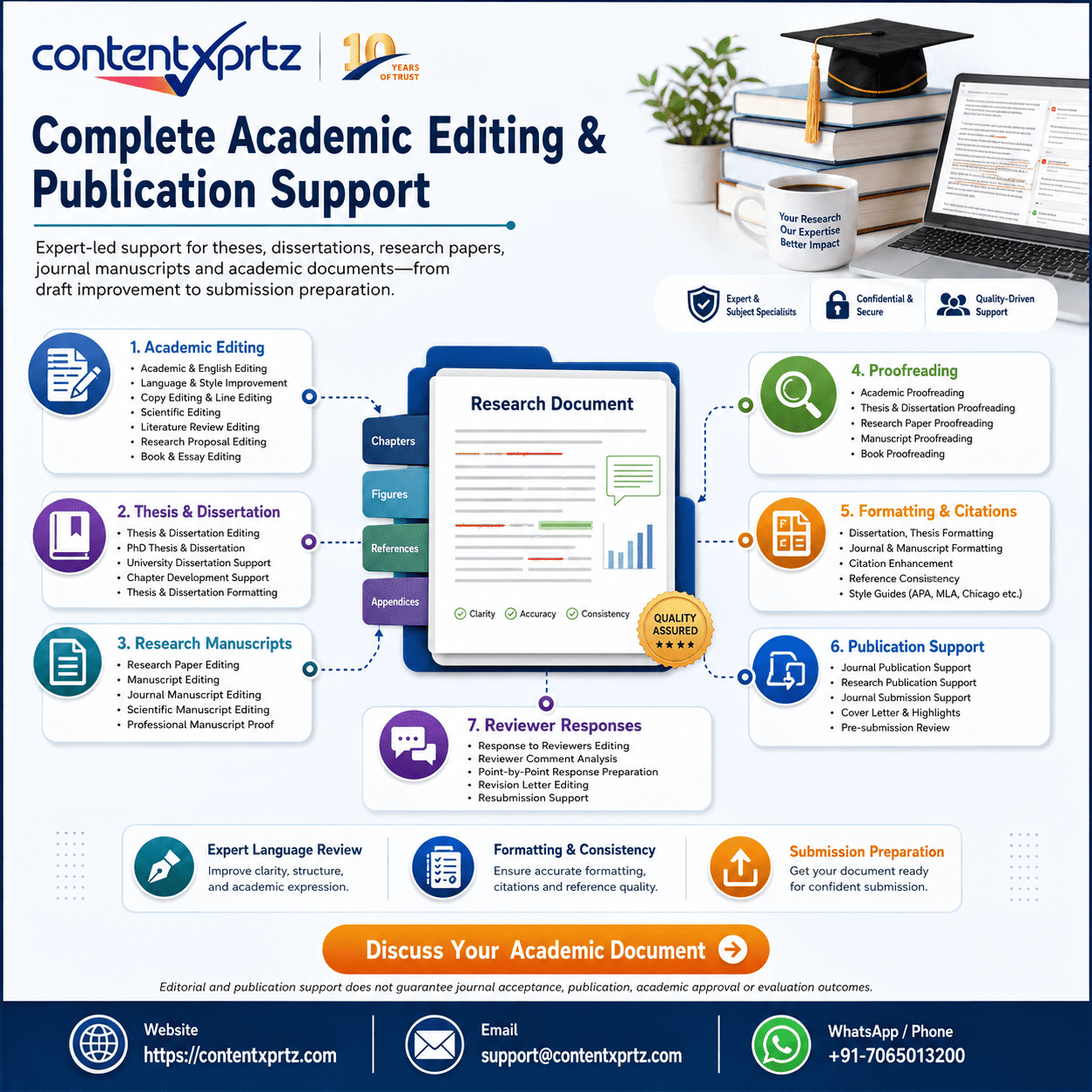
Professional support is most useful when the research is already the author’s own and the goal is to improve communication. Contentxprtz can help researchers refine academic language, structure, consistency, readability, and journal-facing presentation through relevant journal manuscript editing support.
For manuscripts that need a higher-level readiness check before line editing, manuscript assessment may help identify structural or presentation issues that should be addressed first. For researchers navigating submission materials and publication workflow, publication support may be relevant.
Preparing a journal article for expert review?
Improve clarity, consistency, and manuscript presentation while keeping authorship, research decisions, and final responsibility with you.
Summary: Peer Reviewed Journal Articles
Peer reviewed journal articles are scholarly papers assessed through a journal’s expert-review process before publication, but peer review should be treated as quality control rather than a guarantee of truth. Responsible use begins by verifying the journal policy and article type, then critically evaluating the study’s question, methods, evidence, limitations, and conclusions.
Students and researchers can find strong sources through library databases, scholarly indexes, publisher platforms, and citation networks. The best literature reviews synthesize multiple papers by themes, methods, findings, and gaps rather than summarizing each source separately. Authors preparing their own manuscripts should focus on journal fit, transparent reporting, accurate references, restrained interpretation, and clear academic presentation.
Self-service tools and peer feedback may be enough for straightforward polishing. When language, structure, consistency, or journal presentation is limiting the readability of otherwise complete research, ethical expert editing can provide an additional quality-control layer without replacing the author’s ideas, evidence, or responsibility.
Frequently Asked Questions About Peer Reviewed Journal Articles
These answers address common questions students, researchers, and first-time authors ask when finding, evaluating, citing, or preparing peer reviewed research.
What are peer reviewed journal articles?
Peer reviewed journal articles are scholarly papers that a journal evaluates through expert assessment before publication. After an author submits a manuscript, an editor usually checks whether it fits the journal and meets basic requirements. Suitable manuscripts may then be sent to researchers or specialists with relevant expertise. Reviewers assess issues such as the importance of the research question, appropriateness of the methods, strength of the evidence, clarity of reporting, relationship to prior literature, and whether the conclusions are supported.
Peer review is not a guarantee that an article is error-free or permanently correct. It is a quality-control process within scholarly communication. Different journals use different review models, including single-anonymized, double-anonymized, open, or other forms of review. Editorial decisions also remain with the journal, not with reviewers alone.
When you use a peer reviewed article, verify the journal, article record, author information, references, methods, and publication details rather than relying only on a database label. For important academic work, read the study critically and compare it with other credible research on the same question.
How can I tell whether a journal article is peer reviewed?
Start with the journal itself rather than assuming every article in an academic-looking database has been peer reviewed. Visit the journal’s official website and look for an editorial policy, peer-review policy, author guidelines, or “about” page that explains how manuscripts are assessed. Reputable journals normally describe their review process and identify the publisher, editorial leadership, scope, and publication policies.
Next, inspect the article record. A research article often contains an abstract, methods, results, discussion, references, author affiliations, a DOI, and publication history. Those features are useful signals, but none alone proves peer review. Some journals also publish editorials, letters, corrections, news items, book reviews, or commentaries that may not go through the same review process as original research.
If your university library database offers a “peer reviewed” filter, use it as a starting point, then verify the specific journal and article type. When the distinction matters for an assignment, thesis, systematic review, or publication decision, follow your university or target journal’s criteria.
Are peer reviewed journal articles always reliable?
No. Peer review improves scholarly quality control, but it does not make every published finding automatically reliable. Reviewers work with the manuscript and evidence available to them, and they can miss weaknesses. Research may later be challenged because of limitations in design, statistical analysis, measurement, interpretation, reproducibility, reporting, or new evidence.
A stronger approach is to evaluate a paper at several levels. Ask whether the research question is meaningful, the sample and methods are appropriate, the analysis fits the data, the limitations are acknowledged, and the conclusions stay within what the evidence can support. Check whether important conflicts of interest or funding sources are disclosed. Compare the paper with systematic reviews, meta-analyses, replications, and other high-quality studies where available.
For academic writing, treat peer review as an important credibility signal rather than a substitute for critical reading. Your argument should reflect the overall evidence base, not just a single paper that appears to support your preferred conclusion.
What is the difference between a peer reviewed article and a scholarly article?
The terms overlap, but they are not identical. A scholarly article is written for an academic or professional audience and usually uses disciplinary language, references, and evidence. A peer reviewed article is a scholarly work that has additionally passed through the journal’s stated expert-review process before publication.
A scholarly journal can publish material that is not peer reviewed in the same way as original research. Examples may include editorials, news features, correspondence, book reviews, obituaries, invited commentaries, corrections, or certain perspectives. These items can still be useful, but they should not automatically be described as peer reviewed research.
When an assignment asks specifically for peer reviewed sources, verify both the journal and the article type. Do not rely solely on polished formatting, the presence of references, or the fact that the article appears in Google Scholar. If you are unsure, check the journal’s review policy, the article page, or your library database record and ask a librarian or instructor how the course defines an acceptable peer reviewed source.
Where can students find peer reviewed journal articles?
Students can find peer reviewed journal articles through university library discovery systems, subject databases, publisher platforms, scholarly search engines, and discipline-specific indexes. The best route depends on the field. A library portal is often the safest starting point because it can connect you to subscription content, database filters, citation tools, and librarian support.
Build searches around concepts rather than copying a full assignment question into the search box. Identify two or three core ideas, list synonyms, and combine them with Boolean operators such as AND and OR where the database supports them. Then filter by date, document type, subject area, language, or peer-review status only when those limits are academically justified.
Google Scholar can help discover papers and citation connections, but it includes many kinds of academic material. Always verify the source. If a full text is unavailable, check your library’s link resolver, institutional repository, author manuscript, interlibrary loan service, or legitimate open-access version instead of relying on an unverified copy.
How do I read a peer reviewed research article efficiently?
Read strategically rather than treating the article like a textbook chapter from the first line to the last. Begin with the title, abstract, keywords, and conclusion to understand the research question and main claim. Then inspect the introduction to see how the study fits existing literature. Move to the methods and results before accepting the discussion’s interpretation.
For empirical papers, ask what population or material was studied, how variables were measured, what comparisons were made, what analysis was used, and whether the results answer the stated question. Mark the paper’s limitations and note any gap between the evidence and the authors’ conclusions. Figures and tables can often reveal the scale and pattern of results more quickly than narrative text.
Finally, write a short source note in your own words: research question, method, main finding, major limitation, and how the paper relates to your own work. This habit reduces accidental patchwriting and makes later literature-review synthesis much easier.
Can I cite peer reviewed journal articles in a thesis or dissertation?
Yes, peer reviewed journal articles are commonly used as evidence in theses and dissertations, but they should be selected and cited according to the purpose of your research and your institution’s requirements. A strong literature review usually draws on a relevant body of research rather than collecting articles simply because they are peer reviewed.
Prioritize sources that directly address your research question, use appropriate methods, and contribute meaningful evidence or theory. Balance foundational studies with current research where the field requires it. If you cite a paper for a specific numerical result, definition, framework, or claim, check the original article rather than relying on a secondary citation whenever possible.
Your university may specify databases, source types, date ranges, or citation styles. Follow those rules. Also keep accurate bibliographic records while reading. Reference-management software can help, but automatically generated citations still need checking for author names, capitalization, journal details, volume, issue, pages or article number, DOI, and the required citation style.
What does peer review look for in a journal manuscript?
Peer review commonly examines whether the manuscript makes a clear contribution and whether its evidence supports that contribution. Reviewers may consider the originality and importance of the research question, fit with the journal, adequacy of the literature review, appropriateness of methods, transparency of analysis, quality of tables and figures, interpretation of results, acknowledgement of limitations, and consistency between evidence and conclusions.
Reviewers also consider reporting quality and ethical issues relevant to the discipline. Depending on the study, this can include research ethics approval, informed consent, data availability, conflicts of interest, authorship, reporting standards, and whether citations fairly represent prior work. Journal-specific reviewer forms may add further criteria.
For authors, the practical lesson is to prepare for peer review before submission. Read the target journal’s author instructions, make the research question explicit, justify methodological choices, present results transparently, remove internal inconsistencies, verify citations, and ensure the abstract and conclusion accurately reflect the study. Language editing can improve clarity, but it cannot substitute for sound research design or evidence.
Do peer reviewed journal articles have to be open access?
No. Peer review and open access describe different aspects of scholarly publishing. Peer review concerns how a manuscript is evaluated before publication. Open access concerns how readers can access the published work. A peer reviewed article may be freely available, available after an embargo, accessible through a university subscription, or available only through purchase.
Likewise, an open-access article is not automatically peer reviewed simply because it is free to read. You still need to verify the journal’s editorial process and the article type. Reputable open-access journals should clearly explain their peer-review policy, fees where applicable, licensing, editorial governance, and publication ethics.
For students and researchers without subscription access, legitimate open-access routes can include fully open journals, institutional repositories, subject repositories, author-accepted manuscripts, and legally shared versions linked from scholarly indexes. When citing, use the authoritative bibliographic details for the version you actually consulted and follow your required citation style.
Can professional editing help before submitting an article for peer review?
Professional editing can help when the research is complete but the manuscript needs clearer academic expression, stronger organization, language polishing, consistency, or journal-specific formatting. Ethical editing should preserve the author’s meaning and intellectual ownership. It may identify unclear sentences, inconsistent terminology, weak transitions, structural repetition, formatting problems, or places where a claim needs better support or citation.
Editing cannot guarantee acceptance, replace missing research, create results, or make an unsuitable study fit a journal. Authors remain responsible for the research question, data, analysis, claims, references, disclosures, and final submission. Some journals or institutions also have rules about acknowledging substantial editorial assistance, so authors should check applicable policies.
If you are preparing a manuscript for peer review, Contentxprtz can support language and manuscript readiness through its journal manuscript editing service. The useful goal is not to make the paper sound artificially sophisticated; it is to help reviewers understand the research accurately and efficiently while maintaining the author’s voice and academic responsibility.
Conclusion: Use Peer Review as a Starting Point for Scholarly Judgment
The value of peer reviewed journal articles comes from a structured process of expert scrutiny, but their real academic usefulness depends on what you do next. Verify the source, read the methods, examine the evidence, acknowledge limitations, compare studies, and cite claims accurately. For a thesis, dissertation, research paper, or professional evidence review, these habits are more important than simply collecting sources with a “peer reviewed” label.
For authors, the same principle works in reverse. Peer review is easier to navigate when the manuscript presents the research clearly and transparently. Free grammar tools, colleague feedback, and self-editing can be sufficient for many revisions. When a manuscript needs deeper language polishing, structural consistency, or journal-readiness support, professional editing can help reviewers see the work more clearly without changing who owns the research or the conclusions.
If your research is complete and you want expert help refining the manuscript for submission, explore Contentxprtz’s journal manuscript editing service.
At Contentxprtz, we don’t just edit; we help ideas reach their fullest potential.