The Journal of High Technology Management Research: Scopus, Scope & Submission Guide
The Journal of High Technology Management Research was an Elsevier journal focused on the management of emerging and high technologies. For researchers checking its current status, the most important fact is that this title is no longer the active submission identity: Elsevier announced on 27 January 2025 that it had been relaunched under the new name Journal of Strategy & Innovation. The former title’s final preserved run covers 1990–2024, while current submissions should be evaluated against the successor journal’s aims, author guidance, publishing options and editorial information.
This distinction prevents several common errors. A researcher may find the historical Scopus Source ID 19713, ISSN 1047-8310, 2024 CiteScore and older papers under the former title, yet the current journal uses different ISSNs and a revised scope. This guide therefore treats the legacy record and the active successor separately, so PhD scholars, academics and professional researchers can judge indexing, research fit and submission readiness without mixing old and current data.
Quick Answer: What Is The Journal of High Technology Management Research?
The Journal of High Technology Management Research was a semiannual, English-language Elsevier journal published from 1990 through 2024. Its historical aim was to advance interdisciplinary research on the management of emerging technologies and the managerial challenges surrounding technology-based products, services and companies. Its print ISSN was 1047-8310 and online ISSN was 1879-1638.
The journal was indexed in Scopus under Source ID 19713. Its final 2024 Scopus metrics, as reported by an institutional journal browser using Scopus data, were CiteScore 8.4, SJR 0.814 and SNIP 1.592, with Q1 placement across several listed categories. Those values describe the former title’s 2024 record; they should not be presented as current metrics for a journal that still publishes under that name.
For a new submission in 2026, authors should use the successor, Journal of Strategy & Innovation, and confirm the latest scope, fees, timelines and author instructions there before preparing a manuscript.
Key Takeaways for Researchers
- The former journal was published by Elsevier and ran from 1990 to 2024.
- Historical Scopus identifier: Source ID 19713.
- ISSN 1047-8310; online ISSN 1879-1638.
- Final 2024 Scopus metrics available through an institutional journal browser: CiteScore 8.4, SJR 0.814 and SNIP 1.592.
- Elsevier relaunched the title as Journal of Strategy & Innovation in January 2025.
- Current submissions should follow the successor journal’s requirements, not archived instructions for the old title.
- The successor currently supports both open-access and subscription publication options.
- Journal selection should be based on scope and readership first, not indexing or quartile alone.
Journal Information at a Glance
| Field | Journal information |
|---|---|
| Journal name | The Journal of High Technology Management Research |
| Source type | Journal |
| Publisher | Elsevier |
| Print ISSN | 1047-8310 |
| Online ISSN | 1879-1638 |
| Scopus Source ID | 19713 |
| Publication period | 1990–2024 under the former title |
| Frequency | Semiannual |
| Language | English |
| Country in ISSN record | United States |
| Current status | Former title; continued/relaunched as Journal of Strategy & Innovation |
| Former journal page | ScienceDirect archive |
| Current submission identity | Journal of Strategy & Innovation |
How This Journal Profile Was Verified
This profile prioritises the official ScienceDirect archive, Elsevier’s 2025 relaunch announcement, the successor journal insights page, the ISSN International Centre and the supplied Scopus Source ID. The 2024 Scopus metrics are cross-checked through a university journal browser that labels them as Scopus Journal Metrics (2024).
Metrics, fees, indexing and submission policies can change. The older title has also been superseded, so anyone preparing a new paper should reconfirm the active journal page immediately before submission.
Aims and Scope: What Did the Former Journal Cover?
The former journal’s scope centred on interdisciplinary research into the distinctive problems and opportunities created by emerging technologies. Its stated role was to develop theoretical knowledge useful to academics and practitioners studying the management of technology-based products, services and firms, at both micro and macro levels.
That broad remit is reflected in the journal’s historical subject classifications and published papers. Researchers could encounter work connecting technology management with strategy, marketing, innovation, information systems, entrepreneurship, organisational capability and decision making. Examples in its 2023–2024 issues included Internet of Things adoption and business models, digital transformation, AI and employee performance, green innovation, technology orientation, strategic flexibility, board leadership and digital entrepreneurship.
Representative research areas
- Management of technology and innovation
- Technology strategy and strategic management
- Digital transformation and organisational agility
- Technology entrepreneurship and new ventures
- Innovation capability and firm performance
- AI adoption and managerial implications
- Technology-enabled business models
- Information systems and analytics in management
- High-technology marketing and customer relationships
- Leadership in technology-intensive organisations
- Technology transfer and commercialisation
- Inter-organisational collaboration and technological turbulence
These examples describe the former title’s scholarly territory and publication record. They are not a substitute for the current successor journal’s own scope.
Understanding Its Scopus Coverage and Final Journal Metrics
The former title is associated with Scopus Source ID 19713 and remained visible in Scopus-oriented journal records through its final publication year. For institutional reporting, the date matters: the metrics below are explicitly 2024 values for the former title.
| Metric | 2024 value | Researcher interpretation |
|---|---|---|
| CiteScore | 8.4 | Citation-performance indicator for the 2024 reporting cycle. |
| SJR | 0.814 | SCImago Journal Rank value derived from Scopus citation data. |
| SNIP | 1.592 | Field-normalised citation-impact indicator. |
| Quartile | Q1 in the listed 2024 Scopus categories | Category-relative position; not an independent quality guarantee. |
The 2024 category listings included Information Systems and Management, Computer Science Applications, Strategy and Management, Management of Technology and Innovation, and Marketing. Researchers should quote a quartile with its year and category rather than writing simply that a journal “is Q1.”
No current Clarivate Journal Impact Factor for the discontinued title was verified from an authoritative source during preparation of this page. A CiteScore should not be relabelled as an Impact Factor.
What Changed in 2025? The Successor Journal Matters for New Submissions
Elsevier announced on 27 January 2025 that The Journal of High Technology Management Research had been relaunched as Journal of Strategy & Innovation. The successor uses new identifiers: print ISSN 3050-791X and online ISSN 3050-7901.
The revised scope places stronger emphasis on strategy, innovation and organisational transformation in technology-intensive settings. Elsevier highlights digital transformation, innovation strategy, entrepreneurship, strategic management, emerging technologies, future of work, organisational transformation and AI-enabled business models. The publisher also identifies interests such as strategic foresight, impact assessment, intellectual property and intangible assets, deep-tech entrepreneurship, innovation policy, sustainability, collaboration and ecosystems.
This is not merely a cosmetic name change for authors. If your manuscript is being prepared now, its relevance should be tested against the current scope of Journal of Strategy & Innovation, because the active editorial identity has expanded beyond the older “high technology management” framing.
What Does the Active Successor Publish?
Elsevier’s current journal description welcomes conceptual, empirical and interdisciplinary contributions with theoretical, methodological or practical insight. It also explicitly welcomes high-quality literature reviews that advance debate rather than only summarising prior studies.
Recent successor-journal papers show a strong concentration around AI, strategy and innovation. Examples include research on generative AI and innovation differentiation, AI capital and business innovation, AI user personality, innovative-city policy, big-data analytics and firm performance, and transformational leadership in technology-intensive contexts.
For a prospective author, the important question is not whether a paper contains a technology keyword. A stronger fit usually requires a clear contribution to strategy, innovation, entrepreneurship, governance, organisational transformation or the management implications of technological change.
Is This Journal a Good Match for Your Research?
For a new manuscript, treat the successor journal as the decision point. A paper is more likely to be contextually aligned when the central research question explains how technology, innovation or strategic change affects organisations, industries, ecosystems, policy or managerial practice.
| Potential fit | Example | What to check |
|---|---|---|
| Strong | How generative AI changes innovation strategy and organisational capabilities | Clear theoretical contribution and management relevance |
| Strong | Deep-tech venture scaling, governance or commercialisation | Connection to strategy/innovation literature and credible evidence |
| Potential | Digital transformation in public-sector organisations | Whether findings speak beyond one operational case |
| Potential | Technology adoption study | Whether it advances strategy, innovation or organisational theory rather than only measuring acceptance |
| Weak | Pure algorithm-performance paper with no managerial or strategic contribution | A computing or engineering journal may be more suitable |
Journal-fit checklist
- Does the manuscript address the active successor’s aims and scope?
- Is the contribution clearly about strategy, innovation, entrepreneurship, governance or organisational transformation?
- Has the journal recently published conceptually related work?
- Is the methodology appropriate for the research question?
- Does the paper offer more than a descriptive application of a popular technology?
- Will the journal’s management and innovation readership understand why the findings matter?
- Does the intended article type match what the journal currently welcomes?
- Do your university or PhD rules recognise the journal’s current indexing identity?
Preparing and Submitting a Manuscript
Because the former title is no longer the active journal identity, authors should follow the current Guide for Authors for Journal of Strategy & Innovation. Do not rely on an old PDF or third-party summary of the previous journal’s requirements.
Before formatting
Start with scope alignment, article type and contribution. Review several recent papers in the successor journal and compare their research questions, theoretical framing, methods and level of managerial interpretation with your own manuscript.
Submission package
Elsevier journal submissions generally require editable manuscript files and complete author, funding and competing-interest information, but the exact current package for this journal should be checked in its Guide for Authors. If the guide requests highlights, a graphical abstract, anonymised files, data statements or other components, treat those as journal-specific requirements only after confirming them on the active page.
References and formatting
The exact current reference style and formatting rules should be taken from the live Guide for Authors. Reference-management software can reduce formatting work, but imported metadata still needs human checking for author names, article titles, year, volume, issue, pages and DOI.
What Happens After You Submit?
The successor journal’s official insights page provides unusually clear current workflow statistics. It lists 5 days from submission to first decision, 95 days from submission to a decision after review, 26 days from submission to acceptance, and 13 days from acceptance to online publication. These are publisher-displayed journal statistics, not promises for an individual manuscript.
The same page currently lists an acceptance rate of 5%. That figure belongs to the active successor journal and should not be retroactively attributed to The Journal of High Technology Management Research.
The accessible official pages confirm that accepted articles undergo peer review, but the specific reviewer-identity model was not independently verified from the successor’s accessible guide during preparation of this profile. Authors should therefore confirm whether review is single- or double-anonymised in the live Guide for Authors rather than relying on assumptions based on other Elsevier titles.
Open Access, APCs and Publication Fees
The active successor currently supports both open-access and subscription publication. Elsevier’s journal insights page lists an open-access article publishing charge of USD 2,830 excluding taxes, with the note that the amount may be reduced during submission where applicable. Under the subscription option, the page states that no publication fee is charged to authors and articles are immediately available to subscribers.
That is the relevant fee information for an author submitting now. It should not be described as the historical APC of The Journal of High Technology Management Research. Institutions, funders and transformative agreements can affect what an author ultimately pays, so the fee and eligibility should be reconfirmed at the point of submission.
Publication Ethics and Generative-AI Responsibilities
Elsevier’s author policies require responsible reporting, proper acknowledgement of sources, disclosure of competing interests and appropriate treatment of research involving human or animal participants. Authors must also avoid duplicate submission, redundant publication, fabrication, falsification and misleading authorship practices.
Elsevier has publisher-level policies on generative AI in scientific writing. Where AI-assisted technologies are used in manuscript preparation, authors should follow the current disclosure requirements and remain accountable for accuracy, originality, confidentiality, citations and intellectual content. AI tools cannot be credited as authors because authorship requires responsibilities that a tool cannot assume.
As a practical publication-readiness step, verify every citation against the source, review similarity risks, document ethical approvals where relevant, and ensure all authors approve the final submission.
Practical Journal-Fit Scenarios
1. AI and innovation strategy study
A PhD scholar studies how generative AI changes product-development strategy in manufacturing firms. This has a plausible current fit if the paper develops a meaningful strategy or innovation contribution rather than only reporting adoption percentages.
2. Pure computer-vision benchmark
A technically strong paper compares image-classification models but contains no organisational, strategic or innovation-management question. Even though AI is a current journal interest, this manuscript is probably better suited to a technical computing venue.
3. Digital transformation case study
A qualitative study of one organisation may fit if it draws credible, transferable insight about transformation, leadership, governance or innovation capability. A purely descriptive implementation narrative is weaker.
4. Literature review
A review of deep-tech entrepreneurship may be suitable when it maps emerging themes, challenges existing assumptions or proposes a conceptual agenda. Elsevier specifically indicates that mainly descriptive reviews are less likely to be considered.
Pre-Submission Checklist
- Confirm you are using Journal of Strategy & Innovation, not the obsolete former-title submission route.
- Read the current aims and scope and compare at least several recent articles.
- Confirm the current article type and author instructions.
- State the theoretical, methodological or practical contribution clearly.
- Check title, abstract and keywords for accurate alignment with the paper’s contribution.
- Use the live formatting and reference requirements.
- Verify all citations and DOIs.
- Prepare funding, competing-interest, authorship and data statements where required.
- Check ethics approval and informed-consent reporting where applicable.
- Disclose generative-AI assistance when required by current publisher policy.
- Confirm the current open-access APC or choose the subscription route where appropriate.
- Make sure all authors approve the submitted version.
How Contentxprtz Can Support Publication Readiness
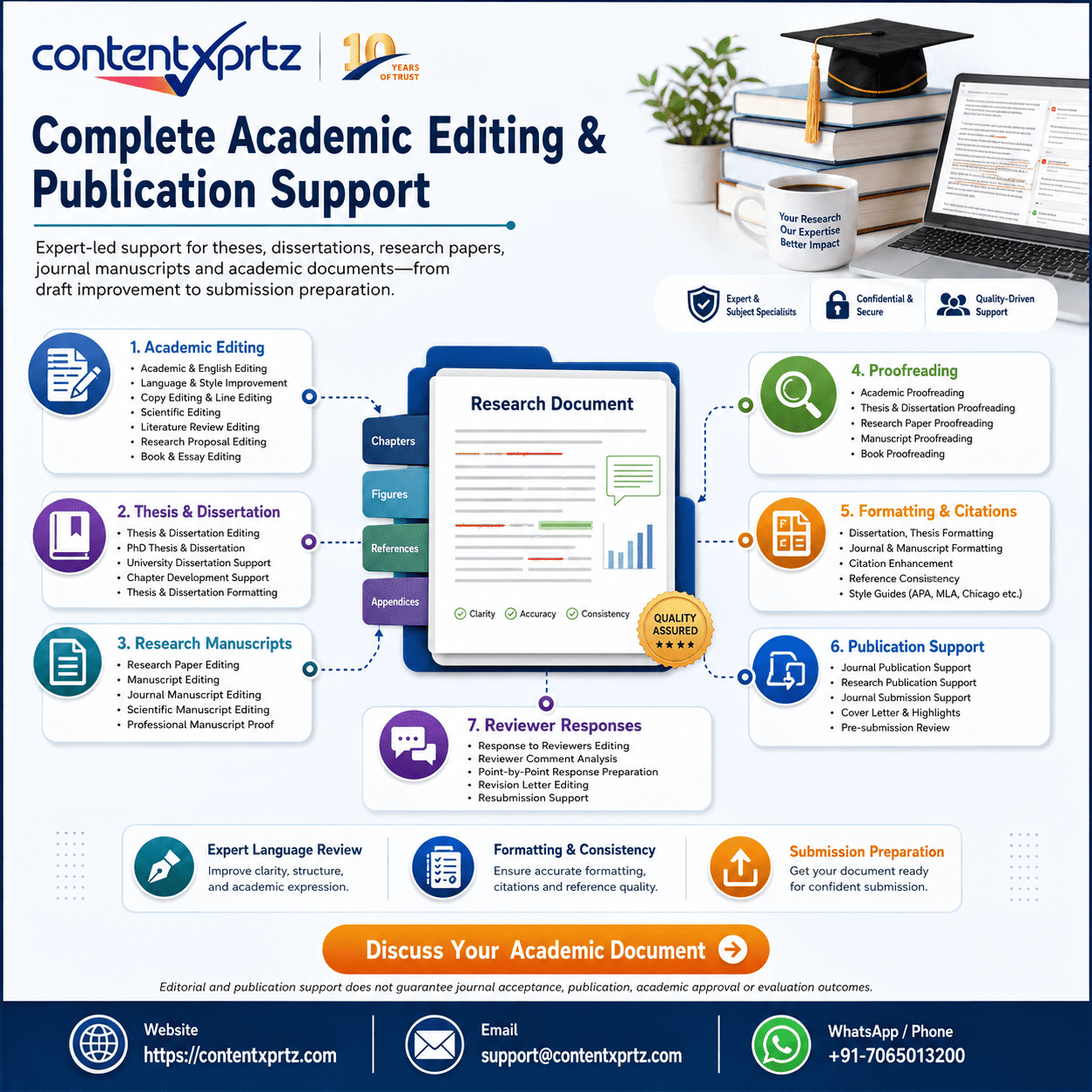
For researchers considering this journal family, Contentxprtz can help with ethical manuscript preparation rather than editorial influence. Support may include scope-alignment review, manuscript assessment, academic editing, ESL language polishing, title and abstract refinement, journal formatting, reference consistency, table and figure language review, cover-letter editing and reviewer-response editing.
A useful starting point is the Contentxprtz journal publication support service. The purpose is to help authors present their own research clearly, accurately and in line with current journal requirements. Contentxprtz does not control editorial decisions and cannot guarantee acceptance or publication.
Preparing a manuscript for Journal of Strategy & Innovation?
Get support with manuscript clarity, journal alignment, references, formatting and publication-readiness checks while keeping authorship, evidence and final submission decisions with the researcher.
Summary: What Researchers Should Remember
The Journal of High Technology Management Research was a long-running Elsevier journal on high-technology and emerging-technology management, indexed in Scopus as Source ID 19713. Its print and online ISSNs were 1047-8310 and 1879-1638, and its final 2024 Scopus metrics included CiteScore 8.4, SJR 0.814 and SNIP 1.592.
For publication decisions today, however, the decisive fact is its 2025 relaunch as Journal of Strategy & Innovation. New manuscripts should be assessed against the successor’s broader strategy-and-innovation scope, current author guide, publishing model and editorial information. Historical indexing is useful context; current scope fit and current submission instructions determine whether a manuscript is ready to submit.
Frequently Asked Questions
What is The Journal of High Technology Management Research?
It was an Elsevier journal focused on interdisciplinary research about managing emerging and high technologies, including technology-based products, services, organisations and strategic challenges. The title ran from 1990 through 2024 and was relaunched in 2025 as Journal of Strategy & Innovation.
Who published The Journal of High Technology Management Research?
Elsevier published the journal. Its former archive remains available on ScienceDirect, and Elsevier now publishes its successor, Journal of Strategy & Innovation.
Was The Journal of High Technology Management Research indexed in Scopus?
Yes. The supplied and cross-checked historical Scopus Source ID is 19713. Researchers should distinguish that former-title record from the active successor journal when documenting current publication requirements.
What was the ISSN of The Journal of High Technology Management Research?
The print ISSN was 1047-8310. The ISSN International Centre lists online ISSN 1879-1638 and identifies 1047-8310 as the ISSN-L.
What were its final 2024 Scopus metrics?
An institutional journal browser reporting Scopus Journal Metrics (2024) lists CiteScore 8.4, SJR 0.814 and SNIP 1.592, with Q1 placement in the listed categories. These are 2024 metrics for the former title.
Did the journal have an Impact Factor?
A current Clarivate Journal Impact Factor for the discontinued title was not verified from an authoritative source while preparing this profile. CiteScore, SJR and SNIP should not be described as an Impact Factor.
Is The Journal of High Technology Management Research still accepting submissions?
Not under that former title. Elsevier announced its relaunch as Journal of Strategy & Innovation on 27 January 2025. New authors should use the successor journal’s current submission route and Guide for Authors.
What subjects does the successor journal cover?
The current scope includes strategy, innovation, technology management, entrepreneurship, governance, digital transformation, emerging technologies, future of work, organisational transformation and AI-enabled business models, with additional interest in areas such as deep-tech ventures, strategic foresight and innovation ecosystems.
What types of papers does Journal of Strategy & Innovation welcome?
Elsevier’s current description welcomes conceptual, empirical and interdisciplinary contributions and also high-quality literature reviews that advance scholarly debate. Authors should verify the exact selectable article types in the current Guide for Authors.
What is the current open-access fee?
The successor journal’s official insights page currently lists an open-access APC of USD 2,830 excluding taxes, with possible reductions where applicable. The subscription option is listed as having no publication fee for authors. Authors should reconfirm the amount before submission.
What is the current acceptance rate?
Elsevier’s insights page currently lists a 5% acceptance rate for Journal of Strategy & Innovation. This should not be attributed retrospectively to The Journal of High Technology Management Research.
How long does the current journal’s publication process take?
The successor’s official insights page lists 5 days to first decision, 95 days to decision after review, 26 days from submission to acceptance and 13 days from acceptance to online publication. These are journal-level statistics, not guarantees for an individual paper.
Is the journal suitable for PhD researchers?
It may be suitable when the manuscript fits the active scope, offers an appropriate scholarly contribution and meets the researcher’s university or doctoral-programme requirements. Scopus indexing or quartile alone does not make a journal automatically suitable for every PhD project.
How can I decide whether my manuscript fits?
Compare the manuscript with the current aims and scope, read several recent papers, check whether the journal publishes your type of contribution, and assess whether the study speaks to strategy, innovation, entrepreneurship, governance or organisational transformation rather than simply mentioning technology.
Can Contentxprtz guarantee acceptance in the journal?
No. Contentxprtz can support ethical manuscript editing, formatting, reference consistency, journal alignment and publication-readiness review, but editorial decisions remain entirely with the journal and acceptance or publication cannot be guaranteed.
Conclusion: Use the Current Journal Identity Before You Submit
The former Journal of High Technology Management Research remains relevant as a Scopus-indexed scholarly record and as the source of a substantial body of research on technology management. For a new submission, however, the active decision is whether your work fits Journal of Strategy & Innovation. Verify the current scope, Guide for Authors, fees and editorial information, then prepare the manuscript around the contribution your research actually makes.
Professional editing can improve clarity and compliance, but it cannot replace strong research design, an authentic contribution or editorial judgement. The safest publication strategy is to choose the journal for genuine scholarly fit and submit a carefully checked manuscript that follows the current rules.