Journal Articles Begin With a Publishable Message, Not a Template
Journal articles are how researchers turn a study, analysis, review, method, case, or scholarly argument into a focused contribution for a defined academic audience. The difficult part is rarely filling headings. It is deciding what the paper is truly saying, which evidence supports that message, which readers need it, and which journal is a realistic home for it. A thesis chapter can contain excellent research and still feel unfocused as an article. A technically correct paper can still be rejected at editorial screening if its scope, article type, novelty statement, structure, or presentation does not fit the journal.
For first-time authors, the process can look deceptively simple: write an introduction, methods, results, discussion, add references, and submit. In practice, journals differ in what they expect from abstracts, headings, reporting detail, tables, figures, data statements, ethics declarations, reference styles, supplementary files, cover letters, and reviewer suggestions. Disciplines differ too. A randomized clinical study, qualitative interview paper, systematic review, engineering methods paper, economics article, and humanities essay do not communicate evidence in the same way. That is why the target journal and article type should influence the manuscript before the final formatting stage.
Language also matters, but publication readiness is broader than grammar. Editors and reviewers need to understand the research question quickly, see why the work matters, follow what was done, distinguish results from interpretation, verify how sources support the argument, and judge whether the conclusions stay within the evidence. Manuscript editing can strengthen this communication by removing ambiguity, repetition, inconsistent terminology, weak transitions, and structural imbalance. It should not create findings, invent citations, conceal methodological limitations, or replace author judgment.
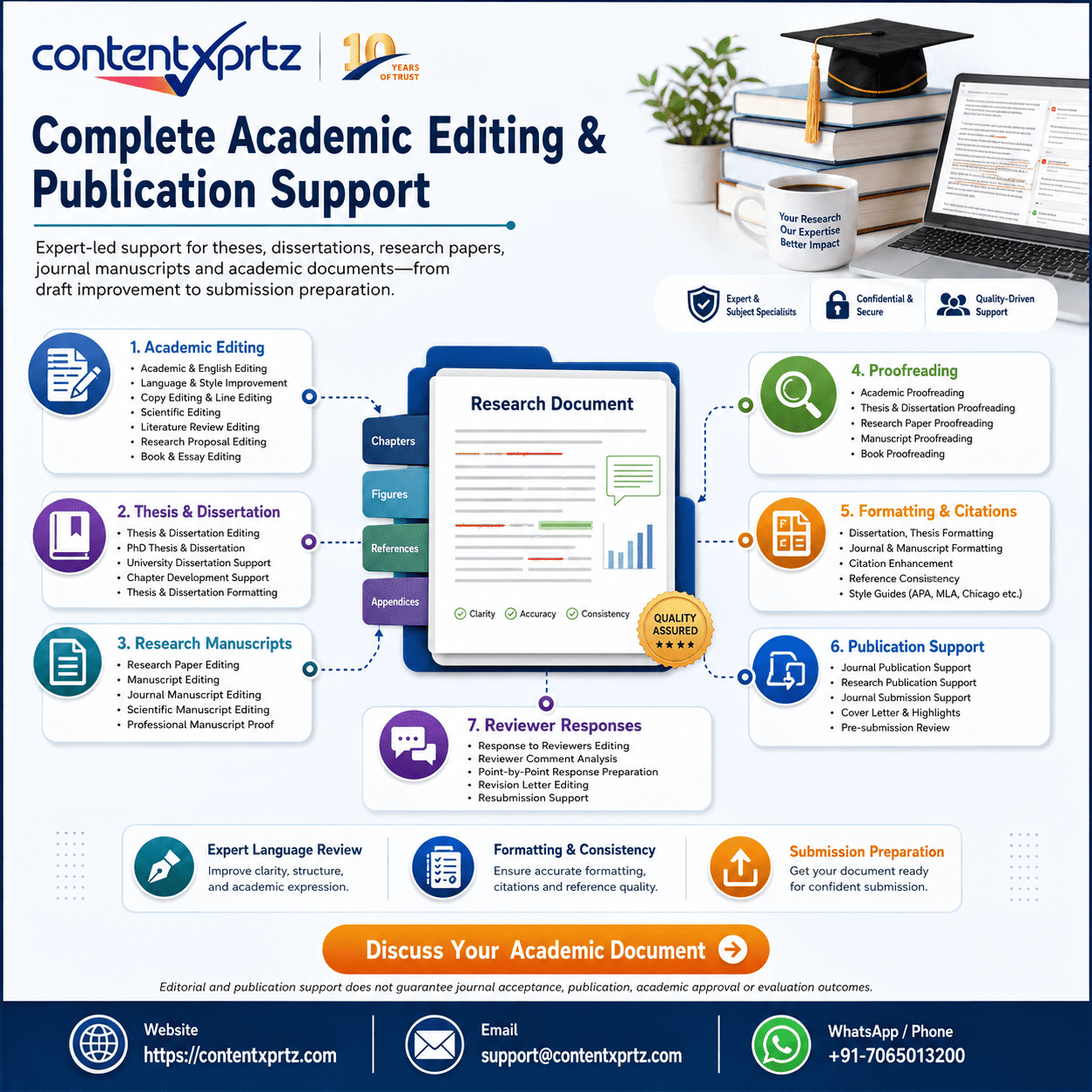
This guide is designed for PhD scholars, postgraduate researchers, early-career academics, ESL authors, and professionals preparing scholarly work for publication. It combines article planning, journal-fit decisions, manuscript editing, publication-readiness checks, peer-review preparation, and academic ethics. Where independent help is useful, Contentxprtz offers academic editing services, journal publication support, and focused journal manuscript editing while keeping the author responsible for the research and final submission.
Quick Answer: What Makes Journal Articles Effective?
Effective journal articles make one clear scholarly contribution, support it with appropriate evidence, and present it in the structure and style expected by a specific journal. Start with the research question and target readership, not with a generic writing template.
Before submission, check journal scope, article type, word limits, required sections, reporting guidelines, citation style, tables and figures, declarations, and file requirements. Then review the manuscript for logical flow, consistency, language, citation accuracy, and whether every conclusion is supported by the results or argument.
Editing can improve communication, but it cannot guarantee publication. Editorial decisions also depend on fit, originality, methodology, evidence, ethical compliance, reviewer judgment, and the journal’s priorities.
Key Takeaways
- A journal article should communicate one focused contribution to a clearly defined scholarly audience.
- The target journal and article type should shape structure, length, references, figures, declarations, and submission files.
- Empirical articles often use Introduction, Methods, Results, and Discussion, but many disciplines and article types use different structures.
- Publication-ready writing requires more than proofreading: logic, section purpose, evidence, citation integrity, and journal compliance all matter.
- Thesis or dissertation material usually needs narrowing and restructuring before it works as a journal manuscript.
- Peer-review preparation includes checking limitations, methods transparency, data presentation, and claims that may invite reviewer questions.
- Authors remain responsible for research, data, citations, declarations, co-author approval, and the final submitted version.
What This Page Covers
- What journal articles are
- Common article structures
- Journal selection and scope
- Manuscript drafting workflow
- Editing and proofreading
- Peer-review readiness
- Citations and publication ethics
Methodology and Academic Sources
This article is based on common scholarly writing, manuscript editing, journal submission, peer-review, and publication-ethics workflows. Publisher requirements vary by discipline, article type, journal, and research design, so the target journal’s current author instructions should always be checked before submission.
The guidance is aligned with established publisher and ethics resources, including the Committee on Publication Ethics guidance, the ICMJE Recommendations, Elsevier author policies and guidelines, Springer Nature author resources, and Crossref documentation for persistent scholarly identifiers and metadata.
What Journal Articles Mean in Academic Publishing
A journal article is a scholarly contribution prepared for publication in a periodical that serves a defined research or professional community. It may report original data, synthesize existing evidence, develop theory, describe a method, analyze a case, debate an issue, or provide a specialized perspective. The phrase therefore describes a publication format, not one single writing pattern.
The most familiar model is an original research article. In many sciences and social sciences, it uses an IMRaD-style structure: introduction, methods, results, and discussion. The introduction establishes the problem and research purpose; the methods explain how the study was conducted; the results report what was found; and the discussion interprets those findings in relation to prior research, limitations, and implications. However, a review article may be organized around search methods and thematic synthesis, a case report around clinical or contextual chronology, and a humanities article around a sustained argument rather than separate methods and results sections.
Research article
Reports original empirical, computational, experimental, observational, or qualitative research using a structure appropriate to the discipline.
Review article
Synthesizes existing literature. Systematic, scoping, narrative, and meta-analytic reviews have different methodological expectations.
Brief communication
Presents a focused finding or concise study within a shorter journal format and tighter limits.
Perspective or commentary
Develops an evidence-informed position, interpretation, or scholarly argument rather than reporting a full original study.
The practical implication is simple: identify the article type before you polish the article. A beautifully edited manuscript can still fail editorial screening if it does not match the journal’s article category or expectations.
Choose the Right Article Type and Journal Before Final Drafting
Journal selection is part of writing strategy because scope and article type determine what information the manuscript needs and how it should be presented. Selecting a journal only after the paper is finished can lead to repeated restructuring, major word-count cuts, reference changes, and figure revisions.
Start with fit, not only prestige
Read the journal’s aims and scope, then examine several recent papers that resemble your topic or method. Ask whether the intended readers would consider your question relevant and whether the contribution is at the depth typically published there. Metrics can be one consideration, but they do not replace scope fit.
| Decision | What to verify | Why it matters |
|---|---|---|
| Article type | Original research, review, case report, brief report, methods paper, perspective, or other category | Determines structure, limits, required declarations, and review expectations |
| Journal scope | Subject area, readership, methodological fit, and recently published topics | Reduces desk-rejection risk caused by poor fit |
| Length | Main text, abstract, references, tables, figures, supplementary files | Prevents late-stage cutting that damages coherence |
| Reporting rules | Study-design checklists, ethics statements, data availability, trial registration where relevant | Supports transparent and complete reporting |
| Publication model | Access options, fees, licensing, repository policy, review model | Affects practical submission and dissemination decisions |
For a shortlist, write one sentence explaining why each journal fits the manuscript. If the reason is only “high impact factor,” the shortlist is not yet strong enough. If the reason is “publishes this article type, reaches the intended field, has recent related papers, accepts this method, and permits the required length,” the decision is more defensible.
A Step-by-Step Workflow for Writing Journal Articles
The most reliable workflow moves from research message to structure, then evidence, then language and formatting. Starting with sentence polishing too early can waste time because entire sections may later be moved, shortened, or deleted.
- Define the central contribution. Write one or two sentences stating the problem, what the study or analysis adds, and why the target reader should care.
- Select the article type and target journal. Download or save the current author instructions and note limits, mandatory sections, citation style, figure requirements, and declarations.
- Build a section-purpose outline. Give every section one job. List the evidence, data, citations, tables, or figures that belong under each heading.
- Draft the methods and results or evidence core first when useful. These sections often provide the factual anchor for the introduction and discussion.
- Write the introduction around the gap. Move from context to the specific unresolved problem, then state the study objective, question, or hypothesis without turning the section into a thesis-length literature review.
- Develop the discussion around interpretation. Explain what the findings mean, compare them with prior work, acknowledge limitations, and distinguish supported implications from speculation.
- Write the title and abstract after the manuscript stabilizes. They should accurately reflect the final paper and help editors understand the contribution quickly.
- Complete technical and ethical checks. Verify references, figures, authorship information, funding, conflicts of interest, ethics statements, data statements, and reporting guidelines where applicable.
- Edit in layers. First review argument and structure, then paragraph flow and terminology, then sentence-level clarity, grammar, style, and journal formatting.
- Prepare the submission package. Confirm file names, anonymization if required, cover letter, highlights, graphical abstract, supplementary files, and any forms requested by the journal.
A layered process is faster than trying to solve scientific logic, paragraph structure, grammar, references, and formatting in one pass. It also makes co-author review more efficient because collaborators can comment on content before time is spent on cosmetic polishing.
Common Problems That Weaken Journal Articles
Many manuscripts are difficult to read not because the research is weak, but because the paper does not make the relationship between question, evidence, and conclusion easy to follow. The following problems are especially common in first submissions.
The introduction becomes a full literature review
Background should lead efficiently to the specific gap and purpose. If every historical detail is included, the research question arrives too late. Keep literature that helps define the problem, establish what is known, identify what remains unresolved, or justify the study.
Results and discussion repeat each other
Results should report the observations or analyses; discussion should explain their meaning. Repeating the same numbers in prose several times reduces space for interpretation. Use tables and figures where they communicate patterns more efficiently.
Claims extend beyond the evidence
Strong writing is precise rather than dramatic. A cross-sectional association does not automatically establish causation. A small single-site study should not imply universal generalizability. The wording of the conclusion should reflect the actual design, sample, uncertainty, and limitations.
Terminology changes across sections
If the same variable, population, intervention, theory, or outcome is called by several names, readers may think they are different concepts. Build a terminology list and use abbreviations consistently.
References are formatted but not verified
Reference software can reproduce incorrect metadata. Check the cited source itself, confirm that the citation supports the claim, and verify identifiers such as DOI when relevant. Never insert an unverified reference solely because an AI system or secondary source suggested it.
Prepare the Manuscript for Submission and Peer Review
Submission readiness means an editor can evaluate the work without being distracted by preventable compliance or presentation problems. Before uploading, compare the manuscript with the journal’s checklist line by line rather than relying on memory.
Make the title and abstract accurate
The title should be specific enough to signal the topic without making claims the paper cannot support. The abstract should represent the actual manuscript: purpose, methods or approach, key findings, and main conclusion where the article type requires them. Avoid introducing evidence in the abstract that does not appear in the paper.
Anticipate reviewer questions
Read the manuscript as a skeptical but fair reviewer. Where did participants or data come from? Why was this method chosen? Are inclusion and exclusion criteria clear? Are measures defined? Are statistical or analytical decisions explained? Are limitations acknowledged? Does each figure stand on its own? Are alternative explanations considered? A short pre-submission peer-style review can reveal gaps before external review begins.
Prepare a clean submission package
Journals may request a cover letter, title page, anonymized manuscript, separate figure files, supplementary material, highlights, graphical abstract, reporting checklist, author-contribution statement, funding statement, conflict-of-interest declaration, ethics approval information, data-availability statement, and suggested reviewers. Requirements vary, so upload only what the current instructions request.
Editing levels: proofreading, copyediting, and substantive manuscript editing
Not every journal article needs the same kind of editorial support. Proofreading is the final surface-level check for grammar, spelling, punctuation, typographical errors, and obvious formatting inconsistencies after the content is already stable. Copyediting goes further by improving sentence clarity, consistency, terminology, style, and readability while preserving the author’s meaning. Substantive or structural manuscript editing examines higher-level issues such as section balance, repetition, paragraph logic, argument flow, placement of information, and whether the manuscript communicates its contribution efficiently.
Choosing the wrong level of editing can waste time. Proofreading a manuscript that still contains three competing research messages may make the sentences cleaner without solving the reason editors struggle to understand the paper. Conversely, a well-structured manuscript that has already been reviewed by experienced co-authors may not need extensive restructuring; a focused copyedit or proofread may be sufficient. Before requesting help, ask what problem is preventing the manuscript from being ready. Is the issue language accuracy, excessive length, unclear argument, inconsistent references, journal formatting, or uncertainty about the submission package? A precise brief leads to more useful editing and helps authors retain control of scientific decisions.
How to review the abstract, tables, and figures as a set
Editors often encounter the manuscript in layers: title, abstract, figures, then main text. These elements should therefore tell a consistent story. Compare the primary objective in the abstract with the outcome emphasized in the results and conclusion. Check that the most important numerical findings are represented consistently across text, tables, and figures. If a table reports one denominator and the prose implies another, or if a figure label uses a different variable name from the methods, confidence in the manuscript can decline even when the underlying analysis is correct.
Every table and figure should answer a clear question. Give it an informative title or legend, define abbreviations, report units, and provide enough context to understand the content without forcing the reader to search the main text for basic definitions. At the same time, avoid repeating every table value in prose. Use the text to identify the pattern or finding that matters, then direct the reader to the table or figure for detail. This approach saves words and keeps the narrative analytical rather than mechanical.
Use the cover letter to explain fit, not to oversell the study
Where a cover letter is requested, keep it concise and factual. Identify the manuscript title and article type, state the central contribution in plain language, and explain why the work fits the journal’s readership or scope. Include declarations the journal specifically asks for, such as confirmation that the manuscript is not under consideration elsewhere. Avoid exaggerated language about being “groundbreaking,” guaranteed to transform the field, or certain to receive high citations. Editors can evaluate significance from the paper itself. A useful cover letter removes uncertainty about fit and submission status rather than acting like an advertisement.
Plan for peer review before the first submission
Peer review is easier to navigate when the manuscript already contains a transparent record of key decisions. Keep organized versions of analyses, figure source files, data dictionaries where relevant, reference libraries, reporting checklists, ethics approvals, and co-author decisions. If reviewers ask why a variable was defined in a particular way or request a sensitivity analysis, the team should be able to reconstruct what was done. Good version control also prevents an old table, abstract, or supplementary file from being uploaded accidentally after late revisions.
When reviewer comments arrive, separate scientific decisions from writing tasks. First determine whether you agree with each comment and what change, clarification, additional analysis, or reasoned explanation is appropriate. Then revise the manuscript and prepare a response that quotes or clearly identifies each comment, states the action taken, and points to the relevant location. If you disagree, respond respectfully with evidence or methodological reasoning. Editing support can improve the clarity and tone of the response letter, but the substantive answer should come from the authors because it concerns the research and its interpretation.
Need an independent manuscript check?
Contentxprtz can review language, structure, consistency, formatting, and journal-readiness while preserving author ownership and responsibility.
Academic Ethics, Authorship and Responsible Editing
Ethical journal article preparation requires transparent authorship, accurate reporting, authentic citations, responsible use of editing or AI tools, and adherence to the journal’s research and publication policies. Good editing should help readers understand the author’s work; it should not disguise borrowed text, invent evidence, fabricate references, or create a false impression of authorship.
Authors remain responsible for checking every factual statement, quotation, citation, table, figure, analysis, and declaration. Co-authors should have appropriate opportunities to review and approve the submitted version according to the standards that apply in their discipline. When an editor makes substantial language or structural suggestions, the authors should review those suggestions rather than accepting them mechanically.
AI-assisted tools require the same caution. They can help with brainstorming, language suggestions, or formatting in some contexts, but generated text and references may be inaccurate. Journals and publishers differ in their disclosure rules and acceptable uses. Check the target journal policy and verify all output against the research record and source literature. AI systems should not be treated as accountable authors.
The Committee on Publication Ethics and publisher-specific policies are useful reference points for publication conduct. For biomedical research, the ICMJE Recommendations provide detailed guidance on authorship, disclosure, manuscript preparation, and editorial considerations. Other disciplines may use different standards, so field-specific guidance should also be consulted.
Practical Journal Article Examples
These examples show how the same research can become more publishable when the author solves the correct problem instead of only correcting grammar.
A PhD chapter is too broad
Situation: A scholar extracts an 11,000-word thesis chapter and submits it almost unchanged. Common problem: the paper contains a long literature review, several research questions, and background written for examiners rather than journal readers. Better approach: select one publishable message, rebuild the introduction around one gap, retain methods and results relevant to that message, and rewrite the discussion for the target journal. Expert help: substantive manuscript editing can identify repetition, section imbalance, and unclear transitions without changing the research findings.
The research is clear to the authors but not to reviewers
Situation: An international research team has sound data, but reviewers previously described the manuscript as difficult to follow. Common problem: sentence-level grammar, inconsistent terminology, overloaded paragraphs, and unclear links between results and interpretation. Better approach: preserve technical meaning while improving sentence structure, terminology consistency, paragraph logic, and signposting. Expert help: academic language editing can reduce ambiguity while leaving scientific decisions with the authors.
A polished paper is repeatedly desk rejected
Situation: A manuscript has been reformatted for several journals but receives rapid editorial rejection. Common problem: journal choices are based primarily on ranking rather than scope and article type. Better approach: compare the abstract and method with recent articles, assess readership and contribution level, and build a reasoned shortlist. Expert help: publication support can improve the selection process and submission readiness, but no service can promise editorial acceptance.
Revisions become defensive and hard to track
Situation: Authors receive major revision and start rewriting without a response plan. Common problem: changes are made inconsistently and the response letter does not show where each comment was addressed. Better approach: create a comment-by-comment matrix, decide the scientific response first, revise the manuscript, then write concise responses with locations of changes. Expert help: editorial support can improve clarity and tone after the authors determine the substantive response.
Citations look complete but contain errors
Situation: A reference manager produces a clean bibliography, but several imported records have wrong years, page ranges, or titles. Common problem: formatting is mistaken for verification. Better approach: audit high-value citations against the original source or trusted metadata, check in-text/list correspondence, and confirm that each citation supports the statement it follows. Expert help: reference and formatting review can detect inconsistencies, but authors should verify source accuracy.
The manuscript is 35% over the limit
Situation: The authors try to solve a scope problem by deleting connecting words and compressing sentences. Common problem: readability drops while unnecessary background remains. Better approach: remove duplicated literature, consolidate results, move appropriate details to supplements, and narrow claims before line editing. Expert help: structural editing can reduce length without erasing essential methodological information.
Journal Article Publication-Readiness Checklist
Use this checklist after the scientific content is stable and before final upload. It separates manuscript quality from submission mechanics so neither is overlooked.
Content and argument
- The research question, objective, hypothesis, or scholarly purpose is explicit.
- The manuscript makes one coherent contribution rather than several loosely connected claims.
- The introduction leads to the gap without unnecessary thesis-level background.
- Methods are transparent enough for the article type and study design.
- Results or evidence directly address the stated question.
- The discussion distinguishes findings, interpretation, comparison, limitations, and implications.
- The conclusion does not claim more than the evidence supports.
Language and presentation
- Terminology, abbreviations, tense, units, statistical notation, and naming are consistent.
- Paragraphs have clear topic focus and logical transitions.
- Tables and figures are readable, numbered correctly, cited in the text, and not unnecessarily duplicative.
- The title and abstract accurately represent the final manuscript.
- References are authentic, traceable, relevant, and consistent with journal style.
Journal compliance
- Article type, word count, heading structure, and file format match current author instructions.
- Required ethics, funding, conflict, authorship, data, and acknowledgements statements are complete.
- Reporting guidelines and checklists have been considered where relevant.
- Submission files, cover letter, supplementary material, and anonymization requirements have been checked.
- All authors have reviewed and approved the final submission version as appropriate.
How Contentxprtz Can Help With Journal Articles
Contentxprtz can support journal authors when the research is complete but the manuscript needs clearer communication, stronger organization, more consistent academic language, or closer alignment with journal presentation requirements. The appropriate level of support depends on the manuscript rather than on a one-size-fits-all package.
Journal manuscript editing can address sentence clarity, academic tone, terminology consistency, paragraph flow, section balance, and journal-facing presentation. Researchers who need a broader readiness review can use manuscript assessment to identify structural or presentation issues before intensive line editing. Where the paper is ready for submission but the process is unfamiliar, publication support can help with practical preparation such as journal-fit review, formatting, submission materials, and reviewer-response presentation when those tasks are within the agreed scope.
The ethical boundary is important: editors should not fabricate evidence, manufacture references, alter data to create a preferred result, or promise publication. Authors retain control of the research and approve the final text. The best collaboration gives the author a clearer manuscript and a clearer understanding of why changes were made.
Summary: Journal Articles
Journal articles succeed when research quality, journal fit, article structure, transparent reporting, academic language, citation integrity, and submission compliance work together. Begin with a focused contribution and realistic target journal. Build the paper so each section performs a clear function, then edit in layers: argument, structure, paragraph flow, sentence clarity, consistency, references, and formatting.
Self-editing may be enough for experienced authors with strong co-author review and a manuscript that already fits the journal. Professional editing is more useful when language obscures meaning, a thesis chapter needs adaptation, sections are unbalanced, references and formatting are inconsistent, or an independent publication-readiness check would help. In every case, authors remain responsible for the research, citations, data, ethical declarations, and final submission.
Frequently Asked Questions About Journal Articles
These answers address common questions from researchers preparing, editing, and submitting scholarly manuscripts.
What are journal articles?
Journal articles are scholarly papers published in academic or professional journals to communicate research findings, reviews, methods, theory, commentary, or other discipline-specific knowledge. Many research articles follow a recognizable structure such as title, abstract, introduction, methods, results, discussion, conclusion, acknowledgements, and references, although the exact format depends on the field and article type. A humanities article may develop an argument through thematic sections, while a clinical paper may follow a highly standardized reporting framework. The safest approach is to identify the target journal and article type before finalizing the manuscript. Read the journal’s author instructions, examine several recent articles in the same section, and note requirements for word count, headings, reference style, tables, figures, supplementary files, declarations, and reporting checklists. A journal article should present a clear contribution supported by appropriate evidence. Editing can improve language, logic, consistency, and presentation, but authors remain responsible for the research, data, interpretations, citations, and final submission.
How is a journal article different from a research paper?
The terms overlap, but they are not always identical. A research paper is a broad term for a document that reports or analyzes research and may be written for a course, conference, institution, repository, or journal. A journal article is specifically prepared for publication in a scholarly or professional journal and must satisfy that journal’s scope, article type, author instructions, ethical requirements, and peer-review expectations. A thesis chapter or classroom research paper often needs substantial adaptation before it works as a journal article. The manuscript may need a narrower research question, a shorter literature review, a more explicit contribution, a journal-specific structure, tighter methods reporting, clearer results, and a discussion positioned against current literature. References, tables, figures, declarations, and supplementary materials may also need reformatting. If you are converting a larger academic document into a journal manuscript, begin by defining the single publishable message and selecting a realistic target journal before editing sentence by sentence.
What structure should journal articles follow?
There is no universal structure for every journal article, but empirical research commonly uses an IMRaD-style sequence: Introduction, Methods, Results, and Discussion, supported by a title, abstract, keywords, conclusion where required, references, and declarations. Review articles, case reports, theoretical papers, qualitative studies, humanities papers, and technical notes can follow different structures. Journal instructions always take priority over a generic template. Start by checking the target journal’s article-type page and several recently published papers in that category. Confirm whether the journal requires structured abstracts, numbered headings, graphical abstracts, data-availability statements, funding disclosures, conflict-of-interest statements, author-contribution declarations, or specific reporting guidelines. Then create an outline in which each section has a clear job. A strong structure reduces repetition because background belongs in the introduction, procedures in methods, observations in results, and interpretation in discussion. Professional manuscript editing can help improve this separation without altering the study itself.
How long should a journal article be?
Journal article length depends on the journal, discipline, and article type. Some journals set strict limits for the main text, abstract, references, tables, figures, or supplementary material, while others provide flexible ranges. Original research, brief communications, systematic reviews, case reports, perspectives, and methods papers often have different limits even within the same journal. Do not choose a word count from a generic web estimate when the target journal provides its own instructions. Check the current author guidelines and decide what counts toward the limit. Then revise for information value rather than simply cutting words. Remove duplicated background, repeated interpretation, unnecessary procedural detail that belongs in supplementary material, and sentences that do not advance the research question. Keep details necessary for reproducibility and transparent interpretation. If the paper substantially exceeds the limit, the problem may be scope rather than wording; splitting or refocusing the manuscript may be more appropriate than aggressive line editing.
How do I choose a journal for my article?
Choose a journal by matching the manuscript’s subject, audience, article type, methodological approach, and level of contribution to the journal’s stated aims and scope. Read recent issues to see whether similar research questions and methods are being published. Check practical factors such as accepted article types, word limits, peer-review model, open-access options, publication fees, data policies, reporting standards, and indexing information that matters to your institution. Be cautious with unsolicited invitations that promise rapid or guaranteed publication. Verify the journal through its official website and publisher information, and review its editorial policies. A realistic journal shortlist should include reasons for fit rather than relying only on a metric or ranking. If you are uncertain, prepare a brief manuscript profile containing title, abstract, keywords, study design, subject area, novelty, and target readership. That information makes journal matching more disciplined and reduces the risk of submitting to a venue that is outside scope.
What makes a journal article publication-ready?
A publication-ready journal article is not merely grammatically correct. It has a clear research question or purpose, a coherent contribution, an appropriate article structure, transparent methods where relevant, accurately presented results, a discussion that distinguishes evidence from interpretation, complete and traceable citations, and formatting aligned with the target journal. The title and abstract should accurately represent the paper, because editors often use them for initial screening. Tables and figures should add information rather than duplicate the text. Terminology, abbreviations, statistical notation, tense, and reference style should be consistent. Required declarations should be present, and any reporting guideline relevant to the study design should be considered. Before submission, complete separate checks for scientific content, language, journal compliance, references, figures, ethics statements, and files. Expert editing can help identify presentation problems and inconsistencies, but it cannot substitute for valid research design, accurate data, or author accountability.
Can I turn a thesis or dissertation into journal articles?
Yes, many researchers develop journal articles from thesis or dissertation work, but direct copy-and-paste conversion is rarely effective. A thesis is written to demonstrate the breadth and depth of a research project to examiners, whereas a journal article usually communicates one focused contribution to a specialist readership within a tighter word limit. Start by identifying one strong research question, dataset, method, or finding that can stand as a coherent paper. Rebuild the introduction around that narrower purpose, reduce literature review material to what the article needs, condense methods without removing essential reproducibility details, select results that answer the article’s question, and rewrite the discussion for the target journal’s audience. Check institutional rules, co-author expectations, prior dissemination policies, and the journal’s approach to material derived from theses or repositories. Cite related publications transparently and avoid redundant publication. A manuscript editor can support the transformation while keeping the intellectual work and claims with the authors.
Do journal articles need professional editing before submission?
Professional editing is optional, not a requirement for every manuscript, but it can be useful when language, structure, consistency, journal formatting, or presentation is obscuring otherwise sound research. Authors with strong academic English and experienced co-authors may be able to complete the process internally. Others benefit from an independent review, especially when writing in a second language, adapting a thesis chapter, responding to prior rejection, or preparing a paper for a highly specific journal format. Ethical editing should improve clarity and readability without inventing data, changing the study’s conclusions, adding unsupported claims, or misrepresenting authorship. Before hiring an editor, define the requested level of support: proofreading, copyediting, substantive language editing, formatting, reference checking, or publication-readiness review. Authors should review every suggested change and remain responsible for the final version. Editing cannot guarantee acceptance because editorial decisions also depend on scope, novelty, methods, evidence, peer review, and journal priorities.
How should references be handled in journal articles?
References in journal articles should be relevant, authentic, traceable, accurately cited in the text, and formatted according to the target journal’s required style. Citation management software can reduce repetitive formatting work, but automated records still need human checking for author names, article titles, journal names, year, volume, issue, pages, DOI, and other metadata. Do not cite a source you have not verified merely because it appears in an AI-generated list or another paper’s references. Make sure every in-text citation has a corresponding reference-list entry and every listed reference is cited where required. Use primary sources when they are the most appropriate evidence, cite reviews for synthesis, and distinguish your interpretation from the claims of cited authors. Before submission, check retracted or corrected literature when it could affect your argument. For author-date styles, verify year and spelling consistency; for numbered styles, confirm numbering after final revisions.
How can Contentxprtz help with journal articles?
Contentxprtz can support researchers with ethical journal manuscript editing, proofreading, language polishing, structural clarity, reference and formatting checks, journal-readiness review, and publication-support tasks that directly relate to the manuscript. The appropriate service depends on the document’s condition. A nearly finished paper may need proofreading and journal formatting, while an ESL manuscript may benefit from deeper language editing. A thesis-derived article may need help with focus, repetition, section balance, and adaptation to journal expectations. Support can also include preparing a cleaner response to reviewer comments when the authors have already decided how to address the scientific issues. Contentxprtz should not replace the author’s research decisions, fabricate citations, create data, conceal plagiarism, or promise publication. Authors remain responsible for the evidence, methods, claims, co-author approvals, declarations, and final submission. The most useful starting point is a manuscript plus the target journal’s author instructions and a clear description of the editing level required.
Turn Good Research Into a Clear, Journal-Ready Manuscript
The core challenge in journal article writing is not simply producing academic-sounding sentences. It is transforming research into a focused contribution that the right readers can understand, evaluate, and connect to existing scholarship. That requires journal fit, disciplined structure, transparent evidence, accurate citations, careful language, and realistic claims.
Experienced authors can often complete much of this work through self-editing and co-author review. Expert-assisted editing becomes valuable when language barriers, structural complexity, journal adaptation, tight word limits, reference inconsistency, or publication unfamiliarity make it difficult to see the manuscript objectively. The role of support is to improve communication and readiness—not to replace the author’s intellectual responsibility or promise a publication outcome.
Contentxprtz helps researchers improve clarity, structure, ethics, and publication readiness through focused manuscript editing and relevant publication support. Authors remain responsible for their research, data, claims, citations, declarations, and final submission decisions.
“At Contentxprtz, we don’t just edit; we help ideas reach their fullest potential.”