What Is the International Journal of Quality & Reliability Management?
The International Journal of Quality & Reliability Management is a peer-reviewed Emerald Publishing journal that connects scholarly research with the practical improvement of quality and reliability in organizations. Its stated remit spans manufacturing, services, public-sector and voluntary-sector settings, while maintaining a clear emphasis on management implications. The journal specifically distinguishes itself from outlets dominated by engineering or heavy mathematical treatments of reliability.
For researchers, that positioning is important. A technically competent manuscript may still be a weak fit if it does not explain how its findings can inform middle or senior managers, quality leaders, operational-excellence teams or organizational decision makers. Conversely, empirical, conceptual, review, case-based and action-research work can fit well when the research question, methodology and managerial contribution are explicit.
Quick answer
IJQRM is published by Emerald Publishing; its print ISSN is 0265-671X and eISSN is 1758-6682. It is ranked by Scopus, and the supplied Scopus Source ID is 144740. Emerald currently reports a 2025 CiteScore of 8.7, a 2025 Impact Factor of 3.0 and a 22.2% acceptance rate for submissions received between 1 April 2024 and 31 March 2025.
Before submitting, authors should confirm that their manuscript is management-oriented, practically useful, 5,000–10,000 words, anonymised for double-anonymous review, and prepared with the required structured abstract and Harvard-style references.
Key takeaways
- Publisher: Emerald Publishing; journal abbreviation commonly used by the publisher: IJQRM.
- Primary emphasis: management aspects of quality and reliability, with practical relevance for organizations.
- Scopus Source ID supplied for this journal: 144740; Emerald lists Scopus among its journal rankings.
- Publisher-reported 2025 CiteScore: 8.7; 2026 CiteScore Tracker: 9.1, updated monthly.
- Publisher-reported 2025 Journal Impact Factor: 3.0; five-year Impact Factor: 3.2.
- Double-anonymous review with at least two independent referees for manuscripts that pass editorial screening.
- Current article length requirement: 5,000–10,000 words, with a structured abstract and up to 12 keywords.
- Gold and green open-access routes are available; the gold OA APC is variable and should be checked at acceptance.
Journal information at a glance
| Field | Journal information |
|---|---|
| Journal name | International Journal of Quality & Reliability Management (IJQRM) |
| Publisher | Emerald Publishing |
| ISSN / eISSN | 0265-671X / 1758-6682 |
| Scopus Source ID | 144740 |
| Current Scopus status | Emerald lists the journal as ranked by Scopus; authors should verify institutional requirements in the live Scopus profile. |
| Primary subject orientation | Quality management, reliability management, business improvement, operations and managerial practice. |
| CiteScore | 8.7 (2025); CiteScore Tracker 9.1 for 2026, updated monthly. |
| Impact Factor | 3.0 (2025); five-year Impact Factor 3.2 (2025). |
| SJR / SNIP / quartile | Not displayed on the current Emerald journal page; verify the latest value and category directly in Scopus. |
| Acceptance rate | 22.2% for submissions from 1 Apr 2024–31 Mar 2025. |
| Time to first decision | 81 days for submissions from 1 Apr 2024–31 Mar 2025. |
| Acceptance to publication | 34 days; publisher data last updated April 2025. |
| Peer review | Double-anonymous; at least two independent referees after editorial screening. |
| Article length | 5,000–10,000 words, including structured abstract, references, tables/figures text and appendices. |
| Open access | Hybrid: gold OA after acceptance or green self-archiving route. |
| Official journal page | Emerald IJQRM page |
| Scopus profile | Scopus Source ID 144740 |
Methodology and sources
This profile was prepared from the journal information supplied with the task and cross-checked against the current official Emerald Publishing page and author guidelines. Current metrics, editorial information, submission requirements, open-access arrangements and timelines can change; researchers should reconfirm them immediately before submission, especially where a university or funder has specific indexing or quartile rules.
Journal aims and scope
IJQRM positions quality and reliability as management concerns rather than purely technical engineering problems. Emerald’s scope describes a journal intended to keep managers and researchers current with new thinking, frameworks, roadmaps, concepts, principles, techniques and developments that can improve product and service quality. The journal covers business improvement in manufacturing and services as well as public and voluntary organizations.
The defining fit criterion is managerial usefulness. Emerald explicitly states that the journal’s primary scope concerns the management aspects of quality and reliability, not engineering-led or heavily mathematical components. An author using optimization, simulation, reliability modelling or statistical methods therefore needs to explain what the results mean for organizational design, leadership decisions, process improvement, risk, maintenance, service performance or quality strategy.
The scope is also receptive to methodological diversity. The publisher encourages literature reviews, case studies, action research and conceptual framework papers, provided the manuscript contains a strong research-methodology section. That makes the journal relevant to researchers who can combine theoretical contribution with practical implementation lessons.
Subjects and research themes covered
The journal’s official topic list spans both established quality-management practice and newer digital or operational-excellence themes. Relevant areas include reliability and maintenance management; sustainability of quality; service quality; product liability; economics and cost of quality; design for reliability and maintainability; quality-management systems such as ISO 9001; total quality management; quality and reliability education; performance of quality; and improvement tools such as QFD, the Kano model and statistical process control.
It also welcomes work on reliability-improvement methods such as Taguchi methods and design FMEA, computer simulation for quality and reliability improvement, Quality 4.0, Lean 4.0 and OPEX 4.0, Lean Thinking, Six Sigma, Kaizen and continuous improvement, quality-improvement frameworks, reliability standards, quality in supply chains, operational excellence and quality in project management.
Likely strong fit
A study that links a rigorous method to a clear quality or reliability management problem and explains actionable implications for organizations.
Potentially weak fit
A highly mathematical reliability paper with limited managerial interpretation, or a generic management paper in which quality or reliability is only incidental.
Scopus indexing, visibility and journal metrics
The journal is identified in the supplied source data with Scopus Source ID 144740, and Emerald lists Scopus among the systems by which the journal is ranked. The publisher also lists EBSCO Business Source products, INSPEC, ProQuest and the Emerging Sources Citation Index (ESCI) among its abstracting and indexing services, alongside several national and business-school journal lists.
For citation metrics, Emerald currently displays a 2025 CiteScore of 8.7 and a 2026 CiteScore Tracker of 9.1. The tracker is updated monthly and should be understood as a current-year indicator rather than the final annual CiteScore. Emerald also displays a 2025 Journal Impact Factor of 3.0 and a 2025 five-year Impact Factor of 3.2.
The current Emerald page does not display SJR, SNIP or a current Scopus quartile. Those indicators can vary by reporting year and subject category. For a PhD, promotion, funding or institutional compliance decision, verify the live Scopus source profile and the exact category used by your institution rather than relying on an old web listing.
Article types and classifications
During submission, authors are asked to select a paper type from Quality Paper, Reliability Paper or Book Review. They must also choose the most appropriate manuscript category. Emerald lists research paper, viewpoint, technical paper, conceptual paper, case study, literature review and general review.
This two-level classification matters because it signals both the subject emphasis and the form of contribution. A conceptual quality-management framework, for example, should not be labelled as an empirical research paper unless it actually tests data or a model. Similarly, a literature review should do more than summarize sources: it should make its review method and critical contribution transparent.
Manuscript and formatting requirements
| Requirement | Current guidance |
|---|---|
| File format | Microsoft Word is required for article files. A PDF may accompany Word; PDF alone is not accepted. LaTeX may be used with an accompanying PDF. |
| Length | 5,000–10,000 words. The count includes the structured abstract, references, text in tables/figures and appendices; allow 250 words per figure or table. |
| Abstract | Structured abstract with Purpose, Design/methodology/approach, Findings and Originality; selected implication sections are optional. Maximum 250 words including keywords and article classification. |
| Keywords | Up to 12 short, relevant keywords. |
| Author details | Entered in ScholarOne; every contributing author needs an account. The anonymised manuscript should not contain identifying author information. |
| References | Recognised Harvard style; Emerald provides its own Harvard style guide. |
| Tables | Submitted separately, numbered consecutively with Roman numerals and clearly positioned in the manuscript. |
| Figures | High-quality electronic files with clear captions; accepted figure formats include AI, EPS, JPEG, BMP and TIF. |
| Funding | All external research funding must be disclosed, including the funder’s role in the research process. |
Authors should also prepare acknowledgements and short biographies separately where used, because those materials can reveal identity during double-anonymous review. A careful pre-submission check should remove author names from the manuscript, figures, captions and self-referential wording that could identify the research team.
How to submit to IJQRM
- Check journal fit. Re-read the official aims and scope and compare your paper with recent IJQRM articles.
- Prepare the anonymised manuscript. Follow the length, structured-abstract, keyword, file and reference requirements.
- Confirm authorship and ethics. Agree the author list before submission, disclose funding and conflicts, and obtain approvals or permissions where required.
- Submit through ScholarOne. Emerald states that the corresponding author must submit through the journal’s ScholarOne system accessed from the official Emerald page; authors should not submit through a third-party proxy.
- Add ORCID and metadata carefully. Ensure names, affiliations, title, abstract and keywords match the manuscript and are entered accurately.
- Retain the manuscript number. The journal sends an automated confirmation after successful submission; that number should be used in later correspondence.
Peer review, editorial screening and timelines
Every submission is first screened by the journal’s editorial office. A manuscript can be declined or returned before external review if it does not fit the journal’s aims, submission policies or quality expectations. Papers considered potentially suitable are sent to at least two independent referees under a double-anonymous peer-review process.
After reviewer reports are received, the editor may accept, request minor or major revisions, or decline the paper. Emerald’s journal-specific operational data currently reports 81 days to first decision for submissions received from 1 April 2024 to 31 March 2025. It reports 34 days from acceptance to publication, based on the previous 12 months and last updated in April 2025. These figures are historical averages, not guaranteed timelines.
The publisher-reported acceptance rate is 22.2% for submissions between 1 April 2024 and 31 March 2025. Authors should treat this as context about selectivity, not as a probability calculator for their manuscript. Scope fit, methodological quality, contribution, clarity and reviewer/editor judgement all affect individual outcomes.
Open access and publication fees
IJQRM operates as a hybrid journal. After acceptance, authors can choose gold open access. Emerald states that gold OA uses a CC BY 4.0 licence and requires an article processing charge. The APC is journal-specific and can change, so the precise amount should be checked on Emerald’s current APC price list or in the editorial system at the point of acceptance.
Authors who do not choose gold OA can use Emerald’s green open-access/self-archiving route. Emerald states that the accepted manuscript can be made openly available without an embargo once the article is published. There is no submission fee merely for sending a paper to the journal; Emerald says payment is requested only when an author elects gold open access after acceptance, subject to applicable arrangements.
Research ethics and publication integrity
Emerald’s journal guidance follows research-integrity principles aligned with COPE. Manuscripts should be original, not simultaneously under consideration elsewhere, and transparent about conflicts of interest. Where human participants are involved, authors must consider ethics approval and informed consent and include the required statements. Permissions must be obtained for third-party material and for non-public organizational or individual information where publication consent is required.
The publisher’s AI policy also requires careful attention. Emerald states that generative AI should not be used to create new submission content, while certain copy-editing uses on an author’s own original work may be permitted under its policy and disclosure expectations. Large language models cannot be credited as authors. Researchers should read the current policy directly before submission because publisher AI rules can evolve.
Who should consider submitting?
IJQRM may be appropriate for researchers, PhD scholars, faculty members and practitioners whose work addresses a substantive quality or reliability management question and produces insight that can influence organizational practice. Strong candidates include studies of operational excellence, Lean and Six Sigma, service quality, quality-management systems, reliability or maintenance management, supply-chain quality, Quality 4.0, improvement frameworks and implementation outcomes.
Journal-fit checklist
- Is quality or reliability management central to the research question rather than a peripheral keyword?
- Does the paper make a clear theoretical, empirical, conceptual or practice contribution?
- Can a middle or senior manager understand why the findings matter?
- Is the methodology rigorous and explained strongly enough for the article type?
- If the work is highly technical, have you translated the technical result into managerial implications?
- Does the manuscript resemble the themes, methods and level of contribution visible in recent IJQRM papers?
- Can the paper comply with the 5,000–10,000-word requirement without padding or excessive compression?
- Does your institution accept the journal’s current indexing/ranking status for your specific academic requirement?
How to prepare a stronger, journal-aligned manuscript
As a practical publication-readiness step, start with the contribution statement rather than the formatting. In one paragraph, explain the management problem, the evidence or conceptual approach, what the study adds to prior quality/reliability literature, and what a manager can do differently because of the findings. If that paragraph is vague, the manuscript is likely to feel unfocused even when the analysis is sound.
Next, compare the paper with several recently published IJQRM articles on adjacent topics. Look for how they position their research problem, describe methodology, build managerial implications and handle limitations. This is general scholarly practice rather than an official requirement, but it can reveal whether your paper speaks the journal’s intellectual language.
Finally, audit the submission package: structured abstract; paper classification; keyword selection; anonymisation; funding and conflict disclosures; ethics statements where applicable; reference consistency; table and figure files; and a concise title that reflects the real contribution. Do not wait until ScholarOne upload to discover missing materials.
Need an ethical publication-readiness review?
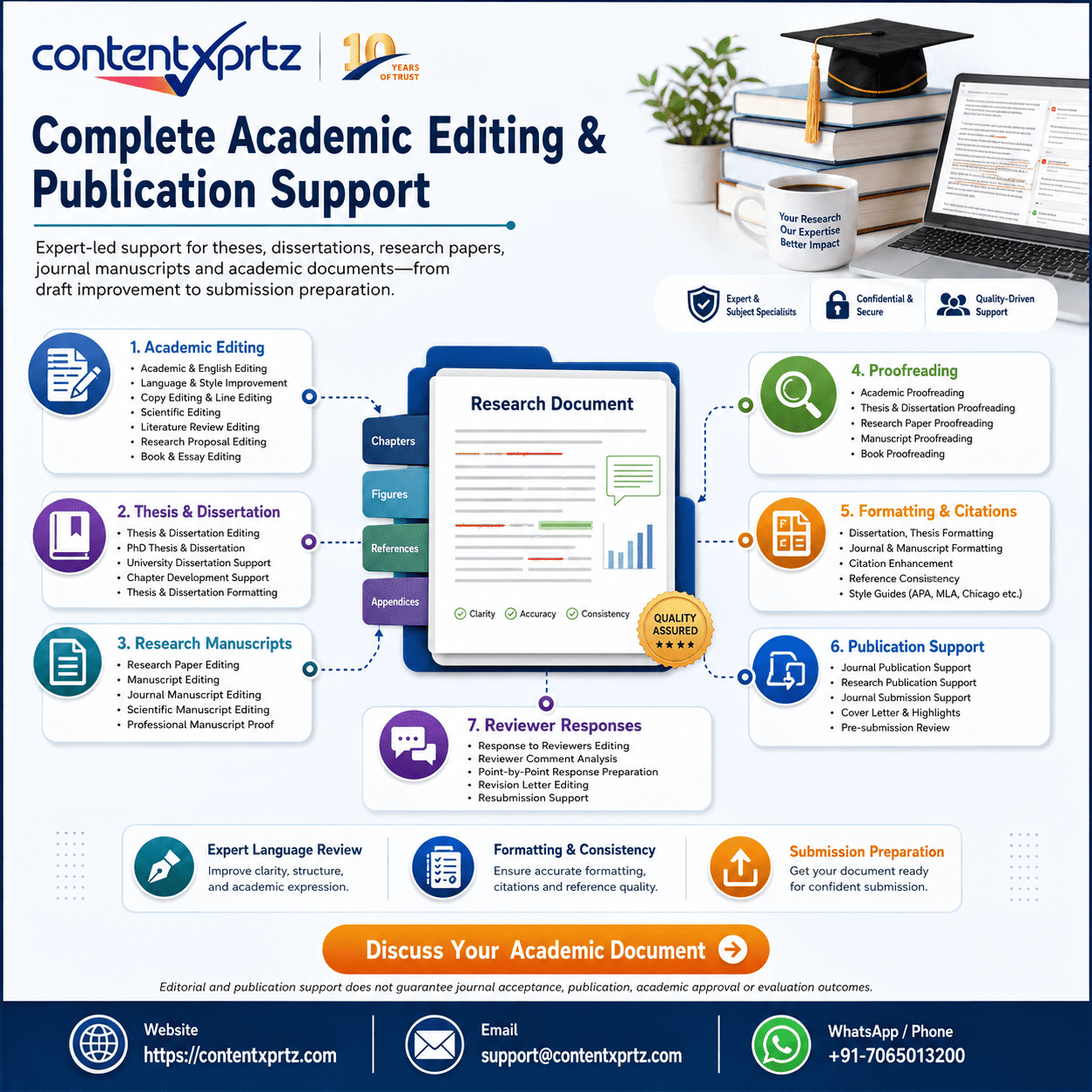
Contentxprtz can support manuscript editing, language polishing, journal formatting, reference checks, journal-fit assessment and reviewer-response preparation. Editorial decisions remain entirely with IJQRM.
How Contentxprtz can support authors
Contentxprtz can help researchers improve clarity, academic language, manuscript organization, abstract structure, referencing consistency, table and figure presentation, and alignment with documented author guidelines. Support can also include a publication-readiness check that flags scope mismatch, incomplete declarations or formatting gaps before the author submits.
That support should remain ethical and transparent. Contentxprtz cannot guarantee acceptance, peer-review success, indexing, citation performance or publication. The author remains responsible for the originality and accuracy of the research, all ethical declarations, the final manuscript, and direct submission through the journal’s official system.
Editorial leadership
Emerald currently lists Professor Jiju Antony of Newcastle Business School at Northumbria University as Editor, supported by an international team of associate editors and an editorial advisory board spanning quality and reliability expertise. Editorial appointments can change, so authors seeking pre-submission advice should use the current contact details shown on the official journal page rather than saved or third-party addresses.
Author decision guide: when IJQRM may not be the right journal
Consider another journal if the manuscript’s dominant contribution is engineering design, mathematical reliability theory or algorithm development with little management interpretation; if the quality/reliability connection is only superficial; if the paper cannot demonstrate a rigorous research method appropriate to its article type; or if your institution requires a specific current quartile or indexing category that you have not verified.
A desk rejection for scope is often avoidable. Before submission, write down the exact IJQRM scope statement your paper addresses and identify two or three recent papers that show comparable managerial relevance. If you cannot do that convincingly, the manuscript may need reframing or a different target journal.
Bottom line
International Journal of Quality & Reliability Management is a well-established Emerald journal for research that connects quality or reliability with practical management improvement. Its current publisher page confirms Scopus recognition, 2025 CiteScore and Impact Factor metrics, double-anonymous review, a selective acceptance rate and detailed submission rules. The strongest prospective submissions are not merely technically correct; they clearly explain why the findings matter to organizations and decision makers.
Use this profile as a research and preparation guide, then confirm the live Emerald and Scopus records immediately before submission because metrics, editorial teams, fees and indexing classifications can change.
Frequently asked questions
These answers distinguish current publisher-reported facts from practical author guidance.
What is the International Journal of Quality & Reliability Management?
It is an Emerald Publishing journal focused on the management dimensions of quality and reliability across manufacturing, services, public-sector and voluntary-sector settings. Its scope emphasizes practical managerial usefulness rather than heavily mathematical or engineering-only reliability work.
Who publishes the International Journal of Quality & Reliability Management?
Emerald Publishing publishes the journal. The official journal page lists ISSN 0265-671X and eISSN 1758-6682.
Is the International Journal of Quality & Reliability Management indexed in Scopus?
Yes. Emerald lists Scopus among the journal rankings, and the supplied Scopus Source Record ID is 144740. Authors should still verify current indexing status in Scopus before using it for institutional or degree requirements.
What is the journal’s current CiteScore?
Emerald reports a 2025 CiteScore of 8.7. It also displays a 2026 CiteScore Tracker of 9.1, updated monthly. The tracker is provisional and should not be treated as the final 2026 CiteScore.
What is the journal’s 2025 Impact Factor?
Emerald displays a 2025 Journal Impact Factor of 3.0 and a 2025 five-year Impact Factor of 3.2.
What are the SJR, SNIP and current quartile?
The current Emerald page does not display SJR, SNIP or a current Scopus quartile. Because these can change by year and category, authors should verify them directly in the latest Scopus source profile or institutional database rather than rely on old third-party values.
What types of manuscripts can be submitted?
The submission system asks authors to choose Quality Paper, Reliability Paper or Book Review, and then a category such as research paper, viewpoint, technical paper, conceptual paper, case study, literature review or general review.
How long should a manuscript be?
Emerald’s current author guidelines state that articles should be 5,000–10,000 words, including the structured abstract, references, text in tables and figures, and appendices. Authors should allow 250 words for each figure or table.
What abstract does the journal require?
A structured abstract is required with Purpose, Design/methodology/approach, Findings and Originality. Research limitations/implications, Practical implications and Social implications are optional where applicable. The abstract section is capped at 250 words including keywords and article classification.
What reference style does the journal use?
The journal accepts recognised Harvard styles and provides Emerald’s Harvard style as its house guide. Citations should be complete, accurate and consistent.
How does peer review work?
Submissions are screened by the editorial office. Suitable manuscripts are sent to at least two independent referees using double-anonymous peer review. Decisions may include acceptance, minor or major revision, or rejection.
What is the journal’s acceptance rate?
Emerald reports an acceptance rate of 22.2% based on submissions between 1 April 2024 and 31 March 2025. This is historical operational data, not a prediction of the outcome for any individual paper.
How long does publication take?
Emerald reports 81 days to first decision for submissions between 1 April 2024 and 31 March 2025 and 34 days from acceptance to publication, last updated April 2025. Actual manuscript timelines can vary.
Is the journal open access?
It is a hybrid journal. Authors may choose gold open access after acceptance, subject to an APC, or use Emerald’s green open-access/self-archiving route. If gold OA is selected, Emerald states that the article is published under CC BY 4.0.
Does the journal charge a submission fee?
Emerald states that there is no submission, processing or review fee unless an author elects gold open access after acceptance. The applicable APC varies and should be checked on Emerald’s current APC price list or in the editorial system.
Is IJQRM suitable for PhD researchers?
Potentially, yes, if the manuscript makes a clear scholarly contribution and has strong managerial relevance to quality or reliability management. Degree candidates should also confirm that the journal meets their university’s current indexing, ranking and publication-policy requirements.
Can Contentxprtz guarantee acceptance in IJQRM?
No. Contentxprtz can support ethical manuscript preparation, language editing, formatting, reference checks, journal-fit assessment and publication readiness, but editorial decisions remain entirely with the journal and its peer-review process.
Final publication-readiness note
A strong IJQRM submission should combine a credible research method, a clear contribution to quality or reliability knowledge, and specific managerial relevance. Careful formatting and language polishing help reviewers engage with the work, but they cannot replace novelty, evidence, ethical research practice or journal fit.
Contentxprtz supports ethical manuscript preparation and publication readiness; it does not promise or guarantee journal acceptance or publication.

Prof. Henry Lawson
Prof. Henry Lawson writes researcher-focused guidance on academic publishing, manuscript preparation, journal selection and scholarly communication for Contentxprtz.