A Business Journal Is More Than a Place to Upload a Paper
If you are searching for a business journal, you may be trying to solve one of several different problems. You might need a scholarly outlet for a management research paper, a credible journal for a doctoral publication requirement, a practitioner publication for a case or viewpoint, or simply a clearer understanding of what “business journal” means. Those goals look similar in a search box, but they lead to different publication decisions.
The safest starting point is to distinguish the publication type before you edit the manuscript. A peer-reviewed academic business journal usually expects a research contribution supported by a coherent literature position, appropriate methods, evidence, disciplined interpretation, and transparent references. A practitioner-oriented business publication may value evidence too, but often places more weight on accessible language, managerial relevance, case insight, and actionable recommendations. Some titles bridge both worlds.
This distinction matters because many submission problems begin with a mismatch, not bad grammar. A well-written empirical paper can be rejected quickly if the journal rarely publishes that topic or method. A thoughtful practitioner article can also fail if it is sent to a scholarly journal that requires a formal research design. Before spending hours reformatting references, researchers should ask a more basic question: Does this journal publish work like mine, for readers who need this contribution?
For PhD scholars and early-career researchers, the pressure can be especially intense. A supervisor may recommend publishing from a thesis, an institution may specify journal requirements, or a researcher may be trying to convert a conference paper into a full article. At the same time, ESL authors can face an additional layer of work: expressing a complex business argument in fluent academic English without losing disciplinary meaning. Editing can help with clarity, but the author still owns the research decisions, evidence, claims, and final submission.
Business research also spans unusually diverse traditions. A strategy paper using panel data, an ethnographic study of organizational culture, a conceptual entrepreneurship article, a systematic review of consumer behavior, and a teaching case can all belong to “business” while following very different conventions. That is why generic publication advice is rarely enough. Strong journal preparation combines journal selection, manuscript structure, academic editing, publication ethics, and submission discipline.
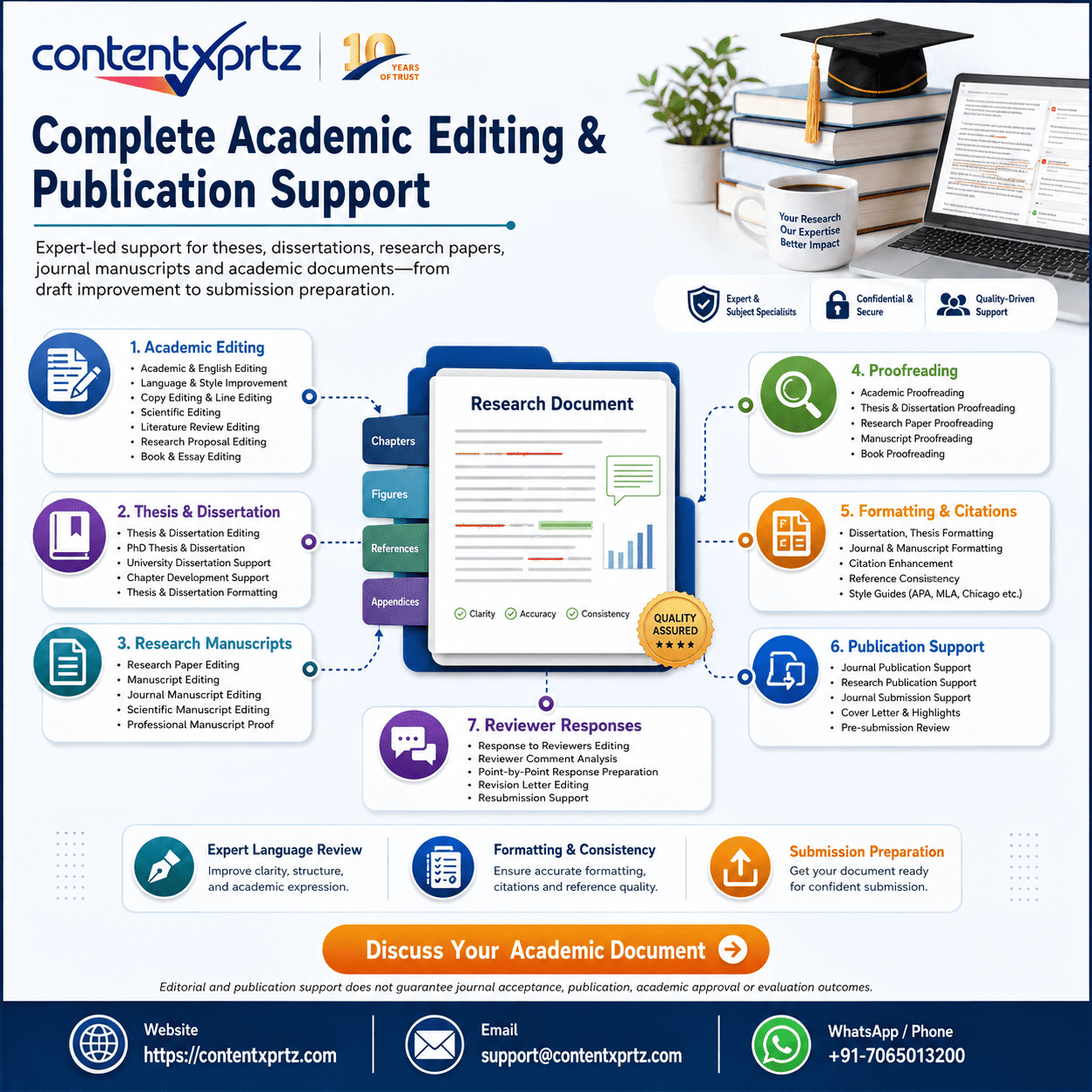
Contentxprtz supports researchers who need help improving a journal manuscript’s language, organization, consistency, and submission readiness. The role of ethical support is to make the author’s work clearer and easier to evaluate—not to invent findings, hide weaknesses, or promise acceptance. This guide therefore focuses first on decisions researchers can verify themselves and then explains where professional journal manuscript editing may add value.
Quick Answer: What Should You Know About a Business Journal?
A business journal is a publication focused on areas such as management, finance, marketing, entrepreneurship, strategy, operations, organizational studies, economics, and related professional fields. In academic publishing, a business journal often means a scholarly or peer-reviewed journal, although some business journals are practitioner-oriented or editorially reviewed instead.
If you want to publish, first identify the exact journal type and read its aims, scope, recent articles, article categories, peer-review policy, and author instructions. Then adapt the manuscript to that journal rather than writing for a generic “business journal.”
The most important caution is that editing cannot fix a poor journal fit or guarantee acceptance. Use editing to improve clarity, structure, consistency, and compliance while keeping the research, evidence, authorship, and final decisions under the authors’ control.
Key Takeaways
- “Business journal” can refer to a scholarly research journal, a professional publication, or a practitioner-oriented outlet, so identify the publication type first.
- Journal fit is usually stronger when your topic, method, audience, and contribution resemble work the journal has recently published.
- Author instructions can differ on word count, abstract structure, reference style, anonymization, declarations, tables, figures, and supplementary files.
- A strong business research article connects its question, literature, method, findings, and implications into one defensible argument.
- Peer review evaluates more than language; editors and reviewers consider scope, rigor, relevance, originality, evidence, and contribution.
- Professional manuscript editing can improve presentation and readability, but it should preserve author ownership and never promise publication.
What This Page Covers
- Business journal meaning and types
- Journal-selection criteria
- Manuscript structure and contribution
- Author guidelines and submission checks
- Peer review and revision strategy
- Ethical editing and publication support
Methodology and Academic Sources
This guide is based on common scholarly publishing workflows, journal author instructions, publication-ethics principles, and manuscript-preparation practices used across business and management research. Because requirements vary by publisher, journal, discipline, article type, and institution, the target journal’s current official author guidance should always take precedence over generic advice.
For example, Elsevier’s author policies and guidelines emphasize ethical publishing, appropriate authorship, originality, source acknowledgement, competing-interest disclosure, research data responsibilities, and accurate reporting. Springer Nature’s article-publishing guidance similarly directs authors to follow journal-specific submission guidelines and prepare manuscripts carefully before submission.
Business-journal requirements can also be highly specific. Emerald journal pages, for example, may provide defined article categories and structured abstract requirements; the Journal of Business Strategy author guidance illustrates how a business-oriented journal can specify elements such as purpose, methodology, findings, originality, and practical implications. These examples are not universal templates. They show why authors should verify the exact rules of the journal they choose.
What “Business Journal” Means in an Academic Context
In academic publishing, a business journal is usually a periodical that publishes scholarship in one or more business-related disciplines, but the label covers a wide range of editorial missions.
Scholarly Business Journal
Publishes research for academic and specialist audiences, commonly with editorial screening and peer review. Articles often foreground theory, methods, evidence, and contribution.
Practitioner-Oriented Journal
Connects research or expert analysis with managerial decisions. It may use editorial review, peer review, or a hybrid process and often prioritizes practical implications.
Professional or Association Journal
Serves members of a profession or industry and may publish cases, reviews, policy analysis, technical guidance, commentary, or applied research.
Business Magazine or News Publication
Focuses on reporting, analysis, interviews, trends, and commentary for a broader audience. It is not automatically a scholarly journal even if the subject matter overlaps.
The difference is not merely stylistic. It changes what counts as a strong submission. A scholarly finance journal may expect transparent econometric methods and a clearly positioned literature contribution. A practitioner strategy journal may value a well-supported framework that executives can apply. A professional accounting publication may prioritize regulatory interpretation and applied examples. Before writing, identify who the journal speaks to and what kind of evidence its readers expect.
How to Choose the Right Business Journal for Your Paper
Choose a journal by testing fit across several dimensions rather than chasing one metric or a familiar publisher name.
Start With Scope and Reader Relevance
Read the aims and scope page, but do not stop there. Scope statements are often broad. Recent articles reveal the journal’s actual editorial conversation: the topics, theoretical traditions, research designs, geographies, industries, and levels of analysis that editors are currently publishing. If you cannot identify several recent papers that relate meaningfully to your work, investigate further before submission.
Check the Article Type
A journal may publish original research, conceptual papers, literature reviews, viewpoints, cases, methodological notes, short communications, or practitioner pieces. Match your manuscript to a named article type. This matters because word counts, abstract formats, review expectations, and evaluation criteria can differ within the same journal.
Review Practical Requirements Before Rewriting
Author instructions affect more than formatting. They can require specific ethics statements, data-availability language, anonymization for double-anonymous review, funding disclosures, contributor statements, structured abstracts, graphical elements, or supplementary files. Read these rules before the final edit so you do not build the paper around assumptions that later need major revision.
| Criterion | What to Check | Good Fit Signal | Warning Sign |
|---|---|---|---|
| Scope | Aims, themes, disciplines, industries | Your question clearly falls inside the journal’s stated domain | You need a long explanation to justify relevance |
| Recent content | Last 1–3 years of articles | Comparable topics, methods, or theoretical conversations appear regularly | No recent article resembles your research area |
| Audience | Academic, practitioner, policy, professional | Your contribution solves a problem the readership recognizes | The manuscript is written for a different community |
| Article type | Research paper, review, case, viewpoint, note | A named category matches your manuscript | You plan to force the paper into an unsuitable category |
| Methods | Quantitative, qualitative, mixed, conceptual, review | The journal publishes your research design | The design is rarely or never represented |
| Submission rules | Word count, references, declarations, files | You can comply without damaging the study | Major requirements are incompatible with the manuscript |
A useful selection process reduces wasted submission cycles. It does not eliminate rejection, because editorial decisions involve judgment and competition, but it helps ensure that the manuscript enters a conversation it can genuinely contribute to.
How to Structure a Business Journal Article So the Contribution Is Clear
A strong business journal article makes the relationship between problem, evidence, and contribution easy to follow.
Title and Abstract
The title should identify the central phenomenon without promising more than the study delivers. The abstract should answer the questions an editor needs first: What problem does the paper address? What did the authors do? What did they find or argue? Why does it matter? If the journal requires a structured abstract, follow its labels exactly. Do not repurpose an unstructured conference abstract without checking the requirements.
Introduction
The introduction should establish significance, identify the gap or unresolved problem, state the research question or objective, and explain the contribution. Avoid opening with several pages of general statements about globalization, digital transformation, or competition unless that context is directly necessary. Editors need to see the paper’s specific business problem early.
Literature and Conceptual Positioning
A literature section should build an argument, not a catalogue. Organize sources around ideas, tensions, constructs, mechanisms, or debates. Explain what is known, where evidence conflicts or remains incomplete, and why your research design is capable of addressing that gap. For conceptual papers, the logic of theory development becomes even more central.
Methodology
Methods should be transparent enough for readers to understand how the evidence was generated and why the approach fits the question. Describe sampling or case selection, measures or interview procedures, analytical techniques, ethics processes where applicable, and limitations relevant to interpretation. The method section should not imitate another paper blindly; it should accurately describe your own research.
Results, Findings, and Discussion
Results report what the analysis produced. Discussion explains what those results mean. Keeping this distinction clear helps prevent unsupported interpretation. In business research, the discussion often needs to address theoretical implications and practical implications separately. A managerial recommendation should follow from the evidence rather than from generic consulting advice.
Conclusion and Limitations
A conclusion should synthesize the contribution without copying the abstract. Limitations are not a ritual list of weaknesses; they define the boundaries of the claim and point to meaningful future research. A paper can be rigorous and still have limits related to context, sample, measurement, time period, or transferability.
Step-by-Step: Prepare a Business Journal Manuscript for Submission
Prepare the submission in a sequence that protects both academic quality and practical efficiency.
- Confirm journal fit. Re-read the aims, scope, article types, recent papers, and editorial policy. Write a one-sentence fit statement for yourself.
- Download or open the current author instructions. Record the word limit, abstract format, reference style, file requirements, anonymization rules, declarations, and figure/table instructions.
- Check the contribution. Make sure the introduction, abstract, discussion, and conclusion describe the same central contribution with appropriate nuance.
- Audit the evidence. Verify that every major claim is supported by data, analysis, literature, or clearly identified argument. Remove claims that reach beyond the evidence.
- Review citations and references. Confirm that cited works appear in the reference list and vice versa, names and dates are consistent, and sources are authentic and traceable.
- Edit at document level. Improve organization, transitions, paragraph logic, terminology, and repetition before spending time on punctuation-level polishing.
- Proofread at sentence level. Correct grammar, spelling, punctuation, tense, article usage, number style, abbreviations, and formatting inconsistencies.
- Prepare submission materials. Draft the cover letter, author details, contribution statements, funding and conflict declarations, ethics information, data statements, and supplementary files where required.
- Run a final technical check. Confirm anonymization, file names, tables, figures, line numbering, metadata, and the exact version being uploaded.
- Submit through the official journal system. Keep the confirmation email, manuscript ID, submitted files, and a dated final copy for your records.
Springer Nature’s manuscript formatting guidance highlights the importance of checking journal instructions on length, required sections, language, contact details, figure placement, references, file formats, and conflicts of interest. Treat that principle as universal even when the details differ: the journal’s own rules control the final submission.
Common Business Journal Submission Mistakes to Avoid
Many avoidable problems come from treating publication as a formatting exercise instead of an editorial decision process.
Choosing by Title Alone
A journal called “business,” “management,” or “enterprise” may still have a narrow disciplinary or methodological focus. Read the scope and recent contents. Names can be broad while editorial expectations are specific.
Using the Same Manuscript for Every Journal
Authors sometimes change only the journal name in the cover letter. A better approach is to revise the framing, abstract, keywords, discussion emphasis, and formatting to suit the target audience without misrepresenting the study.
Overstating Practical Implications
Business journals often value managerial relevance, but practical implications should be proportional to the evidence. A study of one industry, country, or small sample may generate useful insights without justifying universal recommendations.
Treating Language Editing as Research Repair
Fluent English cannot compensate for unclear methods, inconsistent data, fabricated references, weak analysis, or a missing contribution. Editing should improve communication around valid research, not conceal substantive problems.
Ignoring Journal-Specific Abstract Rules
Some business and management journals use structured abstracts. Others impose strict word counts or request specific headings. A polished abstract can still fail a technical check if it does not follow the required structure.
Submitting Before Reference Verification
Reference errors reduce trust and can create ethical concerns. Verify each citation against the original source where possible, especially references generated, reformatted, or suggested with automated tools.
Responding Defensively to Reviewers
A reviewer may be wrong, but the response should still be reasoned. Separate emotional reaction from scholarly response. Explain disagreement with evidence, revise unclear passages, and let the editor see that each point received serious consideration.
Ethical Academic Editing and Author Responsibility
Ethical manuscript editing improves communication while preserving the authors’ intellectual responsibility.
Authors remain responsible for the research question, data, methods, analysis, interpretation, citations, acknowledgements, contributor roles, disclosures, and final text. An editor can suggest clearer wording, flag unsupported transitions, identify inconsistency, or ask whether a citation is missing. The editor should not invent evidence or silently add claims that the authors cannot defend.
Authorship also deserves careful attention. Publisher policies commonly require meaningful contribution for authorship and accurate acknowledgement of other support. The Elsevier author-policy resource describes responsibilities concerning authorship, originality, acknowledgement of sources, competing interests, data, and reporting. Researchers should compare such publisher-level expectations with the exact policy of the target journal.
If AI tools are used during drafting or editing, verify every output carefully. Do not assume generated references exist, do not submit invented quotations, and do not allow a tool to change statistical meaning or research claims without review. Follow the target journal’s current policy on generative AI, disclosure, authorship, and permitted uses.
What Ethical Editing Can Do
- Improve clarity, grammar, academic tone, and sentence flow.
- Strengthen paragraph organization and transitions without changing the research result.
- Flag inconsistent terminology, unexplained abbreviations, and unclear claims.
- Check formatting against journal instructions and identify missing required elements.
- Review citation and reference consistency while asking authors to verify source accuracy.
What It Should Not Do
- Invent data, participants, analyses, citations, ethics approvals, or funding information.
- Guarantee acceptance, indexing, reviewer approval, or publication speed.
- Rewrite the research so extensively that authors cannot explain or defend the final claims.
- Submit or respond under an author’s identity without clear authorization and journal-policy compliance.
Practical Examples: Business Journal Decisions in Real Research Workflows
A PhD Scholar Turns a Thesis Chapter Into a Journal Paper
Situation: A doctoral researcher has a 14,000-word thesis chapter on leadership behavior and wants to submit it to a management journal.
Common mistake: The scholar removes thesis headings and sends the chapter almost unchanged, leaving a long literature review and several research aims.
Correct approach: The author selects one publishable contribution, narrows the research question, checks the target journal’s recent leadership papers, rebuilds the introduction around that contribution, and moves thesis-only detail out of the article.
Ethical support: A manuscript editor can help reduce repetition, strengthen transitions, and align terminology while the scholar decides what evidence and claims remain in the paper.
An ESL Researcher Has Strong Data but an Unclear Argument
Situation: A researcher has a well-designed survey study on digital marketing adoption, but reviewers say the manuscript is difficult to follow.
Common mistake: The author focuses only on grammar corrections and keeps the same paragraph order.
Correct approach: The paper is reviewed at structural level first. The literature is reorganized around competing explanations, the hypotheses are connected more explicitly to theory, and the discussion is revised to distinguish findings from implications.
Ethical support: Language and substantive editing can improve presentation without altering statistical outputs or inventing a stronger contribution than the evidence supports.
A Research Team Targets the Wrong Business Audience
Situation: A team writes a highly technical operations-research paper but chooses a practitioner journal because the title sounds relevant.
Common mistake: They try to make the paper fit by removing equations and adding generic managerial recommendations.
Correct approach: The team reassesses journal fit and identifies a research journal that publishes comparable optimization studies. They then preserve methodological transparency and sharpen the practical interpretation rather than diluting the research design.
Ethical support: Publication guidance can help compare scope and author requirements, but journal selection should still be based on verifiable fit rather than promises of acceptance.
Business Journal Publication-Readiness Checklist
Use this checklist after the research is complete but before the final submission upload.
Journal Fit
- The topic fits the stated aims and scope.
- Recent articles show a meaningful connection to your field, method, or conversation.
- The manuscript matches an accepted article type.
- The intended readership can understand why the contribution matters.
Argument and Evidence
- The research question is explicit and consistent across the paper.
- The literature review establishes a real gap or unresolved issue.
- The method is appropriate and described transparently.
- The findings support the claims made in the discussion and conclusion.
- Limitations define the boundaries of interpretation.
Language and Presentation
- Paragraphs have clear topic logic and transitions.
- Technical terms are consistent and abbreviations are defined.
- Tables and figures match references in the text.
- Citations and references are complete, consistent, and verified.
- Grammar and punctuation have been checked after structural editing.
Submission Compliance
- The manuscript meets current word-count and formatting rules.
- Anonymization is complete where the review model requires it.
- Funding, conflict, ethics, authorship, and data statements are accurate.
- The cover letter identifies fit without exaggerated claims.
- The final files and metadata match the version approved by all authors.
How Contentxprtz Can Help With a Business Journal Manuscript
Contentxprtz is most useful when the research already exists and the author wants expert help making the manuscript clearer, more consistent, and better aligned with scholarly expectations.
Depending on the document, support may include language polishing, paragraph-level restructuring, terminology consistency, abstract refinement, reference-style checks, table and figure review, and journal-guideline alignment. Researchers who need broader support can also explore academic editing services or publication support when those services match the problem.
For a business research article specifically, the journal manuscript editing service is the most direct next step when authors need a publication-focused review of clarity and presentation. If the manuscript’s deeper issue is research design, missing evidence, or an unresolved analytical problem, editing should not be presented as a substitute. Authors may need to return to the research before polishing the prose.
Need a clearer, submission-ready journal manuscript?
Get ethical editing focused on language, structure, consistency, and journal-readiness while retaining full author responsibility for the research.
Summary: Business Journal Selection and Manuscript Preparation
A business journal can be a scholarly research outlet, a practitioner-oriented publication, or a professional periodical. For researchers, the key is to identify the publication type and match the manuscript to its actual editorial scope, readership, article categories, and submission requirements.
Strong business journal manuscripts connect a focused question to relevant literature, appropriate methods or evidence, defensible findings, and a clear contribution. They also follow journal-specific rules on abstracts, word limits, references, declarations, tables, figures, and review preparation.
Self-editing may be enough when the manuscript is already structurally sound and the author can confidently check language and compliance. Professional editing becomes more useful when clarity, organization, ESL language, consistency, or guideline alignment could distract editors and reviewers from evaluating the research itself. In every case, authors remain responsible for the study, sources, claims, ethics, and final submission.
Frequently Asked Questions About Business Journals
These answers address common questions researchers ask when choosing a business publication, preparing a manuscript, and deciding whether editorial support is appropriate.
What is a business journal in academic publishing?
A business journal is a periodical that publishes writing about business, management, organizations, markets, finance, entrepreneurship, strategy, operations, marketing, human resources, or related fields. In an academic context, the term usually refers to a scholarly journal that evaluates research articles through editorial screening and often peer review. Some titles focus mainly on theory and empirical research, while others emphasize managerial practice, cases, policy, or practitioner insight.
The first step is to identify what kind of publication you are dealing with. Read the journal’s aims and scope, recent articles, article types, author instructions, and peer-review policy. A manuscript suitable for a peer-reviewed management journal may require a clear research question, literature positioning, transparent methods, evidence-based findings, and a contribution to theory or practice. A practitioner-oriented business publication may expect a more accessible argument, fewer methodological details, and stronger emphasis on actionable insight. Do not assume that every publication containing “business journal” in its name follows the same standards. Match your manuscript to the specific journal rather than to a generic idea of business writing.
How do I choose the right business journal for my research paper?
Choose a business journal by matching your manuscript’s topic, contribution, method, audience, and article type with the journal’s stated aims and recent publishing record. Start with scope rather than prestige. Read several recent papers and ask whether your research question would make sense beside them. Check whether the journal publishes your methodology, region, industry context, theoretical lens, and type of contribution.
Then review practical requirements: word limits, reference style, structured abstract rules, data or ethics statements, open-access options, fees, review model, and submission format. Verify the journal and publisher through official websites and established indexing or library sources where relevant to your institution. Avoid choosing only because a journal title sounds broad or because an unsolicited email promises rapid acceptance. If two journals look plausible, create a short fit matrix comparing scope, audience, article types, recent topics, and manuscript requirements. The best target is usually the journal for which you can explain, in one or two sentences, why your paper advances a conversation that the journal is already publishing.
What should a business journal article include?
A business journal article should include the elements required by its target publication, but scholarly research articles commonly contain a focused title, abstract, keywords, introduction, relevant literature, research question or hypotheses, methodology, results or findings, discussion, implications, limitations, conclusion, and references. Qualitative, conceptual, case-based, review, and practitioner articles may use different structures.
The important principle is functional clarity. The introduction should establish the business problem or scholarly gap and state the contribution. The literature section should synthesize rather than merely list sources. Methods should explain how evidence was produced or selected. Findings should answer the research question, while the discussion should explain what those findings mean for theory, practice, policy, or future research. Follow the target journal’s instructions even if they differ from conventions you have used before. For example, some management journals request structured abstracts with headings such as purpose, design or methodology, findings, and originality. A strong manuscript is not one that follows a universal template mechanically; it is one whose structure makes the argument, evidence, and contribution easy for editors, reviewers, and readers to evaluate.
Is a business journal the same as a business magazine?
No. A scholarly business journal and a business magazine can both discuss companies, markets, leadership, or management, but they usually serve different purposes and use different editorial processes. Academic business journals commonly publish research-based work for scholars and informed practitioners, provide formal references, and may use peer review. Business magazines usually prioritize timely analysis, reporting, commentary, interviews, and accessible explanations for a broader professional audience.
The distinction matters when you are preparing a submission. A research manuscript with a literature review, detailed methodology, and statistical analysis may fit a scholarly journal but be unsuitable for a general business magazine. Conversely, a concise executive article built around a current management lesson may not meet the evidence and contribution requirements of a research journal. Some publications sit between these categories and publish research-informed practitioner pieces. Always inspect the publication itself: review its article types, author guidance, examples, and editorial description. Do not rely only on the word “journal” or “magazine” in the title, because naming conventions vary across publishers and regions.
How long should a business journal article be?
There is no single correct length for a business journal article. Word limits vary substantially by journal and article type, so the target journal’s author guidelines are the controlling source. A full empirical research paper may be several thousand words, while a research note, viewpoint, case, review, or practitioner piece may have a different range. Some journals count tables, figure text, references, or appendices toward the limit; others handle them separately.
Check the rules before you invest time in heavy editing. If your draft is far above the limit, do not solve the problem by cutting methodological details that are necessary for reproducibility or removing evidence that supports the argument. Instead, remove repetition, compress background material, combine overlapping paragraphs, move permitted supporting material to appendices or supplementary files, and sharpen tables. If the paper is too short, adding generic literature usually weakens it; strengthen the missing logic, evidence, method explanation, or discussion instead. Because formatting rules can change, verify the current instructions on the journal’s official author page immediately before submission.
Do business journals require peer review?
Many academic business journals use peer review, but not every publication described as a business journal follows the same model. Peer review may be single-anonymous, double-anonymous, open, or adapted to the publisher’s editorial workflow. Some practitioner journals, professional association publications, and business periodicals rely mainly on editorial review rather than external scholarly peer review.
Check the journal’s official peer-review or editorial policy instead of assuming. A credible scholarly journal should explain its editorial process with reasonable clarity. If your institution requires publication in a peer-reviewed journal, confirm that the specific article type you plan to submit is actually peer reviewed; editorials, book reviews, invited commentaries, and certain special features may be treated differently from research articles. Peer review also does not mean acceptance is guaranteed or that every published claim becomes unquestionably correct. It is a quality-control process in which editors and reviewers assess fit, rigor, clarity, evidence, and contribution. Authors remain responsible for the accuracy and integrity of the work before and after publication.
How can I improve a business journal manuscript before submission?
Improve a business journal manuscript by reviewing it at three levels: journal fit, argument and evidence, and presentation. First, compare the paper with the target journal’s scope and recent articles. Make the contribution explicit in the title, abstract, introduction, and discussion without repeating the same promotional sentence. Second, test the logic: does the research question follow from the literature, does the method answer that question, do the findings support the claims, and does the discussion avoid going beyond the evidence?
Then conduct a technical and language pass. Check tables and figures against the text, verify citations and reference entries, use consistent terminology, remove undefined abbreviations, and confirm all required declarations. For ESL authors, language editing can improve readability, but editing should preserve technical meaning and authorial ownership. Finally, use the journal’s submission checklist and read the manuscript once in the format reviewers will see. Contentxprtz can support manuscript editing and publication readiness when a researcher needs help with clarity, consistency, structure, or guideline alignment, but decisions about research claims and final submission remain with the author.
Can professional editing guarantee acceptance in a business journal?
No. Professional editing cannot guarantee acceptance in a business journal, and a responsible editing provider should not promise it. Editors can improve language, organization, consistency, readability, formatting, and the visibility of a manuscript’s argument. Publication-support specialists can also help authors check a journal’s instructions, prepare submission materials, and respond more clearly to reviewer comments.
Acceptance depends on factors that editing cannot control, including research quality, originality, methodological rigor, fit with the journal’s scope, editorial priorities, reviewer assessment, competition for space, and the strength of the contribution. A polished paper can still be rejected if the study is out of scope or the evidence does not support the claims. Conversely, an editorial decision may invite revision even when the writing is already strong. Use editing to make the work easier to evaluate, not to manufacture certainty. Authors should retain responsibility for data, analysis, citations, interpretations, ethics statements, conflicts of interest, and final approval of every change.
How should I respond to reviewer comments on a business journal paper?
Respond to reviewer comments systematically, respectfully, and with evidence. Create a point-by-point response document that reproduces or clearly identifies each comment, explains what you changed, and directs the reviewer to the relevant manuscript location. When you agree with a suggestion, state the revision precisely. When you disagree, explain the scholarly reason calmly and support it with evidence or methodological logic rather than dismissing the reviewer.
Start by reading the editor’s decision letter separately from the reviewer reports because the editor may prioritize certain changes. Group overlapping comments, but do not silently ignore any point. Keep tracked changes or a clean/revised version according to journal instructions. If a comment reveals that your argument was misunderstood, first ask whether the manuscript itself was unclear; often the best response is to revise the text, not merely defend the original wording in the letter. Ethical publication support can help organize and polish a response, but the authors should decide the scientific changes and confirm that every response accurately reflects what was done.
When should I use journal manuscript editing support for a business journal submission?
Consider journal manuscript editing support when the research is substantially complete but the paper needs clearer academic English, stronger organization, consistent terminology, tighter argument flow, reference or style checks, or closer alignment with the target journal’s author instructions. Support can be especially useful for first-time authors, interdisciplinary teams, ESL researchers, or authors revising a paper after detailed reviewer feedback.
Editing is not a substitute for missing research, invented data, unsupported references, or authorship. A qualified editor should preserve the author’s ideas and meaning, flag uncertainties rather than fabricate answers, and distinguish language or structural suggestions from substantive research decisions. Before hiring support, decide what you actually need: proofreading for surface errors, copyediting for clarity and consistency, substantive manuscript editing for structure and argument presentation, or publication support for submission-readiness tasks. Contentxprtz’s journal manuscript editing service is most relevant when authors want an expert review of presentation and readability while retaining responsibility for the research, claims, citations, ethics, and final submission.
Choose the Journal Before You Polish the Final Draft
The phrase “business journal” sounds simple, but publication success depends on specificity. You need the right journal type, a credible fit between manuscript and audience, a clear contribution, appropriate evidence, and careful compliance with current author instructions.
Free resources and self-editing can be sufficient when you already understand the target journal and the manuscript is structurally strong. Expert-assisted editing is more useful when language, organization, formatting, or presentation is making it harder for readers to see the research contribution. The goal should be a clearer manuscript—not a manufactured promise of acceptance.
Contentxprtz can help researchers polish business and management manuscripts through ethical journal-focused editing that respects author ownership. You remain responsible for every claim, source, research decision, disclosure, and final submission.
“At Contentxprtz, we don’t just edit; we help ideas reach their fullest potential.”