Thesis or Dissertation Difference: What Graduate Researchers Need to Know
The thesis or dissertation difference can seem simple until a student compares university websites and discovers that the terms are not used consistently. In many North American programs, a thesis is associated with a master’s degree and a dissertation with a doctorate. In the United Kingdom, Australia, India, and several other academic systems, “doctoral thesis” is common, while “dissertation” may describe a master’s or undergraduate research project. The safest definition therefore begins with the degree requirements of the specific institution, not with the document title alone.
Despite the terminology problem, the academic distinction is usually clear. A master’s thesis demonstrates that a student can frame a focused research question, work with relevant literature, use an appropriate method, analyze evidence, and communicate a defensible conclusion. A doctoral dissertation or thesis must normally do all of that at greater depth while making an original contribution to knowledge. The difference is less about one document being “a long essay” and the other being “a very long essay” and more about the level of scholarly independence, originality, methodological responsibility, and contribution expected.
This guide compares purpose, degree level, scope, structure, length, research design, examination, timelines, editing, and ethical support. It is designed for postgraduate students, doctoral candidates, first-time researchers, supervisors, and professionals returning to university. Because requirements differ, readers should use this article as an orientation and then verify every practical decision against their graduate school handbook, approved proposal, supervisor guidance, and examination regulations.
Quick Answer: What Is the Difference Between a Thesis and a Dissertation?
A thesis is commonly a substantial research document completed for a master’s degree. It shows that the student can investigate a defined problem, use scholarly literature, apply an appropriate method, and present a coherent academic argument. A dissertation is commonly the culminating research document for a doctoral degree. It is expected to demonstrate advanced subject mastery and make an original, defensible contribution to the field.
The terms are not universal. Some universities call doctoral work a thesis, while others use dissertation. Some programs use dissertation for a master’s research project. Therefore, the most accurate answer is: the level and rules of the program matter more than the label.
Students should check four items first: the degree regulations, the approved document format, the required contribution level, and the examination process. Those four sources reveal what the institution expects more reliably than a generic definition found online.
Key Takeaways
- A thesis is often linked to a master’s degree; a dissertation is often linked to a doctorate.
- Terminology varies across countries, universities, disciplines, and professional programs.
- Doctoral work generally requires a clearer and more substantial original contribution to knowledge.
- Both documents require ethical research, accurate citation, coherent argument, and independent scholarly judgment.
- Length is a consequence of the project, not the most reliable way to distinguish the two.
- Structure may be traditional, article-based, practice-based, creative, or portfolio-based.
- Institutional regulations and supervisor-approved plans override generic online advice.
What This Page Covers
- The meaning of thesis and dissertation in different academic systems
- A side-by-side comparison of purpose, scope, originality, and assessment
- Typical chapter structures and alternative formats
- Research proposal, ethics, data, defense, and submission differences
- Common student mistakes and practical prevention strategies
- Three realistic examples from master’s and doctoral research
- When ethical thesis editing or dissertation proofreading can help
Methodology and Academic Sources
This article is based on common graduate-research workflows and the broadly shared distinction between master’s-level demonstration of research competence and doctoral-level original contribution. However, universities control their own terminology, formats, word limits, examination procedures, and policies on editorial assistance.
Before making a submission decision, consult your institution’s official graduate handbook and program rules. Useful general guidance is also available through resources such as the Purdue Online Writing Lab’s thesis and dissertation guidance, the ProQuest Dissertations & Theses resources, and your university library’s research and repository services. Where requirements conflict, institutional rules take priority.
Thesis vs Dissertation: Side-by-Side Comparison
The following table summarizes the most common distinction. It is a practical guide rather than a universal rule.
| Comparison point | Thesis | Dissertation |
|---|---|---|
| Typical degree level | Master’s, honours, or some professional programs | Doctoral or terminal research degree |
| Primary purpose | Demonstrate research competence and subject understanding | Demonstrate doctoral independence and an original contribution |
| Research scope | Focused and feasible within a shorter candidature | Broader, deeper, or theoretically more ambitious |
| Originality | May apply known methods to a new case, dataset, or context | Must usually extend, challenge, refine, or create knowledge |
| Literature review | Selective but sufficiently comprehensive for the question | Extensive, critical, and positioned against the field |
| Methodology | Appropriate and clearly justified | Advanced justification, limitations, and methodological contribution where relevant |
| Timeline | Often months to two years, depending on program | Usually several years of full- or part-time research |
| Examination | Committee review, presentation, viva, or written assessment | Formal doctoral examination, often including an oral defense or viva |
| Expected independence | Substantial, with structured supervision | High independence with expert supervisory guidance |
| Typical outcome | Degree completion and evidence of research capability | Degree completion plus a defensible scholarly contribution |
Students should not infer quality from page count. A tightly designed thesis can be academically stronger than a long but unfocused dissertation. Examiners look for alignment among the research question, literature, method, evidence, analysis, conclusions, and claimed contribution.
Why the Terminology Changes by Country and University
The words “thesis” and “dissertation” come from long academic traditions, but institutions have developed different conventions. In the United States, the common pattern is master’s thesis and doctoral dissertation. In the United Kingdom and many Commonwealth-influenced systems, a doctoral candidate often submits a thesis, while a master’s student may submit a dissertation. India uses both terms across institutions, and the exact naming may depend on university ordinances, discipline, and degree type.
This variation explains why a student should avoid copying assumptions from a friend at another university. Two documents called “dissertations” may differ dramatically: one may be a 12,000-word taught-master’s project, while the other is a multi-year doctoral study. Conversely, two doctoral documents may be academically equivalent even when one institution calls the work a thesis and another calls it a dissertation.
Use this four-question terminology check
- What degree is the document completing?
- What original contribution does the program require?
- What examination or defense applies?
- What does the official handbook call the document?
These questions shift attention from vocabulary to academic expectations.
Purpose: Demonstrating Competence vs Contributing New Knowledge
A master’s thesis usually demonstrates that the student can conduct a coherent research project at an advanced level. The student is expected to understand the field, identify a manageable problem, select or adapt a method, interpret evidence, and communicate findings. The work may be original in context without being a major theoretical breakthrough.
A doctoral dissertation must usually establish a more explicit contribution. That contribution can take many forms: a new theory, model, dataset, method, interpretation, design, application, historical account, creative practice, policy framework, or empirical finding. “Original” does not mean that no human has ever considered the topic. It means that the candidate has produced a meaningful, defensible addition to scholarly understanding.
Examples of master’s-level contribution
- Applying an established survey instrument to a new population
- Comparing two known methods in a local setting
- Conducting a focused qualitative study of an underexamined group
- Synthesizing a defined body of literature using a transparent method
Examples of doctoral-level contribution
- Developing and validating a new conceptual model
- Producing a major original dataset with field-wide value
- Challenging a dominant interpretation through new evidence
- Creating a method that changes how a research problem can be studied
Research Scope, Depth, and Independence
Scope refers to what the project includes; depth refers to how rigorously it investigates that scope. Master’s students often benefit from a narrow question that can be completed well within time, ethics, access, and word-limit constraints. Doctoral candidates also need boundaries, but they must show deeper engagement with theory, method, evidence, and implications.
Independence does not mean working without supervision. Both thesis and dissertation writers need guidance. The difference is that doctoral candidates are normally expected to make more high-level decisions, justify those decisions to specialists, respond to uncertainty, and show ownership of a sustained research program.
Scope test
- Can the research question be answered with the available time and data?
- Does each objective contribute directly to the main problem?
- Are the population, setting, period, and variables defined?
- Does the proposed method generate evidence that can answer the question?
- Is the claimed contribution proportional to the actual evidence?
Do a Thesis and Dissertation Have the Same Structure?
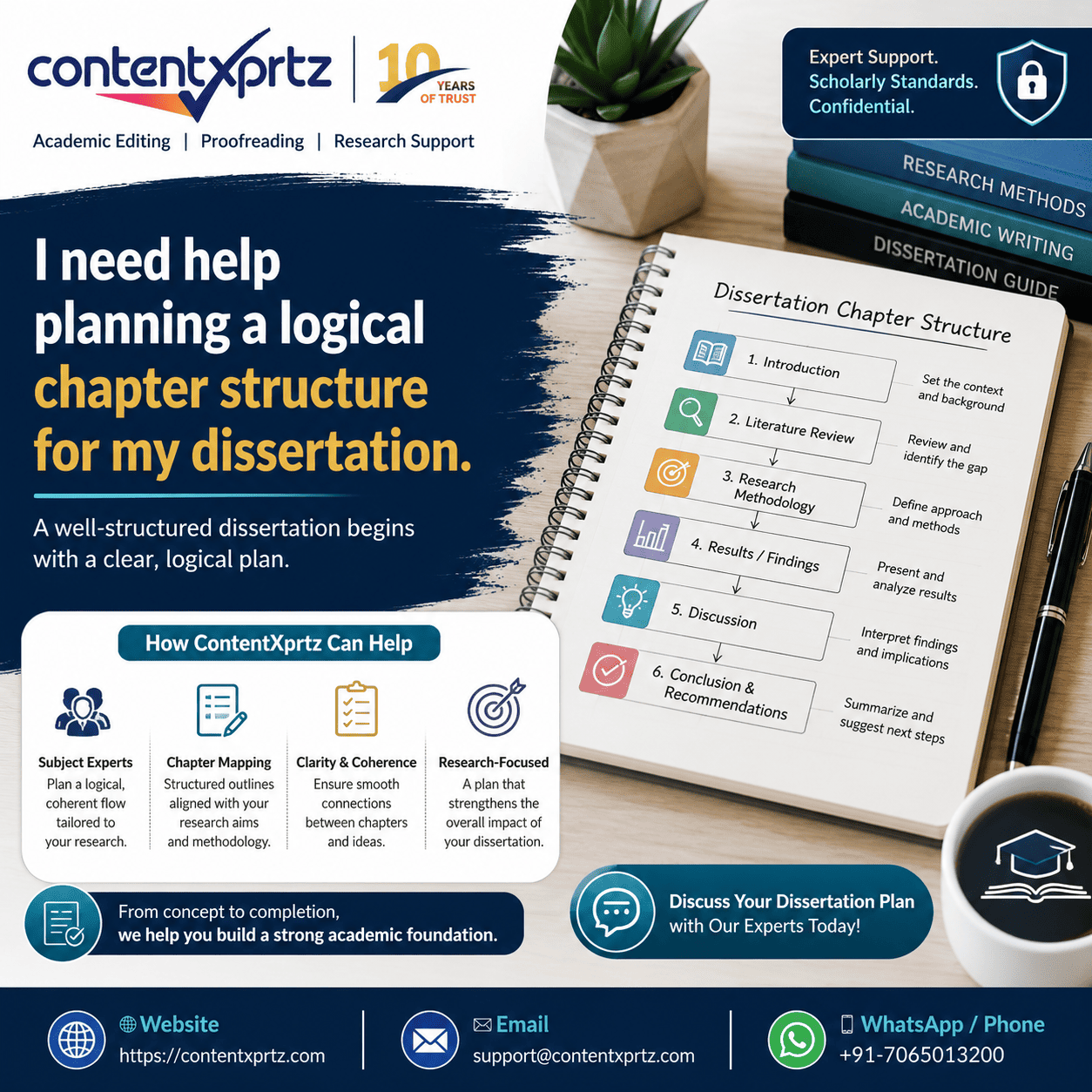
They often share a recognizable structure, but the depth and function of each chapter differ. A traditional research document may contain preliminary pages, introduction, literature review, methodology, results, discussion, conclusion, references, and appendices. Doctoral chapters usually carry a heavier burden of theoretical positioning, methodological defense, synthesis, and contribution.
Introduction
The introduction establishes the problem, context, research gap, aims, questions, significance, scope, and chapter map. In a dissertation, examiners often expect a particularly clear explanation of what is original and why it matters.
Literature review
A thesis literature review demonstrates informed command of the relevant scholarship. A dissertation review must also position the project in relation to major debates, identify unresolved tensions, justify the research gap, and build the conceptual foundation for the contribution.
Methodology
Both documents must explain what was done and why. Doctoral methodology often requires greater attention to epistemology, theoretical assumptions, design trade-offs, validation, reflexivity, limitations, and reproducibility.
Results and discussion
Results present the evidence; discussion explains its meaning. A dissertation typically needs a more sustained comparison with prior research and a more explicit account of how the findings change, extend, or qualify knowledge.
Conclusion
The conclusion answers the research questions, summarizes contribution, acknowledges limitations, and identifies implications. It should not introduce unsupported claims or exaggerate the significance of the study.
Alternative Formats: Article-Based, Practice-Based, and Creative Research
Not every thesis or dissertation follows a five-chapter model. Many universities permit article-based or manuscript-based formats in which publishable papers are connected by an integrating introduction and synthesis. Creative disciplines may use a portfolio, performance, exhibition, composition, film, design outcome, or professional practice accompanied by a critical exegesis.
The format does not reduce the need for a coherent contribution. Candidates must explain how the components form one research program, avoid unnecessary repetition, manage co-authorship transparently, secure permissions where needed, and meet institutional rules for previously published material.
Proposal Expectations: Thesis Proposal vs Dissertation Proposal
A proposal is a research contract in development. It explains the problem, evidence gap, questions, planned method, feasibility, ethics, and expected contribution. Master’s proposals are usually narrower and emphasize a project that can be completed within a limited schedule. Doctoral proposals must usually demonstrate that the research is both feasible and sufficiently original for doctoral examination.
| Proposal element | Master’s thesis emphasis | Doctoral dissertation emphasis |
|---|---|---|
| Problem | Focused and researchable | Significant, unresolved, and contribution-ready |
| Literature | Relevant context and gap | Critical command of debates and theoretical position |
| Method | Feasible and appropriate | Robust, defensible, and aligned with original contribution |
| Risk | Practical timeline and access | Contingency planning for multi-year uncertainty |
| Outcome | Evidence of advanced research competence | A credible path to new knowledge |
Length, Timeline, and Workload
A dissertation is often longer and takes more years, but no universal word count separates the two. Laboratory sciences may produce concise documents with dense data and published papers. Humanities dissertations may require extended archival, conceptual, or interpretive chapters. Professional doctorates may combine applied outputs with reflective analysis.
Students should plan workload by research stages rather than page targets: question refinement, literature search, proposal approval, ethics review, recruitment or data access, data collection, analysis, chapter drafting, supervisor feedback, revision, formatting, proofreading, submission, and examination corrections.
A practical planning principle
Build the schedule backward from the institutional submission date and include revision time. A first complete draft is not a submission-ready document. Complex tables, references, appendices, permissions, and formatting can require more time than expected.
Assessment and Defense Requirements
Both documents may be examined by a committee, but doctoral examination normally tests a higher level of expertise and originality. Examiners may ask why the candidate chose a method, how limitations affect claims, what alternative explanations exist, where the work sits in the field, and precisely what knowledge the research contributes.
A defense is not simply a presentation of chapter summaries. It is an academic conversation about decisions and evidence. Strong preparation includes a concise contribution statement, a map of key findings, awareness of limitations, explanations for major design choices, and calm responses to criticism.
Defense preparation checklist
- State the research problem and contribution in two minutes.
- Explain why the chosen method was appropriate.
- Identify the strongest and weakest evidence.
- Distinguish limitations from fatal flaws.
- Know which claims are supported and which are tentative.
- Prepare to discuss how the work relates to major scholars and debates.
Common Mistakes When Comparing a Thesis and Dissertation
- Assuming the terminology is universal. Always check the local handbook.
- Using length as the main distinction. Academic level and contribution matter more.
- Choosing a doctoral-sized topic for a master’s timeline. A focused question is often stronger.
- Claiming originality without defining it. State what is new, for whom, and why it matters.
- Treating the literature review as a list of summaries. Compare, synthesize, and evaluate sources.
- Writing methodology as a procedural diary. Justify decisions and acknowledge trade-offs.
- Waiting until the end for editing and references. Build quality checks into each chapter.
- Using unauthorized writing assistance. Follow institutional policies and preserve authorship.
Practical Examples: Thesis and Dissertation Decisions
Example 1: A master’s student studying employee wellbeing
Situation: The student proposes to explain employee wellbeing across an entire national industry using interviews, surveys, company records, and policy analysis.
Problem: The question is too broad for a nine-month thesis and the data access is uncertain.
Better approach: The student narrows the project to one occupational group in two organizations and examines a defined relationship using an approved mixed-method design. The contribution is modest but credible: it applies established theory to an underexamined setting and produces evidence relevant to local practice.
Example 2: A doctoral candidate developing a diagnostic model
Situation: The candidate has a large dataset and several promising predictive variables.
Problem: The draft reports statistical performance but does not explain what is conceptually new or how the model improves on existing approaches.
Better approach: The dissertation integrates theory, validation, comparison benchmarks, limitations, and external testing. The contribution is defined not as “a new model exists,” but as a validated approach that improves a specific decision under stated conditions.
Example 3: An international student preparing a dissertation in English
Situation: The research is complete, but the document contains inconsistent terminology, long sentences, unclear transitions, and reference-formatting errors.
Problem: The student fears that editing will change the technical meaning or violate university policy.
Better approach: The student reviews the institution’s editorial-assistance rules, provides the editor with an approved scope, keeps tracked changes, checks every technical revision, and discloses support when required. Ethical thesis editing support improves communication while the student retains responsibility for ideas, methods, data, analysis, and conclusions.
Thesis or Dissertation Planning Checklist
Before research begins
- Confirm the official document name and degree requirements.
- Define a feasible question and contribution.
- Agree on supervision, milestones, ethics, and data management.
- Choose the required format and citation style.
During research
- Maintain a searchable literature and decision log.
- Record method changes and their justification.
- Protect participant data and follow ethics approval.
- Draft chapters while the reasoning is fresh.
Before submission
- Check alignment among questions, methods, findings, and conclusions.
- Verify every citation and reference.
- Review tables, figures, appendices, permissions, and declarations.
- Complete language editing and dissertation proofreading within policy.
- Allow time for supervisor review and final technical checks.
When Academic Editing and Dissertation Proofreading Help
Editing is most useful after the author has completed the intellectual work and needs help communicating it clearly. Depending on university rules, professional support may address grammar, academic tone, paragraph structure, terminology consistency, headings, tables, figures, references, formatting, and cross-references.
Editing should not create the research question, invent a literature review, produce analysis from raw data without authorized collaboration, fabricate citations, or rewrite a weak contribution into an unsupported claim. The researcher must review changes and remain responsible for the final submission.
Contentxprtz provides ethical dissertation editing, thesis proofreading, reference checks, and academic writing support designed to improve clarity while preserving author ownership. Students should share the institutional editing policy, required style guide, document stage, subject area, and deadline before work begins.
Summary: Thesis or Dissertation Difference
The most common thesis or dissertation difference is that a thesis demonstrates master’s-level research competence, while a dissertation demonstrates doctoral-level independence and original contribution. However, universities use the terms differently, so the document name cannot be interpreted without the degree context.
Both require a clear question, scholarly literature, justified methods, ethical evidence handling, coherent analysis, accurate citation, and defensible conclusions. A dissertation normally demands greater depth, originality, independence, and examination. The best next step is to read the official program requirements and convert them into a chapter plan, contribution statement, research timeline, and quality-control checklist.
Frequently Asked Questions
What is the main thesis or dissertation difference?
The main difference is usually the degree level, expected originality, and research scope. A thesis often completes a master’s degree and demonstrates the student’s ability to conduct and communicate a focused research project. A dissertation usually completes a doctoral degree and is expected to make a more substantial, original contribution to knowledge. Terminology varies by country and university, so the institution’s handbook is always the controlling source.
Is a thesis only for a master’s degree?
Not always. In many systems, a thesis is associated with a master’s degree, while a dissertation is associated with a doctorate. However, some universities call doctoral work a thesis, and some undergraduate or professional programs also require a thesis. The title alone does not determine academic level; the program regulations, examination process, and learning outcomes do.
Is a dissertation longer than a thesis?
A dissertation is often longer because doctoral research normally requires a broader literature review, a more extensive methodological justification, deeper analysis, and a clearer original contribution. Length is not a universal rule, however. A concise doctoral dissertation may be stronger than a long one, and word limits differ by discipline, institution, and dissertation format.
Do both a thesis and dissertation require original research?
Both normally require independent scholarly work, but the expected level of originality differs. A master’s thesis may apply an established method to a new setting, synthesize evidence in a disciplined way, or answer a focused question. A doctoral dissertation is generally expected to produce a defensible contribution that changes, extends, tests, or reframes knowledge in the field.
How are thesis and dissertation structures different?
Both may contain an introduction, literature review, methodology, results or findings, discussion, conclusion, references, and appendices. A dissertation usually requires more extensive theoretical positioning, methodological defense, analysis, and explanation of contribution. Some programs allow article-based, practice-based, creative, or portfolio formats, so students should follow their approved institutional structure.
Which is harder, a thesis or a dissertation?
A dissertation is generally more demanding because it is completed at doctoral level and involves a longer research timeline, greater independence, more complex evidence, and a stronger originality requirement. A thesis can still be highly challenging, especially for first-time researchers managing data collection, academic writing, supervision, and deadlines.
Do thesis and dissertation proposals differ?
A master’s thesis proposal usually defines a focused problem, concise literature context, feasible method, timeline, and expected value. A doctoral dissertation proposal normally requires a more detailed theoretical framework, stronger methodological justification, explicit contribution claim, risk planning, ethics considerations, and evidence that the project is viable at doctoral depth.
Are thesis and dissertation defenses the same?
Both may include an oral examination or defense, but doctoral defenses are usually more extensive and place greater emphasis on original contribution, methodological decisions, limitations, and the candidate’s command of the field. Some master’s programs use a presentation, viva, committee review, or written examination instead. Local regulations determine the format.
Can professional editors help with a thesis or dissertation?
Professional editors can ethically help with language, clarity, consistency, formatting, references, tables, and readability when the university permits such support. They should not invent data, write the student’s analysis, change results, fabricate citations, or conceal authorship. Students should review institutional editing policies and disclose assistance when required.
How do I know whether my university requires a thesis or dissertation?
Check the official program handbook, graduate school website, candidature documents, supervisor guidance, and examination regulations. These sources specify the required document name, word limit, format, submission process, ethics obligations, and defense requirements. Do not rely only on terminology used by another university or country.
Conclusion: Focus on Academic Expectations, Not Labels
Students often begin by asking whether they are writing a thesis or dissertation. A more useful question is: what level of research, originality, evidence, and independence must this degree demonstrate? Once that is clear, the title becomes less confusing.
A well-designed master’s thesis is focused, feasible, analytically sound, and clearly written. A successful doctoral dissertation is all of those things while also establishing an original contribution that specialists can examine and debate. Neither document benefits from unnecessary length, inflated claims, weak citations, or last-minute formatting.
Contentxprtz can support thesis editing, dissertation proofreading, academic formatting, and manuscript clarity within ethical and institutional boundaries. The author remains responsible for the research, evidence, argument, and final submission. “At Contentxprtz, we don’t just edit; we help ideas reach their fullest potential.”