Meaning of Dissertation in English: Definition and Academic Guide
Meaning of dissertation in English is a simple language question with an important academic context. In plain English, a dissertation is a substantial piece of academic writing focused on a particular subject, usually completed as part of a university degree. It is more than a long essay: the student normally identifies or refines a research question, studies relevant evidence or scholarship, chooses an appropriate way to investigate the topic, develops an argument or analysis, and presents the work in a structured document. Cambridge Dictionary describes the term broadly as a long piece of writing on a particular subject, especially one completed for a degree. That definition is a useful starting point, but students also need to understand how universities actually use the word.
The confusion begins because dissertation does not mean exactly the same thing in every country, subject, or degree. A master’s student in the United Kingdom may call the final research project a dissertation, while a doctoral student in the United States may also use the word dissertation for the main research document of a PhD. Some undergraduate programmes require dissertations; other courses use terms such as thesis, capstone project, research project, extended essay, or major project. The correct meaning therefore depends on context. If a university says you must submit a dissertation, its handbook and assessment criteria—not a generic word count found online—define what you must produce.
Students also search this term because they are trying to understand what the assignment demands in practice. They may be worried about choosing a topic, writing in academic English, planning chapters, reviewing literature, using citations correctly, collecting data, meeting a deadline, or deciding whether they need dissertation support. For PhD scholars and postgraduate students, the challenge can be larger: the document may represent months or years of research, and weak structure or unclear language can make good work difficult to assess. ESL researchers may understand their subject deeply but still need help with sentence flow, terminology, transitions, or scholarly tone.
This guide explains the word first, then moves into the academic task behind it. You will see how dissertation differs from thesis, essay, and research paper; what common sections do; how to plan a dissertation step by step; what mistakes to avoid; and when self-editing, supervisor feedback, university writing support, or ethical academic editing may be appropriate. The aim is not to make every dissertation look identical. It is to help you understand the term clearly and make better decisions about your own programme, research, writing, and final presentation.
Quick Answer: Meaning of Dissertation in English
A dissertation is a long, structured piece of academic writing about a focused subject, usually prepared for a university degree. It normally shows that the student can investigate a question independently, use appropriate sources or data, develop a reasoned analysis, and present conclusions in a formal academic document.
The word is a noun. In academic sentences you might write, “She is completing her dissertation on climate adaptation,” or “The dissertation examines changes in consumer behaviour.” The plural is dissertations. It is commonly associated with undergraduate, master’s, or doctoral research depending on the institution.
The most important caution is that dissertation and thesis are not universal labels. Their use changes across countries and universities. Before planning chapters or word count, read your programme handbook and marking criteria so that the meaning is translated into the exact task your institution expects.
Key Takeaways
- A dissertation is an extended academic research document on a focused topic.
- It usually requires more independent research, planning, and analysis than a normal essay.
- The terms dissertation and thesis vary by country and university, so local rules matter.
- Common sections include an introduction, literature review, methodology, findings or analysis, discussion, conclusion, and references, but structures differ by discipline.
- A dissertation does not always require new empirical data; some programmes allow literature-based, applied, design, or secondary-data projects.
- Editing can improve clarity and consistency, but the student remains responsible for ideas, evidence, citations, and the final submission.
- The safest first step is to read the official handbook before copying any generic dissertation template.
What This Page Covers
- The plain-English definition, pronunciation, grammar, and academic use of the word dissertation
- How dissertation differs from thesis, essay, research paper, and capstone project
- Why terminology changes between UK, US, and institution-specific contexts
- Common dissertation sections and what each section is meant to achieve
- A step-by-step planning and writing workflow for students and researchers
- Common mistakes, practical examples, and a submission-readiness checklist
- When self-service support is enough and when ethical editing or proofreading can help
Table of Contents
- Meaning, pronunciation, and academic use
- Why students search for the term
- Step-by-step dissertation workflow
- Dissertation vs thesis, essay, and research paper
- Common dissertation structure
- How to judge dissertation readiness
- Common mistakes
- Practical examples
- Dissertation checklist
- Frequently asked questions
Methodology and Academic Sources
This guide combines established English-language definitions with university academic-writing guidance. The Cambridge Dictionary definition of dissertation supports the plain-English meaning. The University of Oxford provides guidance on essay and dissertation writing skills and separately explains how the terms thesis and dissertation can differ between UK and US usage. The University of Manchester’s Academic Phrasebank illustrates common language functions used in research papers and dissertations.
These sources help explain general conventions, but they cannot replace your own university regulations. Dissertation requirements vary by discipline, degree level, ethics process, research method, chapter format, and assessment criteria. Researchers should check their official handbook and supervisor guidance before deciding on structure, length, or permitted editing assistance. Contentxprtz can support ethical editing and proofreading, but authors remain responsible for the research question, evidence, analysis, citations, and final submission.
What “Dissertation” Means in an Academic Context
In academic English, a dissertation is an extended, focused research document prepared to demonstrate advanced study and independent inquiry. The exact level of independence varies. An undergraduate dissertation may be a first major research project; a master’s dissertation may require a more developed research design and critical synthesis; a doctoral dissertation may be expected to make a significant original contribution, depending on local terminology and regulations.
Pronunciation, part of speech, and everyday usage
Dissertation is a countable noun. Cambridge gives the British pronunciation approximately as /ˌdɪs.əˈteɪ.ʃən/ and the American pronunciation approximately as /ˌdɪs.ɚˈteɪ.ʃən/. The stress falls on the “tay” sound. Common forms include “a dissertation,” “my dissertation,” “doctoral dissertation,” “master’s dissertation,” and the plural “dissertations.”
| Expression | What it usually means | Example |
|---|---|---|
| Dissertation | A substantial academic research document | A student submits a dissertation to complete a degree requirement. |
| Dissertation topic | The focused subject or problem being investigated | The topic may be narrowed from a broad interest to a researchable question. |
| Dissertation proposal | A plan explaining the intended research | It may include the question, rationale, literature, methods, and timeline. |
| Dissertation supervisor | An academic who guides the project within programme rules | The supervisor may advise on scope, method, structure, and progress. |
| Dissertation defence or viva | An oral examination used in some programmes | The student explains and answers questions about the research. |
The word itself does not tell you the required word count, chapter order, research method, or assessment standard. Those details come from the institution. This distinction matters because two students can both be “writing a dissertation” while completing very different academic tasks.
Why Students, PhD Scholars, and Researchers Search for This Meaning
People usually search the meaning because they have encountered the word in a course, application, handbook, or supervisor conversation and need to know what work it represents. The language question is often the beginning of a larger academic decision.
For first-time university students
A student who has only written essays may hear “dissertation” and assume it is simply a much longer essay. That can lead to poor planning. A dissertation normally involves a longer research cycle, more independent decision-making, and stronger integration across sources, methods, analysis, and conclusion.
For master’s students
Master’s programmes often use the dissertation as a major final component. Students may need to develop a feasible question, identify a method, work with a supervisor, meet ethics requirements where relevant, and produce a sustained academic argument under a strict deadline.
For doctoral candidates
In systems that use doctoral dissertation, the word refers to the principal research document associated with the doctorate. Expectations for originality, methodological rigour, contribution, and examination are substantially higher than for taught-course assignments.
For ESL academic writers
English-language terminology adds another layer. An ESL scholar may understand the research process but be unsure whether “dissertation,” “thesis,” and “research project” describe the same document. Clear definitions reduce that uncertainty, while dissertation proofreading support may later help with grammar and consistency if permitted by university policy.
Free, Low-Cost, and Professional Ways to Understand and Prepare a Dissertation
Most students can answer the basic meaning for free, but preparing the actual dissertation may require different kinds of support at different stages. Start with official sources before paying for any service.
| Option | Best use | Strength | Limitation |
|---|---|---|---|
| Dictionary | Understanding the word and basic usage | Fast, clear definition | Does not explain your programme rules |
| University handbook | Word count, structure, assessment, deadlines | Authoritative for your course | May assume familiarity with research terms |
| Supervisor | Scope, research question, method, feasibility | Knows the academic context | Feedback time may be limited |
| University writing centre or language support | Academic writing development and feedback | Often low-cost or included in tuition | Availability and permitted support vary |
| Professional editing | Clarity, grammar, coherence, consistency, formatting | Focused review of a complete or substantial draft | Must stay within academic integrity rules |
A sensible sequence is dictionary for meaning, handbook for requirements, supervisor for research decisions, and writing or editing support for communication. Paying for editing before you know the research question or programme rules rarely solves the real problem.
When Self-Service Is Enough and When Expert Editing Is Safer
Self-service is usually enough when you only need the definition, a basic outline, or help understanding the assignment. Your university handbook, library, writing centre, supervisor, and credible academic resources should come first.
Expert editing becomes more useful after substantial writing exists. Consider it when the argument is difficult to follow because of language, chapters repeat one another, terminology changes across the document, citations are inconsistent, the draft is over the word limit, or the English obscures otherwise sound research. For PhD scholars and ESL researchers, a professional editor can provide an additional quality-control layer, provided the work remains the author’s own.
The boundary is important. Editing should improve expression and presentation; it should not fabricate evidence, perform unacknowledged research, invent citations, or replace the student’s assessed intellectual contribution. If your university has a proofreading policy, follow it exactly.
How to Plan and Write a Dissertation: Step by Step
Writing a dissertation becomes manageable when you treat it as a sequence of research decisions rather than one enormous writing task. The steps below are general; your programme may arrange them differently.
1. Translate the assignment into concrete requirements
Record the deadline, word limit, required sections, research ethics process, formatting rules, referencing style, supervision arrangements, and marking criteria. Separate what is compulsory from what is merely common practice.
2. Choose a focused and feasible topic
A broad interest such as “social media and mental health” is not yet a dissertation question. Narrow it by population, context, period, theory, method, outcome, or case so that the project can be completed with the time and resources available.
3. Formulate a research question, aim, or problem
The question should guide what evidence you need and what your conclusion must answer. Avoid questions that are so broad that every source seems relevant or so narrow that meaningful evidence is unavailable.
4. Review the literature strategically
Identify what is already known, how researchers have studied the issue, where findings disagree, and what gap or problem your project addresses. The University of Manchester’s Academic Phrasebank is useful for understanding common rhetorical functions in introductions, literature reviews, methods, discussions, and conclusions.
5. Select an appropriate research design
Decide whether the project will use experiments, surveys, interviews, observations, archival materials, textual analysis, secondary data, modelling, design work, a structured review, or another approved approach. The method must fit the research question.
6. Obtain ethics approval where required
If the project involves human participants, personal data, sensitive topics, animals, or other regulated activity, follow the institution’s process before collecting data. Do not assume that a student project is automatically exempt.
7. Create a chapter plan before drafting heavily
Give each chapter a job. The introduction frames the problem; the literature review establishes context; the methodology explains what you did; the analysis or results presents evidence; the discussion interprets it; the conclusion answers the research question and explains significance and limitations.
8. Draft for meaning before polishing every sentence
Write the argument in a form you can revise. Constantly perfecting the first page can delay the analytical work that determines the quality of later chapters. Keep source details accurate from the beginning.
9. Revise at three levels
First revise the whole dissertation for argument and chapter order. Second revise paragraphs for logic, evidence, and transitions. Third proofread sentences for grammar, punctuation, terminology, citations, formatting, and typographical errors.
10. Complete a final compliance check
Confirm word count, title page information, contents, figure and table numbering, reference list, appendices, file format, naming rules, required declarations, submission portal, and deadline. A strong dissertation can lose professionalism through avoidable final-stage errors.
Dissertation vs Thesis, Essay, and Research Paper
The terms overlap, but they usually signal different levels of scope, independence, and institutional purpose. Use the comparison below as orientation, not as a substitute for local rules.
| Document | Typical purpose | Common characteristics | Important caution |
|---|---|---|---|
| Dissertation | Major degree-related research project | Focused question, substantial literature engagement, method or analytical approach, sustained argument | Degree level and terminology vary by country and university |
| Thesis | Major research work for a degree | Can be very similar to a dissertation | UK/US usage often differs; local regulations control |
| Essay | Answer or discuss a set academic question | Usually shorter, narrower, and completed within a course | Some extended essays can still involve significant research |
| Research paper | Present research or scholarly analysis | May follow journal-style sections and be written for a course or publication | Length and originality vary widely |
| Capstone or project report | Demonstrate applied learning or professional competence | May include design, implementation, reflection, or client-based work | May not use a traditional dissertation chapter structure |
The University of Oxford’s guidance on writing theses and dissertations explicitly notes that UK and US terminology can be inverted. This is why “Is a dissertation a thesis?” has no single global yes-or-no answer. They belong to the same family of extended academic research documents, but the label is institution-specific.
What Is the Common Structure of a Dissertation?
A dissertation usually moves from the research problem to prior scholarship, method, evidence, interpretation, and conclusion. The sequence below is common in many empirical projects, while humanities and practice-based disciplines may organise material differently.
Title page and front matter
These pages can include the title, author, degree, institution, date, declaration, acknowledgements, abstract, table of contents, and lists of figures or tables. Follow the required order exactly.
Introduction
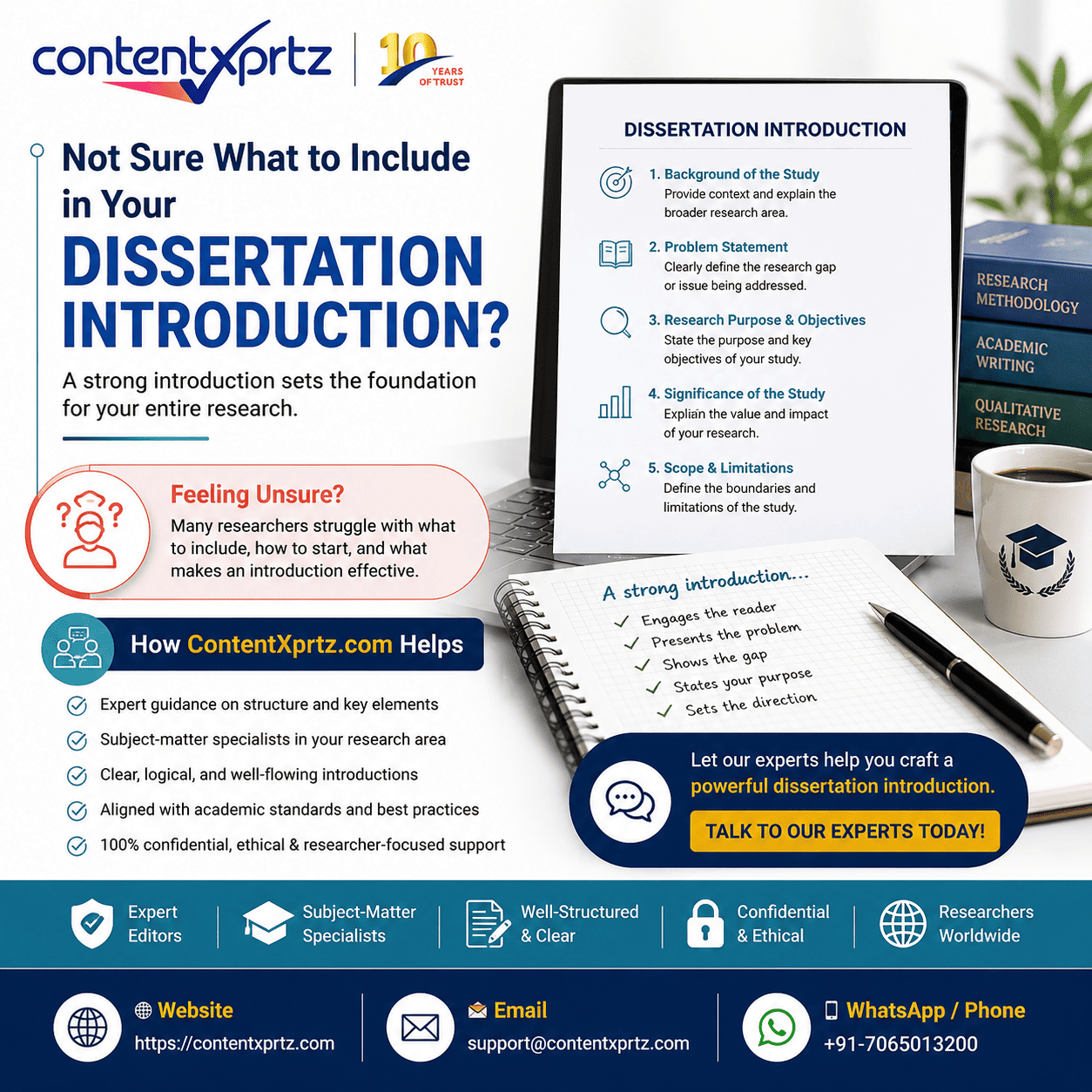
The introduction establishes context, identifies the research problem, states the aim or question, explains significance, and previews the dissertation. Oxford’s writing guidance emphasises argument and planning rather than simply displaying everything the student knows.
Literature review
This section explains what is already known, evaluates relevant scholarship, identifies debates or gaps, and positions the present study. It should synthesise rather than become a list of article summaries.
Methodology or research design
The methodology explains how the project was conducted and why the approach was appropriate. It may discuss sampling, data sources, instruments, analytical procedures, validity, limitations, ethics, or theoretical method depending on the discipline.
Results, findings, analysis, or thematic chapters
This is where the dissertation presents the evidence and analysis that answer the research question. Quantitative, qualitative, textual, historical, legal, engineering, and creative projects organise this material differently.
Discussion
The discussion interprets the findings, connects them with prior scholarship, considers alternative explanations, explains implications, and acknowledges limitations. In some disciplines, discussion is integrated with results or analytical chapters.
Conclusion
The conclusion answers the research question at the level supported by the evidence. It should not introduce major new evidence. It may restate the contribution, discuss limitations, and suggest future research or practice implications.
References and appendices
The reference list must match the required citation style and the sources actually cited. Appendices may contain supporting material such as instruments, supplementary tables, technical details, coding frameworks, or documents that would interrupt the main argument.
How to Judge Whether a Dissertation Draft Is Academically Ready
A dissertation is ready when its research logic, evidence, structure, citations, and language work together to answer the stated question within the programme rules. Grammar alone cannot rescue a weak research design, and strong research can still be difficult to evaluate if the writing is disorganised.
| Area | Questions to ask before submission |
|---|---|
| Research question | Is it clear, focused, and actually answered by the dissertation? |
| Literature | Does the review synthesise relevant scholarship and explain the project’s position? |
| Method | Is the approach appropriate, transparent, and consistent with the research question? |
| Evidence | Do the claims match the data, texts, cases, or sources presented? |
| Argument | Does each chapter contribute to one coherent line of reasoning? |
| Limitations | Are uncertainty, scope, and methodological limits acknowledged honestly? |
| Citations | Are sources authentic, traceable, cited consistently, and included in the reference list? |
| Language | Is the English precise, readable, and consistent without changing the intended meaning? |
| Compliance | Does the document meet word count, format, ethics, declaration, and submission rules? |
Use your marking rubric as a diagnostic tool. If the rubric rewards critical analysis, simply adding more references is unlikely to solve a descriptive chapter. If the method is unclear, polishing grammar should come after the research logic is clarified. Thesis and dissertation editing support is most valuable when it is targeted at the stage of the real problem.
Ethical Academic Editing and Author Responsibility
Ethical editing improves how the author’s work is communicated without taking over the author’s intellectual responsibility. A student should remain able to explain the research question, justify the method, defend the interpretation, verify every citation, and accept or reject every editorial change.
Universities differ in what they allow. Some permit proofreading of grammar and spelling but restrict changes to argument or structure. Others permit broader language editing for certain students or programmes, sometimes with disclosure. Therefore, check the official academic-integrity, proofreading, and use-of-AI policies before sending assessed work to an editor.
Responsible support may flag unclear claims, repeated information, weak transitions, inconsistent terminology, citation mismatches, or formatting problems. It should not invent references, create data, produce false quotations, manipulate results, conceal plagiarism, or write material that the student is required to author independently. AI-generated text also requires careful verification; references and factual claims must be checked against authentic sources.
Common Dissertation Mistakes to Avoid
Many dissertation problems begin before the final proofreading stage. Avoiding the following mistakes saves time and makes supervisor feedback more useful.
- Choosing a topic that is too broad. A broad theme is not yet a researchable question.
- Copying a generic chapter template. Structure should follow the discipline, research design, and university rules.
- Writing the literature review as a list. Synthesis and critical comparison matter more than one-paragraph summaries of every source.
- Collecting data before confirming method and ethics. This can make evidence unusable.
- Changing the research question without aligning later chapters. The title, aims, methods, findings, discussion, and conclusion must still fit together.
- Using citations that you have not verified. Every reference should be authentic and traceable.
- Confusing proofreading with substantive research revision. Grammar correction cannot repair an unsupported argument.
- Leaving formatting and references to the final night. Build consistency as you draft.
- Using AI text without verification. Generated content may contain inaccurate statements or fabricated references.
- Ignoring the marking criteria. A well-written dissertation can still underperform if it does not satisfy assessed learning outcomes.
Practical Examples: What “Dissertation” Means in Real Student Situations
Example 1: A master’s student mistakes a dissertation for a long essay
Situation: Riya is told to complete a 12,000-word dissertation and begins by expanding a previous 2,000-word essay topic. Common confusion: She assumes that more words and more references will automatically create a dissertation. Correct approach: She narrows the topic into a research question, reviews the programme rubric, plans a method, and creates chapters that each contribute to answering the question. How ethical guidance helps: A supervisor can test feasibility, while an editor later helps remove repetition and improve the clarity of the final argument without choosing the research decisions for her.
Example 2: A US PhD applicant sees “doctoral dissertation”
Situation: Daniel studied in a system where the word thesis was used for major degree research, so he assumes dissertation must mean something different. Common confusion: He searches for a universal distinction. Correct approach: He recognises that terminology changes by country and institution. For the programme he is reading about, “doctoral dissertation” refers to the principal research document of the PhD. How ethical guidance helps: Clear academic language support can explain terminology, but only the university’s regulations define the examination process, originality standard, and required format.
Example 3: An ESL scholar has sound research but unclear English
Situation: Mei has completed interviews, analysis, and a complete dissertation draft. Her supervisor understands the findings but repeatedly marks unclear sentences and inconsistent terminology. Common mistake: She considers rewriting large sections with automated text generation, which risks changing meaning or introducing inaccurate claims. Correct approach: She first clarifies her intended argument, then uses permitted language editing and proofreading to improve grammar, transitions, and consistency. How ethical guidance helps: An editor can flag ambiguity and improve readability while Mei verifies every change and remains responsible for the research and final wording.
Dissertation Planning, Writing, and Submission Checklist
Understand the task
- The official handbook has been read, including word count and assessment criteria.
- The terms dissertation, thesis, project, or capstone are understood in the programme’s own context.
- The deadline, submission format, and required declarations are recorded.
- The policy on proofreading, editing, and AI assistance has been checked.
Build the research
- The topic has been narrowed to a feasible research question or aim.
- The literature review identifies patterns, debates, gaps, and relevant methods.
- The chosen method or analytical approach fits the research question.
- Ethics approval has been obtained before data collection where required.
Write and revise
- Each chapter has a defined role in answering the research question.
- Claims are supported by appropriate evidence and authentic citations.
- Paragraphs have clear purpose, logical sequence, and useful transitions.
- Limitations are acknowledged without overstating what the study proves.
Final quality control
- In-text citations and the reference list match.
- Tables, figures, headings, abbreviations, and terminology are consistent.
- Grammar and punctuation have been proofread after structural revision.
- The document meets the word limit and formatting rules.
- The submitted file is the correct final version and the submission receipt is saved.
How Contentxprtz Can Help With Dissertation Writing and Editing
Contentxprtz is most relevant when a student or researcher understands the academic task but needs structured support improving the document. The service can assist with language editing, proofreading, clarity, coherence, formatting, and dissertation-focused review while keeping the author responsible for the research and academic decisions.
If your draft is complete but difficult to read, dissertation writing and editing services can help identify unclear sentences, inconsistent terminology, repetition, weak transitions, and presentation issues. If your need is mainly surface-level correction, proofreading may be more appropriate than deeper editing. If the research question, method, or findings are still unresolved, supervisor or subject-specialist guidance should come before language polishing.
Before using any external support, confirm what your university permits. Ethical editing should make your ideas easier to understand, not replace your authorship or create research that you cannot defend.
Summary: Meaning of Dissertation in English
The meaning of dissertation in English is an extended academic research document focused on a particular subject and usually completed as part of a university degree. It is typically more independent and research-intensive than an ordinary essay, but there is no single global word count, chapter template, or degree level attached to the term.
Dissertation and thesis often overlap, and their usage can change between countries and institutions. A common dissertation may include an introduction, literature review, methodology, findings or analysis, discussion, conclusion, and references, but the correct structure depends on the discipline and programme.
The practical next step is simple: understand the word, then read your own handbook. Use your supervisor for research decisions, university resources for academic skills, and ethical editing or proofreading only where it is permitted and genuinely needed. The author remains responsible for the question, evidence, analysis, citations, and final submission.
Frequently Asked Questions
What is the meaning of dissertation in English?
The meaning of dissertation in English is a substantial piece of academic writing on a focused subject, usually completed as part of a university degree. A dissertation normally asks the student to define a question or problem, examine relevant sources, develop and support an argument, and present the work in an organised academic form. Depending on the programme, it may also include original data collection, analysis of existing data, textual or documentary analysis, a design project, or another approved research method. The word is a countable noun: you can write “a dissertation,” “the dissertation,” or “several dissertations.” In everyday academic English, people often use the term for a major final research project rather than an ordinary essay. However, terminology varies across countries and universities. Some institutions use dissertation mainly for master’s work, while others use it for undergraduate or doctoral research. The safest interpretation is therefore: a long, structured, degree-related research document whose exact requirements are defined by the university or department.
What is a dissertation in simple words?
In simple words, a dissertation is a long university research paper in which you investigate one topic in depth and show what you have learned through evidence, analysis, and organised academic writing. It is usually more demanding than a normal class essay because you are expected to make more decisions yourself: choosing or refining a topic, setting a research question, finding and evaluating sources, selecting a method, organising chapters, and explaining what your findings or analysis mean. A dissertation does not have to be complicated in language. Strong work is usually clear, precise, well supported, and easy for the reader to follow. The exact form depends on the subject. A laboratory dissertation may contain methods, results, figures, and statistical analysis; a humanities dissertation may build a sustained argument from primary texts and scholarship; a professional programme may use a case study, project, or applied research design. Always check your course handbook because the word “dissertation” describes the type of academic project, not one universal chapter template.
Is a dissertation the same as a thesis?
Dissertation and thesis are closely related terms, but they are not used identically everywhere. Both normally refer to substantial academic research submitted for a degree, and both can require a research question, literature engagement, analysis, conclusions, citations, and formal presentation. The main difference is often local academic convention rather than a universal rule. University of Oxford guidance notes a common UK convention in which “dissertation” is often used for a master’s final project while “thesis” is associated with undergraduate or doctoral work, whereas in the United States “dissertation” commonly refers to doctoral research and “thesis” to master’s work. Other institutions use the words differently, and some programmes use them almost interchangeably. Therefore, do not decide what you must submit from the word alone. Check your official programme handbook, assessment regulations, supervisor guidance, required word count, and submission format. Those documents define your real task more accurately than a general dictionary distinction.
What is the difference between a dissertation and an essay?
A dissertation is usually longer, more independent, and more research-driven than an ordinary academic essay. An essay often responds to a set question within a course and may be completed over a relatively short period using a selected body of reading. A dissertation normally requires the student to manage a larger research process: narrowing a topic, defining a research question, locating and evaluating a wider evidence base, choosing an appropriate method or analytical approach, planning a sustained argument, and producing a document with several connected sections or chapters. Dissertations also commonly include elements that essays may not require, such as an abstract, methodology section, dedicated literature review, results or findings, appendices, and a formal statement of limitations. The distinction is not simply word count. What matters is the degree of independent inquiry, research design, depth, and integration across the whole document. Your department may still call a shorter final project a dissertation, so use institutional guidance as the final authority.
What is the usual structure of a dissertation?
A common dissertation structure includes a title page, abstract, contents page, introduction, literature review, methodology or research design, findings or results, discussion, conclusion, reference list, and appendices where needed. This sequence is useful because it moves the reader from the research problem to the evidence and then to the interpretation. However, it is not universal. In humanities subjects, literature and analysis may be integrated across thematic chapters instead of appearing as separate “results” and “discussion” sections. In science and social science projects, methods, results, and discussion may be more clearly separated. Practice-based and professional dissertations may use a project report, portfolio, case study, or reflective component. The best structure is the one that meets your programme rules and makes your argument easy to follow. Before drafting, compare your handbook, marking criteria, supervisor advice, and—if permitted—high-quality previous dissertations from your department. Then build a chapter plan that gives each section a clear purpose in answering the research question.
How long is a dissertation?
There is no universal dissertation length. Word limits differ by degree level, discipline, institution, assessment design, and whether tables, footnotes, references, appendices, or other elements are included in the count. A master’s dissertation at one university may be around ten thousand words, while another programme may require substantially more or less. Doctoral dissertations can be much longer, and some professional or practice-based programmes use shorter written components combined with other assessed work. The important rule is to follow the official limit for your course rather than a general number found online. Check whether the stated limit is a maximum, a target range, or a strict cap, and confirm which sections count toward it. A strong dissertation is not improved by unnecessary length. Examiners usually benefit from a document in which every chapter contributes to the research question, evidence is presented efficiently, repetition is removed, and the conclusion reflects what the study can genuinely support. If your draft is far over the limit, structural editing is often more useful than simply deleting random sentences.
Does a dissertation have to include original research?
Not every dissertation requires original empirical data, but most require some form of independent intellectual work. “Original” can mean different things at different degree levels. A project may collect new interviews, survey responses, experiments, observations, or measurements. It may analyse an existing dataset in a new way, compare documents or texts, conduct a systematic or structured review, develop a model, evaluate a policy, build a design or technical artefact, or apply an established theory to a new case. Some taught programmes allow literature-based dissertations with no new data collection. Doctoral work normally carries a higher expectation of an original contribution to knowledge, but the exact standard is defined by the institution and discipline. Do not assume that originality means inventing a completely new topic. More often, it means making a defensible contribution through the question, evidence, method, interpretation, synthesis, or application. Confirm the permitted research design with your supervisor and course documents before investing substantial time in data collection or analysis.
What does “write a dissertation” mean for a student?
To “write a dissertation” means more than producing a long document. It usually means completing a supervised research project from planning to final submission. The student first clarifies the assignment and research area, then narrows the topic into a workable question. Next comes a review of relevant scholarship, selection of methods or an analytical approach, ethical approval where required, evidence collection or source analysis, interpretation, drafting, revision, referencing, and final formatting. Good dissertation work is iterative: the question may become more precise after reading, the chapter plan may change after analysis, and the discussion may need revision so that claims match the evidence. Students should keep notes on sources and decisions throughout rather than trying to reconstruct them at the end. If English is not your first language, language editing can help make the argument clearer, but it should preserve your meaning and comply with university rules. The author remains responsible for the research, claims, citations, and final submitted version.
Can I use editing or proofreading help for my dissertation ethically?
Editing and proofreading can be ethical when they improve presentation without replacing the student’s authorship or academic decisions, and when the assistance is permitted by the university. Proofreading usually focuses on surface-level issues such as spelling, punctuation, grammar, typographical errors, and consistency. Academic editing may also address clarity, sentence structure, organisation, transitions, terminology, and formatting. The acceptable boundary varies by institution: some universities allow language correction but restrict substantive rewriting, while others require students to disclose certain forms of assistance. An editor should not fabricate sources, invent results, change data, create unsupported arguments, conceal authorship, or write assessed content that the student is expected to produce independently. Before using any service, read your university’s academic integrity and proofreading rules and ask your supervisor if the policy is unclear. Keep a version history and review every change yourself. Ethical support strengthens communication; it does not transfer responsibility for the research or final submission away from the student.
When should I seek professional dissertation editing support?
Professional dissertation editing can be useful after you have a genuine draft and need help making the document clearer, more consistent, and easier to evaluate. Common reasons include repeated grammar problems, unclear paragraph logic, inconsistent terminology, weak transitions between chapters, a reference list that does not match in-text citations, formatting errors, or difficulty reducing a draft to the required word limit without losing the argument. It may also help ESL writers who understand their research well but need support expressing it in formal academic English. Editing is not a substitute for choosing the topic, conducting the research, interpreting results, or meeting with your supervisor. A responsible editor should work within your university’s rules, preserve your intended meaning, flag uncertainties rather than inventing answers, and leave you in control of every final decision. Contentxprtz offers dissertation-focused editing and proofreading support for students who already own the ideas and research and want a more polished, coherent, submission-ready presentation.
Conclusion: Understand the Term, Then Follow Your University Rules
The main problem behind the search is usually not vocabulary alone. Students want to know what they are expected to produce. In practical academic terms, a dissertation is a substantial, focused research document that demonstrates the ability to investigate a question, use evidence responsibly, develop analysis, and communicate conclusions in a structured form.
Free resources are enough to understand the definition and begin planning. Your university handbook and supervisor should then determine the real requirements. Expert-assisted editing becomes useful when a genuine draft needs clearer English, stronger coherence, better consistency, or careful final proofreading. It should never replace the research, data, argument, or author responsibility that the degree is assessing.
Contentxprtz supports students and researchers who want to improve clarity, structure, academic presentation, and dissertation readiness while respecting institutional rules and academic integrity. Review dissertation writing and editing support if your draft is ready for a professional quality check. “At Contentxprtz, we don’t just edit; we help ideas reach their fullest potential.”