Custom Dissertation Writing Service: What Ethical Support Should Actually Include
A custom dissertation writing service can mean very different things, and that difference matters. A responsible service helps a student or researcher plan, organise, edit, proofread, format, and strengthen a dissertation while keeping the research decisions, analysis, claims, and final authorship with the student. An irresponsible service crosses that boundary by producing assessed work for submission as if the student wrote it. For doctoral candidates, postgraduate students, ESL researchers, and working professionals, the safest way to evaluate any provider is therefore to ask a simple question: Does the support improve my own work, or replace my responsibility for it?
Dissertations are difficult because they combine several demanding tasks at once. A candidate may need to refine a research problem, build a defensible literature review, explain a methodology, analyse evidence, maintain argument flow across long chapters, apply a citation style consistently, respond to supervisor feedback, and meet institutional formatting rules. The pressure is often intensified by deadlines, language barriers, work commitments, or uncertainty about what supervisors expect. In that situation, expert academic writing support can be useful, but it must be structured around learning, revision, and transparent assistance rather than hidden authorship.
Free grammar tools and generic AI tools can catch surface errors, yet they may miss disciplinary tone, conceptual gaps, unsupported claims, inconsistent terminology, weak transitions, citation problems, or contradictions between chapters. Human academic editing can add value when it explains why a passage is unclear, identifies recurring patterns, checks consistency, and helps the author make informed revisions. The goal should be a stronger dissertation that remains recognisably the researcher’s own intellectual work.
This guide explains what ethical dissertation support looks like, which services are appropriate at different stages, how to compare providers, what warning signs to avoid, and how to protect academic integrity. It also shows where Contentxprtz can support dissertation support, academic editing, and dissertation proofreading without taking over the author’s research responsibility.
Quick Answer: What Is a Custom Dissertation Writing Service?
An ethical custom dissertation writing service is a tailored academic support service that works with a student’s own research, draft, data, supervisor feedback, and university requirements. It may provide planning guidance, chapter-level feedback, developmental editing, language editing, proofreading, citation checks, formatting support, and revision coaching.
The key boundary is authorship. The service should not invent research, fabricate references, create results, or secretly write assessed content for the student to submit as their own. Students should check their university’s policy on third-party editing and permitted assistance before engaging any provider.
A good provider makes the author more capable: comments are explainable, changes are traceable, and the final document remains grounded in the student’s own argument, evidence, and decisions.
Key Takeaways
- Choose dissertation support that improves your own draft rather than replacing your authorship.
- Editing, proofreading, structure review, citation checks, formatting, and coaching are safer than ghostwriting.
- University rules on third-party editing vary, so check local policy before commissioning support.
- Ask providers to define exactly what they will change, what they will not change, and how revisions are documented.
- Never accept fabricated sources, invented data, guaranteed grades, or promises of guaranteed approval.
- Use expert support where it adds judgement: argument clarity, chapter coherence, methodology explanation, scholarly tone, and consistency.
- The researcher remains responsible for claims, evidence, citations, analysis, and final submission.
What This Page Covers
- The ethical meaning of custom dissertation support
- Differences between writing assistance, editing, proofreading, and coaching
- How to decide what level of help you need
- What a responsible workflow looks like from proposal to final submission
- Common warning signs and academic-integrity risks
- Three realistic dissertation support examples
- A provider-selection checklist and ten detailed FAQs
Table of Contents
Methodology and Academic Sources
This article is based on common dissertation-development, academic editing, proofreading, and research-integrity workflows. Institutional rules differ, so students should always check their university handbook, graduate-school guidance, supervisor instructions, and any policy covering external editing or AI use. For broader authorship principles, the ICMJE authorship recommendations emphasise meaningful intellectual contribution and accountability. The Committee on Publication Ethics provides widely used publication-ethics guidance, while Elsevier Researcher Academy offers manuscript-preparation education. These resources are not substitutes for a student’s own university rules.
What “Custom” Should Mean in a Dissertation Context
Custom should mean tailored to the author’s project, not “written secretly on the author’s behalf.” Ethical tailoring starts with the actual dissertation: the research question, discipline, chapter plan, methods, data, supervisor comments, referencing style, submission format, and stage of completion. The support then responds to those needs rather than delivering a generic essay.
For example, a doctoral candidate in education may need help making the conceptual framework consistent with the interview analysis. A management student may need a structural review showing where the literature review becomes descriptive rather than analytical. An engineering researcher may need language editing that preserves technical terminology while improving sentence clarity. These are different assignments, so a useful service should define scope before editing begins.
| Support type | Appropriate purpose | What the student must retain |
|---|---|---|
| Planning and coaching | Clarify milestones, chapter logic, questions, and revision priorities | Research choices and written decisions |
| Developmental editing | Identify gaps in argument, structure, coherence, and evidence use | Core ideas, analysis, interpretations, and revisions |
| Language editing | Improve grammar, academic tone, clarity, and readability | Meaning and disciplinary claims |
| Proofreading | Correct final-stage spelling, punctuation, typographical, and consistency errors | Substantive content |
| Citation and formatting support | Check consistency with a required style and institutional layout | Source authenticity and citation responsibility |
Why Students and PhD Scholars Search for Dissertation Writing Help
Most students do not search for help because they lack ideas. They search because a dissertation is unusually long, interconnected, and high stakes. Problems that seem small in one chapter can create contradictions elsewhere. A weak definition in the literature review may affect the methodology; inconsistent coding language can confuse the findings; an unclear distinction between results and discussion can make a strong study look unfocused.
Time pressure is another driver. Part-time doctoral candidates may be balancing employment, family, fieldwork, and revision cycles. International students may understand their subject deeply but need help expressing complex ideas in formal academic English. First-time researchers may not yet know the difference between proofreading and substantive editing. In all of these cases, support is most valuable when it reduces avoidable friction while preserving the learning and intellectual work that the dissertation is designed to assess.
Free, Low-Cost, and Professional Options: Which One Fits?
Free support is often enough during early drafting. Supervisor meetings, university writing centres, peer review groups, library consultations, spellcheckers, citation managers, and institutional templates can solve many problems without paid help. Students should use these resources first because they are usually aligned with local academic expectations.
Low-cost tools can help with mechanical consistency, but they should not be trusted blindly. Automated grammar suggestions can alter meaning, citation generators can import incorrect metadata, and AI-generated text can introduce unsupported claims or fabricated references. Every suggestion needs human verification.
Professional support becomes more useful when the dissertation is long, technically complex, written in a second language, close to submission, or affected by recurring feedback that the author struggles to resolve. At that point, targeted thesis and dissertation support can be more efficient than repeatedly fixing surface errors without addressing the underlying pattern.
Step-by-Step: How Ethical Dissertation Support Should Work
1. Define the permitted scope
Before sharing a document, check university rules and decide what help is allowed. Create a written scope covering editing level, citation checks, formatting, comments, confidentiality, turnaround, and whether tracked changes will be used.
2. Share context, not just a file
A good editor needs the research question, discipline, style guide, university template, supervisor feedback, and stage of submission. Context prevents unnecessary rewriting and helps preserve technical meaning.
3. Start with diagnosis
For a long dissertation, a sample or chapter-level assessment can identify patterns before full editing. Typical issues include repetitive signposting, inconsistent terminology, weak synthesis, unclear claims, tense shifts, or mismatches between research questions and discussion sections.
4. Use comments for substantive issues
When a sentence reflects a conceptual uncertainty, the editor should flag it rather than invent a conclusion. Comments can ask the author to clarify evidence, define a term, explain a methodological choice, or reconcile conflicting statements.
5. Keep changes transparent
Tracked changes or an equivalent audit trail helps the student see what changed. Transparency also supports learning: the author can accept, reject, or revise suggestions and identify recurring weaknesses.
6. Run a final consistency check
Near submission, review headings, tables, figures, abbreviations, terminology, cross-references, citation style, reference-list consistency, spelling conventions, and formatting. This is where professional editing and proofreading can add practical value.
7. Author performs the final verification
The researcher should read the final dissertation, verify every source and numerical claim, confirm that edits preserved meaning, check institutional requirements, and submit only work they can explain and defend.
Ethical Academic Editing and Author Responsibility
The safest principle is that editing may improve communication but should not manufacture scholarship. The student should remain responsible for the research problem, literature selection, methodology, data, analysis, interpretation, argument, and conclusions. A third party may identify that an argument is unclear; it should not invent evidence to repair it.
Academic integrity also applies to references. A service should never fabricate citations or insert sources that have not been verified. If an editor recommends a source category or flags a missing citation, the student should locate, read, and evaluate the relevant literature. The same principle applies to AI: generated suggestions should be checked carefully, and any institutional disclosure rules should be followed.
Where a dissertation later becomes a journal article, authorship and contribution expectations may also matter. Publisher guidance such as the ICMJE roles and responsibilities guidance reinforces accountability for published work. A dissertation is governed primarily by university rules, but the underlying principle is similar: contributors should not obscure who performed the intellectual work.
Common Mistakes to Avoid When Choosing a Dissertation Service
- Buying a complete dissertation: this can undermine academic integrity and leaves the student unable to defend the work.
- Choosing a provider based on guaranteed grades: no editor controls supervisor judgement, examination, or university decisions.
- Accepting untraceable references: every citation should lead to a real source the author has checked.
- Skipping the scope agreement: unclear boundaries can lead to over-editing or unwanted rewriting.
- Sending sensitive research without checking confidentiality: ask how files, participant information, and unpublished findings are handled.
- Using one editing level for every chapter: a near-final methods chapter may need proofreading while an early discussion chapter may need structural feedback.
- Ignoring supervisor feedback: external editing should help the student respond to legitimate feedback, not work around it.
Practical Examples: What Responsible Support Looks Like
Example 1: A PhD scholar preparing for final submission
A doctoral candidate has completed the research and received supervisor feedback that the discussion chapter is repetitive and does not clearly connect findings to the research questions. The common mistake would be to ask an external writer to rewrite the discussion and create stronger conclusions. A better approach is developmental editing: the editor maps each research question to the relevant findings, flags repeated interpretation, identifies places where literature needs to be compared more directly, and leaves comments where the author must make the intellectual decision. The student then rewrites the chapter and can explain every conclusion at the viva.
Example 2: An ESL master’s student with a strong study but uneven language
The student’s methodology and analysis are sound, but sentence structure, articles, prepositions, and academic tone make the dissertation difficult to read. A grammar tool fixes some errors but introduces awkward terminology. Ethical language editing can improve readability sentence by sentence while preserving meaning and discipline-specific vocabulary. The student reviews tracked changes, learns recurring patterns, and performs the final verification. The support improves communication without changing the research contribution.
Example 3: A professional returning to university
A part-time MBA student has strong workplace knowledge but inconsistent Harvard-style citations and a literature review that summarises one source at a time. The right support is not to write a new review. Instead, an academic editor can show how to group sources by theme, compare authors, distinguish evidence from opinion, and standardise references. The student then restructures the chapter using their own reading and judgement. This is a useful case for combined coaching, editing, and citation support.
Dissertation Service Selection Checklist
Before you pay for support, confirm all of the following
- The provider clearly distinguishes editing and coaching from ghostwriting.
- The scope is compatible with your university’s rules.
- Your research, data, and unpublished material will be handled confidentially.
- Changes can be tracked or explained.
- The editor will preserve your technical meaning and disciplinary terminology.
- References will be checked for consistency, not fabricated.
- No one promises guaranteed grades, approval, publication, or examiner outcomes.
- You remain responsible for accepting changes and final submission.
- The service can work with your required citation style and formatting template.
- You know exactly what is included in the fee and revision scope.
If your main concern is final-stage accuracy, proofreading support may be enough. If the problem is argument flow, chapter organisation, or repeated supervisor feedback, a deeper academic edit may be more appropriate.
How Contentxprtz Can Help Without Replacing Your Authorship
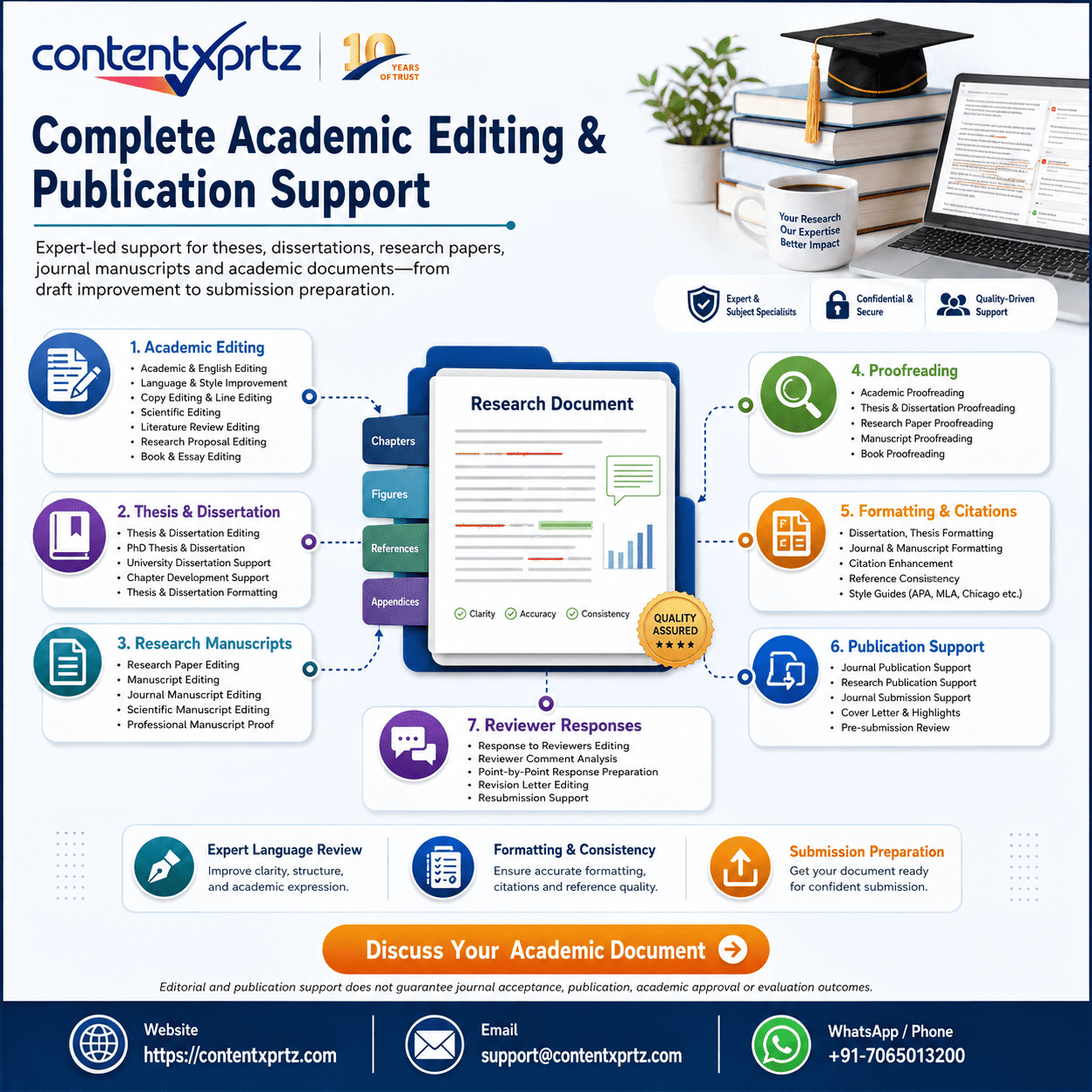
Contentxprtz can support dissertation writers through targeted academic editing, proofreading, structure review, citation consistency, formatting, and research-communication guidance. The useful starting point is to identify the exact problem: Is the thesis structurally weak? Is the language masking strong ideas? Are references inconsistent? Is the draft almost ready but needs a final quality check?
For dissertation-focused work, the most relevant next step is the Contentxprtz dissertation service. The engagement should be tailored to the student’s own draft and institutional requirements, with clear boundaries that protect academic integrity.
Summary: Custom Dissertation Writing Service
A custom dissertation writing service is safest when “custom” means personalised academic support rather than outsourced authorship. Good support can help a student organise chapters, improve clarity, correct language, strengthen coherence, apply citation and formatting rules consistently, and prepare a final draft for submission. It should not create research findings, fabricate sources, invent analysis, or deliver work that the student cannot defend.
Start with free institutional resources where they meet your needs, then use professional support selectively when the dissertation requires deeper editorial judgement or a rigorous final quality check. Whatever service you use, keep the research decisions and final responsibility with the author.
Frequently Asked Questions
What is a custom dissertation writing service?
A custom dissertation writing service is a tailored form of academic support built around a specific dissertation, discipline, research stage, and institutional requirement. Ethical services focus on coaching, structure review, editing, proofreading, citation consistency, formatting, and feedback on the student’s own work. The important distinction is that the service should not replace the student as author. A provider can point out that a literature review lacks synthesis, that a methodology description is unclear, or that references are inconsistent, but the student should make the substantive research decisions and approve the final wording. Before using any service, check your university’s policy on external editing and third-party assistance because permitted support varies across institutions.
Is it ethical to use a dissertation writing service?
It can be ethical when the service supports the student’s own work and complies with university rules. Editing, proofreading, formatting, coaching, and feedback are commonly treated differently from ghostwriting, but each institution may define the boundary in its own policy. The safest approach is to ask what assistance is permitted and disclose it where required. Avoid any provider that offers to write assessed chapters secretly, fabricate data, create sources, or guarantee an academic result. Ethical support should make changes transparent and keep the student responsible for the research question, methodology, evidence, analysis, conclusions, citations, and final submission.
What is the difference between dissertation editing and dissertation proofreading?
Dissertation editing usually addresses deeper issues such as clarity, argument flow, paragraph structure, repetition, terminology, scholarly tone, and consistency across chapters. Proofreading is a later-stage quality check that focuses on grammar, spelling, punctuation, typographical errors, formatting inconsistencies, and minor presentation problems. A draft that is still changing substantially usually needs editing before proofreading. A nearly final dissertation that has already been approved structurally may only need proofreading. Using the wrong service can waste time: proofreading cannot repair a weak argument, while heavy editing may be unnecessary when the document is already stable.
Can a service write my literature review or methodology for me?
A responsible service should not create assessed dissertation chapters for you to submit as your own. It can help you plan a literature-review structure, identify where synthesis is weak, explain how to organise themes, review whether methodological explanations are understandable, or edit language in text you have drafted. The literature selection, interpretation of sources, methodological choices, and reasoning should remain yours. If you are struggling to begin, coaching or a chapter outline based on your own research question is a safer form of support than commissioning hidden authorship.
How much dissertation help is too much?
Support becomes too much when it changes who is actually doing the intellectual work. If an editor is deciding your research question, inventing analysis, writing conclusions you cannot explain, adding sources you have not read, or generating entire assessed chapters, the assistance is no longer simply editorial. A useful test is whether you can defend every claim, method, citation, and interpretation in the final dissertation. Another is whether the assistance would still be acceptable if described accurately to your supervisor or institution. When in doubt, check the university’s policy before proceeding.
Can professional editing improve a dissertation written in English as a second language?
Yes, language editing can be especially useful for ESL researchers when the underlying research is strong but grammar, sentence structure, word choice, or academic tone makes the argument harder to follow. The editor should preserve technical meaning and avoid simplifying specialised terminology incorrectly. Tracked changes and comments are helpful because they let the author review every revision and learn recurring language patterns. The student should still perform the final reading to confirm that the edited text says exactly what was intended. Professional editing improves communication; it does not change the quality of the underlying research itself.
Can a dissertation service check citations and references?
Yes. Citation support can check whether in-text citations and the reference list are consistent, whether required elements are present, and whether formatting follows styles such as APA, Harvard, Chicago, Vancouver, or a university-specific guide. However, a formatting check is not the same as verifying the truth or quality of a source. The student should confirm that every reference is authentic, has been read where relevant, supports the claim being made, and is represented accurately. Never accept fabricated references or citations added only to make a chapter look more scholarly.
Should I use AI tools or a human editor for my dissertation?
They solve different problems. AI and grammar tools can help with surface-level wording, brainstorming, or error detection, but they can also alter meaning, generate confident but inaccurate statements, or invent references. Human editors can apply context, disciplinary judgement, and cross-chapter consistency, but they must still work within academic-integrity boundaries. Many students use a combination: automated tools for low-risk checks and human review for complex argument, language, or consistency issues. Whatever tools you use, verify outputs carefully and follow your university’s rules on AI use and disclosure.
How do I choose a trustworthy dissertation support provider?
Look for a provider that defines services clearly, explains ethical boundaries, protects confidentiality, uses transparent editing methods, and does not promise grades or approval. Ask whether edits are tracked, whether the editor will preserve technical meaning, how references are handled, what revision scope is included, and how sensitive research data is protected. A trustworthy provider should be comfortable saying what it will not do. If the main sales message is guaranteed results, rapid production of complete dissertations, or “plagiarism-free” ghostwritten work, treat that as a warning sign rather than a benefit.
When should I contact Contentxprtz for dissertation support?
Consider Contentxprtz when you already have research, notes, chapter drafts, supervisor feedback, or a near-final dissertation and need focused help with structure, academic clarity, language, proofreading, citation consistency, or formatting. The most useful engagement begins with a clear problem and a defined editing scope. If you are at an early stage, coaching or structural feedback may be appropriate; if you are close to submission, proofreading and consistency checks may be enough. In all cases, the dissertation should remain your own intellectual work, and you should confirm that the requested assistance is permitted by your institution.
Conclusion: Choose Support That Strengthens Your Own Dissertation
The value of dissertation support is not measured by how much work a provider can take away from you. It is measured by whether the support helps you communicate your own research more clearly, consistently, and confidently. Free university resources are often enough for early-stage questions. Professional assistance can become useful when a long draft needs deeper structural editing, when language obscures strong ideas, or when a final document needs rigorous proofreading and formatting.
If you decide to use a custom service, define the scope, check institutional rules, insist on transparent revisions, verify every source, and keep control of all substantive decisions. Contentxprtz can help improve clarity, structure, consistency, ethics, and submission readiness through focused dissertation and academic editing support.
“At Contentxprtz, we don’t just edit; we help ideas reach their fullest potential.”