Website Copy Localization
Localize homepages, landing pages, service pages, campaign content, and conversion-focused copy for target markets.

Adapt your website for the language, search behaviour, culture, terminology, and user expectations of each target market. We localize website copy, SEO metadata, navigation, CTAs, forms, product content, help pages, and reusable interface text while keeping meaning, brand voice, and page intent consistent.
Project pricing and delivery dates are confirmed after reviewing page volume, languages, content format, and QA requirements.
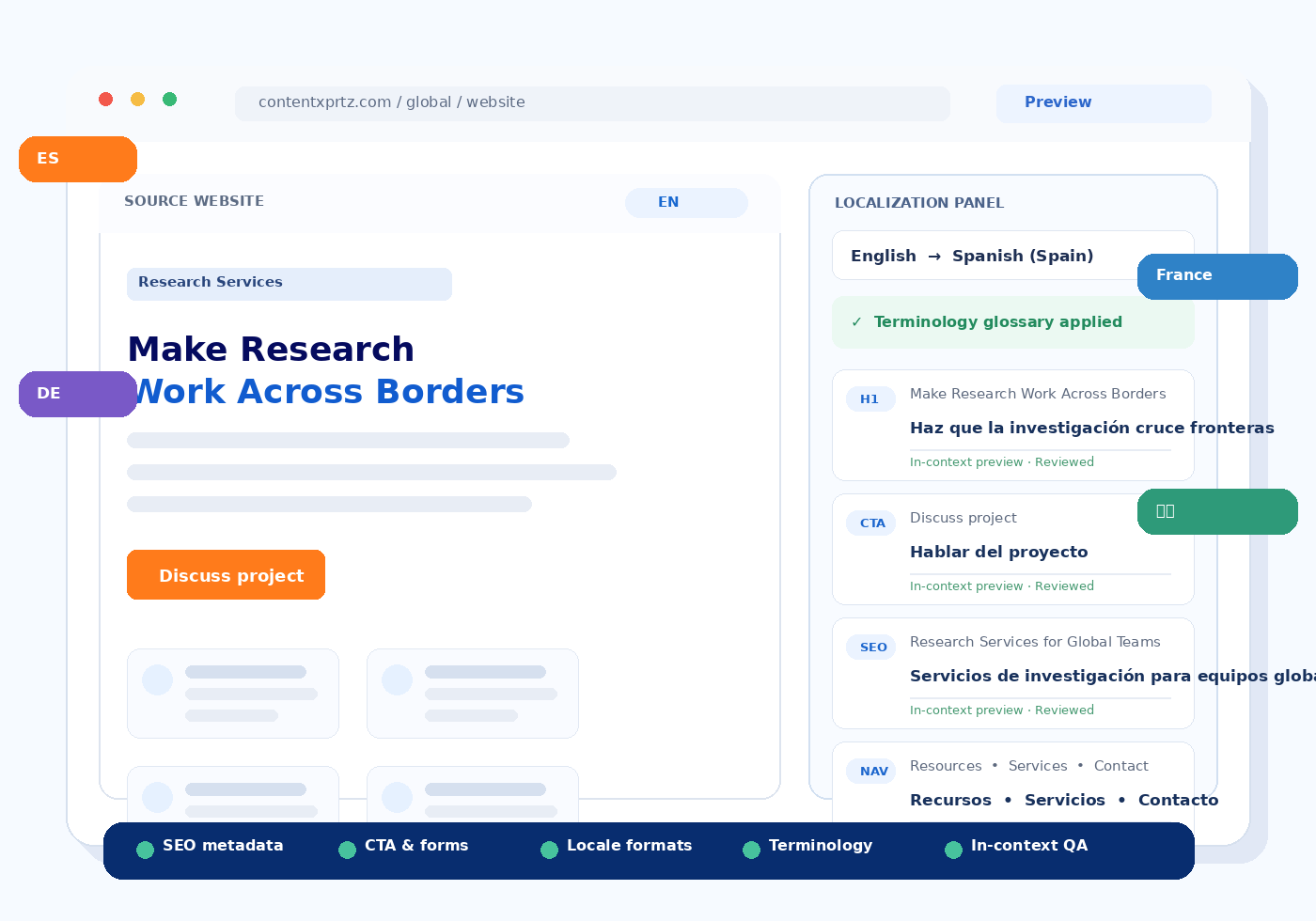
The entry rate aligns with Contentxprtz’s current website-localization positioning and includes language adaptation for real page elements rather than plain body-text translation alone.
Starting price
per 1,000 source words for one target locale
Suitable for: Website pages, navigation, CTAs, forms, product/service content, help text, and reusable interface copy being adapted for a new market.
Keyword research, technical SEO implementation, CMS publishing, hreflang coding, DTP, multiple locales, or complex ecommerce catalogs are separately scoped. Faster delivery for website localization can be considered after volume, file readiness, and specialist availability are reviewed.
Buy Service NowWhy partner with us?
Localize homepages, landing pages, service pages, campaign content, and conversion-focused copy for target markets.
Adapt page titles, meta descriptions, headings, anchor text, and search-facing copy within the agreed localization scope.
Localize menus, buttons, labels, forms, validation messages, onboarding copy, and other website microcopy.
Adapt category pages, product descriptions, promotions, filters, support copy, and checkout-facing text for local buyers.
Work with supplied page exports, content IDs, reusable components, and structured files so localized content stays traceable.
Localize FAQs, help-centre articles, product guidance, policy-facing copy, customer-support templates, and instructional content.
Review pages, content types, languages, SEO fields, user journeys, and target-market goals.
Confirm scope, glossary, style, page priority, file or CMS workflow, review steps, and delivery format.
Adapt copy, metadata, UI text, terminology, locale conventions, and market-facing language.
Check linguistic accuracy, terminology, style, consistency, and target-audience readability.
Review headings, buttons, menus, forms, truncation, variables, and page meaning in previews or screenshots.
Return approved localized content and agreed QA notes in the confirmed delivery format.
Client feedback on localization work focuses on language quality, reliability, responsiveness, and understanding of the target market.
“Their localization quality and cultural understanding helped us successfully enter new markets. Exceptional team!”Marketing Director
“Accurate, fast, and reliable. Our go-to partner for all multilingual content and ongoing localization needs.”Head of Operations
“Professional, responsive and detail-oriented. They truly understand our industry and audience.”Communications Manager
Practical answers about scope, SEO, CMS workflows, quality checks, timelines, pricing, tools, and post-delivery support for website content localization.
Website translation changes text from one language to another. Website localization also adapts terminology, tone, navigation, calls to action, forms, SEO metadata, units, date and number formats, cultural references, and other audience-facing details so the site feels appropriate for the target locale.
The scope can include landing pages, service pages, product content, navigation, buttons, forms, error messages, SEO titles and descriptions, blog or help content, FAQs, policy-facing copy, image text, and other customer-facing website strings supplied for the project.
Yes. The workflow can be planned around supplied CMS exports or structured content files. The exact handoff format is confirmed before work begins so content IDs, page relationships, reusable components, and locale fields remain traceable.
It can include localization of page titles, meta descriptions, headings, internal anchor text, calls to action, and keyword-aware page copy within the agreed scope. Target-market keyword research and technical SEO implementation should be confirmed separately when required.
Projects can use an agreed glossary, style guide, approved terminology, translation memory, page-level context, and reviewer feedback so repeated product, brand, technical, and interface language stays consistent across the site.
Yes. Ecommerce localization can cover product titles and descriptions, category pages, navigation, filters, promotions, checkout-facing copy, FAQs, customer-support content, and locale-specific language conventions within the confirmed project scope.
A typical quality workflow combines linguistic review, terminology and style checks, consistency review, QA for variables and formatting, and in-context checks for headings, buttons, menus, forms, truncation, and page-level meaning when preview access or screenshots are available.
The schedule depends on page volume, word count, number of languages, content complexity, CMS or file format, review rounds, implementation responsibilities, and in-context QA needs. A delivery plan is confirmed after the source content and target locales are reviewed.
Urgent delivery may be possible depending on content volume, language pair, specialist requirements, reviewer availability, and the amount of in-context QA needed. Share the launch date and priority pages so feasibility can be assessed.
Pricing depends on the confirmed scope, which can include source word count, number of target languages, content type, CMS or file format, localization depth, SEO requirements, engineering or implementation support, and QA or review needs. A project-specific quote is provided after review.
The service can be planned around common localization workflows, translation memories, terminology resources, structured exports, and project files. Tool access, connectors, repositories, or implementation responsibilities are confirmed before the project starts.
Post-delivery support can cover agreed corrections, reviewer feedback, terminology updates, and clarification of localized strings within the confirmed scope. Ongoing website localization can also be planned as a separate recurring workflow.