UI & App Localization
Menus, buttons, labels, placeholders, alerts, tooltips, notifications, settings, and mobile or desktop interface text.

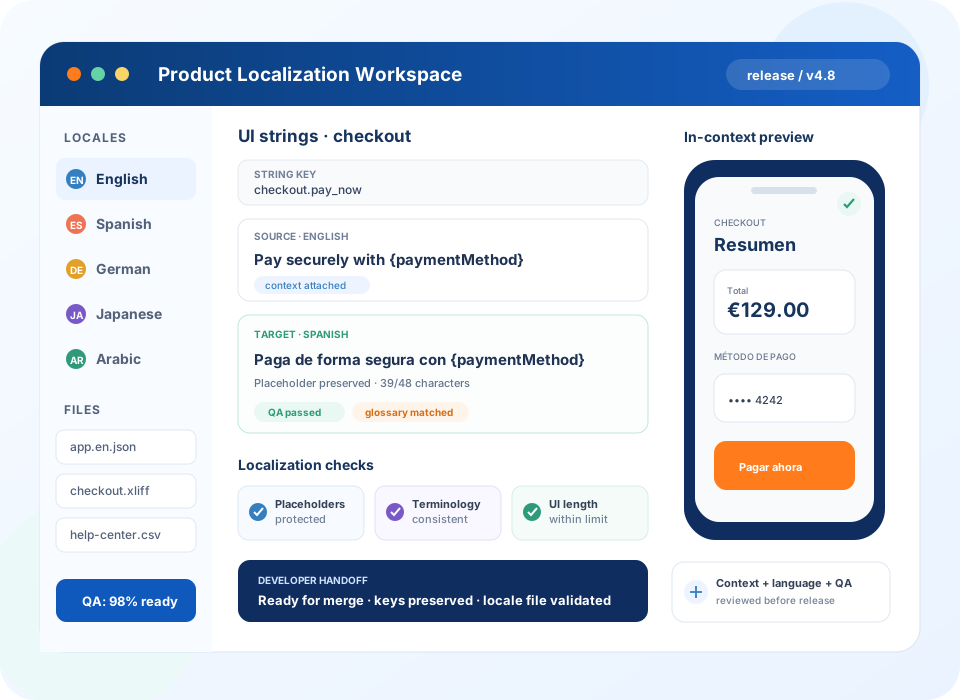
Localize the words users see and act on inside your product—from UI strings and onboarding to help content, product pages, notifications, release notes, and support journeys. Contentxprtz combines language adaptation with terminology control, technical awareness, and in-context quality review.
The entry price follows Contentxprtz’s current software-localization anchor and covers a compact one-locale batch where UI context, terminology, placeholders, and product language need more than standard translation.
Starting price
for up to 3,000 source words in one target locale
Suitable for: UI strings, onboarding, SaaS dashboards, product flows, notifications, help snippets, and related product text with usable context.
Platform integration, full functional LQA, additional locales, complex structured files, continuous release workflows, or large string libraries receive a custom quotation. Faster delivery for software & product localization can be considered after volume, file readiness, and specialist availability are reviewed.
Buy Service NowLocalize interface language, product content, documentation, and release communication as one connected experience—while keeping terminology, technical constraints, and user intent in view.
Menus, buttons, labels, placeholders, alerts, tooltips, notifications, settings, and mobile or desktop interface text.
Workspace copy, account flows, analytics labels, subscription screens, permissions, empty states, and administration content.
Product descriptions, feature pages, pricing-page copy, upgrade messaging, campaign modules, and customer-facing product education.
Knowledge-base articles, FAQs, setup guides, troubleshooting content, in-product help, and user documentation.
App-store descriptions, update notes, release communications, onboarding announcements, and launch-facing copy.
Review for language quality, terminology, truncation risk, layout context, placeholders, consistency, and test-build usability.
Move from source review and terminology planning through localization, developer-safe handoff, in-context QA, and final delivery without treating product copy as disconnected text.
Review files, languages, audience, strings, context, variables, and release goals.
Define workflow, glossary, style, owner roles, context inputs, and QA depth.
Adapt strings and product content for meaning, tone, terminology, and target-market use.
Return content in agreed structures with keys, tags, variables, and formatting kept in scope.
Check terminology, language, placeholders, truncation, consistency, and in-context fit.
Provide final localized files and review notes for merge, upload, publishing, or release.
Adapt software and product content for the terminology, conventions, and user expectations of each market while keeping the product experience consistent across locales.
Combine human language review, terminology governance, context checks, and localization tooling so each string remains accurate, usable, and technically safe for implementation.
Scope can cover interface strings, product pages, help content, release communication, and related assets, with source formats and context organised around your product workflow.
Localized files in the agreed structure, terminology or glossary updates where in scope, QA notes, issue flags, and a handoff prepared for product, content, or engineering review.
Client feedback on existing Contentxprtz localization work highlights consistent interface language, clearer onboarding, natural market-specific wording, and careful attention to audience and context.
“Our dashboard and onboarding localization kept labels, buttons, and help messages consistent and easy to understand across the product experience.”Lucas MeyerSaaS Product Lead, Germany
“The localized website content paid close attention to tone, audience, and search intent, helping the adapted pages feel natural for the target market.”Sarah WilliamsMarketing Manager, Canada
Practical answers about scope, file formats, terminology, developer-safe handling, linguistic testing, languages, pricing, timelines, and project intake.
It is the adaptation of user-facing software and product content for a specific language and market. The work can include UI strings, menus, buttons, onboarding, alerts, product pages, help content, release notes, and supporting terminology, with attention to context, culture, usability, and technical constraints.
Translation focuses on transferring meaning between languages. Localization goes further by adapting terminology, tone, interface length, cultural references, date and number conventions, product context, and other market-specific details so the experience feels natural to the target user.
Projects can include app and SaaS interface strings, dashboards, onboarding flows, error messages, notifications, app-store copy, product descriptions, help-center articles, FAQs, release notes, in-product education, documentation, and related customer-facing content.
Yes. Scope can be planned around structured localization files and exports such as JSON, XML, XLIFF, PO, CSV, spreadsheets, properties files, resource bundles, and other agreed formats. Placeholder, variable, key, and tag handling is reviewed as part of the technical workflow.
The workflow separates translatable content from technical tokens and checks variables, placeholders, tags, key names, and protected terminology during review. Any special syntax or developer instructions should be supplied with the source files.
Yes. Existing glossaries, product terminology, brand terms, feature names, prohibited translations, and style guidance can be applied across the project. When a project needs terminology planning, a working glossary can be prepared and aligned before localization begins.
Context files, screenshots, prototypes, screen recordings, design references, and test builds can be used to clarify where a string appears and what it needs to communicate. This helps reduce ambiguous translations and supports more natural in-context wording.
Localization QA can include language review, terminology checks, placeholder and tag checks, truncation awareness, layout review, consistency checks, and in-context linguistic testing when a suitable build, staging environment, screenshots, or test access is supplied.
The service is designed for multilingual projects, and the attached service design states coverage across 100+ languages. Exact language-pair availability is confirmed during project scoping so the right linguists and reviewers can be assigned.
The published starting price for Software & Product Localization is ₹10,500 for up to 3,000 source words in one target locale. The quote is based on factors such as source and target languages, string or word volume, file format, product complexity, terminology needs, context availability, QA depth, and any engineering or in-context review requirements.
The delivery schedule is confirmed after the source files, target languages, release size, QA scope, and deadline have been reviewed. For release-driven work, share the target deployment date so the localization workflow can be planned around it.
Share the source files or export, source and target languages, approximate string or word count, product type, target markets, desired deadline, glossary or style guide if available, screenshots or context references, and any protected tokens or technical instructions.
Share your product, languages, file structure, market context, and release requirements so the localization workflow can be scoped around the work you actually need.
Tell us what you are localizing, where it is going, and what your release workflow looks like. The published starting price for Software & Product Localization is ₹10,500 for up to 3,000 source words in one target locale. For Software & Product Localization, the stated entry scope typically takes 4–7 business days for the entry batch; final timing is confirmed against volume, complexity, and workflow requirements.
The fields below are tailored to software and product localization so the project can be reviewed for language, technical, and QA requirements.
Localize the interface, product content, support journey, and release communication users rely on—without losing terminology, context, or technical integrity.