Scientific Manuscript Editing
Language, terminology, research-section presentation, technical consistency, and submission-focused editorial review.

Refine scientific and medical manuscripts for clearer language, consistent terminology, stronger research presentation, and cleaner submission-ready formatting—without changing the intended scientific meaning.
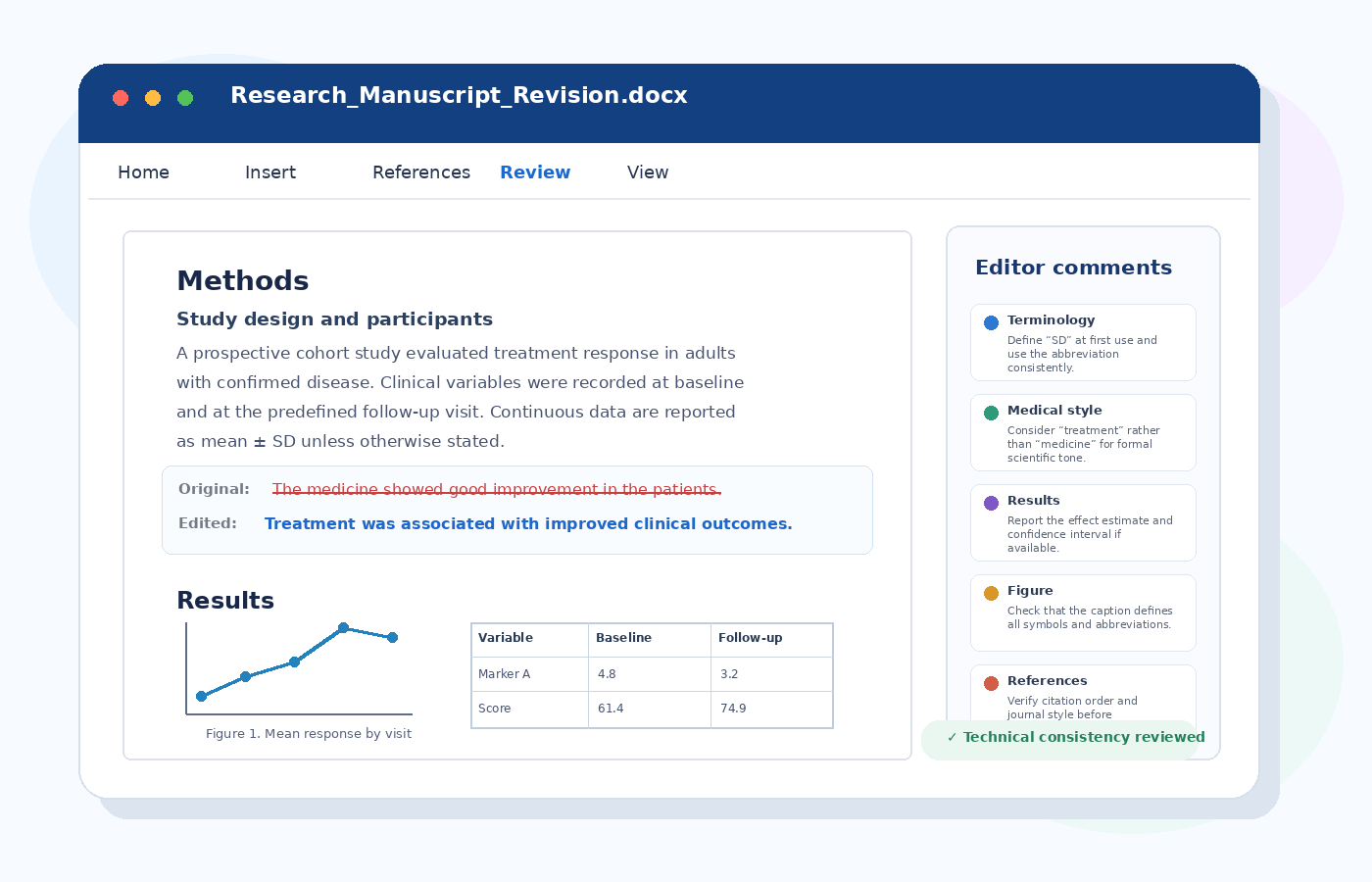
Consistency across technical language
Clear, discipline-aware presentation
Transparent review of every revision
Unpublished content handled privately
Guideline checks when instructions are supplied
Scientific and medical editing needs subject-aware terminology and precision, so the starting rate reflects deeper language control than general proofreading while leaving scientific conclusions with the author.
Starting price
per 1,000 words
Suitable for: Scientific manuscripts, medical articles, research reports, case material, technical summaries, and evidence-led content needing language refinement.
Statistical validation, medical advice, factual verification against source data, regulatory review, extensive reference checking, or urgent specialist work are outside the base editing price. Faster delivery for scientific & medical editing can be considered after volume, file readiness, and specialist availability are reviewed.
Buy Service NowScientific and medical writing often carries dense terminology, evidence, units, abbreviations, tables, figures, and journal-specific presentation requirements. Editing brings these elements into a clearer, more consistent manuscript without replacing author responsibility for the underlying research.
Language, terminology, research-section presentation, technical consistency, and submission-focused editorial review.
Clearer medical phrasing, consistent terminology and abbreviations, and polished presentation for developed medical content.
Improve clarity and consistency in study-design descriptions, results narratives, terminology, units, and cross-references.
Presentation and consistency checks for labels, captions, symbols, abbreviations, units, numbering, and cross-references.
Review against supplied journal or publisher instructions for applicable language, formatting, reference, and presentation details.
Check recurring terminology, capitalization, abbreviations, units, symbols, notation, citations, references, and related presentation details.
A structured review moves from manuscript context and editorial priorities through language editing, technical consistency, quality review, and transparent delivery.
Review document type, field, target, priorities, and supplied instructions.
Refine language, clarity, scientific phrasing, and sentence or paragraph flow.
Check terminology, abbreviations, units, notation, tables, figures, and references.
Assess clarity and consistency across key manuscript sections and author instructions.
Re-check edited text, comments, formatting cues, and recurring consistency points.
Provide tracked changes, a clean edited copy, and relevant editor notes.
Editing can focus on the full manuscript or priority areas such as the abstract, methods, results, discussion, tables, figures, references, or sections flagged by a journal, supervisor, or co-author.
These short examples show the type of language and presentation refinement this service can provide. They are illustrative editorial examples, not client quotations or scientific claims.
The delivery package is designed to make author review straightforward and to show what changed, why certain points were flagged, and where final author decisions are still required.
Review edits transparently and accept or reject revisions as part of your final author review.
A clean version reflecting the completed editorial changes for easier reading and final preparation.
Comments identify points that need clarification, author confirmation, or additional attention before submission.
Recurring checks across terminology, abbreviations, units, symbols, notation, citations, references, tables, and figures.
Need a dedicated Scientific Editing plan? Explore the specialist Scientific Editing Service for scientific and technical manuscripts requiring deeper submission-focused editorial support.
View Scientific Editing Service →This section highlights practical service characteristics that help authors review revisions, track technical consistency, and understand points that need final author attention.
Tracked changes make sentence-level and presentation edits visible for author review.
Terminology, abbreviations, units, notation, tables, figures, and references are reviewed for consistency within scope.
Editor comments identify wording, presentation, or consistency points that require author clarification or decision.
Answers to common questions about scope, document types, terminology, journal guidelines, tracked changes, turnaround, pricing, and editorial boundaries.
Scientific and medical content editing improves language, clarity, terminology consistency, research presentation, and document-level presentation while preserving the author’s intended scientific meaning. It can also include checks across methods, results, tables, figures, captions, citations, references, units, symbols, and journal or publisher requirements when supplied.
Proofreading is mainly a final-stage correctness check. Scientific and medical content editing can involve deeper sentence and paragraph refinement, discipline-appropriate phrasing, terminology consistency, research-section presentation, and more detailed editor comments.
Typical documents include research papers, journal manuscripts, theses and dissertations, abstracts, methods and results sections, clinical and medical reports, technical reports, protocols, case-based content, and other developed scientific or medical documents.
Yes. The editing scope can include consistency of scientific and technical terminology, abbreviations, capitalization, units, symbols, notation, and discipline-appropriate phrasing throughout the document.
Yes. Scientific editing can include presentation review of the abstract, introduction, methods, results, discussion, and conclusion, with attention to clarity, logical presentation, terminology, and consistency.
Yes. The editing scope can include consistency checks for tables, figures, captions, units, symbols, abbreviations, notation, and cross-references so that presentation is clearer and more consistent.
Yes, when the relevant author or publisher guidelines are supplied. The editor can review applicable language, terminology, presentation, tables, figures, references, and formatting requirements within the confirmed scope.
Yes. You receive tracked changes, a clean edited copy, and editor notes so you can review revisions and understand important language or presentation decisions.
The editing service focuses on language, presentation, consistency, and editorial review. Authors remain responsible for the underlying research data, scientific claims, clinical accuracy, statistical analysis, source verification, and final approval of the manuscript.
The editing scope can include citation, reference-list, and cross-reference consistency checks and review against a supplied style or journal guide. It does not replace source verification or the author’s responsibility for citation accuracy and completeness.
Turnaround depends on the manuscript length, technical complexity, required editorial depth, tables and figures, formatting or citation requirements, and the requested deadline. Share the document details and deadline so feasibility can be assessed before work begins.
Pricing depends on factors such as word count, editorial depth, technical complexity, document condition, formatting or citation requirements, and deadline. Submit the manuscript details to request a scope-based quote.
Manuscripts, instructions, personal details, and unpublished research materials are handled as confidential service information through the designated submission and delivery process.
Share your contact details, document type, approximate word count, target journal or style guide if applicable, deadline, and the areas you want the editor to focus on. The request can then be reviewed for scope and deadline feasibility.
Provide enough document information to assess the requested editing depth, technical complexity, deadline feasibility, and any journal, publisher, or reference-style requirements.
The more specific your brief, the easier it is to understand the editorial scope before the work begins.
Research paper, journal manuscript, thesis chapter, report, protocol, or other scientific/medical content.
Share your required delivery date so feasibility can be assessed before confirmation.
Language, terminology, methods/results presentation, tables, figures, references, formatting, or other focus areas.
Include the relevant author guidelines or style requirements when they need to be followed.
Share your contact details and document information. Pricing and delivery timing can then be assessed against the actual manuscript scope.
Improve language, terminology, methods and results presentation, technical consistency, tables, figures, references, and overall readability while keeping the research and final scientific decisions with the author.