Research Paper Translation
Translate research sections, argumentation, evidence and scholarly discussion into clear English while retaining the source meaning.

Translate French research and academic documents into natural English without losing the meaning, terminology, evidence, citations, numbers, or structure that make the work academically precise.
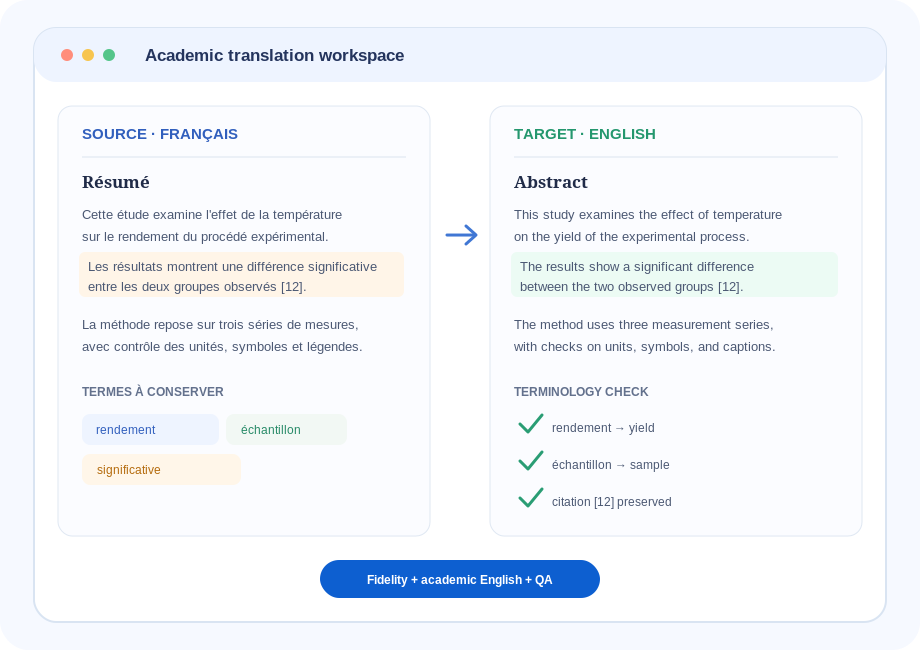
French-to-English academic translation can usually be quoted cleanly by source word count, with the main work centered on precise scholarly meaning, idiomatic English, and discipline-appropriate terminology.
Starting price
per 1,000 French source words
Suitable for: French journal papers, thesis/dissertation sections, research reports, abstracts, conference material, and academic teaching content.
Specialist legal/medical research, complex references, scans requiring manual extraction, uncommon regional usage, or rush delivery may require a higher quotation. Faster delivery for french to english academic translation can be considered after volume, file readiness, and specialist availability are reviewed.
Buy Service NowWhy choose academic translation?
Core French to English academic translation services
Translate research sections, argumentation, evidence and scholarly discussion into clear English while retaining the source meaning.
Support longer academic documents with consistent terminology, headings, citations and cross-section language.
Prepare English-language manuscript text around the structure, terminology and submission instructions you provide.
Translate compact academic text where precision, word economy and faithful presentation of the research contribution matter.
Maintain distinctions between sources, claims, synthesis and commentary across longer academic prose.
Translate labels, notes, captions and supporting content in context with the main academic document when included in scope.
Our French to English academic translation process
Review the document type, subject, structure, instructions and potential terminology risks.
Identify recurring terms, abbreviations, style requirements and protected research details.
Convert the French source into natural academic English while preserving meaning and nuance.
Refine clarity, scholarly register, terminology and source-to-target consistency.
Check citations, numbers, units, labels, headings and unresolved queries before handoff.
Provide the translated document in the agreed format with any relevant translator queries.
The translation approach should reflect the discipline, document purpose and target readership—not just the language pair.
Quality control covers both linguistic accuracy and the research details that can be damaged by careless translation.
Use French to English academic translation when the research already exists in French and the next audience needs an English scholarly version.
These illustrative examples show the difference between literal word replacement and context-aware academic translation. They are not client text.
French source
« Les résultats suggèrent une association modérée entre les deux variables. »
Academic English
“The results suggest a moderate association between the two variables.”
Why it matters: “Suggest” preserves the cautious evidential strength of suggèrent rather than overstating the finding.
French source
« Les données ont été recueillies auprès de trois groupes indépendants. »
Academic English
“Data were collected from three independent groups.”
Why it matters: The English reads naturally while retaining the method, number of groups and relationship described in the source.
French source
« Le rendement moyen augmente lorsque la température est stabilisée. »
Academic English
“The mean yield increases when the temperature is stabilised.”
Why it matters: A glossary can keep rendement as “yield” throughout the manuscript and apply the requested English convention consistently.
Pricing and delivery are confirmed after document review so the quote can reflect the source word count, academic discipline, technical complexity, formatting requirements and requested deadline.
Send enough information for the French source, academic discipline, complexity and presentation requirements to be assessed before a quote is confirmed.
Length, subject complexity, formatting, terminology requirements and review depth can all affect the work involved. The schedule is therefore confirmed after the document or detailed scope is assessed.
Request Scope, Quote & ScheduleA strong translation should read naturally in English without quietly changing the evidence, emphasis or technical meaning of the French source.
Arguments, limitations, comparisons, uncertainty and cause-and-effect relationships should remain faithful to the original.
The target should sound like scholarly English rather than a visibly literal translation from French.
Key concepts, abbreviations and technical equivalents should not drift from one section to another.
Numbers, units, citations, tables, figure labels and cross-references need the same care as prose.
Answers to common questions about scope, terminology, citations, English style, pricing and delivery.
It converts academic content written in French into clear scholarly English while preserving the source meaning, discipline-specific terminology, citations, numbers, headings, tables, captions and other document elements included in the agreed scope.
The service is suitable for research papers, journal manuscripts, theses, dissertations, abstracts, conference papers, literature reviews, academic chapters, reports and related scholarly materials.
The workflow compares source and target meaning, maintains a terminology record for key terms, checks ambiguous passages in context and performs a final bilingual review before delivery.
Yes. Repeated technical terms, abbreviations and preferred equivalents can be tracked in a bilingual terminology list so the same concept is translated consistently across sections.
Citation callouts, reference numbering and bibliographic structure should normally be preserved. Text inside titles or reference entries is changed only where the agreed scope or target requirements call for it.
You can specify the target English convention or provide journal, university or publisher guidelines. Those instructions can then guide spelling, punctuation and presentation choices.
They are treated as protected research details. The translation review checks that numbers, units, symbols and mathematical expressions remain consistent with the source unless the supplied instructions require a formatting change.
They can be included when they are part of the submitted material and agreed scope. Captions, labels, notes and table text are reviewed in context with the surrounding academic content.
The target English is reviewed for clarity, academic register and consistency as part of translation quality control. A separate deeper editing service should be discussed when substantial restructuring or developmental editing is required beyond translation.
A quote is confirmed after the document scope is reviewed. Relevant factors can include word count, subject complexity, formatting requirements, supporting files and the requested delivery date.
The delivery schedule is confirmed after the document is reviewed because manuscript length, technical complexity, formatting and the required review depth can affect the work involved.
Provide the French source text, document type, subject area, approximate word count, requested deadline and any journal, university, publisher, terminology or English-style instructions that should be followed.
Share the document type, approximate word count, discipline, deadline and any terminology or submission instructions so the scope can be assessed accurately.
The more context you provide, the easier it is to assess the translation depth, document handling and schedule.
Research paper, thesis, dissertation, abstract, report or another academic document, plus the discipline.
Share the French source word count or a reasonable estimate.
Provide the date and, where important, the local time by which you need the translation.
Include glossaries, preferred terms, UK/US English preference and journal or university guidance.
Mention tables, captions, supplementary materials or presentation details that also need translation.
Use this form for a scope, quote and delivery assessment. You can provide the detailed document information first and share files through the next step of the enquiry process.
Share your manuscript details, target audience and deadline to start a French to English academic translation assessment.