Corporate Document Localization
Reports, company profiles, policies, SOPs, internal communications, proposals, and other business documents.

Localize corporate communications, websites, reports, sales content, training material, policies, campaigns, and customer-facing assets while preserving meaning, terminology, tone, and brand standards across markets.
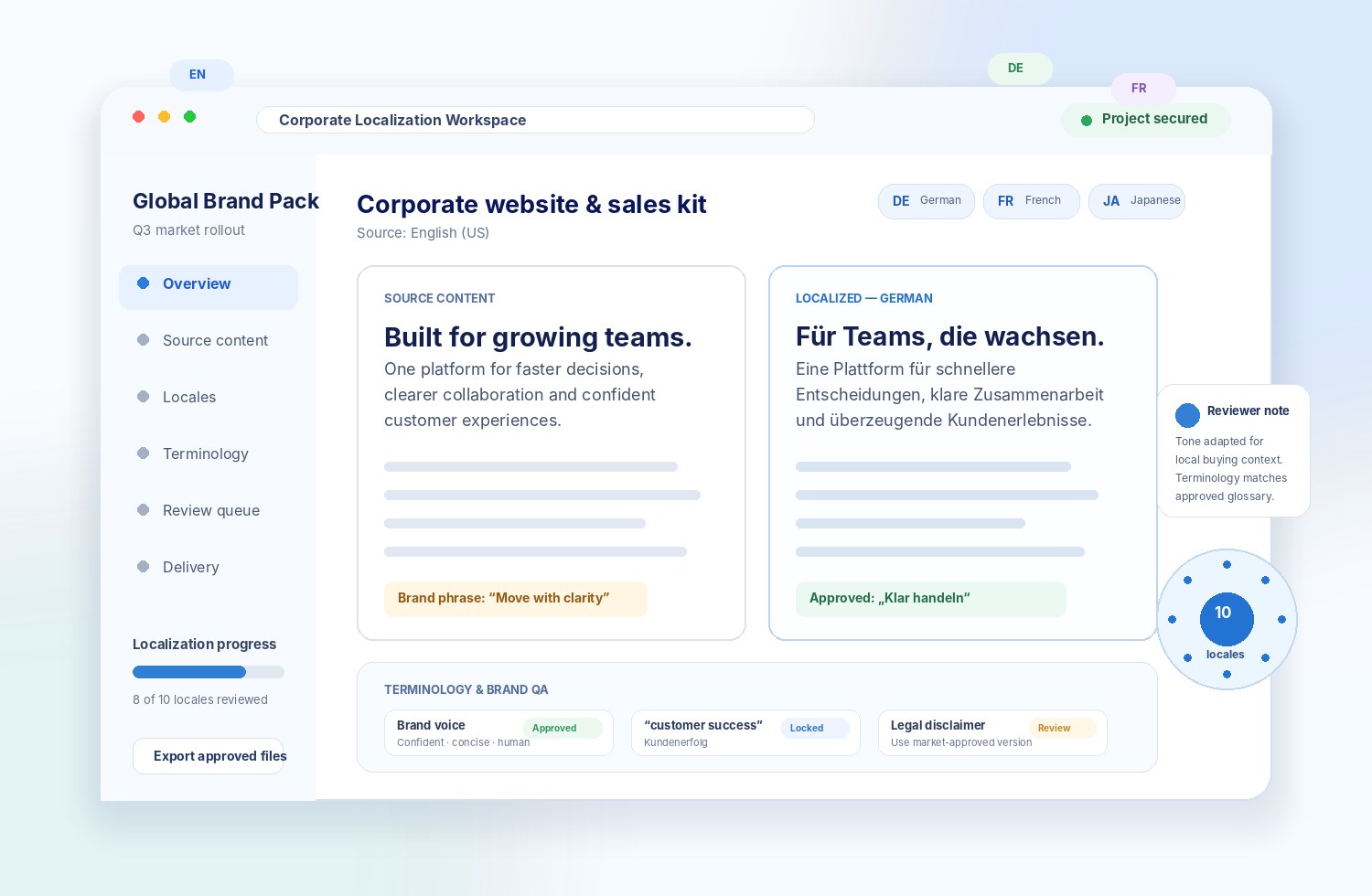
Business localization combines translation with brand, market, terminology, and format adaptation so the same corporate message works naturally in the target locale.
Starting price
per 1,000 source words for one locale
Suitable for: Corporate reports, presentations, websites, campaigns, policies, training content, and employee or sales materials going into a new market.
Regulated content, multi-country variants, design-heavy presentations, DTP, ongoing localization programs, or urgent campaign launches may require custom pricing. Faster delivery for corporate localization can be considered after volume, file readiness, and specialist availability are reviewed.
Buy Service NowReports, company profiles, policies, SOPs, internal communications, proposals, and other business documents.
Website copy, landing pages, product and service pages, UX content, metadata, and customer-facing digital content.
Pitch decks, sales presentations, proposals, product narratives, partner material, and business-development content.
Campaign copy, brochures, email content, social messaging, product launches, and market-facing brand communication.
Onboarding material, learning modules, process documentation, internal knowledge content, and workforce communications.
Policies, compliance-facing communication, controlled terminology, disclaimers, and market-specific corporate documentation.
We review content, target markets, brand context, formats, and business goals.
We align locales, terminology, style guidance, reviewers, files, and project workflow.
Native-language specialists adapt content for meaning, audience, brand, and market context.
Editors review language, terminology, tone, consistency, and business-context accuracy.
Final QA checks glossary use, formatting, key details, labels, and locale-specific consistency.
Approved localized files are returned in the agreed project structure and delivery format.
Build one controlled localization workflow across customer-facing, internal, technical, regulated, and market-launch content.
Combine human linguistic judgment, terminology control, structured review, and localization technology to protect meaning and consistency at scale.
From market launch to internal operations, localize the content your customers, employees, partners, and stakeholders actually use.
“Their localization quality and cultural understanding helped us successfully enter 5 new markets. Exceptional team!”
“Accurate, fast, and reliable. Our go-to partner for all multilingual content and ongoing localization needs.”
“Professional, responsive and detail-oriented. They truly understand our industry and audience.”
Practical answers about corporate localization scope, brand control, languages, quality, pricing, timelines, and recurring multilingual content.
Translation converts content from one language to another. Corporate content localization goes further by adapting business terminology, brand voice, market references, tone, formatting, and audience expectations so the content feels appropriate for the target market.
Typical projects can include corporate websites, landing pages, company profiles, reports, proposals, sales decks, product and service content, policies, SOPs, training material, internal communications, brochures, marketing campaigns, support content, and presentation or multimedia scripts.
Yes. Brand voice, approved messaging, terminology, product names, tone rules, and market-specific preferences can be documented before localization and checked during review so each language version stays aligned with the source brand.
The workflow can use approved glossaries, terminology lists, style guidance, translation memory, reviewer feedback, and document-wide QA checks so recurring business terms remain consistent across files and future updates.
Yes. Ongoing localization can be scoped for recurring website updates, product releases, campaigns, internal communications, training content, and other repeat business materials that need consistent multilingual treatment over time.
Business localization can be scoped across major international languages, including English, Spanish, French, German, Chinese, Japanese, Arabic, Russian, Portuguese, Italian, and Korean, with additional languages confirmed according to project requirements.
Yes. Existing terminology lists, brand guidelines, preferred translations, banned terms, tone rules, and reference materials can be incorporated into the localization brief so reviewers work from the same approved language standards.
The localization workflow can include native-language review, terminology control, editing and proofreading, brand and style checks, automated QA where appropriate, and a final project-level quality check before files are released.
Confidential content can be scoped with controlled access, secure file handling, and project-specific confidentiality requirements. If your organization requires an NDA or specific security instructions, include them in the enquiry so they can be reviewed before work begins.
Yes. The service can cover digital and offline business content, including website copy, landing pages, product and service pages, corporate documents, sales material, internal communication, training content, and campaign assets.
The published starting price for Corporate Localization is ₹3,500 per 1,000 source words for one locale. A project-specific quote is prepared after reviewing the language pair, content volume, content type, file format, subject complexity, review requirements, and delivery scope.
This page does not state a fixed turnaround. The delivery plan is confirmed after the project scope, languages, volume, file formats, review stages, and deadline requirements have been assessed.
Tell us what content you need to localize, which markets or languages you are targeting, and what brand, terminology, security, or review requirements matter to your team.
Provide enough detail for the team to review language scope, content type, workflow, QA needs, and deadline feasibility.
Build multilingual business communication that stays clear, culturally relevant, terminology-consistent, and aligned with your market goals.