100+ Languages
Localization coverage for multilingual publishing programs

Localize manuscripts, ebooks, metadata, cover copy, and publishing assets for new language markets while protecting author voice, terminology, cultural context, and edition consistency.
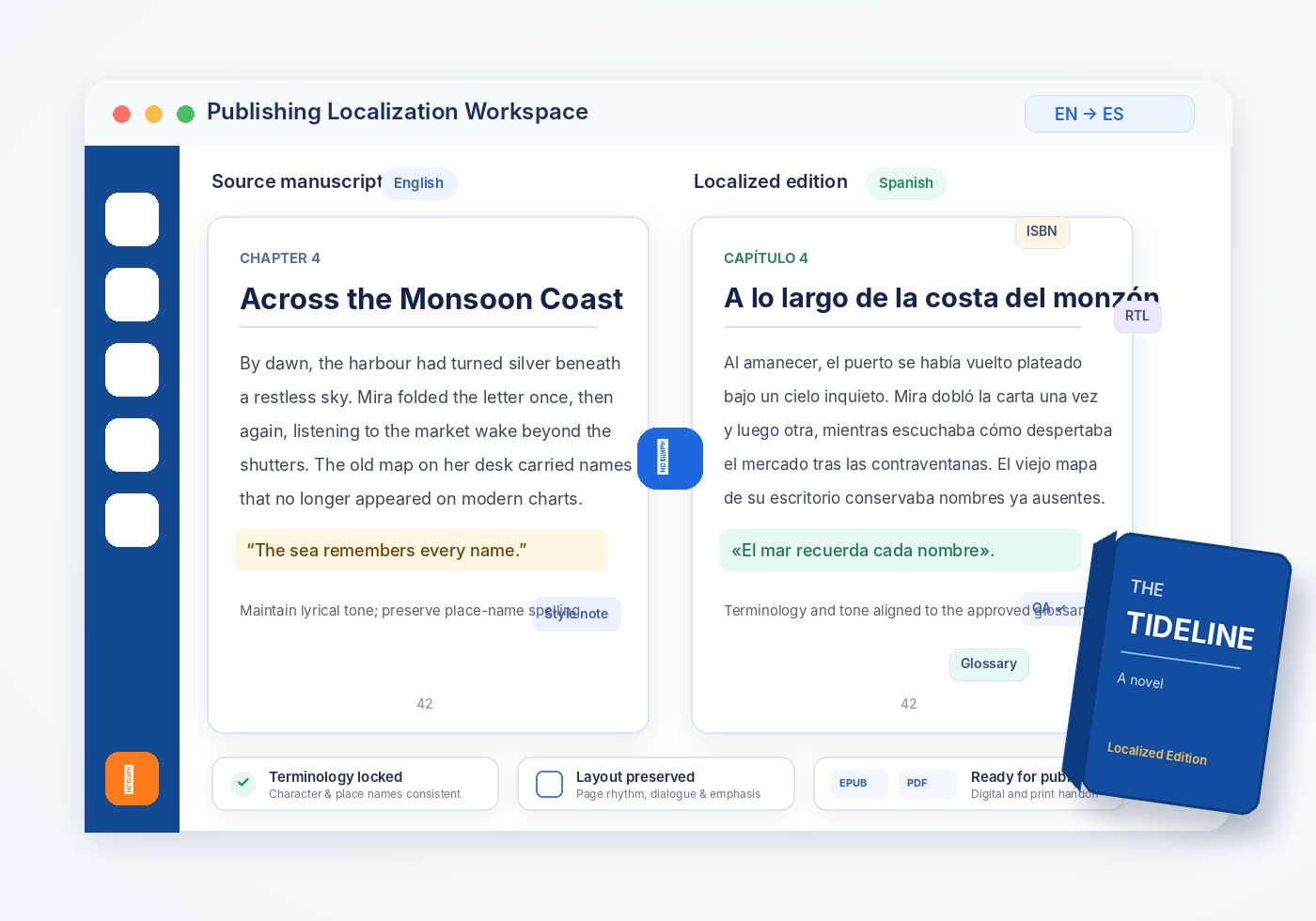
Localization coverage for multilingual publishing programs
Language and cultural review for target readers
Text, metadata, layout, and digital-edition considerations
Controlled handling for unpublished manuscripts and files
Publishing localization requires voice, cultural context, and long-form consistency in addition to translation, so the rate starts above standard document translation.
Starting price
per 1,000 source words
Suitable for: Books, manuscripts, educational titles, and publishing content being adapted for a specific language market and readership.
Literary transcreation, verse, complex rights-sensitive references, multiple target markets, DTP/layout work, or full-length books receive a manuscript-based quotation. Faster delivery for book localization can be considered after volume, file readiness, and specialist availability are reviewed.
Buy Service NowWhy partner with us?
Our core publishing localization services
Localize chapter text, dialogue, headings, front matter, back matter, notes, and recurring terminology while preserving the author’s voice.
Prepare localized content for digital editions with attention to reading flow, navigation labels, metadata, and platform-facing text.
Adapt translated copy to page layouts, text expansion, captions, callouts, tables, and print-oriented publishing files.
Localize titles, subtitles, descriptions, keywords, contributor information, categories, and retail-facing book metadata.
Adapt cover lines, blurbs, back-cover copy, author bios, launch descriptions, and promotional publishing content for local audiences.
Localize reading guides, worksheets, captions, glossaries, downloadable extras, and other supporting content distributed with a title.
A structured workflow connects editorial analysis, native-language localization, quality review, and publishing handoff without forcing unsupported fixed turnaround claims.
Review the manuscript, audience, languages, file types, publishing goals, and existing reference material.
Define the localization brief, glossary, style rules, character and place-name treatment, and production workflow.
Native-language specialists localize the content with the book’s voice, meaning, register, and readership in mind.
Editors review language, continuity, tone, consistency, terminology, and publishing-specific presentation.
Run structured QA across chapters, metadata, repeated names, numbers, formatting, links, and layout-sensitive content.
Provide the agreed localized files for your publishing, production, retailer, or distribution workflow.
Plan localization around the type of title, target readership, language direction, edition format, and any recurring terminology or style rules that need to stay consistent.
Publishing content we localize
100+ languages. One publishing standard.
Publishing localization benefits from repeatable language decisions, multi-stage review, terminology control, and production-aware QA across the manuscript and supporting assets.
Our quality framework
Target-language experts selected for the content and audience.
Translation, editing, proofreading, and production-focused checks.
Quality processes aligned with the site’s ISO 9001:2015 and ISO 17100:2015 positioning.
Glossaries, series terminology, names, and style decisions kept consistent.
Structured linguistic and functional checks across deliverables.
Feedback can be incorporated into approved terminology and style decisions.
Technology & tools we use
A publishing localization project can include more than the manuscript itself. Scope the language, metadata, marketing, layout-sensitive, and supporting assets that belong to the same edition.
What we localize
Typical publishing localization deliverables
Translated and reviewed manuscript content in the agreed working format.
Approved glossary, recurring-name treatment, and key style decisions where applicable.
Localized title metadata and retailer-facing descriptions included in the agreed scope.
Content prepared for print or digital layout workflows when DTP/localization is part of the project.
Documented issues, queries, or production notes that require publisher or author confirmation.
The agreed localized files organized for publishing, distribution, or further production.
Sample use cases
This section makes the project controls visible: editorial fidelity, continuity, publishing readiness, and confidential handling.
Localization decisions are reviewed in context so narrative voice, argument, intent, and reader experience remain central.
Names, terms, capitalization, recurring phrasing, and approved style decisions can be controlled across multiple files or titles.
Language review is paired with attention to metadata, layout-sensitive text, navigation, captions, and final-file consistency.
Unpublished manuscripts and supporting files are handled using the site’s established confidentiality and security process.
Answers to practical questions about book localization, publishing assets, author voice, terminology, formats, languages, QA, confidentiality, and project planning.
It is a publishing-focused localization workflow that adapts manuscript text and related publishing content for another language and readership. The work can include linguistic translation, cultural adaptation, terminology control, metadata localization, layout-aware review, and quality checks for the agreed files.
Direct translation focuses primarily on transferring meaning between languages. Publishing localization also considers voice, readership, cultural references, recurring terminology, series continuity, metadata, layout constraints, digital-edition text, and other elements that influence how the finished title is experienced in the target market.
Preserving voice is a core editorial objective. The localization brief can document tone, register, character speech, recurring phrasing, names, and other style decisions so reviewers can evaluate the localized edition consistently.
The service can be scoped for fiction, nonfiction, academic and educational titles, children’s content, business books, reference works, series, self-publishing projects, and related marketing or metadata assets. Final scope depends on the files and requirements you provide.
Yes, metadata can be included in the agreed scope. Typical publishing metadata may include titles, subtitles, descriptions, keywords, categories, contributor information, and retailer-facing copy.
The service can cover text intended for digital and print editions, including layout-sensitive copy, navigation labels, captions, and production notes. Share your source files and target deliverables so format compatibility and production scope can be confirmed before work begins.
Right-to-left support can be planned as part of the localization and layout workflow. Directionality, punctuation, numerals, page composition, and other locale-specific requirements should be identified at the project-planning stage.
A glossary and style guide can be created or applied to recurring names, places, technical terms, capitalization, punctuation, and other editorial decisions. The same reference material can then guide translation, review, and QA across chapters or related titles.
Yes, these assets can be included when they are part of the agreed publishing scope. They are treated as reader-facing marketing content and may require more adaptation than a literal line-by-line translation.
The workflow can include native-language review, terminology and style checks, cross-file consistency review, spelling and punctuation checks, repeated-name verification, numbers and formatting checks, and layout-sensitive QA for the agreed deliverables.
The page follows Contentxprtz’s established secure and confidential handling approach. Share only the files needed for assessment and use the enquiry form to describe any NDA, access, or pre-publication requirements that must be considered.
Turnaround depends on manuscript length, language pair, editorial complexity, number of assets, review stages, and production requirements. For Book Localization, the stated entry scope typically takes 5–8 business days per 5,000 words; final timing is confirmed against volume, complexity, and workflow requirements.
Yes. Multi-language programs can be planned around a shared source manuscript, glossary, style decisions, and production requirements. The project structure should identify which assets and editions are needed for each locale.
Provide the manuscript or a representative sample where possible, approximate word count, source and target languages, genre or subject, required file formats, metadata or marketing assets, publishing platform or production requirements, and your target deadline.
Let’s bring your book to new readers
Tell us what you are publishing, where it is going, which languages you need, and which manuscript, metadata, marketing, or production assets should be included.
Share enough information for the project to be reviewed for scope, language direction, publishing requirements, and deadline feasibility.