Academic Content Localization Services

Academic Content Localization Service for Global Learning & Research

Adapt research, educational, e-learning, publishing, and academic digital content for multilingual audiences without losing subject meaning, terminology, document structure, or learning intent.

  • Native linguists and academic-context review
  • Terminology, references, tables, and format control
  • Cultural, regional, and learning-context adaptation
  • Secure and confidential document workflows
Quote and delivery schedule are confirmed after reviewing languages, content volume, formats, subject requirements, and QA scope.
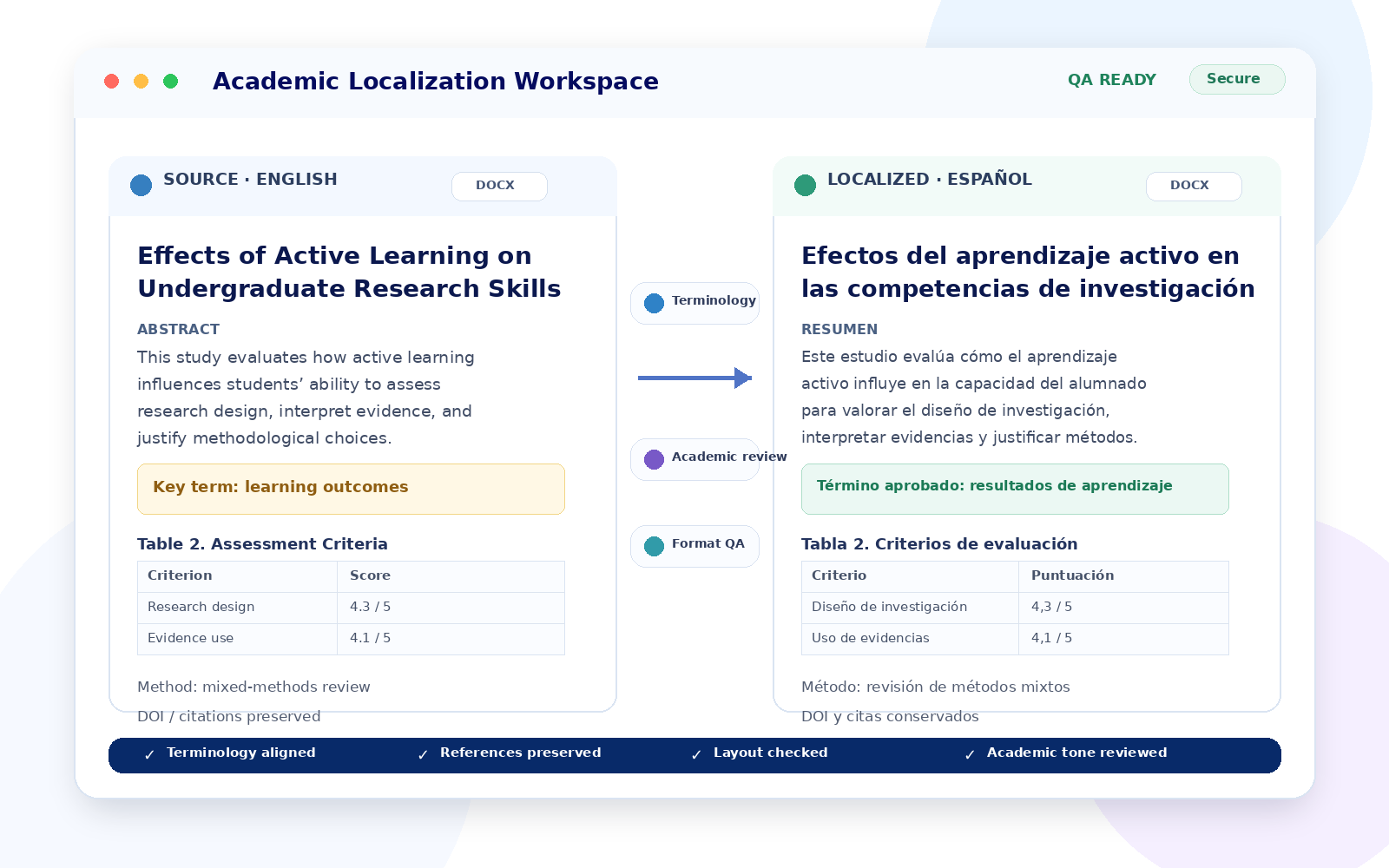
Academic content localization workspace showing a research article localized from English into Spanish with terminology, references, layout and academic quality checks
100+Languages Covered
100M+Words Translated
500+Native Experts
10,000+Projects Delivered
1

Academic Localization That Protects Meaning and Learning Intent

Localize academic content as a complete communication system—language, terminology, structure, regional conventions, interface text, multimedia, and delivery format—not as isolated sentences.

Why partner with us?

Global Reach, Academic Context

  • Human-first localization with native-language review
  • Subject-aware terminology and academic tone control
  • Contextual accuracy across learning objectives and research meaning
  • Format, reference, table, figure, and metadata consistency checks
  • Cultural and regional adaptation where the content requires it
  • Secure workflows, NDA support, and controlled document handling
  • Scalable support for single files, courses, repositories, and multilingual programs
Our Core Services

Research & Journal Localization

Research papers, journal content, abstracts, reports, references, tables, figures, and publication materials.

E-learning & Course Localization

Course modules, learning objectives, activities, assessments, handouts, and downloadable learning resources.

Thesis & Dissertation Localization

Long-form academic documents with terminology, section hierarchy, references, tables, captions, and front matter.

Textbook & OER Localization

Chapters, examples, exercises, glossaries, captions, teacher resources, and open educational materials.

Academic Website & LMS Localization

Academic websites, LMS interfaces, navigation, course catalogs, student portals, help content, and system strings.

Multimedia & Lecture Localization

Lecture transcripts, captions, subtitle files, voice-over scripts, on-screen text, slides, and multimedia learning assets.

2

Our Academic Content Localization Process

A six-stage workflow keeps source meaning, terminology, academic context, formatting, and delivery requirements aligned across every target language.

1

Analyze

Review content, audience, subject area, files, formats, and learning goals.

2

Plan

Set language pairs, glossary, style guide, tools, responsibilities, and file workflow.

3

Localize

Translate and adapt language, context, examples, interface text, and regional conventions.

4

Academic Review

Review subject terminology, meaning, tone, references, and learning intent.

5

Quality Check

Run language, terminology, format, functional, and consistency QA against the agreed scope.

6

Deliver

Return localized files in the required formats with approved project assets and handoff notes.

3

Built for Academic, Research, Publishing, and Learning Environments

Support multilingual learning and research across institutions, publishers, platforms, professional programs, and subject domains.

Academic Environments We Support

10 contexts
Universities & Colleges
Research Institutions
Academic Publishers
EdTech & LMS
Medical Education
STEM & Engineering
Professional Certification
Public Education
Training & L&D
International Programs

100+ Languages. One Quality Standard.

Multilingual
ENEnglish
ESSpanish
FRFrench
DEGerman
ZHChinese
JAJapanese
ARArabic
RURussian
PTPortuguese
ITItalian
KOKorean
+90+90 More
Right-to-left support
Locale & date formats
Cultural adaptation
Glossaries & style guides
4

Quality Framework and Localization Technology

Combine human academic judgment with terminology assets, localization tools, QA checks, and secure workflows to keep multilingual content consistent across files and releases.

Our Quality Framework

Human + QA
Native LinguistsNatural target-language academic expression
Subject-Aware ReviewMeaning and discipline context checked
Multi-Stage ReviewLocalization, review, and proofreading passes
Quality in
Every Word
Terminology ControlGlossaries, memories, and style guides
Format & Functional QAFiles, layout, interface, captions, and outputs
Continuous ImprovementFeedback retained for recurring programs

Technology & Tools We Use

Localization Stack
SSDL Trados Studio
mQmemoQ
PPhrase
SSmartcat
WWordfast
MMemsource
CCrowdin
XXTM International
5

What We Localize and How the Output Changes

From individual documents to complete learning ecosystems, the service can adapt language and presentation while preserving academic purpose and source integrity.

What We Localize
  • Research papers, abstracts, and journal materials
  • Theses, dissertations, and academic reports
  • Textbooks, workbooks, and open educational resources
  • Course modules, syllabi, and lecture notes
  • Assessments, quizzes, rubrics, and instructions
  • Academic websites, portals, and LMS content
  • Captions, transcripts, subtitles, and voice-over scripts
  • Tables, figures, labels, captions, and supplementary files
  • Certificates, forms, guides, and student-facing documents
  • More academic and learning assets by project scope
Illustrative Localization Snapshot

Meaning Preserved, Language Localized

Source · English

Students will evaluate the validity of a research design and justify the chosen methodology.

Localized · Spanish

El alumnado evaluará la validez de un diseño de investigación y justificará la metodología seleccionada.

Learning verb preservedTerminology alignedAcademic tone checkedFormat retained
Localization Deliverables
Localized Source FilesDOCX, PPTX, XLSX and supported editable assets
Managed Service FilesXLIFF, CSV, JSON, XML and platform exports
E-learning PackagesSCORM, xAPI or LMS-ready project formats when supplied
Graphics & DTPLocalized labels, layouts, PDFs and publication assets
Terminology AssetsApproved glossary, style guidance and reusable terms
QA Handoff NotesResolved issues, format checks and project-specific notes
Sample Use Cases
Launch Global CoursesPrepare one curriculum for delivery across multiple language markets.
Expand Research ReachMake research, reports, and publication materials accessible to new academic audiences.
Localize LMS ContentAdapt course screens, strings, modules, assessments, and learner support content.
Support Regional ComplianceAlign educational wording, formats, and required local conventions where supplied.
Improve Learner ExperienceReduce language friction while retaining subject meaning and instructional intent.
6

Clients Trust Our Localization Work Globally

The supplied localization reference highlights accuracy, cultural understanding, reliability, responsiveness, and attention to audience as recurring client priorities.

★★★★★

“Their localization quality and cultural understanding helped us successfully enter 5 new markets. Exceptional team!”

Marketing DirectorGlobal SaaS Company
★★★★★

“Accurate, fast, and reliable. Our go-to partner for all multilingual content and ongoing localization needs.”

Head of OperationsE-commerce Brand
★★★★★

“Professional, responsive and detail-oriented. They truly understand our industry and audience.”

Communications ManagerPharma Company
10,000+Projects Delivered
100M+Words Translated
100+Languages
500+Native Experts
98%On-time Delivery
99%Client Retention
7

Academic Content Localization FAQs

Answers about scope, academic review, terminology, files, multimedia, quality checks, pricing factors, turnaround planning, and confidentiality.

What is an Academic Content Localization Service?

Academic content localization adapts educational and research content for a target language and audience while protecting subject meaning, terminology, references, structure, formatting, learning intent, and cultural context. It goes beyond direct translation when local conventions, examples, interfaces, multimedia, or delivery formats also need adaptation.

What types of academic content can be localized?

The service can cover research and journal content, theses and dissertations, textbooks and open educational resources, course modules, e-learning content, LMS interfaces, assessments, lecture materials, academic websites, captions, transcripts, certificates, guides, and supporting documents.

How is academic localization different from ordinary translation?

Translation primarily transfers language. Academic localization also considers discipline-specific terminology, learning objectives, regional conventions, examples, date and number formats, interface labels, multimedia, accessibility, references, layout, and other elements that affect how academic content works for the target audience.

Do you use native linguists and subject-aware reviewers?

The localization workflow is built around native-language review, terminology control, and subject-context checks so the localized content reads naturally without losing the intended academic meaning. Reviewer matching can be planned around the content type and subject area.

Can you localize e-learning courses and LMS content?

Yes. Course pages, module text, interface strings, quizzes, instructions, downloadable resources, captions, transcripts, and other learning assets can be prepared for multilingual delivery, with functional checks for the target format where required.

Can you localize research papers, theses, and journal materials?

Yes. Academic manuscripts and research materials can be localized with attention to terminology, section structure, references, tables, figures, captions, abbreviations, units, and discipline-appropriate language. The exact scope should be confirmed before work begins.

How do you maintain terminology consistency across a project?

A project can use an approved terminology list, glossary, translation memory, style guide, and reviewer feedback loop. Key academic terms are identified before or during localization and checked again during quality review so repeated concepts remain consistent.

Do you preserve citations, references, tables, and figures?

The workflow can preserve and check citations, references, tables, figures, captions, numbering, cross-references, equations, units, and document hierarchy when those elements are included in the agreed localization scope.

Can you handle multimedia academic content?

Yes. Localization can include lecture transcripts, subtitle files, captions, voice-over scripts, on-screen text, and supporting multimedia copy. Timing, terminology, screen space, and format requirements can be reviewed as part of the project plan.

How is quality checked before delivery?

A typical workflow combines translation or localization, academic or subject-aware review, terminology checks, language QA, and format or functional QA. The final review is aligned with the agreed files, style guide, glossary, and delivery requirements.

How much does academic content localization cost?

Pricing is confirmed after the project is reviewed. Factors can include source and target languages, content volume, subject complexity, file formats, multimedia or DTP requirements, review depth, and delivery schedule. No fixed price is assumed on this page.

How long does academic content localization take?

The delivery schedule depends on content volume, language pairs, subject complexity, file formats, review requirements, and the number of target languages. Share the files and deadline in the enquiry so a realistic project schedule can be confirmed.

Can you support right-to-left languages and localized layouts?

Yes, when included in scope. Right-to-left presentation, text expansion, localized date and number formats, line breaks, fonts, tables, interface elements, and page or screen layout can be checked so the localized content remains usable and readable.

How do you handle confidential academic or unpublished material?

The page follows the confidentiality-focused workflow shown in the supplied localization service design, with secure document handling and NDA support where required. Project access and delivery should be limited to the agreed workflow and recipients.

Academic Localization Enquiry

Get a Project-Specific Localization Quote

Pricing and turnaround are not assumed. They are confirmed after reviewing the language pairs, content volume, subject complexity, formats, review depth, multimedia or DTP needs, and your delivery schedule.

Languages & AudienceSource language, target languages, region, and intended academic audience.
Content & SubjectResearch, course, textbook, LMS, assessment, multimedia, or another academic format.
Files & VolumeWord count, slide count, runtime, number of files, and editable source formats.
Review & DeadlineTerminology assets, subject review, DTP, functional QA, accessibility, and delivery date.
Get a Free Quote

Tell Us What You Need Localized

Provide enough project detail for us to understand the academic content, target audience, languages, file formats, and deadline.

Security check *Loading question…

Use this form for project scoping. Share confidential files only through the approved document-transfer process once the enquiry moves forward.

Let’s Bring Your Academic Content to the World

Make research and learning accessible across languages while keeping terminology, academic meaning, structure, and learner experience consistent.

ISO 9001:2015 Certified NDA Protected & Confidential Secure Document Workflows