Grammar & Clarity Gaps
Awkward wording, missing articles, overloaded sentences, or vague pronouns can make a simple instruction feel uncertain.

Improve the language, structure, terminology, instructions, and presentation of software documentation without changing the intended technical meaning. The service is designed for documentation that is already drafted and needs a careful professional editorial pass before users, customers, or developers rely on it.
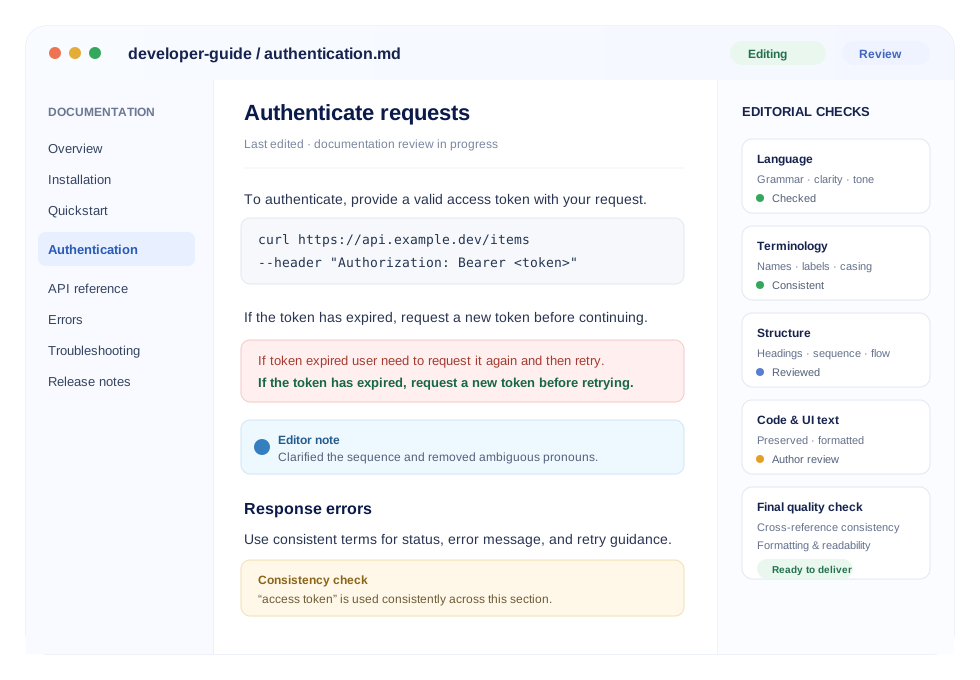
Review what changed and why
Keep names and labels aligned
Language and structure in context
Limited-access file workflow
Timing confirmed after review
The starting edit focuses on clarity and consistency across software instructions and explanations while preserving approved technical behaviour.
Suitable for: Best for release-stage help, developer, admin, or product documentation that needs editorial refinement rather than new writing.
for up to 2,000 words of drafted software documentation
Software Documentation Editing Service starts at ₹3,500 for up to 2,000 words of drafted software documentation.
Buy Service NowSubstantive rewriting, software testing, code execution, major information-architecture changes, screenshot production, or broad multi-file refactoring is quoted separately.
Documentation can be technically correct yet still be difficult to use when language, structure, terminology, examples, or navigation cues are inconsistent. Editing focuses on the reader-facing problems that make instructions harder to follow.
Awkward wording, missing articles, overloaded sentences, or vague pronouns can make a simple instruction feel uncertain.
Feature names, UI labels, capitalization, abbreviations, and repeated technical terms need consistent treatment across the documentation.
Prerequisites, steps, notes, warnings, and follow-up actions can appear in the wrong order or at the wrong level of emphasis.
Section names, anchors, figure references, links, or references to other instructions can become inconsistent as documentation changes.
Code blocks, placeholders, parameter names, and surrounding explanations need clear formatting and consistent editorial treatment without altering intended behaviour.
Uneven headings, lists, callouts, labels, tables, examples, and inline code can make otherwise useful documentation look unfinished.
The editorial pass follows the documentation from sentence-level language through document-wide consistency, while keeping code, commands, product behaviour, and approved technical meaning under author control.
A software documentation edit should do more than fix a typo. It should make the instruction easier to understand, preserve the intended technical meaning, and show the author what changed.
Choose the service depth that matches the condition of your documentation. This page is for editing existing software documentation, not for silently replacing technical validation or content creation.
| Service Level | Proofreading | Software Documentation Editing | Technical Writing / Development |
|---|---|---|---|
| Primary focus | Grammar, spelling, punctuation, typos | Language, clarity, structure, terminology, consistency, presentation | Creating or substantially developing content from requirements and source material |
| Sentence rewriting | Light correction only | Yes, where clarity requires it | Yes, as part of content development |
| Information flow | Limited | Reviewed within the supplied documentation | May be designed from the ground up |
| Terminology consistency | Obvious inconsistencies | Document-wide editorial check | Defined and developed with the content |
| Technical validation | No | Not unless separately scoped | Depends on the agreed writing and subject-matter workflow |
| Best for | Near-final docs needing a final language check | Existing software docs that need a deeper editorial pass | Missing, incomplete, or newly planned documentation |
Software documentation editing improves how supplied content is expressed and organised. Functional testing of code, commands, endpoints, product behaviour, or technical claims is separate unless explicitly agreed.
The exact sections depend on your documentation set. A typical editorial review follows the reader journey from orientation and setup through task completion, reference material, troubleshooting, and updates.
The workflow moves from scope confirmation to line-by-line editing, consistency review, final quality control, and delivery. The exact path is adjusted to your file format and documentation requirements.
Deliverables are matched to the file format and agreed scope. Where revision tracking is available, the package can show the editorial trail as well as the clean final content.
The final pass checks the edited documentation as a complete set rather than treating every sentence in isolation.
Grammar, syntax, concise technical wording, and sentence readability.
Terminology, UI labels, capitalization, abbreviations, and repeated wording.
Headings, lists, callouts, code styling, tables, captions, and document hierarchy.
Cross-reference consistency and clean-up after the main editorial pass.
Final files, comments, and clean-copy deliverables matched to the agreed scope.
Send the documentation type, representative files, and required output format with your enquiry. Compatibility and editorial depth are confirmed before work begins.
Software documentation can contain unpublished product information, internal processes, or pre-release details. The service follows the confidentiality and file-handling practices used by Contentxprtz.
Turnaround is confirmed after scope review. Delivery timing is confirmed after the documentation length, editing depth, format, complexity, and deadline are reviewed.
For planned documentation work where the editorial schedule can be set after a normal scope review.
For a closer deadline that requires the editorial schedule to be reviewed for priority handling.
For urgent documentation where feasibility must be checked against file size, complexity, editing depth, and required output.
The value of documentation editing is visible in the final file: clearer instructions, more consistent wording, more disciplined presentation, and an editorial trail that helps authors review changes.
Questions about scope, technical boundaries, files, delivery, confidentiality, pricing, and turnaround for software documentation editing.
The service focuses on language, clarity, terminology consistency, structure, headings, instructions, cross-references, formatting, and presentation. The exact scope is confirmed from the files and requirements you provide.
API and developer documentation can be reviewed as editorial content. Share the format, scope, style guidance, and any code or terminology that must remain unchanged so compatibility can be confirmed before work begins.
The editing focus is documentation language and presentation. Code behaviour, product logic, and technical claims are not changed unless you explicitly provide approved source material and request a defined technical-content update.
Where the supplied file format supports revision tracking, edits can be delivered with visible changes or comments together with a clean final version. Delivery format is confirmed during scope review.
The editor checks repeated product terms, feature names, UI labels, abbreviations, capitalization, and related wording for consistency within the supplied documentation and style guidance.
Yes when you supply the relevant style guide or editorial rules. They are used as the reference for wording, capitalization, terminology, formatting, and presentation choices within the agreed scope.
Not as part of language editing alone. Functional verification of commands, endpoints, code, and product behaviour requires separate technical validation unless that work is explicitly included in an agreed scope.
Send the documentation files or a representative sample, approximate word count or page count, target audience, style guide if available, required output format, deadline, and any terminology or content that must remain unchanged.
Turnaround is confirmed after reviewing document length, editorial depth, file complexity, formatting requirements, supporting guidelines, and deadline. Turnaround is confirmed after scope review.
Software Documentation Editing Service starts at ₹3,500 for up to 2,000 words of drafted software documentation. Substantive rewriting, software testing, code execution, major information-architecture changes, screenshot production, or broad multi-file refactoring is quoted separately.
The service follows the confidentiality and file-handling practices presented on this page, including secure file transfer and storage, limited access, no third-party sharing, NDA availability on request, and file deletion after project completion.
Use the editor comments and clean copy to review the changes, then send any clarification questions or revision requirements through the agreed support channel so the next step can be confirmed.
Share your documentation type, approximate volume, file format, target audience, deadline, style guidance, and the areas that need editorial attention.
Share representative files, approximate volume, deadline, and time zone.
Highlight clarity, terminology, structure, cross-references, formatting, or other concerns.
Developer guide, API docs, user guide, knowledge base, release notes, or other content.
Provide your terminology list, voice rules, brand style, or documentation guide if available.
Identify code, commands, UI labels, product terms, or approved wording that should not be altered.
Tell us how you want visible edits, comments, clean files, and formatting handled.
Submit your contact details and project requirements so the documentation can be reviewed for editorial scope, delivery feasibility, and quote preparation.