
Professional Medical & Scientific Writing Support

Medical Review Article Writing Service for Clear, Evidence-Led Manuscripts

Turn a defined medical topic, literature set or review question into a coherent article with organised evidence, connected synthesis, traceable citations and a manuscript structure that is ready for author review.

  • Review-question, scope and manuscript-structure planning
  • Literature organisation, evidence extraction and cross-study synthesis
  • Citation-aware drafting with source traceability and reference support
  • Journal-aware formatting and author revision support where included
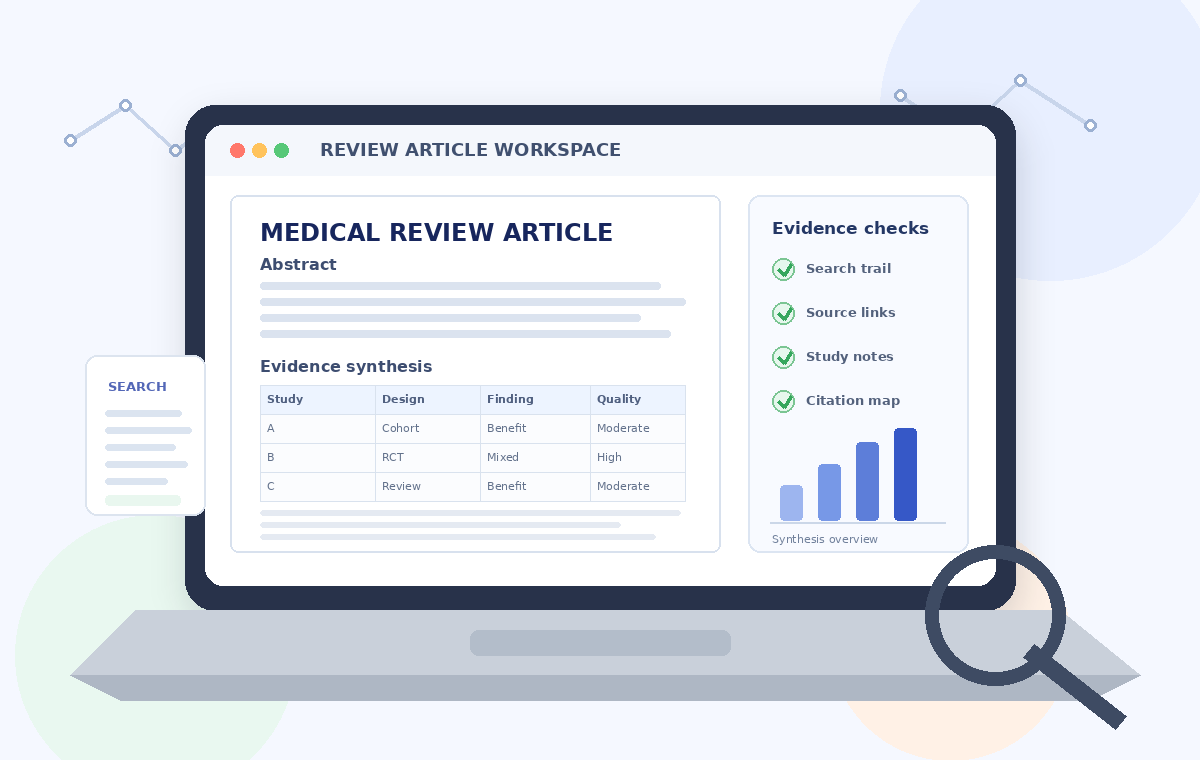
Medical review article manuscript workspace showing evidence synthesis, study table, references and source checks

Literature-Led Workflow

Research questions, source discovery and evidence organisation are planned before drafting.

Source Traceability

Claims, citations and source notes are kept connected throughout the writing process.

Structured Synthesis

Findings are grouped, compared and synthesised rather than presented as disconnected summaries.

Journal-Aware Formatting

Supplied journal or institutional instructions can be incorporated into manuscript preparation.

Revision Support

Author feedback and requested revisions can be integrated before final handoff.

Professional Medical Review Article Writing Support Built Around the Evidence

A strong medical review article does more than collect papers. It defines a workable review question, organises the literature, compares findings across studies, explains areas of agreement or uncertainty, and guides the reader through a clear clinical or scientific narrative.

This service is designed for authors who already have a topic, objective, literature set or publication goal and want structured support converting that material into a coherent review manuscript. The writing process can include research planning, source organisation, evidence synthesis, section drafting, citation integration, tables, formatting and author revisions depending on the agreed brief.

Where a formal review methodology is required, the exact search, screening, extraction and reporting approach should be agreed before work begins. The author or research team retains responsibility for scientific judgment, disclosures, authorship requirements and final approval.

1

Who This Service Is For

Use medical review article writing support when the subject expertise, publication goal or literature base exists but the research organisation, synthesis and manuscript development need a more structured workflow.

Clinicians & Medical Researchers

For subject-matter experts who need organised writing support around an established medical topic.

Postgraduate & Doctoral Researchers

For researchers developing literature-led articles, thesis-derived reviews or scholarly review manuscripts.

Faculty & Academic Teams

For collaborators who need a consistent manuscript structure, evidence trail and shared drafting workflow.

Biomedical Researchers

For technical topics that require precise terminology, evidence comparison and careful source integration.

Journal Authors

For authors preparing a review manuscript around a target journal, audience or publication brief.

Research & Consulting Teams

For organisations preparing evidence-led medical content with clear source documentation and review checkpoints.

2

Are You Facing These Review-Article Challenges?

Medical reviews become difficult when the topic, source trail and article narrative are not organised together. These are common signals that a more deliberate research-and-writing workflow is needed.

Topic Too Broad

The review question is wide, unfocused or difficult to translate into a coherent article structure.

Fragmented Literature

Relevant evidence is spread across multiple sources, designs, populations or time periods.

Unclear Search Approach

Keywords, databases, inclusion logic or evidence boundaries are not yet organised.

Weak Synthesis

Studies are being listed individually without comparison, interpretation or a clear thematic narrative.

Citation Gaps

Claims, references and source notes are difficult to trace consistently through the draft.

Journal Structure Confusion

The manuscript needs a stronger title, abstract, section flow or alignment with supplied journal instructions.

3

What’s Included in Our Medical Review Article Writing Service

The exact scope is agreed before work begins. A complete engagement can combine research planning, evidence organisation, manuscript development and publication-focused preparation around the needs of the review.

Topic & Review Question Refinement

Clarify the review focus, scope, population, intervention or clinical theme where relevant.

Search Strategy Planning

Organise keywords, concepts, databases and practical search logic appropriate to the agreed review scope.

Literature Screening Support

Create a transparent working approach for identifying and prioritising relevant sources.

Evidence Extraction & Organisation

Capture study characteristics, key findings and source notes in a structured working format.

Critical Reading & Synthesis

Compare evidence quality, consistency, limitations and themes without overstating conclusions.

Section-by-Section Drafting

Develop a coherent introduction, thematic body, discussion and conclusion around the review question.

Citation & Reference Integration

Connect in-text citations with the working reference list and check presentation consistency.

Tables & Evidence Summaries

Develop clear evidence tables or narrative summaries when they help readers compare studies.

Journal & Style Alignment

Apply supplied author guidelines, section requirements and reference style instructions where available.

Abstract & Final Synthesis

Prepare a concise abstract and conclusion that accurately reflect the body of the review.

4

From Scattered Literature to a Coherent Medical Review

The service is structured to move from an unclear evidence set to an organised manuscript while keeping the author’s scientific judgment and source responsibility visible throughout the process.

Before: Working Materials

  • Broad or shifting review question
  • Articles saved without a clear evidence map
  • Study findings summarised in isolation
  • Unclear source-to-claim traceability
  • Sections that repeat rather than synthesise
  • Formatting decisions left until the end

Our Service: Structured Workflow

  • Agree review scope and article purpose
  • Organise source discovery and evidence notes
  • Group findings into themes or comparison points
  • Draft sections around connected evidence
  • Integrate citations and supporting tables
  • Review structure, terminology and formatting

After: Author-Review Manuscript

  • Focused review question and section logic
  • Organised evidence trail and source notes
  • Comparative synthesis across the literature
  • Clearer citation placement and reference list
  • Consistent manuscript presentation
  • Editable file ready for subject-matter review
5

How Our Medical Review Article Writing Process Works

A six-stage workflow keeps research organisation, drafting and quality review connected so the final manuscript can be assessed transparently by the author or research team.

01

Submit Your Brief

Share the topic, objectives, available sources, target journal or institutional requirements and preferred scope.

02

Scope the Review

Define the review question, literature boundaries, source requirements, deliverables and practical workflow.

03

Research & Organise

Identify and organise relevant evidence, source notes, themes, study characteristics and citation information.

04

Draft & Synthesise

Build the article around a logical evidence-led structure with connected interpretation across sources.

05

Quality Review

Check source traceability, terminology, structure, citations, formatting and consistency against the agreed brief.

06

Final Handoff

Deliver the agreed manuscript files and supporting materials for author review and further revision if needed.

6

What You’ll Receive

Deliverables depend on the agreed project scope. The examples below reflect the kinds of working files that can accompany a medical review article engagement.

Medical Review Article Draft

A structured manuscript developed around the approved review question and agreed scope.

Evidence Summary Table

A working study or evidence table when useful for comparing key source characteristics.

Reference List

A consolidated reference list aligned with the manuscript citations and supplied style instructions.

Formatted Manuscript

A clean document prepared around the requested section structure and journal guidance where supplied.

Revision-Ready File

An editable manuscript suitable for author comments, subject-matter review and agreed revisions.

7

Scope, Quote & Delivery Planning

Medical review projects vary widely by topic breadth, evidence volume, manuscript length and publication requirements, so the project is scoped before a quote and delivery plan are confirmed.

Topic Breadth

A tightly defined clinical question requires a different level of research and synthesis from a broad multi-theme review.

Evidence Volume

The number, complexity and accessibility of relevant sources affect the amount of screening, extraction and synthesis required.

Publication Requirements

Journal structure, tables, reference style, supplementary material and revision requests can change the project scope.

How to request an accurate quote: share the review topic or question, target journal or audience, available source set, approximate manuscript length, required tables or supplementary files, reference style and preferred deadline.
8

How Delivery Timing Is Set

Delivery timing is confirmed after the actual research and manuscript workload is understood, so the schedule reflects the agreed scope rather than a generic estimate.

Review Scope

Topic breadth, required methodology and the number of article sections influence planning.

Evidence Workload

The number of sources, screening effort, extraction depth and synthesis complexity affect the schedule.

Revision Requirements

Author review cycles, journal formatting, tables and requested supporting files are included in the delivery plan when agreed.

9

Why Choose Us for Medical Review Article Writing?

The value is in a disciplined research-to-manuscript workflow: medical context, source traceability, connected synthesis, transparent scope and author collaboration.

Medical Context Matters

Terminology, population details, outcomes and clinical nuance are handled as part of the writing workflow.

Synthesis Over Summary

The manuscript is designed to connect findings, differences, limitations and themes across the literature.

Traceable Sources

The workflow keeps source information close to the claims and sections that use it.

Clear Scope Boundaries

The service is organised around agreed materials, deliverables and author review rather than hidden assumptions.

Revision Collaboration

Author or subject-matter feedback can be incorporated through a defined revision cycle.

Submission-Aware Preparation

Supplied journal instructions can guide structure, formatting and reference presentation.

10

Quality You Can Review and Verify

Quality control focuses on the manuscript’s evidence trail, scientific presentation, structure and agreed formatting, with transparent checks before author handoff.

1. Research CheckConfirm that the working evidence set and source notes match the agreed review scope.
2. Source-to-Text CheckReview citation placement and claim-to-source traceability through the drafted sections.
3. Scientific Writing ReviewCheck structure, terminology, transitions, synthesis and consistency for readability and accuracy of presentation.
4. Final VerificationReview formatting, references, tables, section completeness and agreed author-action items before handoff.
11

Specialist Roles in the Review-Article Workflow

The mix of specialist support depends on the project. A review-article workflow may involve literature research, medical or scientific writing, and reference or manuscript review functions.

Medical Literature Research

Supports search planning, source organisation, evidence notes and study-level working information.

Scientific & Medical Writing

Develops the article narrative, evidence synthesis, section flow and medical terminology within the agreed brief.

Reference & Manuscript Review

Checks citation presentation, references, formatting, tables, consistency and final author-action items.

12

Medical Review Article Writing Across Disciplines

Projects can span clinical, public-health, biomedical and health-professions topics. Final subject fit is confirmed after the topic and evidence requirements are reviewed.

Internal Medicine
Public Health
Pharmacology
Nursing
Dentistry
Surgery
Psychiatry
Allied Health
Medical Education
Biomedical Sciences
13

Professional Support vs Managing the Entire Review Workflow In-House

The comparison is about workflow capacity, not replacing subject expertise. Authors remain responsible for scientific judgment and final manuscript approval.

Common In-House Pressure Points

  • Research time competes with clinical, academic or project responsibilities
  • Search records and source notes become difficult to manage consistently
  • Draft sections are written before the evidence structure is clear
  • Reference cleanup and table preparation are deferred until late
  • Multiple collaborators use inconsistent terminology or section logic
  • Journal formatting is handled only after the manuscript is complete

Professional Service Benefits

  • Defined research-to-writing workflow before intensive drafting begins
  • Organised evidence tables, source notes and citation trail
  • Synthesis planned around themes, comparisons and limitations
  • Consistent manuscript structure and terminology across sections
  • Formatting and journal instructions considered during development
  • Clear author review and revision checkpoints before final handoff
14

What a Well-Managed Review Workflow Is Designed to Improve

These are practical workflow goals intended to make the review clearer, more traceable and easier for authors to assess; they are not publication guarantees.

Clearer Review Focus

A defined question and evidence boundary reduce drift and repetition across the manuscript.

Stronger Evidence Narrative

Related studies are compared and synthesised instead of appearing as isolated paper summaries.

More Traceable Citations

Source notes and manuscript citations stay connected during research, drafting and review.

Easier Author Review

Structured sections, supporting files and clear revision points make subject-matter review more manageable.

15

Medical Review Article Writing Service FAQs

Answers to practical questions about review scope, literature searching, evidence tables, citations, journal formatting, authorship responsibility, revisions, pricing and delivery planning.

What is a medical review article writing service?

It is structured writing support for literature-led medical manuscripts. The work can include review-question refinement, research planning, source organisation, evidence synthesis, drafting, citations, formatting and revision support within an agreed scope.

Can you support both narrative and structured medical reviews?

The workflow can be adapted to the type of review requested and the materials available. The exact search, screening, synthesis and reporting approach should be agreed at the start, particularly when a formal review methodology is required.

Do I need to provide the research topic and sources?

You should provide the topic, intended audience, any existing literature, key papers, target journal or institutional instructions, and any boundaries you want the review to follow. Source discovery and organisation can then be planned around that brief.

Can the service help refine a broad medical topic?

Yes. Topic refinement can be part of the initial scope so the review question, evidence boundaries and article structure are clear before drafting begins.

Does the service include literature searching?

Search planning and literature discovery can be included when they are part of the agreed project scope. The databases, keywords, date ranges and inclusion logic should be defined before intensive screening begins.

Will I receive an evidence or study summary table?

An evidence summary table can be included when it is useful for the review. It may capture study design, population, intervention or exposure, outcomes, key findings, limitations and source details depending on the topic.

How are citations and references handled?

Source details are organised during the research workflow, citations are connected to the relevant claims or sections, and the reference list is checked for consistency with the requested style or supplied journal instructions.

Can you follow a target journal format?

Yes, when you provide the journal author guidelines or a clear publication brief. Section structure, word-allocation decisions, reference presentation and other formatting choices can then be aligned to those instructions.

Can tables and figures be included?

Evidence tables, summary tables and simple manuscript-supporting figures can be prepared when they are relevant to the agreed deliverables and supported by the underlying sources.

Will the service guarantee journal acceptance?

No. Editorial or writing support cannot guarantee acceptance, peer-review outcomes or publication decisions. Authors and journals retain responsibility for scientific judgment, disclosure requirements and final publication decisions.

Who remains responsible for the scientific content?

The author or research team remains responsible for the underlying scientific claims, data, interpretations, disclosures, authorship requirements and final approval of the manuscript.

Can I request revisions after reviewing the draft?

Yes. Revision support can be included so author comments, subject-matter corrections and agreed changes are incorporated before final handoff.

How are price and turnaround determined?

Price and delivery timing are confirmed after the topic breadth, evidence volume, manuscript length, required outputs and publication requirements are reviewed.

What should I send with my enquiry?

Send the review topic or question, purpose, target audience or journal, existing sources, approximate manuscript length, preferred deadline, required reference style, and any methodology, table or formatting requirements.

Request a Medical Review Article Scope Assessment

Share enough information for the topic, evidence workload, manuscript requirements and preferred deadline to be reviewed before a quote and delivery plan are confirmed.

Review topic or question

State the clinical, biomedical or public-health focus and what you want the article to clarify.

Existing literature & source requirements

Share key papers, current search work, databases, date limits or required evidence types if already defined.

Journal & formatting instructions

Provide target-journal author guidelines, citation style, tables, word expectations and other submission requirements.

Deadline & revision needs

Include your preferred delivery date and whether author or co-author revision cycles need to be planned.

Helpful to include: topic, review type or intended method, approximate word count, target journal, available references, required tables or figures, reference style, preferred deadline and any existing draft sections.
Medical Review Article Enquiry

Discuss Your Review Article

Send the project details below so the service scope, quote and delivery timing can be assessed.

Do not send confidential patient identifiers or restricted data through this form. Supporting files can be shared through the appropriate project channel after scope review.

Ready to Structure Your Medical Review Article?

Share the topic, evidence base, target journal and deadline so the review scope can be assessed before work begins.

Request a Scope Review