
Source-linked workflowKeep research notes and manuscript claims connected to identifiable literature.
Medical Research Support
Medical Review Article Research Support Service for Clearer, Traceable Evidence Synthesis
Build a stronger review workflow around a focused medical question, transparent literature-search logic, consistent study screening, structured evidence extraction, and a manuscript plan that keeps claims connected to the underlying sources.
- Organise the review question and search concepts into a traceable framework
- Structure screening criteria and evidence mapping for a transparent review workflow
- Source-linked synthesis notes and citation organisation
- Manuscript structure that preserves author interpretation
A starting price is shown in the Pricing & Delivery section above. The final quotation and delivery commitment are confirmed after the actual scope, files, requirements, and deadline are reviewed.
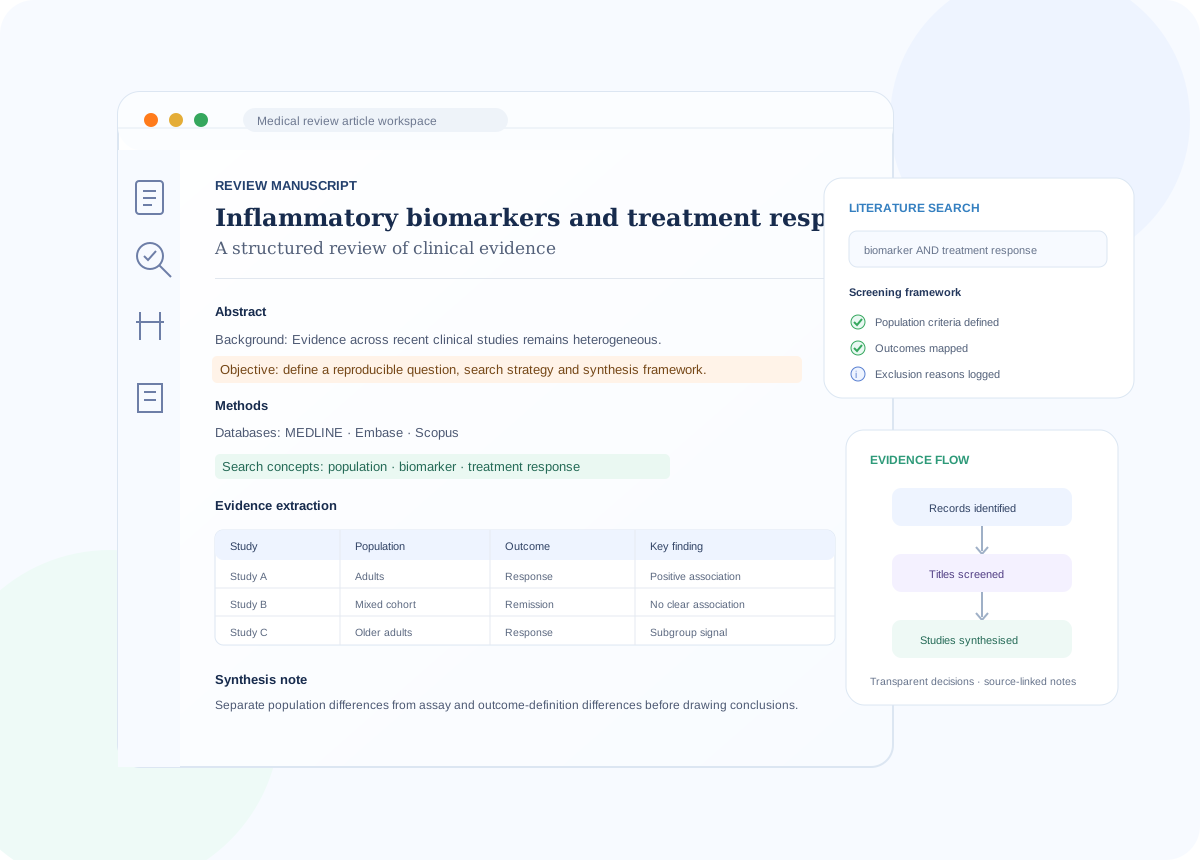
Evidence organisationStructure study characteristics, outcomes, and synthesis points consistently.
Transparent documentationMake search, screening, extraction, and author queries easier to review.
Confidential handlingUse the established Contentxprtz enquiry workflow for unpublished research materials.
Medical Review Article Research Support Pricing
Research support is workload-driven: a focused narrative review needs much less screening and evidence organisation than a systematic review. The project minimum applies to a defined, bounded evidence-support assignment.
Review Evidence Support
For authors who need help structuring a literature search, organising sources, and creating traceable evidence materials for a medical review article.
Projects from ₹12,000per defined research-support scope
- Search-question and keyword/subject-heading planning support
- Database-search strategy documentation based on agreed sources
- Reference screening or organisation within the defined volume
- Evidence table or source-summary framework for traceable synthesis
- Citation-management and duplicate-cleanup support where included
- Clear handoff of search notes and organised source records for author review
Full systematic-review execution, meta-analysis, risk-of-bias assessment, or very large screening sets require a separate quotation.
Pricing scales with evidence volume: Number of databases, search iterations, records screened, full texts reviewed, extraction fields, and review methodology determine the final quotation.
1
Common Review-Article Challenges We Help Organise
Medical review articles become difficult to defend when the research question, search logic, screening decisions, evidence table, and synthesis structure are developed separately. The support workflow is designed to make those parts connect.
Unfocused Review Question
Broad or shifting questions make search terms, eligibility criteria, and final synthesis harder to align.
Fragmented Search Logic
Keywords, subject headings, synonyms, populations, interventions, and outcomes may not be organised into a reusable search plan.
Inconsistent Screening
Unclear inclusion and exclusion rules can make study selection difficult to explain and reproduce.
Weak Evidence Matrix
Important study details may be captured unevenly, making comparison across populations, methods, and outcomes harder.
Unclear Synthesis
Results can become a sequence of study summaries rather than an organised comparison of evidence, variation, and limitations.
Citation & Source Drift
Claims, references, extraction notes, and manuscript wording can become disconnected as the review evolves.
2
What’s Included in Medical Review Article Research Support
The exact combination depends on your review type and manuscript stage. The areas below show the research-support tasks that can be discussed and scoped for a medical review article.
Question Refinement
Clarify the population, exposure/intervention, comparator, outcome, setting, and review purpose where relevant.
Search Architecture
Organise concepts, synonyms, controlled vocabulary ideas, database logic, and search documentation.
Eligibility Framework
Structure inclusion/exclusion criteria so screening decisions can be applied consistently.
Evidence Extraction
Build a study-characteristics and outcome matrix appropriate to the review question.
Synthesis Mapping
Group findings by clinically or methodologically meaningful themes rather than simply listing studies.
Manuscript Structure
Plan logical sections for background, methods, results/evidence synthesis, discussion, limitations, and conclusion.
Research Notes & Queries
Flag missing information, interpretation choices, inconsistent definitions, and points that require author decisions.
Citation Organisation
Keep references and source-linked notes aligned with the evidence discussed in the manuscript.
Table & Figure Planning
Organise evidence tables, study-characteristic summaries, and flow-style visual requirements.
Guideline Alignment
Use supplied journal, institutional, protocol, or reporting instructions to guide the agreed research presentation.
Ready to move forward?Start the service with the scope and delivery option that fits your document.
Buy Service Now
3
Built for Medical Researchers at Different Review Stages
Use the service when the evidence base exists but the review process needs clearer organisation, traceability, or manuscript development. The starting point can be a topic, a search export, an evidence table, or a partial draft.
Clinical Researchers
Evidence-focused review projects connected to a clinical question or specialty.
Postgraduate Students
Medical dissertations, thesis chapters, and review assignments requiring a defendable research workflow.
Journal Authors
Review manuscripts being developed toward a target journal or publication format.
Academic Teams
Multi-author reviews that need shared extraction fields, screening logic, and source-linked notes.
Research Collaborations
Projects where evidence needs to be organised consistently across contributors.
Early-Stage Review Authors
Researchers who need a practical structure before drafting the full review article.
4
See the Difference a Structured Research Workflow Makes
This illustrative example shows the difference between a loose literature summary and a review workflow that connects the research question, screening logic, evidence table, and synthesis plan. It is not a real clinical result.
Before Support
Working note: “We searched several databases for studies on inflammatory biomarkers and treatment response. Many papers were included, but the results were mixed.”
After Structuring
Research framework: define the review population and outcome first; map search concepts and eligibility criteria; extract study design, assay, treatment, outcome definition, and effect direction; then synthesise evidence by sources of clinical and methodological heterogeneity.
Clearer review logic
Traceable evidence
Stronger synthesis structure
Want expert support on the next step?Choose the service now and continue with a clear, defined workflow.
Buy Service Now
5
How the Research Support Workflow Works
The workflow starts with your review goal and available materials, then turns them into a traceable research structure. Scope can be adapted depending on whether you are starting from a topic, a search export, an evidence table, or a draft manuscript.
Share the Review Brief
Provide the topic/question, review type, target journal or institution, available sources, current draft, and deadline.
Define the Research Frame
Clarify the question, concepts, eligibility logic, evidence fields, and expected manuscript structure.
Organise Search & Screening
Develop or refine a transparent search/screening workflow and keep selection decisions visible.
Map Evidence & Synthesis
Structure study information, outcomes, limitations, and themes so evidence can be compared consistently.
Handoff for Author Review
Receive the agreed research materials, notes, source links, manuscript support, and unresolved author decisions.
6
What You May Receive
Because the service keyword does not match a supplied fixed plan, deliverables are not presented as a rigid package. The final handoff should reflect the specific research-support scope agreed for your review.
Search-Strategy Notes
Concepts, terms, logic, and database-specific notes where included.
Screening Framework
Eligibility criteria and decision structure for transparent study selection.
Evidence Matrix
Study characteristics, methods, outcomes, limitations, and source-linked notes.
Structured Review Outline
A section plan connecting research methods, evidence, synthesis, discussion, and limitations.
Citation & Source List
Organised references and source records corresponding to the agreed workflow.
Research Notes
Queries, unresolved decisions, evidence gaps, and author-action points.
7
Medical Review Types and Research Materials We Can Discuss
These are common contexts in which a structured research-support workflow may be useful. They are not presented as fixed packages or guarantees; describe your exact methodology and required output in the enquiry.
Narrative ReviewSystematic ReviewScoping ReviewRapid ReviewEvidence OverviewClinical Literature ReviewMedical Thesis ChapterDissertation Review ChapterJournal Review ManuscriptSearch Strategy NotesStudy Screening RecordsEvidence Extraction TablesReference LibrariesProtocol or Reporting InstructionsPartial Manuscript Drafts
Ready to start your project?Buy the service now and move directly to the next step.
Buy Service Now
8
Why Choose a Structured Research-Support Approach
The value of review support is not simply adding more text. It is creating a research trail that makes it easier to see how the question, sources, evidence, author decisions, and manuscript structure connect.
Source Traceability
Keep notes and claims connected to identifiable literature.
Author Control
Preserve author responsibility for interpretation and conclusions.
Transparent Notes
Surface uncertainty, inconsistencies, and decisions requiring author input.
Evidence-led Synthesis
Organise findings around clinically meaningful comparisons and limitations.
Consistent Structure
Use common fields and logic across screening, extraction, and synthesis.
Submission Context
Use supplied journal or institutional instructions when shaping the agreed output.
Ready to get this document professionally supported?Use the same secure service checkout shown in Pricing & Delivery.
Buy Service Now
9
Frequently Asked Questions
These answers define the service conservatively because the supplied service keyword does not include a fixed catalogue plan, price, turnaround, or word-count allowance.
What does medical review article research support cover?
The service is designed to support the research workflow behind a medical review article. Depending on the agreed scope, that can include refining the review question, organising search concepts, setting screening criteria, structuring evidence extraction, mapping themes or outcomes, organising citations, and developing a clear manuscript structure.
Can you support systematic, scoping, and narrative medical reviews?
The research-support workflow can be adapted to different review types. Share the intended review methodology, target journal or institution, and any protocol or reporting requirements so the scope can be confirmed before work begins.
Do you guarantee that every relevant study will be found?
No research search can responsibly guarantee perfect retrieval. The service focuses on a transparent, documented search and screening approach so the author can review the logic, sources, limits, and decisions used.
Does the service include statistical meta-analysis?
Statistical meta-analysis is not presented on this page as a standard inclusion. If quantitative analysis is required, describe it in the enquiry so the requested scope can be reviewed and confirmed separately.
Will you invent data, citations, or clinical conclusions?
No. Research support should remain traceable to real source material. The workflow is designed to organise and communicate evidence without fabricating studies, citations, data, or clinical conclusions.
What should I send to start a medical review article project?
Send the review topic or question, review type if known, target journal or institution, any protocol or reporting instructions, existing search notes or references, current manuscript or outline, and your required deadline.
Can you work from an existing set of studies?
Yes. If you already have screened studies, an evidence table, search results, or a partial manuscript, those materials can be used as the starting point for an agreed research-support scope.
How are sources and screening decisions kept transparent?
A structured workflow can use search notes, eligibility criteria, screening records, evidence tables, source-linked notes, and author queries so important decisions remain visible rather than disappearing into the prose.
Can the support follow a target journal’s requirements?
When journal or institutional instructions are supplied, they can be used to guide the agreed organisation, reporting structure, citation presentation, and submission-readiness checks relevant to the project.
How are pricing and turnaround confirmed?
A starting price is shown in the Pricing & Delivery section above. The final quotation and delivery commitment are confirmed after the actual scope, files, requirements, and deadline are reviewed.
Will the author remain in control of interpretation and conclusions?
Yes. Research support can organise evidence and improve the clarity of the review workflow, but the author remains responsible for scholarly interpretation, clinical claims, final conclusions, and submission decisions.
Medical Review Enquiry
Tell Us What Stage Your Review Is At
Share the research question, review type, current search or manuscript status, target journal or institution, required outputs, and deadline. This allows the research-support scope to be assessed without inventing a package that may not fit your project.
Review brief
Topic/question, review type, objective, target audience, and manuscript stage.
Search status
Databases searched, existing terms, exported records, screening status, and included studies.
Evidence materials
Extraction sheets, notes, reference library, tables, protocols, or reporting guidance already available.
Deadline & required handoff
State the exact deadline and the research or manuscript materials you need at completion.
Research Support Enquiry
Request a Project Scope Review
Provide enough detail to understand the medical review workflow you need. We will use the information to assess scope and respond through the contact details you provide.
Ready to Turn a Medical Review Topic into a Clearer Research Workflow?
Share what you already have and what you still need. We can assess the review stage, required research support, and appropriate next step.