
Medical Researchers
Researchers preparing evidence-based review manuscripts for journals or scholarly audiences.
A final-stage proofreading service for medical review articles that are already structurally developed and need precise language correction, terminology consistency, clean citation and reference presentation, and careful checking across headings, tables and figure captions—without substantive rewriting.
When the structure, evidence and argument of your medical review article are already in place, proofreading focuses on the final layer: accurate language, consistent terminology, dependable presentation and a cleaner manuscript for author review before submission.
A medical review article can be technically sound yet still contain small language and presentation issues that distract the reader. This service checks grammar, spelling, punctuation, word-level consistency, abbreviations, headings, citations, references, tables, figure captions and other final-stage details.
The proofreading pass is designed to preserve your intended scientific meaning. It is not a substitute for substantive editing, developmental editing, literature searching, evidence appraisal, statistical analysis or rewriting of the review’s conclusions.
If you provide target-journal or publisher instructions, relevant presentation details can be checked against those supplied requirements as part of the agreed proofreading scope.
The service is suited to authors whose scientific content is substantially complete and who want a dedicated final language and consistency check.
Researchers preparing evidence-based review manuscripts for journals or scholarly audiences.
Authors finalizing narrative, scoping, systematic or other medical review-style manuscripts.
Clinicians translating specialist knowledge and published evidence into a polished review article.
Faculty, scholars and postgraduate authors preparing medical or health-science review manuscripts.
Co-author groups that want a final consistency pass after multiple contributors have revised the manuscript.
Authors who want sentence-level correction and consistency without changing the underlying research message.
Small inconsistencies can accumulate across a long medical manuscript, particularly after several rounds of co-author revision.
Agreement errors, tense shifts, punctuation problems and overlooked typographical mistakes.
The same condition, intervention or technical concept expressed differently across sections.
Acronyms introduced twice, used before definition or presented inconsistently after revisions.
Inconsistent citation presentation, numbering, punctuation or obvious reference-list mismatches.
Figure and table labels, captions, abbreviations or cross-references that no longer match the final manuscript.
Presentation details that need a final check against supplied journal or publisher instructions.
The exact scope is confirmed from your manuscript and requirements, with the proofreading pass focused on final-stage language and presentation rather than substantive redevelopment.
Grammar, spelling, punctuation, syntax and typographical correction.
Light correction of awkward wording where meaning can be preserved without substantive rewriting.
Consistency checks for specialist terms and recurring medical language.
Definition, capitalization and repeated-use consistency across the manuscript.
Heading hierarchy, section labels, numbering and basic presentation consistency.
Checks for obvious inconsistencies in in-text citation style, punctuation or numbering.
Presentation checks for recurring reference elements and obvious citation/reference discrepancies.
Labels, captions, abbreviations, notes and visible cross-reference consistency.
Relevant final presentation checks when journal or publisher instructions are supplied.
A version showing corrections and a clean proofread manuscript for final author review.
The goal is controlled correction: remove avoidable language and consistency errors while keeping the scientific statement intact.
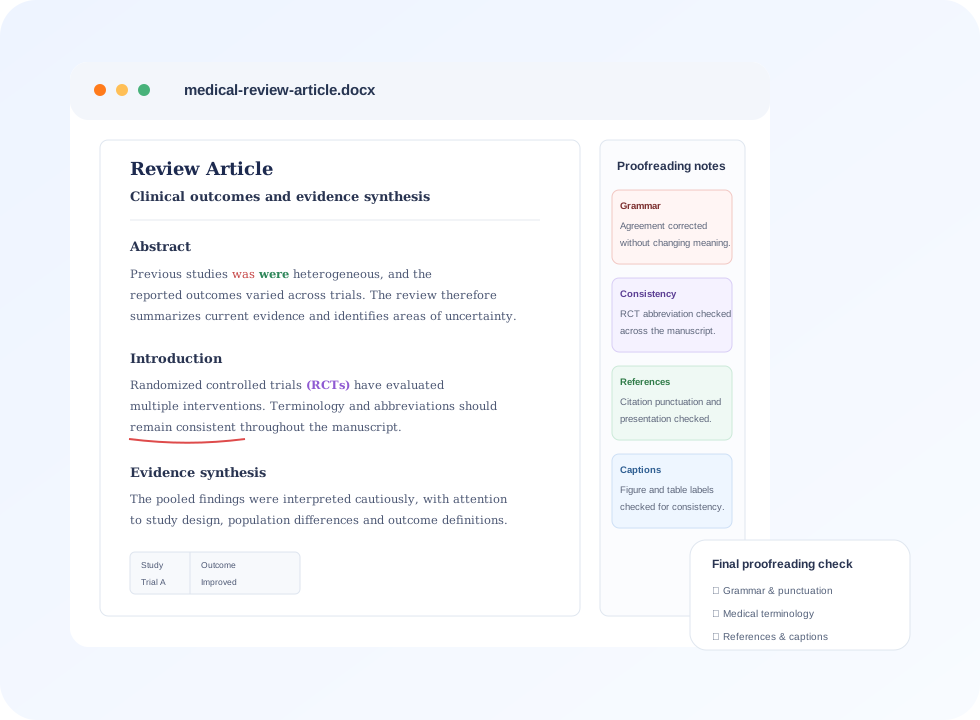
“The findings of previous studies was inconsistent, however several trials reports a clinically relevant benefit.”
“The findings of previous studies were inconsistent; however, several trials reported a clinically relevant benefit.”
What changed: subject–verb agreement, punctuation and verb tense. The scientific meaning was not rewritten or expanded.
Each stage keeps the focus on final-stage correction, internal consistency and clear author visibility of the changes made.
Share the latest manuscript, requirements, intended journal if known and your deadline.
We assess manuscript length, condition and the proofreading checks required.
Grammar, spelling, punctuation, typographical issues and light clarity problems are corrected.
Terminology, abbreviations, citations, references, headings, tables and captions are checked for consistency.
The corrected document is reviewed again for remaining surface-level presentation issues.
You receive the agreed proofread files for your own final scientific and submission review.
Deliverables are designed to make the proofreading transparent and easy to review before you finalize the manuscript.
Corrections remain visible so you can review what was changed.
A readable clean version after the proofreading corrections are applied.
Recurring specialist terms, abbreviations and related presentation checked across the article.
Visible citation and reference presentation inconsistencies addressed within the agreed scope.
Final checks on labels, captions, notes, abbreviations and visible cross-references.
Every medical review article differs in length, condition, supporting material and required checks. A fixed price, word-count limit or turnaround is therefore not displayed for this service; the scope, quote and delivery timing are confirmed after the manuscript details are reviewed.
The length and current quality of the near-final article influence the level of proofreading effort required.
Language-only checks, reference presentation, tables, captions and supplied journal guidelines can affect the agreed scope.
Your requested submission date is reviewed together with manuscript scope before delivery timing is confirmed.
No fixed delivery promise is shown for this non-catalogue-specific service. Timing depends on the manuscript length, condition, requested checks and deadline you provide.
A focused proofreading workflow helps separate final presentation checking from the scientific decisions that remain the responsibility of the author team.
Checks are framed around a medical review article rather than generic business copy.
The service stays at proofreading level instead of silently redeveloping your argument.
You can review edits before accepting them into the final manuscript.
Recurring medical terms and abbreviations are checked across sections.
Citation and reference formatting inconsistencies can be surfaced and corrected within scope.
Tables, figures, notes and visible cross-references receive a final consistency check.
Unpublished manuscript information is treated as confidential service material.
A last check helps catch surface errors that can remain after repeated author revisions.
The workflow separates initial correction from consistency review and final verification so the manuscript receives more than a single linear read-through.
The workflow separates language accuracy, medical consistency and final quality-control responsibilities so the manuscript receives a focused final-stage review.
Grammar, punctuation, spelling, sentence-level readability and consistent formal academic presentation.
Language accuracyRecurring terminology, abbreviations, units, symbols, labels and discipline-specific presentation consistency.
Terminology consistencyA final verification pass across headings, citations, references, tables, captions and corrected language.
Final verificationThe proofreading pass can cover the complete manuscript or selected final-stage sections, depending on the scope you submit.
Authors know their content best, but familiarity can make small language and presentation inconsistencies harder to notice after repeated revisions.
Share the manuscript, your target journal if known, required checks and deadline. We’ll review the scope before confirming the service details.
Answers to common questions about scope, delivery and what a proofreading-level service does—and does not—cover.
It focuses on final-stage language and presentation checks such as grammar, spelling, punctuation, typographical errors, light sentence-level clarity, terminology and abbreviation consistency, and agreed checks on citations, references, headings, tables and figure captions.
No. Proofreading is intended for a manuscript that is already structurally developed. It does not normally restructure sections, redevelop arguments, add literature, rewrite conclusions or perform developmental editing.
Yes. Recurring medical terminology, acronyms, capitalization, units and symbols can be checked for internal consistency within the manuscript and against supplied requirements where relevant.
The proofreading scope can include consistency and presentation checks for in-text citations and the reference list, including obvious numbering, punctuation, style or matching issues. It is not a literature-verification or source-validation service unless separately agreed.
Yes, when included in the submitted manuscript and agreed scope. Labels, captions, notes, abbreviations and visible cross-references can be checked for language and presentation consistency.
The service is presented with tracked corrections for review, together with a clean proofread copy so you can compare the corrected version and complete your own final author sign-off.
Relevant presentation details can be checked against journal or publisher instructions that you provide. The exact guideline-dependent scope should be confirmed with the manuscript before work begins.
No. A proofreading-level service should preserve the intended scientific meaning. Decisions about evidence interpretation, claims, conclusions and scientific accuracy remain with the author team.
Pricing and delivery timing are confirmed after reviewing manuscript length, condition, requested checks, supplied guidelines and deadline. This avoids applying a one-size-fits-all scope to different review articles.
Send the latest editable manuscript, approximate word count, target journal or publisher instructions if available, reference style if known, your deadline and any areas you specifically want checked.
Yes. A final proofreading pass can be useful after major author-side revisions because new wording, moved text and updated references can introduce small inconsistencies. The revised manuscript should be structurally settled before final proofreading.
You can describe the sections you want checked in the enquiry. Feasibility and scope can then be confirmed based on the material supplied and whether a partial-document pass will meet your needs.
Share enough detail for the proofreading request to be assessed accurately. The final scope, price and delivery timing can then be confirmed without guessing.
Complete the form and we’ll review your requirements.
Send your manuscript details and deadline. We’ll assess whether proofreading fits the document and confirm the appropriate scope before work begins.