
Professional Medical & Academic Editing Support

Medical Review Article Editing Service for Clear, Coherent, Journal-Ready Manuscripts

Refine a medical review article for academic clarity, logical section flow, consistent medical terminology, precise scholarly expression, and cleaner journal presentation—without changing the evidence or conclusions you intend to communicate.

  • Language, clarity, tone, and sentence-level refinement throughout the review
  • Section flow and coherence across the abstract, introduction, evidence synthesis, discussion, and conclusion
  • Consistency checks for medical terminology, abbreviations, citations, references, tables, figures, and captions
  • Editorial comments for wording, consistency, or author-clarification points that need attention
Tracked revision workflow Clear editor comments Journal-guideline review when supplied
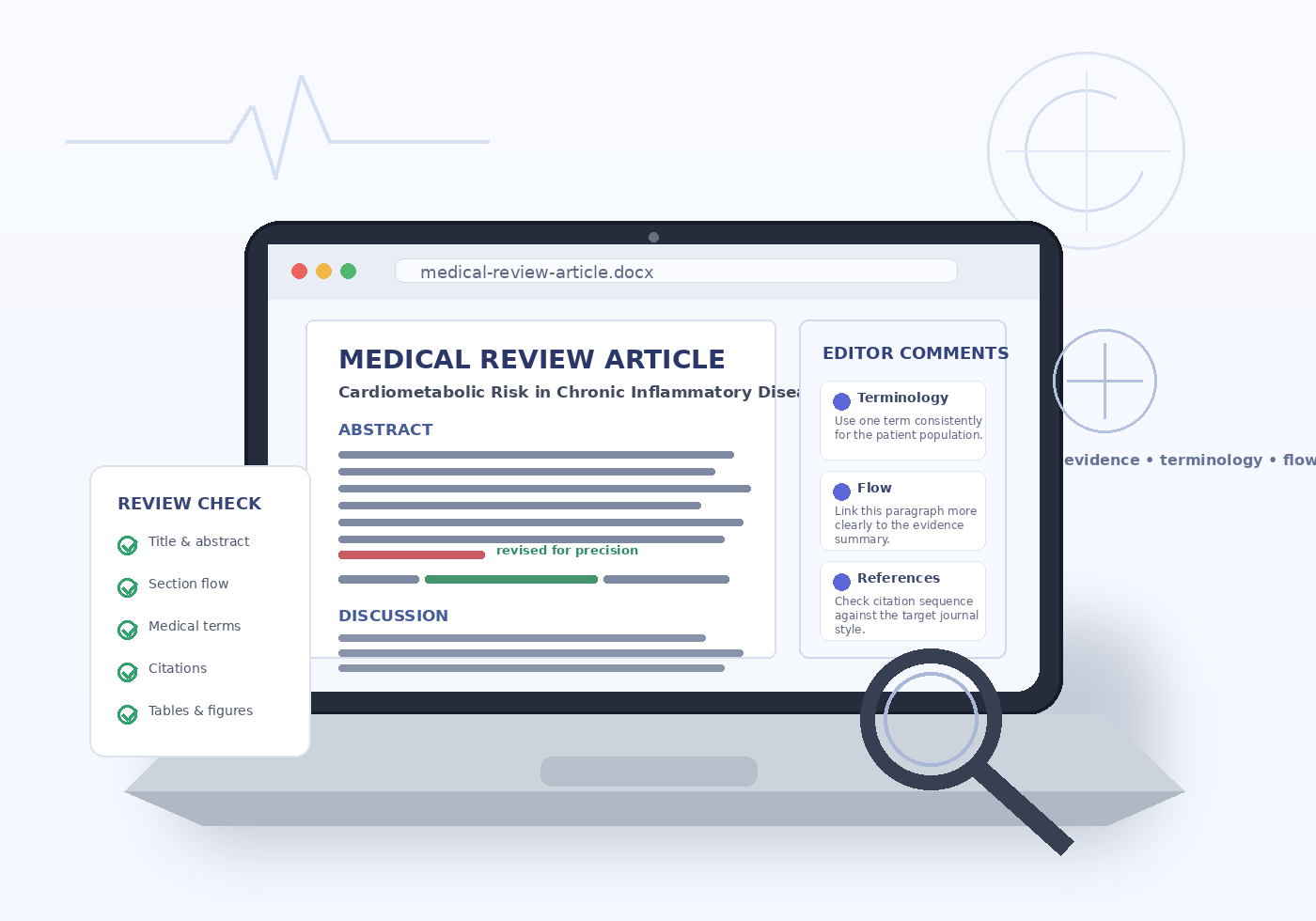
Medical review article manuscript with tracked revisions, medical terminology checks, reference review, and editor comments
Tracked Revisions

See editorial changes clearly in the manuscript.

Terminology Consistency

Check repeated medical terms and abbreviations.

Editor Comments

Flag wording or clarification points for author review.

Reference Presentation

Review citation and reference consistency.

Journal Alignment

Use supplied author guidelines for presentation checks.

1

Professional Medical Review Article Editing

Editorial support designed for review manuscripts that already contain the author’s evidence and interpretation but need clearer language, stronger coherence, consistent terminology, and more polished academic presentation.

Editing That Strengthens Presentation Without Replacing Your Scholarship

A medical review article often brings together findings from multiple sources, studies, clinical contexts, and terminology systems. Even when the evidence is complete, the manuscript can become difficult to follow if section transitions are abrupt, terminology changes across sections, references are presented inconsistently, or dense sentences obscure the central synthesis.

This service focuses on the manuscript as an academic document: language is refined, paragraphs are made easier to follow, repeated concepts are expressed consistently, and the relationship between sections is made clearer. Where wording or logic is ambiguous, the editor can flag the point for author review rather than silently altering the intended meaning.

It is an editing service, not a substitute for peer review, clinical judgment, statistical review, evidence appraisal, or author responsibility for the scientific content.

2

Who This Service Is For

Use medical review article editing when the manuscript is substantively developed and the main need is stronger scholarly communication, consistency, and presentation.

Postgraduate Authors

Review manuscripts prepared for coursework, thesis chapters, or research outputs.

Doctoral Researchers

Evidence-synthesis sections or review papers that need a more consistent academic voice.

Journal Authors

Medical review articles being prepared for a target journal or publisher.

Clinical & Health Researchers

Review manuscripts that bring together medical, clinical, or health-science evidence.

Research Teams

Multi-author manuscripts that need consistency across sections, terms, citations, and presentation.

3

Are These Issues Making Your Review Article Harder to Read?

Editing is most useful when the evidence is already present but the manuscript’s language or presentation makes the synthesis less clear than it should be.

Dense Sentences

Long or layered sentences obscure the review’s main message.

Weak Section Flow

Paragraphs or sections do not connect cleanly across the synthesis.

Terminology Drift

Medical terms, abbreviations, and labels change across the manuscript.

Citation Inconsistency

References, numbering, or in-text presentation are uneven.

Table & Figure Mismatch

Captions, labels, abbreviations, or callouts are not fully aligned.

Journal Presentation Gaps

Formatting or presentation needs review against supplied instructions.

4

What’s Included in Medical Review Article Editing

The scope is built around the communication and presentation needs of review manuscripts rather than content generation or independent scientific verification.

Language & Clarity

Grammar, syntax, word choice, concision, readability, and academic expression.

Section Coherence

Transitions and continuity across the manuscript’s major sections.

Medical Terminology

Consistency of terms, abbreviations, capitalization, units, and notation.

Citations & References

Presentation consistency and obvious cross-reference or numbering issues.

Tables & Figures

Captions, labels, abbreviations, callouts, and language consistency.

Abstract Refinement

Clarity, concision, internal consistency, and alignment with the manuscript’s stated focus.

Journal-Style Review

Editorial checks against supplied author instructions where relevant.

Editor Comments

Clear notes where wording, logic, or author confirmation is needed.

Consistency Pass

Headings, capitalization, style, repeated phrases, and manuscript-wide conventions.

Presentation Review

Section hierarchy, tables, figures, references, spacing, and visible formatting consistency.

5

From Difficult-to-Follow Draft to Clearer Review Manuscript

The goal is not to replace the author’s scholarship. It is to make the existing synthesis easier to understand, review, and prepare for submission.

Before Editing

Common Manuscript Friction

  • ×Long, multi-clause sentences that weaken clarity
  • ×Abrupt transitions between evidence themes
  • ×Inconsistent abbreviations or disease terminology
  • ×Repetitive phrasing across sections
  • ×Uneven citation, table, figure, or caption presentation
  • ×Formatting that does not fully reflect supplied journal instructions
Our Editing Service

Targeted Editorial Review

  • Refine language while preserving author meaning
  • Strengthen paragraph and section transitions
  • Standardize recurring terminology and abbreviations
  • Improve concision and remove avoidable repetition
  • Review references, captions, labels, and callouts for consistency
  • Flag unclear points for author confirmation
After Editing

A More Coherent Manuscript

  • Clearer scholarly expression
  • More consistent narrative flow
  • Stable medical terminology and abbreviations
  • Cleaner manuscript presentation
  • More consistent citations, references, tables, and figures
  • Visible revision trail for author review
6

How the Medical Review Article Editing Process Works

A clear workflow keeps the manuscript, target-journal requirements, author priorities, editorial revisions, and final quality review connected from submission to delivery.

01

Submit Manuscript

Share the current review article and relevant supporting instructions.

02

Define Scope

Clarify word count, deadline, target journal, citation style, and priority concerns.

03

Editorial Review

Assess language, flow, terminology, consistency, references, and presentation.

04

Manuscript Editing

Apply revisions and add comments where author clarification is needed.

05

Quality Check

Review consistency across sections, tables, figures, citations, and formatting.

06

Edited Handoff

Return the edited manuscript for author review and final decisions.

7

What You’ll Receive

Deliverables are designed to make revisions visible, make editorial decisions easier to review, and keep the manuscript ready for the author’s final scientific and submission checks.

Edited Review Manuscript

Language and presentation revisions applied through the manuscript.

Visible Revision Trail

Tracked edits that let the author see what changed.

Editor Comments

Notes for unclear wording, consistency questions, or author decisions.

Reference & Caption Review

Presentation checks across citations, references, tables, figures, and captions.

Clean Review Copy

A cleaner version for the author’s final content and submission review.

8

Choose the Editing Focus Your Review Article Needs

Medical review manuscripts do not all need the same depth of intervention. The enquiry can be scoped around the areas that are creating the most friction.

Language & Readability

Best when the structure is sound
  • Grammar, syntax, and word choice
  • Sentence clarity and concision
  • Academic tone and consistency
  • Reduction of repetition and awkward phrasing

Flow & Coherence

Best when sections feel disconnected
  • Paragraph transitions
  • Section-to-section continuity
  • Theme and evidence-synthesis flow
  • Heading hierarchy and information sequencing

Submission Presentation

Best when journal instructions are available
  • References and citation presentation
  • Tables, figures, captions, and labels
  • Terminology and abbreviation consistency
  • Editorial checks against supplied author guidelines
9

Quote and Turnaround Are Based on the Manuscript

No unsupported fixed price or delivery time is assumed for this specific service. The scope is reviewed from the manuscript details you provide.

Manuscript Scope

Length, document condition, tables, figures, references, and required editorial depth affect the work involved.

Deadline Review

Share the exact deadline and time zone so feasibility can be assessed before work begins.

Request a Quote

Send the manuscript details and requirements for a service-specific scope and quotation.

10

Why Choose Medical Review Article Editing?

The service is designed around the needs of evidence-dense review manuscripts, with emphasis on clarity, consistency, author control, and transparent editorial changes.

Review-Article Focus

Editing is shaped around synthesis-heavy academic manuscripts.

Medical Terminology

Consistency checks support clearer technical communication.

Transparent Comments

Unclear points can be flagged rather than silently reinterpreted.

Reference Consistency

Citations and reference presentation receive an editorial consistency pass.

Figures & Tables

Captions, labels, callouts, and repeated terminology can be aligned.

Journal-Guideline Review

Supplied author instructions can guide presentation checks within scope.

11

Quality You Can Review, Not Just Accept on Trust

A transparent editing workflow helps the author see the revisions, understand flagged issues, and make the final scientific decisions before submission.

Editorial Pass

Author-Point Flags

Consistency Check

Final Verification

12

Medical Review Manuscripts We Can Work On

The editorial approach can be adapted to different review-article formats while keeping the focus on language, consistency, structure, and presentation rather than generating the scientific content.

Narrative Reviews

Systematic Review Manuscripts

Scoping Reviews

Meta-analysis Manuscripts

Clinical Reviews

Evidence Syntheses

Mini-Reviews

State-of-the-Art Reviews

13

When Professional Editing Adds More Value Than a Final Self-Edit

Authors know the science best; an independent editorial pass can help surface language and presentation issues that are easy to overlook after repeated revisions.

Final Self-Editing Challenges

  • ×Familiarity with the text can make repeated wording or weak transitions harder to notice.
  • ×Different co-authors may introduce inconsistent terminology, abbreviations, and tone.
  • ×Reference, table, figure, and caption presentation may become uneven over multiple revisions.
  • ×Dense clinical or technical language can remain grammatically correct but difficult to read.
  • ×Journal presentation details can be easy to miss while focusing on the scientific argument.

Professional Editorial Review

  • Provides an independent language and coherence pass across the whole manuscript.
  • Helps harmonize terminology, abbreviations, style, and section-level presentation.
  • Checks visible consistency across references, tables, figures, captions, and callouts.
  • Refines dense sentences while preserving the intended scientific meaning.
  • Uses supplied journal instructions as an editorial reference point where appropriate.
14

What a Strong Editing Outcome Should Look Like

A good edit should make the manuscript easier to follow without making the author lose control of the evidence, interpretation, or final scientific decisions.

Clearer Communication, Same Authorial Responsibility

The edited manuscript should read more consistently from section to section, use technical language more precisely, and present its supporting elements more coherently. It should also make significant editorial interventions visible enough for the author to review.

Clearer sentence structure
More consistent terminology
Stronger paragraph transitions
Cleaner reference presentation
Aligned tables and figure captions
Visible author-review points
15

Medical Review Article Editing FAQs

Answers to common questions about editing scope, manuscript types, terminology, references, journal instructions, pricing, turnaround, and author responsibility.

What is a Medical Review Article Editing Service?

It is an editorial service for medical review manuscripts that focuses on clarity, academic language, section flow, terminology consistency, presentation, references, and submission-readiness while preserving the author’s intended meaning and evidence.

What types of medical review articles can be edited?

The service can be used for narrative reviews, systematic-review manuscripts, scoping reviews, evidence syntheses, clinical reviews, mini-reviews, state-of-the-art reviews, and review manuscripts that include meta-analysis sections.

Do you rewrite the scientific conclusions of my review article?

Editing focuses on expression, coherence, consistency, organisation, and presentation. Your evidence, interpretation, and conclusions remain your responsibility, and unclear points can be flagged for review rather than silently changed.

Can the editing include medical terminology consistency?

Yes. Terminology, abbreviations, capitalization, symbols, units, and repeated technical expressions can be checked for consistency across the manuscript.

Can references and citations be checked?

Reference and citation presentation can be checked for consistency, including obvious numbering, style, and cross-reference issues. Editorial checking does not replace independent source verification or a formal evidence-quality assessment.

Can you edit tables, figures, and captions in a review article?

Language and presentation consistency in tables, figures, captions, labels, callouts, abbreviations, and cross-references can be reviewed when those materials are supplied with the manuscript.

Can you follow a target journal’s author guidelines?

When target-journal instructions are supplied, the manuscript can be reviewed for editorial consistency with the relevant language, presentation, heading, citation, reference, table, figure, and formatting requirements that fall within the editing scope.

Will I receive tracked changes and editor comments?

The editing workflow can present revisions transparently with tracked changes and editorial comments so you can review important wording, consistency, or clarification points.

What should I send with my manuscript?

Send the current manuscript, target-journal instructions if available, required citation or formatting style, any reviewer or supervisor comments relevant to the edit, and your deadline and priority concerns.

How is turnaround determined?

Turnaround depends on manuscript length, editorial depth, complexity, tables and figures, reference requirements, supplied journal instructions, and the requested deadline. The feasible schedule should be confirmed after the document is reviewed.

How is pricing determined?

Pricing depends on the manuscript and requested editing scope. Submit the document details, approximate word count, deadline, and requirements so the service can be assessed and quoted without assuming a fixed package price.

Is editing the same as peer review or medical advice?

No. Editorial support improves manuscript language and presentation. It does not replace peer review, evidence appraisal by the authors, clinical judgment, statistical review, regulatory review, or medical advice.

Medical Review Article Editing Enquiry

Request an Editing Quote for Your Review Manuscript

Share enough information for the manuscript to be assessed without assuming a fixed price, turnaround, or editing depth that has not yet been reviewed.

Manuscript & word count

Provide the document type and approximate word count.

Deadline & time zone

State the exact deadline so delivery feasibility can be assessed.

Target journal & guidelines

Include author instructions when the manuscript is being prepared for a specific journal.

Priority concerns

Tell us whether language, flow, terminology, references, tables, figures, or formatting need the most attention.

Helpful to include: current manuscript status, approximate word count, target journal, citation style, tables/figures, deadline, and any reviewer or supervisor comments relevant to the edit.
Send Your Enquiry

Medical Review Article Editing Request

Enter your contact details and manuscript requirements. The information you provide will be used to understand the editing scope and respond to your enquiry.

Security check *Loading question…

Please avoid sending confidential patient-identifying information through the enquiry text field. Manuscript files and detailed instructions can be handled through the appropriate submission process after your request is reviewed.

Ready to Refine Your Medical Review Article?

Share your manuscript details, target journal, deadline, and priority editing concerns to request a service-specific review and quote.

Request an Editing Quote