
Understand Goals
Clarify objectives, audiences, context and the change you want communication to support.
Turn complex research, evidence and specialist knowledge into clear messages, credible stories and useful content for the stakeholders who need to understand, fund, use, share or act on your work.
A communication approach designed to move research from evidence to understanding, engagement and real-world use.
A structured path from discovery and evidence review to content creation, distribution and evaluation.
Clarify objectives, audiences, context and the change you want communication to support.
Review research materials, evidence, messages, stakeholder needs and key insights.
Shape core messages, communication goals, formats, channels and stakeholder pathways.
Craft stories, briefs, visuals, reports, presentations and campaign-ready communication.
Share content through the channels and formats that fit each audience and objective.
Track reach, engagement and useful indicators, then refine the communication approach.
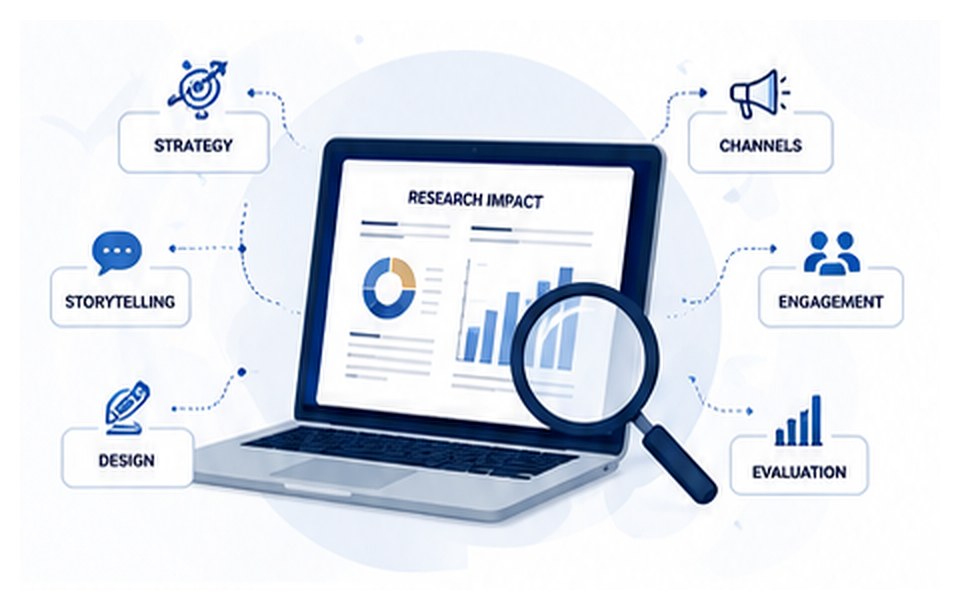
Integrated research communication capabilities that connect evidence, audience needs and measurable engagement.
Craft clear, compelling messages that resonate with the intended audience and reflect the true value of the research.
Translate complex research into accurate, engaging content for academic, professional and public audiences.
Design infographics, posters, data visualisations, reports and presentations that tell the research story clearly.
Plan multi-channel communication strategies to improve reach, engagement, relevance and influence.
Connect with media, stakeholders and communities through structured outreach and audience-ready content.
Define relevant metrics, collect evidence and report communication outcomes that demonstrate real-world change.
A practical mix of research analysis, visual communication, content systems, outreach and performance measurement.
Tools we use: Tableau • Power BI • Illustrator • InDesign • Canva Pro • Figma • WordPress • Google Analytics • Mailchimp • and more
Build stakeholder-ready assets, then place each message in the channels most likely to reach the right audience.
Connect evidence, communication activity, audience interaction and measurable outcomes in one clear impact pathway.
Adapt the communication objective to the context—academic, health, policy, funding, public awareness or corporate impact.
Increase visibility, citations and collaboration opportunities.
Communicate findings clearly to improve understanding of health outcomes.
Influence policy with evidence-based communication.
Strengthen proposals and demonstrate measurable impact.
Educate communities and drive social impact.
Report sustainability, innovation and organisational impact effectively.
Choose a working model that fits the communication need, then progress through a staged research-to-impact workflow.
Defined scope and timeline. Ideal for one-time projects.
Ongoing support and content for continuous communication.
Targeted campaigns for events, initiatives and stakeholder moments.
Long-term partnership for sustained research communication impact.
Research communication requires more than attractive content—it needs evidence discipline, audience thinking and a clear path to action.
Deep understanding of research and complex topics.
Evidence-based approach with accuracy at the centre.
High-quality design that communicates clearly.
Messages are tailored for the right audiences and contexts.
Measure, learn and continuously improve communication.
Experience communicating across countries, cultures and contexts.
From strategy to storytelling, we help connect research evidence with the audiences, channels and engagement approaches that can move it further.
Discuss Your RequirementPractical answers about scope, audiences, deliverables, channels, impact measurement and how an engagement begins.
It is a structured communication service that turns research, evidence and specialist knowledge into clear stakeholder-facing content, visuals, campaigns and impact reporting for the audiences who need to understand, use or act on the work.
The service is suitable for researchers and academics, universities and research institutes, NGOs and non-profits, government and public agencies, foundations and donors, science and health organisations, think tanks and policy groups, and industry or innovation teams.
Typical outputs include research summaries, plain-language briefs, impact stories, case studies, infographics, data visualisations, posters, reports, whitepapers, fact sheets, presentations, pitch decks, web content, landing pages, social media content, press kits and media materials.
Yes. The service includes audience and stakeholder thinking, message development, content strategy and channel planning so that communication is aligned to the people and contexts that matter.
Yes. Scientific writing and editing support can translate complex research into accurate, engaging content for different audiences while preserving the evidence, meaning and appropriate level of technical detail.
Yes. Visual communication can include infographics, data visualisations, posters, presentation design and other visual formats that make research findings easier to understand and share.
Yes. Communication can be planned across websites, blogs, email campaigns, social media, webinars, events, media outreach, reports, publications, conferences and partnership channels.
The process defines relevant communication and engagement metrics, collects appropriate evidence and reports on reach, engagement, interaction and other indicators that help demonstrate real-world change.
Useful inputs include the research or project background, key findings, evidence or source material, priority stakeholders, communication objectives, existing brand or style guidance, required channels, important dates and any impact measures already being tracked.
The service can be structured as project-based, retainer-based, campaign-based or strategic-partner support depending on the communication need.
The service framework shows discovery and research in weeks 1–2, strategy and planning in weeks 3–4, content creation and design in weeks 5–8, distribution and launch in weeks 9–10, followed by ongoing evaluation and optimisation.
Use the enquiry form to share your research topic, audience, communication goals, channels, deadlines and required outputs. The scope can then be reviewed against the most suitable engagement model.
Share your research context, priority stakeholders, intended outcomes and the communication formats or channels you are considering.
Provide project background, source materials, key findings and any existing content.
Identify who needs to understand, use, fund, share or act on the research.
Clarify whether the goal is awareness, engagement, adoption, funding, policy influence or another outcome.
Share any reach, engagement, outcome or reporting indicators that matter to the project.
Submit the essentials below so the communication need, likely deliverables and suitable engagement model can be reviewed.