
Clarify goals, audience, use case and available source material.
Research Case Study Service for Clear, Evidence-Led Stories of Impact
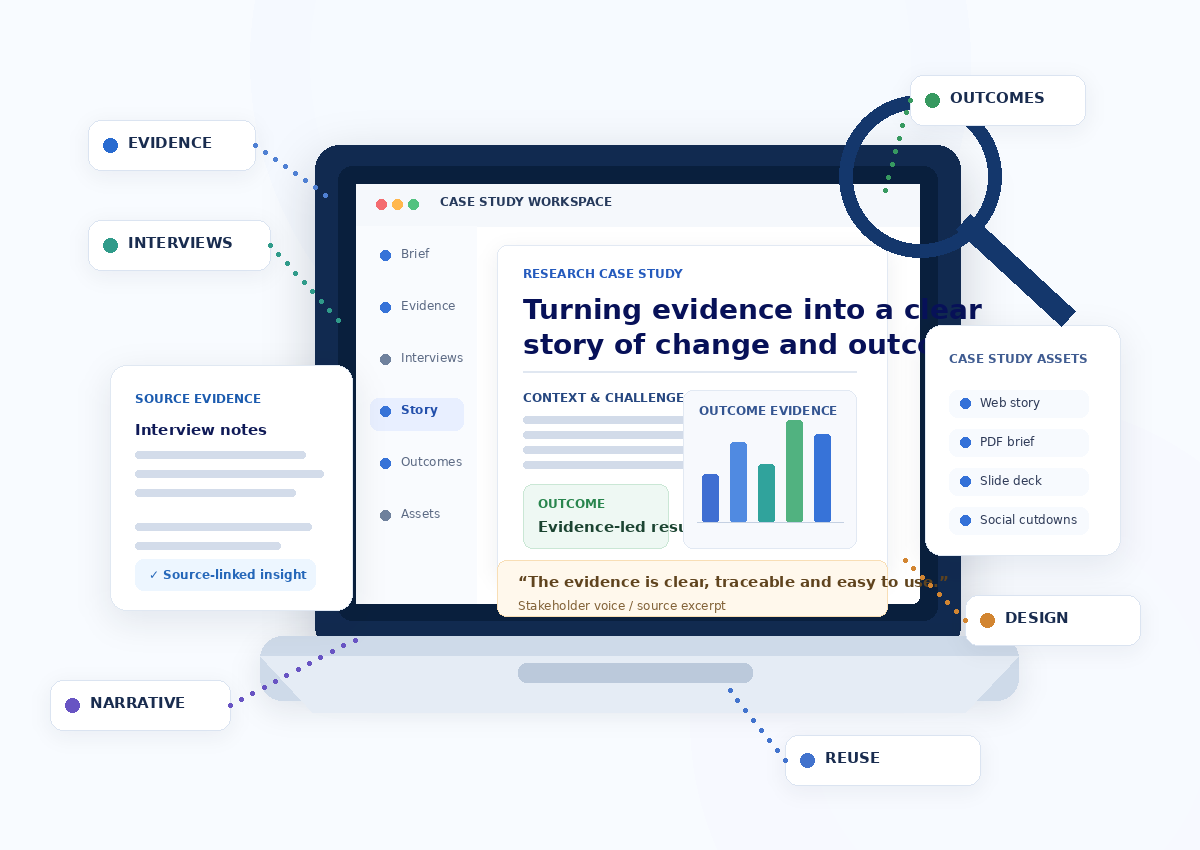
Turn complex research, project evidence, stakeholder insight and outcomes into a compelling case study that is easy to understand, credible to review and ready to reuse across reports, websites, presentations and outreach.
No fixed price or delivery-time claim is shown on this page; scope is assessed from the actual evidence, interview needs, review steps, design requirements and final formats.
What a Strong Research Case Study Should Make Clear
Our Proven 6-Stage Case Study Process
A structured path from brief and source evidence to a clear narrative, validated outcome story and reusable final asset.
Review evidence, findings, interviews, data and context.
Define the angle, message hierarchy, proof points and story arc.
Write the narrative and shape evidence into readable sections.
Check source alignment, stakeholder feedback and visual accuracy.
Prepare the agreed final formats for publication, reporting or outreach.
What We Do
The service combines evidence interpretation, research storytelling, visual communication and content adaptation around one coherent case study.
Evidence Review & Synthesis
Organise the research context, source documents, approved findings and supporting evidence so the story rests on material that can be traced and checked.
Stakeholder Insight
Integrate approved interview notes, quotations and stakeholder perspectives where they add context, explanation or a useful human voice to the evidence.
Case Study Narrative
Build a clear story around the challenge, research or intervention, key evidence, outcomes and implications without overstating what the source material supports.
Visual Communication
Use charts, callouts, diagrams, timelines and evidence highlights where they make the story easier to scan and understand.
Design & Layout
Structure the content as a polished case study asset with clear hierarchy, evidence panels, readable sections and publication-ready presentation.
Multi-Format Adaptation
Repurpose the approved core story for other formats in the brief, such as a website page, PDF, report insert, slide deck or short-form communication.
Tools & Capabilities
Use the combination of analysis, writing, visualisation, design and content systems that best fits the evidence and the final channel.
Tools may include: Tableau, Power BI, Illustrator, InDesign, Canva Pro, Figma, WordPress and Google Analytics where they are appropriate to the agreed case study output.
Key Deliverables & Multi-Format Reuse
Build one evidence-led core narrative, then prepare the outputs that match how the story needs to be read, reviewed, presented or shared.
Key Deliverables
- ✓Case study narrative and plain-language summary
- ✓Challenge, approach, evidence and outcome structure
- ✓Approved stakeholder quotes or insight callouts
- ✓Data visualisations, evidence panels or outcome highlights
- ✓Designed PDF or web-ready case study where included
- ✓Presentation or report adaptation where included
- ✓Short-form content cutdowns where included
- ✓Final reviewed copy with agreed factual corrections
One Story, Multiple Formats
Readable online narrative
Evidence-led story angles
Designed downloadable asset
Decision-ready insertion
Slides for briefings and events
Our Research Case Study Framework
A simple evidence chain keeps the final story connected to what was actually done, observed and learned.
Who We Help & Common Use Cases
Case studies can make research more usable when the audience needs a concise explanation of the problem, evidence, change and implications.
Academic Research
Show research relevance, application, collaboration or knowledge-transfer outcomes.
Health & Science
Communicate evidence, implementation, programme learning or research-led change.
Policy & Advocacy
Explain evidence, policy relevance, stakeholder need and implications for decision-makers.
Grants & Funding
Present evidence of need, delivery, learning and outcomes in a focused narrative.
Public Awareness
Translate complex findings into an accessible story for communities and non-specialists.
Corporate & ESG
Document research-backed initiatives, sustainability learning and evidence of change.
Engagement Models & Typical Workflow
Choose a project structure that reflects whether you need one case study, ongoing support, a campaign set or a longer-term research communication partner.
Engagement Models
Typical Engagement Workflow
Delivery timing is confirmed after the source volume, interview requirements, review stages, design complexity and requested output formats are assessed.
Why Choose This Research Case Study Service?
The value comes from combining research understanding with disciplined evidence handling, clear writing, audience-aware structure and visual communication.
Research Case Study Service FAQs
Answers to common questions about source material, interviews, evidence, visuals, formats, review and project scoping.
What is a Research Case Study Service?
It is a structured service for turning research evidence, project context, stakeholder insight and outcomes into a clear case study narrative that can be used by research, policy, funding, institutional and professional audiences.
What types of research can be developed into a case study?
The service can support academic, scientific, health, policy, social-impact, innovation, programme and institutional research when there is enough source material to explain the context, approach, evidence and outcomes accurately.
Can you work from raw notes, reports and existing research documents?
Yes. Source material can include research papers, internal reports, evaluation documents, project summaries, interview notes, presentations, data extracts and approved background material. The case study is developed from the evidence supplied for the project.
Can stakeholder interviews be included?
Stakeholder interviews can be incorporated when they are part of the agreed brief. Interview material can be used to add context, lived experience, expert perspective or an approved quotation while keeping the evidence trail clear.
How do you keep the case study evidence-led?
Claims are mapped back to the source material provided for the project. Where a statement needs clarification, attribution or stronger evidence, it is flagged for review instead of being presented as an unsupported outcome.
Can the case study include data visualisation?
Yes, when suitable data is supplied. Tables, charts, callout metrics, timelines and simple visual summaries can be used to make findings easier to understand without changing the meaning of the underlying evidence.
What materials should I provide before the work begins?
Useful inputs include the project or study background, objectives, research outputs, approved findings, relevant data, stakeholder material, audience information, brand guidance and any required publication or confidentiality constraints.
Can one case study be adapted into multiple formats?
Yes. The core narrative can be structured for formats such as a website case study, PDF brief, presentation, report insert, funding communication or short-form promotional content when those outputs are included in the project scope.
Can sensitive or confidential material be handled carefully?
The brief can specify information that must be excluded, anonymised, generalised or held for internal review. Only approved material should be used in the final public-facing version.
Can the case study be revised after stakeholder review?
A review stage can be built into the workflow so factual corrections, approved stakeholder comments and evidence clarifications are incorporated before the final version is prepared.
Do you create both the narrative and the visual layout?
The service can combine evidence synthesis, narrative development, visual communication and layout when the brief requires a finished case study asset rather than text only.
How are pricing and delivery timing determined?
Pricing and delivery timing are confirmed after the brief is reviewed because the workload depends on the volume of source material, interview requirements, evidence complexity, review steps, design needs and number of final formats.
Discuss Your Research Case Study Requirement
Share enough context to assess the evidence volume, audience, stakeholder inputs, visual needs, review path and final formats.
Help Us Understand the Case Study
A useful brief makes it easier to determine the right narrative depth, evidence review effort and output structure without making assumptions about your research.
Explain the study, programme, initiative or intervention the case study should cover.
List reports, papers, data, evaluations, presentations, interview notes or approved source material.
Identify who needs to read or use the case study and what they should understand.
Flag factual reviewers, stakeholder approval needs, confidentiality constraints or anonymisation requirements.
Specify whether you need web copy, PDF, report content, slides, short-form assets or another agreed format.
Request a Scope Assessment
Send the core project details below. The form does not assume a fixed price or turnaround; both are assessed from the actual requirement.
Turn Your Research Evidence Into a Case Study People Can Understand and Use.
From evidence mapping to narrative, visual communication and final assets, build a case study that keeps the research clear and the outcomes credible.