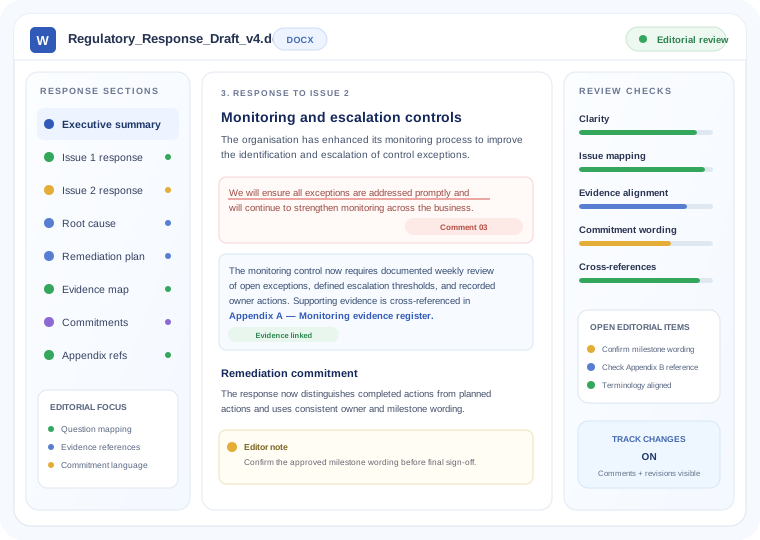
Regulatory Response Editing Service for Clear, Structured, Review-Ready Submissions
★★★★★4.8 rating from Researchers, Authors, Students, and Scholars
Strengthen regulator-facing responses without changing the underlying facts. We refine structure, issue-to-response mapping, tone, evidence references, commitment language, consistency, and presentation so your internal reviewers can assess a clearer final draft.
Response-by-response clarity and logical flow
Consistent evidence, appendix, owner, date, and milestone references
Tracked changes, editor comments, and a clean edited copy
Editorial review that preserves client-owned facts and approvals
A regulator-facing response needs a tighter editorial standard than ordinary business copy because question mapping, evidence references, commitments, owners, dates, and tone must stay coherent. This starting scope is for a developed response whose underlying facts and positions are already owned by the client.
Starting price
₹12,000
for one response pack up to 5,000 words
Best for a response draft that is substantively developed and needs a focused edit before final internal, legal, compliance, or regulatory approval.
Structure and issue-to-response mapping refined so each answer addresses the supplied question directly and avoids unnecessary ambiguity
Tone, grammar, sentence clarity, defined terms, dates, owners, milestones, and commitment language checked for consistency across the response pack
Evidence, appendix, table, policy, and section references reviewed for visible coherence when the relevant source materials are provided
Tracked comments used to flag factual gaps, potentially inconsistent commitments, or wording that requires responsible-owner confirmation
Tracked and clean edited files with one consolidated editorial revision round
Scope note: Long response packages, heavy redrafting, legal or regulatory strategy, technical source verification, multiple stakeholder cycles, or urgent deadlines are quoted separately.
Issue-Mapped Review
Keep each answer visibly tied to the relevant question or finding.
Confidential Handling
Define handling requirements for sensitive, unpublished regulator-facing material before transfer.
Tracked Revisions
Review wording changes and editor comments before final sign-off.
Consistency Checks
Align supplied owners, dates, milestones, evidence, and appendices.
Why Regulatory Responses Get Delayed or Challenged
Common editorial issues that can make a response harder to review, reconcile, or approve internally.
Weak Issue Mapping
The draft does not clearly show which question, finding, or request each answer addresses.
Unsupported Statements
Claims are difficult to reconcile with the evidence, appendix, policy, or control references supplied.
Vague Commitments
Owners, actions, timing, status, or expected completion wording is ambiguous or inconsistent.
Inconsistent Facts
Dates, labels, terminology, control names, or issue descriptions vary between sections and annexes.
Dense or Defensive Language
Long, indirect sentences can obscure the answer, the remediation position, or the supporting rationale.
Fragmented References
Evidence, appendices, management actions, and supporting documents are not consistently cross-referenced.
1
What This Regulatory Response Editing Service Covers
A complete editorial pass can follow the full response journey—from question mapping and core answers to remediation wording, evidence references, appendices, and final presentation.
1
Cover Note / Executive Summary
2
Regulator Question Mapping
3
Issue-by-Issue Response
4
Factual Chronology
5
Root-Cause Explanation
6
Remediation Plan
7
Action Owners
8
Milestones & Dates
9
Evidence Cross-References
10
Policy / Procedure References
11
Risk & Control Descriptions
12
Management Commitments
13
Annex Consistency
14
Language & Formatting
15
Appendices & Attachments
Ready to move this document forward?Start the service with the same checkout path shown in pricing.
A representative example showing how vague regulator-facing language can be made more specific and reviewable without inventing underlying facts.
Before — Rough DraftIssue
“We have strengthened monitoring and will make sure all exceptions are addressed promptly. The business will continue to improve the process going forward.”
Does not identify the control change or review frequency.
“Promptly” and “going forward” are vague.
No evidence or appendix reference is visible.
→
During — Annotated DraftEditorial Review
Clarify what changed in the monitoring control and distinguish completed action from future action.Use the approved owner / milestone terminology consistently with the remediation tracker.Cross-reference the supporting evidence supplied in the appendix.
Editor comment: Confirm the exact status wording before final sign-off; do not infer completion from the current draft.
→
After — Clean Edited DraftRefinement
“The monitoring control now requires documented review of open exceptions, defined escalation thresholds, and recorded owner actions. The supporting evidence is cross-referenced in the response appendix. Any remaining milestone wording is retained for client confirmation before final approval.”
✓Clearer description of the control change
✓Evidence reference made visible
✓Unconfirmed status not presented as fact
✓More concise, review-ready language
Illustrative editorial example only; it does not represent a real client, regulator, control, commitment, or factual scenario.
Want this level of improvement on your file?Buy the service and continue with the scope shown above.
What Makes This Different From Simple Proofreading or Formatting
Regulatory response editing goes beyond surface correction by reviewing how the supplied answers, evidence references, remediation language, and supporting sections fit together.
Support Dimension
Formatting Review Presentation check
Language Editing Grammar & style
Full Regulatory Response Editing End-to-end editorial review
Question-to-response mapping
×
×
✓
Evidence and appendix reference consistency
Limited
×
✓
Root-cause / remediation alignment
×
×
✓
Commitment, owner, date, and milestone consistency
×
Limited
✓
Regulator-facing clarity and tone
×
✓
✓
Grammar, syntax, and readability
Basic
✓
✓
Heading, numbering, and cross-reference presentation
✓
Limited
✓
Editor comments on ambiguity / client action points
×
Limited
✓
Final response coherence check
×
×
✓
Best for
Presentation clean-up
Language polish
Complete editorial review
Editorial scope does not replace legal interpretation, compliance advice, factual validation, regulatory strategy, management approval, or formal sign-off.
4
Regulatory Response Materials We Can Edit
The same editorial approach can be applied to different regulator-facing and assurance-related response formats when the underlying client material is supplied.
Regulatory Information Request Response
Supervisory Letter Response
Remediation Progress Update
Finding / Issue Response
Management Action Plan Narrative
Incident / Breach Response Narrative
Attestation or Control Narrative
Regulator / Board Pack Narrative
5
Our Development and Review Workflow
A controlled editorial sequence keeps the response scope, source material, tracked revisions, review comments, and final handoff easy to follow.
1
Submit Brief & Materials
Share the request, response draft, supporting references, and review deadline.
2
Scope Review
Confirm document volume, editorial depth, complexity, and priority areas.
3
Editor Assignment
Allocate the work according to the response type and required editorial depth.
4
Structure Mapping
Check question-to-answer flow, section order, headings, and response logic.
5
Response Editing
Refine language, tone, concision, transitions, terminology, and presentation.
6
Evidence & Consistency Check
Cross-check supplied owners, dates, commitments, appendices, and evidence references.
7
Final Quality Review
Recheck editorial changes, comments, formatting, numbering, and open action points.
8
Final Delivery
Provide tracked and clean versions with reviewer notes where applicable.
Ready to use the structured workflow?Start now and submit your document requirements through checkout.
The final editorial pass checks how the response reads as a complete document, while clearly separating editorial refinement from client-owned factual, legal, regulatory, and approval decisions.
1
Structure Review
Check question mapping, sequence, headings, and overall response flow.
2
Clarity Pass
Improve concision, readability, sentence construction, and directness.
3
Tone & Commitment Pass
Review regulator-facing tone and flag vague or inconsistent commitment wording.
4
Consistency Check
Compare supplied facts, owners, dates, milestones, terms, and status wording.
5
References Check
Validate presentation of supplied evidence, appendix, section, and document references.
6
Final Verification
Review tracked edits, comments, numbering, formatting, and open action points.
8
Editorial Boundaries and Confidential File Handling
Regulatory responses can contain sensitive facts and commitments. The editing workflow is designed to improve the document without substituting editorial judgment for client approvals.
Editorial Boundaries
The editor strengthens expression and coherence while keeping substantive ownership with your organisation.
We do not invent facts, evidence, root causes, action owners, dates, or completion status.
Ambiguous claims or commitments are flagged for client confirmation.
Client-supplied terminology and approved positions are preserved unless clarity requires a query.
Final factual, legal, compliance, regulatory, and management sign-off remains with the client.
Important: This is an editorial service, not legal advice, regulatory advice, compliance advice, or a representation of regulator acceptance.
Confidentiality and File Handling
Use the enquiry form for scope details only and follow your organisation’s information-handling rules when sharing restricted or sensitive regulatory content.
Share only the documents required for the agreed editorial scope.
Sensitive unpublished response material is treated as confidential working content.
Access should be limited to the assigned working team and authorised client reviewers.
Where your organisation requires a specific transfer method or NDA, state that requirement before sending restricted files.
9
Turnaround Options, Custom Quote Logic, and FAQs
Because regulatory response scope can vary significantly, timing and pricing are confirmed only after reviewing the document set, editorial depth, and deadline.
Turnaround Options
Select the urgency level that best reflects your internal review window. Exact timing is confirmed after scope review.
Standard
Planned editorial review for normal response cycles.
Priority
Accelerated review subject to scope and confirmed availability.
Express
Urgent support for tight deadlines, subject to feasibility confirmation.
Custom Quote / Pricing Logic
A personalised quote is prepared after reviewing the work required. Contentxprtz regulatory response editing starts from ₹12,000 for one response pack up to 5,000 words. Final pricing and delivery depend on draft condition, number of questions, evidence references, editing depth, stakeholder cycles, and deadline.
1Total document length and number of response questions
2Depth of editing and amount of structural refinement
3Evidence, appendix, and cross-reference complexity
4Number of related files or response components
5Formatting or house-template requirements
6Requested review cycle and deadline
Pricing and exact turnaround are confirmed only after scope review; this page does not invent a package price or fixed delivery promise.
Answers to common questions about editorial scope, response mapping, evidence references, tracked changes, confidentiality, and quoting.
What does a Regulatory Response Editing Service include?+
It focuses on editorial clarity, structure, issue-to-response mapping, consistency of supplied facts, evidence and appendix references, commitment wording, grammar, tone, formatting, and tracked revisions. It does not replace legal, regulatory, compliance, or management approval.
Do you provide legal or regulatory advice?+
No. The service is editorial. It can flag ambiguity, inconsistency, unsupported wording, or unclear commitments in the material supplied, but legal interpretation, regulatory strategy, factual validation, and final approval remain with the client and its advisers.
Can you edit an early regulatory response draft?+
Yes, provided there is enough client-supplied substance to edit. We can improve organisation, wording, flow, and consistency and identify areas requiring clarification instead of inventing facts, evidence, owners, dates, or commitments.
Can you map each answer to the regulator's question or issue?+
Yes. When the request, notice, or question set is supplied, the editorial review can check whether each response clearly addresses the corresponding question and whether headings and cross-references make the mapping easy to follow.
Can you review evidence and appendix references?+
Yes, for editorial consistency against the supplied materials. We can identify missing, inconsistent, duplicated, or unclear references, but we do not independently verify the underlying evidence.
Can you edit root-cause and remediation language?+
Yes. We can improve clarity, sequencing, terminology, and alignment between the stated issue, root cause, remediation action, owner, milestone, and evidence references while leaving factual and substantive approval with the client.
Can you review commitments, dates, and ownership wording?+
Yes. The editorial pass can check that commitments, dates, action owners, status language, and milestone terminology are expressed consistently and can flag wording that appears vague or internally inconsistent for client confirmation.
Will I receive tracked changes?+
The workflow on this page is designed around a tracked-changes version for review, together with a clean edited copy and editor comments or action points where clarification is required.
What files should I provide?+
Provide the regulator request or question set where applicable, the current response draft, relevant supporting references, any required template or style guidance, and the deadline or review milestone.
Can you work with a house template or regulator format?+
Yes, when the applicable template, formatting instructions, or response structure is supplied. We can align headings, labels, numbering, references, and presentation to that framework.
How is the quote determined?+
A custom quote is based on the material submitted for review, including document length, number of questions or issues, editorial depth, evidence and appendix complexity, formatting requirements, requested review cycle, and deadline.
How are sensitive response materials handled?+
The workflow is designed for confidential document handling. Share only the material needed for the agreed editorial scope and follow your organisation's own information-handling and approval requirements for sensitive or restricted regulatory content.
Regulatory Response Editing Enquiry
Share the Scope of Your Regulatory Response
Tell us what you need edited, the approximate document volume, the response stage, and your review deadline. Do not paste restricted regulatory content into this form; sensitive files can be shared later through an agreed method.
Response type and stage
Tell us whether this is an information request, finding response, remediation update, supervisory response, or another regulator-facing document.
Deadline and review cycle
Include the internal review milestone and whether you expect one editorial pass or a follow-up revision cycle.
Provide non-sensitive scope details below. The exact editorial approach, price, and turnaround can be confirmed after the material is reviewed.
Ready to Strengthen Your Regulatory Response?
Share the scope and we can help turn a working draft into a clearer, more consistent, review-ready response while preserving client-owned facts and approvals.