₹15,000
per month for up to 10 controlled documents
Ideal for teams with an established quality-document set that needs routine controlled updates rather than continuous new-document development.
Buy Service Now
Keep quality documentation aligned as processes, owners, references, templates, and review requirements change. We help maintain controlled document sets with structured revisions, traceable change notes, consistent metadata, cross-reference checks, and clear handover for your internal review and approval.
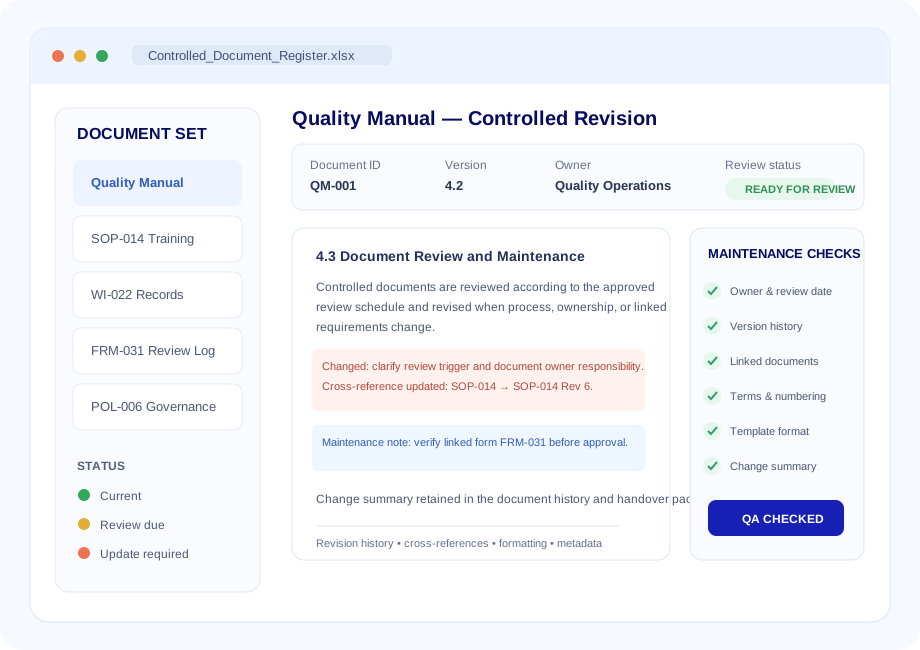
Quality documentation loses value when procedures, forms, owners, equipment references, or document-control details change without a corresponding update. This monthly scope is for a small approved document library that needs an orderly maintenance rhythm and visible revision history.
Ideal for teams with an established quality-document set that needs routine controlled updates rather than continuous new-document development.
Buy Service NowSmall documentation gaps can accumulate across a controlled set. Maintenance focuses on keeping the content, control information, and linked-document relationships coherent as the underlying process changes.
Multiple copies or inconsistent revision labels make it difficult to know which document is current.
Documents remain in use even though a scheduled review or known process change requires attention.
Linked SOPs, forms, appendices, section numbers, or document IDs no longer match the maintained set.
Revision tables and change summaries do not clearly explain what changed or why a new version exists.
Headings, headers, footers, numbering, metadata fields, and tables vary across related documents.
Document owner, approver, effective status, or obsolete/superseded state needs confirmation before release.
A complete maintenance cycle can be scoped around the parts of your controlled-document system that actually need attention, from inventory review and targeted revisions through quality checks and handover.
Revise affected sections while preserving usable content and the document's existing purpose.
Check obvious dependencies between SOPs, forms, appendices, references, and related document IDs.
Align revision tables, metadata, numbering, headers, footers, and template elements to supplied conventions.
Prepare a clear package for your designated owner and approver to review, decide, and authorize.
The service is more than surface-level proofreading. It connects content changes with document-control details so the revised file and its maintenance history remain understandable together.
Version field: v4.1 in header, v4.0 in revision table.
Reference: “See SOP-014 Rev 4” although the linked SOP has moved to a later revision.
Responsibility: “Quality team reviews documents periodically” — owner and trigger are unclear.
Formatting: section numbering differs from the current template.
Revision note: Confirm the current document owner and review trigger before final approval.
Cross-reference check: Validate the linked SOP ID and current revision against the supplied document register.
Template alignment: Update heading levels, revision table, and metadata fields to the current template.
Change summary: Record the sections revised and the reason supplied for the change.
Consistent version: header, footer, file name, and revision table use the same revision identifier.
Updated references: linked document IDs and section callouts are aligned to the supplied register.
Clear maintenance trail: change summary and review notes explain what was updated.
Quality documentation maintenance looks at the controlled document as part of a managed set. Language and formatting matter, but so do version details, linked references, change history, ownership cues, and handover clarity.
| Support Dimension | Proofreading | Formatting / Template Support | Full Quality Documentation Maintenance |
|---|---|---|---|
| Grammar, spelling & readability checks | ✓ | Limited | ✓ |
| Template, headings, numbering & layout consistency | × | ✓ | ✓ |
| Targeted content updates based on supplied change requirements | × | × | ✓ |
| Version history & revision-table maintenance | × | Limited | ✓ |
| Linked document / form / appendix cross-reference checks | × | × | ✓ |
| Metadata, owner, status & review-field consistency | × | Limited | ✓ |
| Change summary and owner-query notes | × | × | ✓ |
| Flagging likely obsolete, duplicate, or conflicting items for confirmation | × | × | ✓ |
| Clean review-ready document set and maintenance tracker | × | Partial | ✓ |
Formal approval, authorization, effective-date decisions, and document retirement remain with your designated owners and approvers.
Scope can cover one document or a connected set. The starting point is your current files, templates, control rules, and the changes that need to be reflected.
Maintain policy-level structure, document-control fields, references, section alignment, and revision history.
Update process steps, roles, control statements, references, forms, and document history based on supplied changes.
Maintain step clarity, sequence, screenshots or callouts supplied by you, role references, and linked procedures.
Align field labels, document IDs, revision details, instructions, and layout with the maintained procedure set.
Maintain responsibilities, terminology, linked standards or internal references, ownership fields, and revision notes.
Update controlled fields, status columns, references, review information, and consistency with related documents.
Maintain headings, identifiers, completion instructions, data fields, and linkages to the governing document.
Coordinate updates across related documents, attachments, appendices, tables, and supporting material.
A staged workflow keeps change requirements, document revisions, quality checks, and unresolved owner questions visible before the maintained set is handed back for internal approval.
Current documents, templates, known changes, linked files, and priorities.
Assess document set, maintenance depth, dependencies, and open questions.
Map documents, sequence, owners, review fields, and affected references.
Update affected content, forms, metadata, numbering, and revision notes.
Review linked IDs, forms, appendices, terminology, and internal references.
Check clarity, consistency, template alignment, and change completeness.
Flag items that require confirmation, approval, or internal decision.
Deliver maintained files, clean versions, change summary, and tracker as scoped.
A clear input pack helps separate confirmed changes from items that need owner judgment. Deliverables are then matched to the agreed maintenance depth rather than filled with unsupported assumptions.
Maintenance is checked in layers so document changes are not treated as isolated edits. The review combines content consistency with document-control and presentation checks.
Document purpose, section order, headings, and required control fields.
Terminology, role names, instructions, wording, and repeated content.
Linked documents, forms, appendices, IDs, section callouts, and references.
Revision table, version fields, owner/status details, dates, and identifiers as supplied.
Headings, tables, numbering, headers, footers, spacing, and template consistency.
Clean-file check, change summary, unresolved queries, and handover completeness.
The service can be applied wherever teams maintain structured procedures, instructions, forms, policies, or controlled document sets. Any sector-specific requirements should be supplied with the files.
The monthly starting scope is ₹15,000 for up to 10 controlled documents. Larger libraries, more frequent change cycles, and urgent release requirements are priced after the document set is reviewed.
Best for planned maintenance cycles and non-urgent document updates.
For upcoming review, approval, release, or audit-preparation windows where faster sequencing is needed.
For time-sensitive controlled-document changes, subject to scope and feasibility review.
Pricing is proposed after reviewing the actual maintenance workload. The quote can take into account:
Contentxprtz quality documentation maintenance starts from ₹15,000 per month for up to 10 controlled documents. Final monthly pricing depends on library size, update frequency, document complexity, linked forms and records, change volume, and service-level needs.
Practical answers about scope, document types, version control, templates, approvals, cross-references, deliverables, pricing, and confidential handling.
The service can include document inventory review, controlled revisions, version-history updates, cross-reference checks, metadata and numbering consistency, template alignment, change summaries, and preparation of a review-ready document set based on the files and requirements you provide.
Common document types include quality manuals, SOPs, policies, procedures, work instructions, forms, templates, checklists, registers, controlled logs, and related support documents.
Yes. Where the existing SOP remains usable, maintenance can focus on the sections affected by a process, ownership, terminology, formatting, or reference change while preserving unaffected content.
Version fields, revision tables, change summaries, dates, and related document-control details can be reviewed and updated according to the conventions and requirements you provide.
Yes. The maintenance review can identify and correct obvious inconsistencies in document IDs, linked SOPs, forms, appendices, section references, and related controlled-document references within the supplied set.
Yes. Supply the current template or formatting instructions and the maintained documents can be aligned to that structure, including headings, numbering, tables, headers, footers, and standard metadata fields where applicable.
No. Contentxprtz can prepare and maintain documentation, but formal review, approval, authorization, effective dates, and implementation decisions remain with your designated document owners and approvers.
The review can flag likely duplicates, superseded references, conflicting versions, or documents that appear to require owner confirmation. Final obsolescence decisions should be made by your authorized document owner or control function.
Provide the documents to be maintained, your current templates or document-control rules, known changes, owner or approver information where relevant, linked files, priority items, and any target review or approval date.
Depending on the agreed scope, you can receive revised documents, a clean document set, tracked or highlighted changes where appropriate, a change summary, issue or query notes, and an updated document register or maintenance tracker.
Because this is not a fixed catalogue plan, a custom quote can be based on the number and length of documents, condition of the current files, maintenance depth, linked-document complexity, formatting requirements, number of forms or appendices, and the requested delivery window.
Your documents, instructions, personal details, and internal or unpublished materials should be handled as confidential service information through the designated submission and delivery process.
Share the document set, current condition, known changes, linked files, review priorities, and target timing. The request can then be scoped without inventing requirements that belong to your internal quality or approval process.
Number and type of SOPs, policies, work instructions, forms, templates, manuals, or registers.
Whether the files are current, overdue for review, inconsistent, or already marked with change notes.
Processes, responsibilities, references, terminology, templates, or control fields that need updating.
Related SOPs, forms, appendices, document registers, templates, or owner instructions.
Review, approval, release, or other target dates and the order in which documents should be handled.
Tracked changes, clean copies, change summary, owner-query log, maintenance tracker, or another requested handover format.
Share your contact details and a short description of the document set so the maintenance scope and quote can be reviewed.
Share the current document set and change requirements so the maintenance scope can be reviewed and structured around what actually needs updating.