₹7,500
for up to 4,000 words
Best for a developed quality document whose process content is already owned and approved in principle, but whose language and consistency need refinement.
Buy Service Now
Strengthen SOPs, policies, procedures, work instructions, manuals, quality-system documents, and other controlled documentation with focused editorial support for clarity, structure, terminology, consistency, document-control presentation, and reader usability.
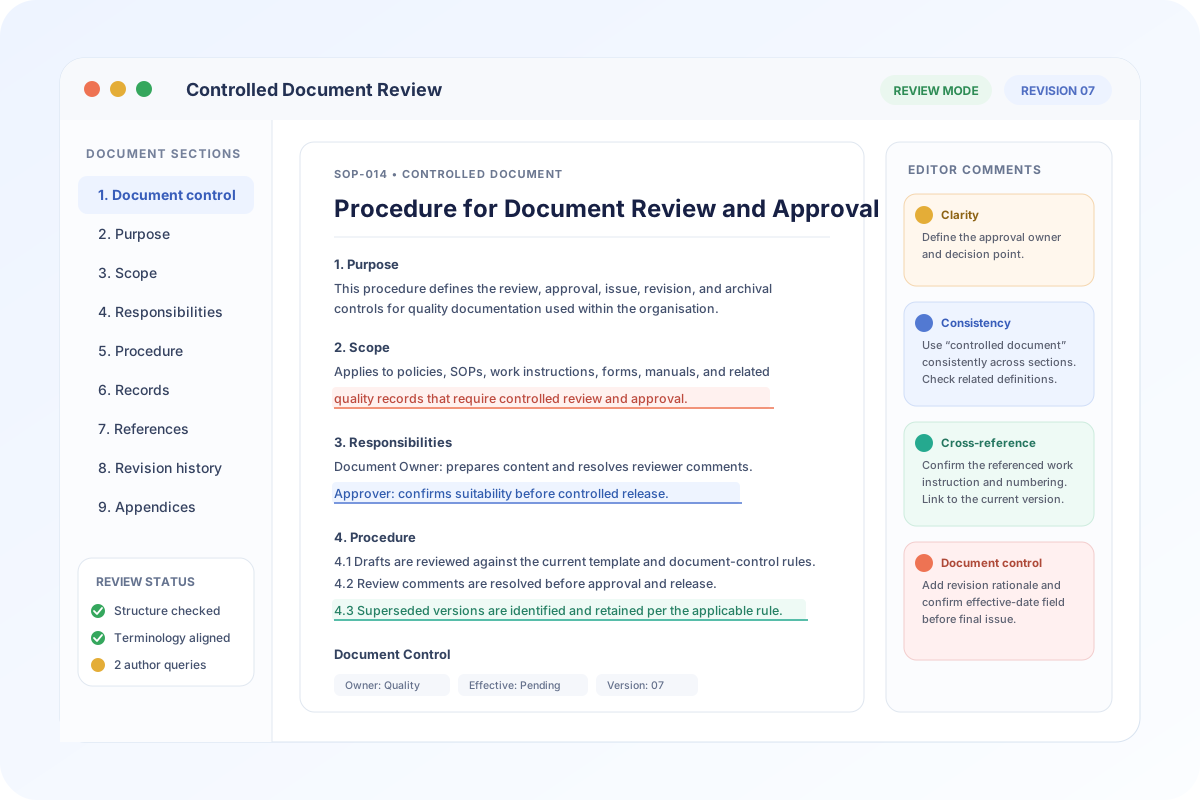
Quality documents must stay usable for the people who perform, review, approve, and audit the process. This starting edit is for an existing SOP, work instruction, policy, form-related procedure, or quality document that needs clearer wording and stronger document control without redesigning the underlying process.
Best for a developed quality document whose process content is already owned and approved in principle, but whose language and consistency need refinement.
Buy Service NowMany documentation problems are not caused by a single typo. They arise when structure, terminology, process logic, roles, references, and document-control information are difficult for reviewers or users to interpret consistently.
The document does not clearly establish what it covers, who it applies to, or where its boundaries sit.
The same role, process, record, system, or action is described in different ways across sections.
Ownership, review, approval, escalation, or execution responsibilities are difficult to distinguish.
Steps are out of sequence, decision points are hidden, or instructions rely on assumptions the reader may not share.
Version, owner, effective date, approval, revision rationale, or status information is unclear or presented inconsistently.
Cross-references, forms, appendices, headings, labels, tables, or numbering are difficult to follow or visibly inconsistent.
The review is shaped around the condition of your draft and the materials you provide. The service can cover the full document or focus on selected sections and high-risk areas.
Editing should make the document easier to follow without silently changing its technical intent. Ambiguities and owner decisions are surfaced through comments rather than guessed.
“The team checks the document and approves it if it is okay. Updated documents should be stored and old versions should not be used.”
Document Owner submits the revised document for review. The designated Approver confirms suitability before controlled release.
When a new revision becomes effective, the controlled location should identify the current approved version and manage superseded copies according to the applicable document-control rule.
The Document Owner submits each revision for review. The designated Approver confirms suitability before the document is released for use.
When a revision becomes effective, the controlled repository identifies the current approved version. Superseded versions are handled in accordance with the applicable document-control requirement.
Quality documentation often needs more than surface correction. The table below shows the typical difference in editorial depth.
| Support Dimension | Formatting Review | Language Proofreading | Quality Documentation Editing |
|---|---|---|---|
| Grammar, spelling & punctuation | Limited | ✓ | ✓ |
| Document structure & hierarchy | Limited | × | ✓ |
| Purpose, scope & reader clarity | × | Limited | ✓ |
| Roles & responsibilities clarity | × | × | ✓ |
| Process logic & instruction flow | × | × | ✓ |
| Terminology consistency | Limited | Limited | ✓ |
| Document-control presentation | Limited | × | ✓ |
| Cross-references, labels & numbering | Limited | Limited | ✓ |
| Tables, forms & appendices consistency | Limited | Limited | ✓ |
| Editor comments for owner action | × | Limited | ✓ |
| Tracked changes & clean final copy | Varies | ✓ | ✓ |
| Reviewer-focused refinement | × | × | ✓ |
The editing approach is adapted to the document purpose, audience, supplied template, and level of intervention required.
Step-based documents that need precise actions, roles, sequencing, and controlled presentation.
High-level documents requiring consistent language, scope, responsibilities, and governance wording.
Operational instructions that benefit from clear steps, decision points, warnings, references, and usable layout.
Multi-section documentation requiring consistent terminology, hierarchy, navigation, and cross-references.
Structured narratives where chronology, issue description, actions, rationale, and readability are important.
Protocols or reports requiring clean structure, consistent labels, tables, references, and presentation.
Response documents that need concise issue framing, clear actions, consistent terminology, and professional presentation.
Supporting documents that need consistent labels, instructions, fields, numbering, and reader-friendly language.
The workflow starts with the purpose of the document and your requirements, then moves through structural, language, consistency, and final quality checks.
Share the document, template, supporting references, deadline, and review priorities.
Assess length, condition, complexity, related files, and required editorial depth.
Match the work to the relevant documentation and subject context where possible.
Check purpose, scope, hierarchy, roles, sequence, duplication, and reader flow.
Improve clarity, grammar, concision, terminology, instructions, and presentation.
Review terms, labels, references, numbering, tables, headings, and document-control fields.
Verify tracked changes, unresolved comments, formatting, and clean-copy readiness.
Provide the agreed edited files and clear owner-action notes where confirmation is still needed.
Good editing depends on context. Providing the applicable template, standards, definitions, supporting references, and reviewer expectations helps the editor distinguish language issues from owner decisions.
The review method separates structural clarity, language quality, consistency, references, and final verification so that visible issues are not treated as isolated corrections.
Check purpose, scope, hierarchy, section order, duplication, and overall reader flow.
Improve sentences, instructions, concision, grammar, and professional tone.
Review consistency of roles, process terms, defined terms, abbreviations, and labels.
Review visible sequencing, cross-references, tables, forms, headings, and numbering.
Review presentation of version, owner, status, revision, approval, and related fields where supplied.
Confirm revision visibility, clean-copy consistency, unresolved queries, and delivery readiness.
Quality documentation appears across many sectors and functions. The service scope should be defined by your document, terminology, standards, and owner requirements rather than by a generic template.
This service does not use an unsupported fixed price or turnaround claim. The final quote and delivery commitment depend on the actual document set and confirmed editorial scope.
Availability depends on document length, complexity, editing depth, related files, and the requested delivery window.
Share the document type, approximate length, condition of the draft, relevant template or standard, deadline, and the areas that need the most attention. The scope can then be assessed before a quote is confirmed.
Get a Custom QuoteAnswers to common questions about scope, document types, technical meaning, deliverables, turnaround, pricing, and confidentiality.
It is an editorial service for documents that need clearer language, stronger structure, consistent terminology, usable instructions, and cleaner presentation while preserving the document owner’s intended meaning and technical content.
The service can be used for SOPs, policies, procedures, work instructions, manuals, quality-system documents, forms, audit responses, CAPA or deviation narratives, validation documents, training materials, and related controlled documentation.
No. Proofreading mainly corrects final-stage grammar, spelling, punctuation, and typographical issues. Quality documentation editing can also improve structure, process clarity, terminology consistency, roles and responsibilities, cross-references, and document-control presentation within the agreed scope.
The editing approach is intended to preserve the owner’s technical meaning, process intent, decisions, and requirements. Where a change could affect meaning or needs subject-matter confirmation, it should be raised as an editor comment rather than silently rewritten.
Yes. Provide the applicable template, style guide, terminology list, numbering convention, document-control rules, or other instructions. The edit can then be aligned to the supplied requirements within the agreed scope.
The editing workflow is designed to provide a tracked-changes version so revisions can be reviewed, together with a clean edited copy for easier reading and final owner review.
Yes. Where required, the service can flag unclear sequencing, duplicated sections, inconsistent headings, missing transitions, or structural issues that make the document difficult to follow. Material changes that affect process intent should remain subject to owner approval.
These elements can be reviewed for visible consistency and presentation within the supplied document set. Source-system accuracy, regulatory interpretation, and technical validation remain the responsibility of the document owner or designated subject-matter reviewer.
Yes. The service can improve clarity, consistency, structure, and presentation of documents prepared for internal review, audit responses, customer review, management review, or similar assessment contexts without making unsupported compliance claims.
Turnaround depends on document length, complexity, editing depth, number of related files, formatting or cross-reference requirements, and your deadline. Share the required delivery date and time zone so feasibility can be assessed before work begins.
A custom quote is based on factors such as word count or page count, condition of the draft, editing depth, number of files, formatting and cross-reference needs, and the required delivery window.
Use the designated service submission process and share only the files needed for the agreed work. If you have specific confidentiality, access, retention, or NDA requirements, include them with your enquiry so they can be considered before the project is confirmed.
Share enough context to assess the document condition, editorial depth, supporting files, deadline feasibility, and the areas that need focused review.
Tell us whether you have an SOP, policy, work instruction, manual, report, response, protocol, or another controlled document.
Explain who uses or reviews the document and what the document is intended to achieve.
Provide the applicable template, style guide, terminology list, document-control rules, or other required instructions.
List the forms, appendices, related procedures, standards, or supporting documents that matter to the edit.
Provide your required date and time zone so turnaround feasibility can be assessed.
Highlight clarity, structure, roles, process logic, terminology, cross-references, document control, or formatting concerns.
Complete the form below so the document and requested scope can be reviewed before a quote or delivery commitment is confirmed.
Share your draft, template requirements, review priorities, and deadline so the editing scope can be assessed and a clear next step can be proposed.