₹25,000
for a defined writing project
Suitable for one defined regulatory document or substantial section set that can be developed from supplied source information and client-approved positions.
Buy Service Now
Turn source requirements, process knowledge, existing drafts, and reviewer input into a logically structured regulatory document with clearer ownership, control language, traceability, evidence references, version presentation, and review notes—within a scope defined before work begins.
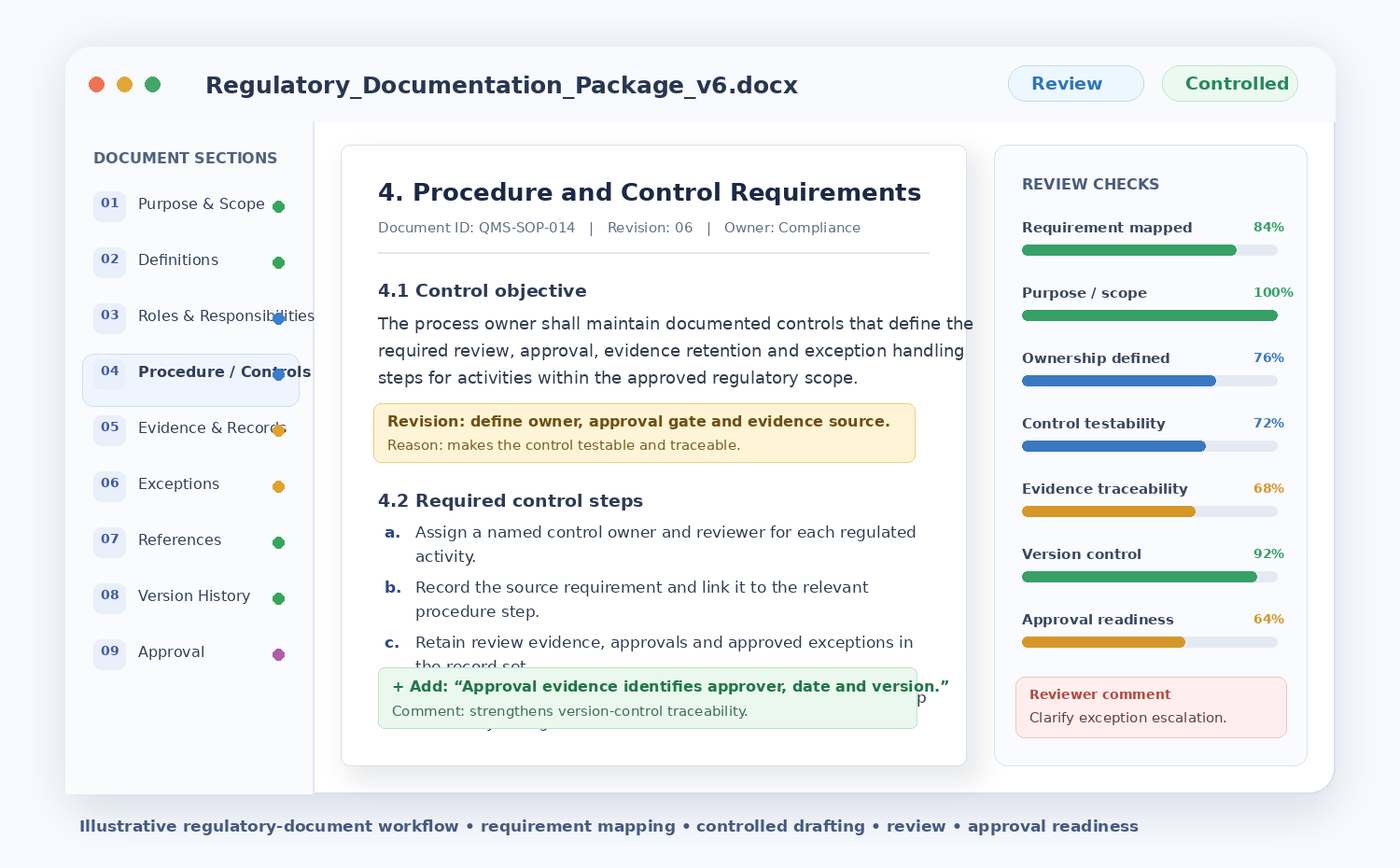
Work is defined against the document, sources, and review objective.
Initial enquiries can stay minimal; transfer needs are agreed during scoping.
Comments distinguish editorial improvements from decisions needing specialist input.
The quote confirms the exact output set, review depth, and delivery plan.
Regulatory writing should be scoped to the actual source pack and required document, not sold as generic per-word copy. This minimum is intended for a bounded assignment where the client can provide the facts, approved evidence, templates, and decisions needed to develop a controlled draft.
Suitable for one defined regulatory document or substantial section set that can be developed from supplied source information and client-approved positions.
Buy Service NowRegulatory and controlled documents often slow down in review when the document is difficult to interpret, trace, own, or evidence. These are common documentation gaps—not a prediction of regulatory outcomes.
The document does not clearly state what is controlled, what is excluded, or which objective it supports.
Source obligations are not visibly linked to the sections, controls, records, or decisions that address them.
Roles use broad terms such as “team” or “management” without enough accountability, review, or approval context.
Control steps are described but the expected record, evidence source, retention point, or follow-up is unclear.
Definitions, document references, ownership names, version fields, or related links do not align across the package.
Open decisions, escalation triggers, approver roles, or unresolved reviewer comments are not easy to identify.
The work can begin with source material, an existing draft, or a defined documentation brief. The exact pathway depends on whether you need new drafting, restructuring, reviewer-focused refinement, or a controlled final presentation.
A strong regulatory document makes the obligation, owner, action, evidence, exception path, and approval structure easier to follow. This illustrative example shows the type of documentation refinement the service can perform.
“High-risk exceptions should be reviewed before use. Teams need to keep evidence and escalate issues when required.”
“The designated control owner must review each high-risk exception before approval. The decision and supporting evidence must be recorded in the agreed system of record. Exceptions meeting the defined escalation criteria must be referred to the designated approver.”
The final controlled wording is presented after the client or qualified reviewer resolves open decisions and confirms the applicable requirement, owner, evidence source, escalation criteria, and approval path.
Illustrative example only. Final wording must be validated against the client’s actual legal, regulatory, technical, quality, compliance, and governance requirements.
Proofreading and language editing can improve correctness and readability. Full regulatory documentation support works at the document-architecture level as well, using the supplied requirements and process context to improve traceability, ownership, controls, evidence references, review logic, and controlled presentation.
| Support Dimension | Proofreading | Language Editing | Regulatory Documentation Writing Support |
|---|---|---|---|
| Requirement mapping & traceability | — | — | ✓ Included when scoped |
| Document purpose, scope & architecture | — | Limited wording | ✓ Included |
| Roles, ownership & approval language | — | Clarity only | ✓ Structured support |
| Control, evidence & record alignment | — | — | ✓ Included when sources exist |
| Grammar, clarity & consistency | ✓ Final-stage | ✓ In-depth | ✓ Integrated |
| Definitions, terminology & cross-references | Basic consistency | ✓ Language consistency | ✓ Document-level consistency |
| Reviewer-focused comments & action points | — | Language queries | ✓ Included when needed |
| Version, appendices & controlled presentation | Formatting check | Presentation check | ✓ Structured support |
| Best for | Final correctness check | Language polish | End-to-end documentation development or major regulatory-document refinement |
Examples include the following document categories when the required source material and subject-matter context are available. Suitability is confirmed during scoping.
The workflow is designed to keep source requirements, writing decisions, reviewer comments, and final deliverables traceable from scoping through delivery.
Share the objective, current material, and governing inputs.
Confirm document condition, expected outputs, and review boundaries.
Organise supplied obligations, references, and traceability needs.
Build or refine section hierarchy, roles, controls, and evidence logic.
Write or restructure the controlled document within the agreed scope.
Surface open decisions and incorporate confirmed subject-matter input.
Review terminology, references, version fields, evidence, and formatting.
Provide the agreed clean, annotated, and supporting documentation outputs.
A precise brief reduces avoidable rework. The output package is then matched to the agreed document objective, source set, and review depth.
What You Share
What You Receive
A multi-stage documentation review checks structure, readability, traceability, internal consistency, references, and final presentation before the agreed files are delivered.
Purpose, scope, hierarchy, and document flow.
Conciseness, terminology, instructions, and readability.
Connections between supplied obligations and document content.
Ownership, action, records, evidence, and exception logic.
Cross-links, definitions, version fields, and presentation consistency.
Agreed changes, clean copy, comments, and delivery set.
Important: this quality review is documentation-focused. Final compliance interpretation, legal or regulatory advice, technical validation, approval, submission, and sign-off remain with the client and its appropriately qualified reviewers.
Structured regulatory documentation is used across many sectors. Exact suitability depends on the document, governing sources, and the subject-matter expertise available from your organisation.
Common Documentation Contexts
These are examples, not claims of certification or specialist regulatory authority. The service scope is confirmed against the source materials and review needs you provide.
Confidentiality & File Handling
This service does not use a published flat price or fixed delivery promise. Scope, source readiness, document complexity, review depth, and deadline feasibility are assessed first.
Turnaround Options
No timeline should be treated as confirmed until the document, source set, review expectations, and target milestone have been assessed.
Custom Quote
A quote is intended to make scope, deliverables, and delivery expectations explicit before work starts.
Answers to common questions about scope, drafting from source material, requirement mapping, controlled documents, confidentiality, pricing, turnaround, deliverables, and final compliance responsibility.
The service can support document planning, requirement-to-section mapping, drafting or restructuring, role and control wording, evidence and record references, terminology consistency, review comments, version presentation, and a clean review copy. The exact deliverables are confirmed during scoping.
Yes. When you provide the governing requirements, existing material, process context, templates, and subject-matter input, the service can help turn those sources into a structured draft. Missing policy, legal, technical, or regulatory decisions are flagged for your qualified reviewers rather than invented.
Yes. Existing documents can be reviewed for structure, clarity, internal consistency, ownership language, requirement traceability, evidence references, version presentation, and reviewer action points within the agreed scope.
Yes, where the source requirements are supplied. The documentation workflow can create or refine traceability between requirements, sections, controls, responsibilities, evidence, records, and related references. Final interpretation and compliance validation remain with your designated qualified reviewers.
No. This is a documentation writing and editorial support service, not legal, regulatory, certification, or compliance sign-off. Final interpretation, validation, approval, submission, and accountability remain with the client and the appropriately qualified legal, regulatory, technical, quality, or compliance reviewers.
Useful inputs include the document objective, applicable requirements or standards, current drafts, process maps, control descriptions, roles and owners, evidence or record locations, internal templates, terminology lists, reviewer comments, and the target review or submission milestone.
Yes, when the applicable template, instructions, or source requirements are supplied and the requested work is within the confirmed scope. The service can structure and present the document against those materials without replacing specialist interpretation or formal approval.
Editable text documents are generally the most practical for drafting and tracked revisions. Supporting material may also include spreadsheets, PDFs, process notes, reference lists, or other source files. The preferred working format and transfer method can be confirmed during scoping.
The initial enquiry should contain only the information needed to understand the request. For work that proceeds, document handling and access can be limited to the assigned workflow, and an appropriate file-transfer approach can be agreed for sensitive or unpublished material.
There is no flat price or fixed turnaround published for this service. A quote and delivery plan are based on document length, starting condition, document type, number and complexity of source requirements, traceability depth, tables or appendices, formatting needs, review rounds, and deadline feasibility.
Priority or urgent requests can be assessed, but feasibility depends on document size, complexity, source readiness, required review depth, and available reviewer time. A delivery commitment should only be made after the brief and source materials have been reviewed.
Deliverables depend on the agreed scope and may include an annotated or tracked draft, a clean review copy, requirement or traceability notes, reviewer comments and action points, structural recommendations, and reference, formatting, or version-consistency checks. The confirmed quote should state the exact output set.
Share the document type, current stage, source requirements, review objective, approximate size, target milestone, and the areas that need support. Avoid sending sensitive document content through this initial form.
Identify the document type, audience, intended use, and current stage.
Describe the standards, obligations, internal controls, or reference material available.
Share the review, approval, audit, inspection, or submission date if one exists.
State whether you need new drafting, restructuring, review comments, traceability, or final presentation support.
Do not paste confidential content here. Flag the sensitivity so a transfer approach can be discussed.
Note any unresolved ownership, control, evidence, terminology, or approval questions.
Provide enough information to assess the service scope and contact you about the next step. Do not include confidential document text or restricted attachments in this initial enquiry.
Share your objective, current document stage, source requirements, and review milestone. We will use those details to scope the writing and documentation support you actually need.