₹15,000
for one document package up to 5,000 words
Best for a mature regulatory document package that has already been drafted and needs a structured quality gate rather than substantive authoring.
Buy Service Now
Strengthen policies, procedures, control narratives, compliance documents, governance papers, and response drafts with a structured review of clarity, completeness, internal consistency, evidence links, cross-references, approvals, version control, and final presentation.
Scope note: This service is for documentation quality review. It does not provide legal advice, independently determine regulatory obligations, certify compliance, or guarantee approval or acceptance.
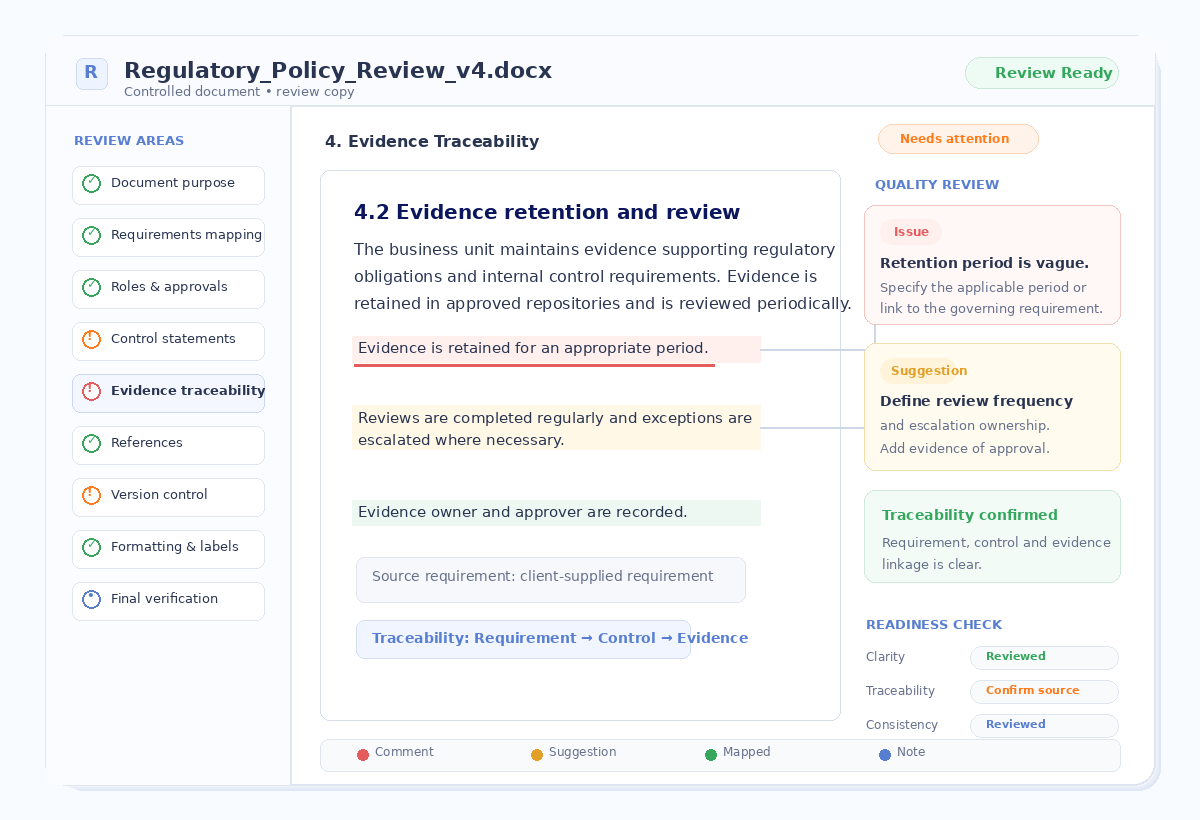
Quality review focuses on the document as a controlled deliverable: completeness, consistency, traceability, presentation, and visible review risks. The starting scope is for a developed package that needs an independent QC pass before it moves to the responsible approval or submission team.
Best for a mature regulatory document package that has already been drafted and needs a structured quality gate rather than substantive authoring.
Buy Service NowReview content hierarchy, clarity, completeness, and internal logic.
Client documents are treated as confidential service material.
Check linkages using the source requirements and evidence you provide.
Comments, action points, and clean reviewed content where agreed.
Common documentation-quality issues can create repeated clarification, internal challenge, avoidable review cycles, and uncertainty about what the document requires or evidences.
The document does not make its objective, audience, applicability, or boundaries easy to understand.
Statements are not clearly connected to the client-supplied requirement, source, control, or evidence they are intended to address.
Accountabilities, review responsibilities, approvals, or escalation points are incomplete or open to interpretation.
Important claims, controls, or process steps are not supported by referenced evidence, records, or source material.
Terminology, definitions, cross-references, section logic, or repeated statements do not align across the document.
Versioning, change history, ownership, approvals, dates, labels, or appendices are incomplete or difficult to follow.
A complete quality review can move from document purpose and source requirements through process clarity, traceability, evidence, approvals, document control, and final readiness.
The exact review depth is agreed for your document. Where regulatory, policy, supervisory, contractual, or internal-standard alignment is required, provide the governing source material so the review can check documentation traceability rather than infer obligations.
Check that the document purpose and intended use are clear.
Review context, rationale, and supporting explanation for completeness.
Map content to client-supplied requirements, standards, or source instructions where applicable.
Clarify who, what, where, and when the document applies.
Review responsibilities, ownership, approvals, and escalation points.
Check sequence, hand-offs, dependencies, and decision points for clarity.
Review control wording for clear action, ownership, evidence, and frequency where supplied.
Check whether source requirements, controls, records, and evidence are logically linked.
Review how exceptions, deviations, risks, and follow-up actions are described.
Harmonize defined terms, abbreviations, capitalization, and key terminology.
Check internal links, section references, supporting documents, and citations for consistency.
Review labels, captions, forms, schedules, and appendices for clear use and alignment.
Check version labels, change summaries, effective dates, and document-control fields.
Review approval fields, review status, ownership, and sign-off presentation.
Perform a final clarity, consistency, formatting, and completeness check before handoff.
The review turns vague or difficult-to-evidence wording into clearer documentation, while preserving the author’s intended business meaning and flagging decisions that still need owner confirmation.
“The business will keep records for an appropriate period. Reviews will happen regularly and any exceptions will be escalated when needed.”
“Appropriate period” needs the applicable period or a link to the client-supplied governing requirement.
Define review frequency, accountable role, exception threshold, and escalation route.
Link the requirement → control statement → evidence record → approval or review evidence.
“Records are retained for the period specified in the applicable source requirement. The designated owner reviews the records at the documented frequency. Exceptions are recorded, supported by evidence, and escalated to the named approver in accordance with the documented process.”
Regulatory documentation quality review looks beyond surface presentation. It checks whether the document is understandable, internally coherent, well controlled, and traceable to the source material supplied for review.
| Review Dimension | Formatting Review Layout & presentation |
Language Editing Grammar, clarity & style |
Regulatory Documentation Quality Review End-to-end documentation quality |
|---|---|---|---|
| Page layout, headings & presentation consistency | ✓ | Limited | ✓ |
| Grammar, readability & clear wording | × | ✓ | ✓ |
| Document purpose, scope & completeness | × | × | ✓ |
| Roles, ownership, approvals & escalation clarity | × | × | ✓ |
| Requirement, control & evidence traceability | × | × | ✓ |
| Cross-references, terminology & internal consistency | Limited | Limited | ✓ |
| Version control, change history & document-control fields | Limited | × | ✓ |
| Best for | Presentation consistency | Language polish | Complete documentation-quality review |
Important: Quality review can check documentation against requirements and source material you provide, but it does not replace legal counsel, compliance ownership, regulatory interpretation, or formal organizational approval.
The service can be scoped to a range of policy, procedure, control, compliance, governance, and response documents where quality, consistency, traceability, and review readiness matter.
A staged review keeps the document, source requirements, quality issues, review notes, and final delivery aligned from intake through final verification.
Share the latest draft plus relevant source requirements, templates, and supporting material.
Confirm the document purpose, review depth, priority areas, and expected deliverables.
Route the work to a reviewer suited to the document type and quality-review requirement.
Review organization, missing elements, section purpose, and logical flow.
Check links between supplied requirements, statements, controls, references, and evidence.
Refine wording, terminology, cross-references, and presentation while preserving intended meaning.
Review versioning, approvals, labels, references, formatting, and requested document-control fields.
Provide the reviewed copy and agreed review notes or supporting outputs.
The quality of the review depends on the quality of the source material. Supplying the latest draft, relevant requirements, evidence, templates, and deadlines helps keep observations grounded and actionable.
A multi-stage review helps separate structural quality, wording clarity, traceability, consistency, document control, and final verification instead of treating the document as a single proofreading pass.
Check hierarchy, sequence, section purpose, and overall coherence.
Improve readability, precision, and unambiguous wording without changing intended meaning.
Check alignment to the source requirements and evidence supplied for review.
Review terminology, roles, statements, tables, labels, and cross-document consistency.
Check references, version fields, approvals, appendices, numbering, and formatting.
Perform a final pass for completeness, review-note closure, and delivery readiness.
The review combines multiple documentation-quality dimensions while treating client documents and related information as confidential service material throughout the submission and delivery workflow.
Contentxprtz regulatory documentation quality review starts from ₹15,000 for one document package up to 5,000 words. Final price and delivery depend on package size, review depth, source-material volume, tables and appendices, and deadline.
Delivery timing is confirmed after the review requirements and supporting material are assessed.
A quote can be prepared around the actual work required rather than a generic package.
Practical answers about scope, source requirements, outputs, timing, and confidentiality.
The review focuses on document quality: structure, completeness, clarity, consistency, roles, cross-references, document-control fields, and—when source material is supplied—traceability between requirements, statements, controls, evidence, and supporting references. The confirmed scope depends on the document and materials you provide.
No. This is a documentation quality-review service. It does not provide legal advice, interpret law on your behalf, certify regulatory compliance, or guarantee acceptance by a regulator, auditor, reviewer, or governing body.
Yes, when you want the review to check alignment or traceability against specific obligations, standards, guidance, internal policies, or reviewer instructions. The quality review is grounded in the source material you provide.
Examples include policies, standards, procedures, control narratives, compliance manuals, governance papers, regulatory or supervisory response drafts, audit or inspection response packs, and records or evidence schedules. Suitability is confirmed during scope review.
Yes. The service can review whether sections are logically organized, whether responsibilities and process steps are clear, and whether the document is internally consistent, in addition to sentence-level clarity and presentation.
Yes, when the relevant requirements, controls, evidence references, or source documents are supplied and traceability is included in the agreed scope. The review can flag missing, unclear, or inconsistent linkages for author follow-up.
Where the document format supports it and the agreed review approach calls for annotation, the reviewed copy can show tracked changes or comments so you can see proposed wording changes, quality issues, and author-action points.
Delivery timing depends on document length, complexity, review depth, the number of source requirements or supporting files, the amount of traceability work required, and your deadline. Timing is confirmed after the material is reviewed for scope.
A custom quote can reflect document length or page count, review depth, document complexity, source-requirement mapping, evidence or cross-reference checks, supporting files and tables, and deadline requirements. Contentxprtz regulatory documentation quality review starts from ₹15,000 for one document package up to 5,000 words. Final price and delivery depend on package size, review depth, source-material volume, tables and appendices, and deadline.
Client documents and related information are treated as confidential service material and should be exchanged through the designated submission and delivery process. The service follows the controlled handling approach used for Contentxprtz client documents.
Share enough context for the document to be assessed for scope, supporting material, review depth, deadline feasibility, and the most useful review outputs.
Tell us what the document is, who will use or review it, and what stage it is at.
Identify the regulatory, policy, internal-standard, template, or reviewer instructions you want checked.
Highlight clarity, completeness, traceability, roles, controls, evidence, approvals, references, or document control.
Share your required date, time zone, milestone, and preferred review outputs.
Use the form below to describe your document, review objective, supporting requirements, and deadline.
Share your document context, source requirements, review priorities, and deadline so the scope can focus on the quality issues that matter most.