Structured Maintenance
Updates are organised around the supplied document set and requested changes.

Keep policies, procedures, standards, control descriptions and supporting compliance records aligned with approved changes, clear ownership and traceable document history. The service focuses on structured updates, version control, cross-reference checks and maintainable documentation.
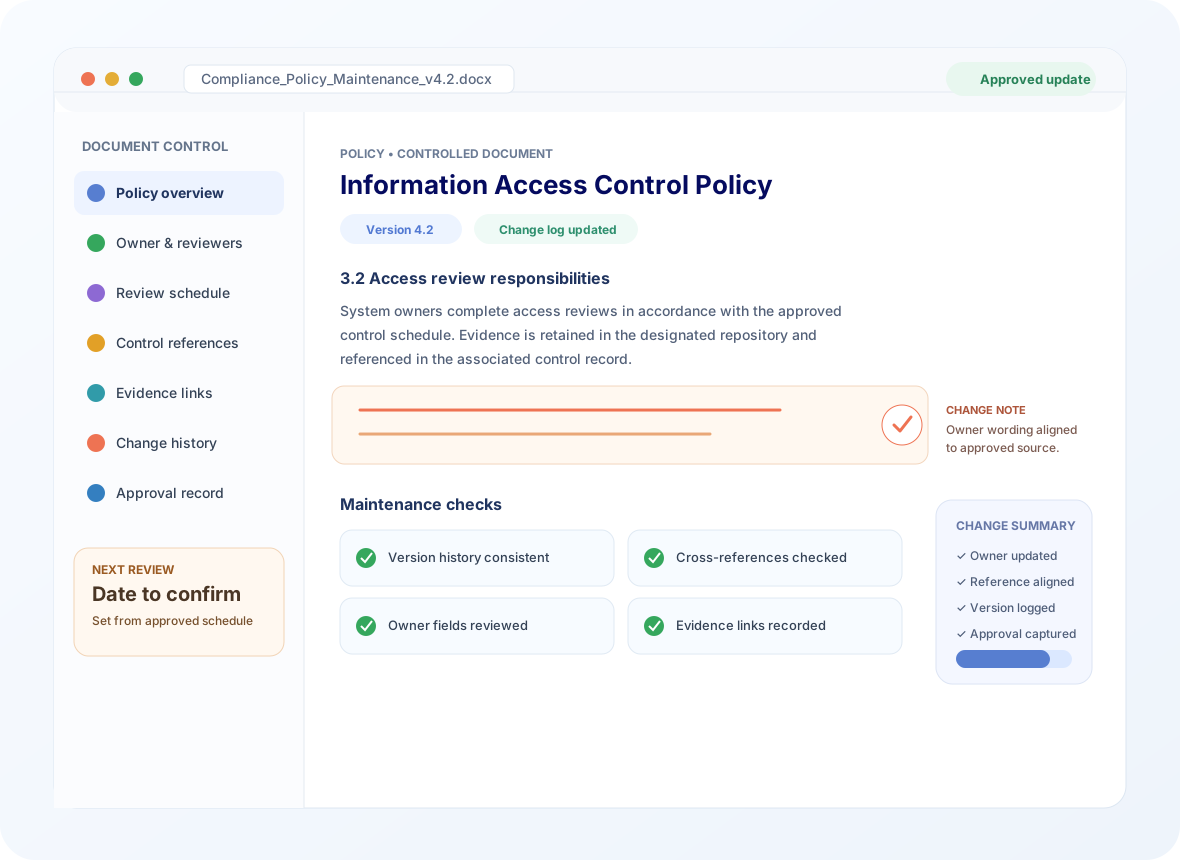
Updates are organised around the supplied document set and requested changes.
Version fields, change summaries and review information can be kept aligned.
Linked terms, references and document relationships can be checked together.
Internal materials should be shared through the designated project channel.
Maintenance is most useful as a recurring service because policies and procedures can drift as processes, owners, forms, and requirements change. The monthly entry scope is designed for a small controlled library that needs scheduled review, version discipline, and documented updates.
Best for teams that already have approved compliance documents and need a dependable monthly maintenance cycle rather than a one-time rewrite.
Buy Service NowCommon documentation weaknesses are often less about the existence of a policy and more about whether its ownership, references, version history, change rationale and linked procedures remain current and internally consistent.
Document owners, reviewers or approval responsibilities are missing, inconsistent or no longer current.
Business, control or requirement changes have not been incorporated into the approved document set.
Working copies, local files and published versions contain different wording or document-control information.
Controls, evidence references, source requirements or related procedures are not linked clearly enough for review.
Terminology, control IDs, section references, document titles or appendices do not match across the pack.
Review dates, approval records, version notes or superseded-document information have not been updated.
The exact maintenance scope depends on your current document set and the change requirements you provide. A complete maintenance pack can span the following controlled-document elements.
From baseline inventory to final versioned delivery, the service can connect document updates with the information needed to keep the pack understandable and maintainable.
Illustrative example: the aim is not to change an organisation's underlying compliance decision, but to make the approved requirement clearer, traceable and easier to maintain in the controlled document.
“Access reviews are completed regularly and evidence is retained. Changes should be approved where required.”
“System owners complete access reviews in accordance with the approved control schedule. Evidence is retained in the designated repository and referenced in the associated control record. Changes to scope or review frequency are documented and approved through the applicable governance process.”
The final wording is consistent with the supplied source requirements, and the document-control fields are updated for the agreed maintenance cycle.
Compliance documentation maintenance extends beyond presentation and grammar by connecting controlled wording with ownership, version history, change traceability, linked references and the wider document pack.
| Support Dimension | Document Formatting Review Structure & presentation | Language Editing Grammar & style improvement | Compliance Documentation Maintenance Controlled document upkeep |
|---|---|---|---|
| Document inventory & scope baseline | × | × | ✓ |
| Owner, reviewer & review-field updates | × | × | ✓ |
| Requirement, control & procedure alignment | × | × | ✓ |
| Version history & change-log maintenance | × | × | ✓ |
| Cross-document terminology & reference checks | △ | △ | ✓ |
| Language clarity & consistency | △ | ✓ | ✓ |
| Formatting, numbering & template consistency | ✓ | △ | ✓ |
| Approval / maintenance notes for the updated pack | × | × | ✓ |
| Preparation for the next maintenance cycle | × | × | ✓ |
| Best for | Presentation consistency | Language polish | Controlled document upkeep |
Document maintenance can be scoped across individual controlled documents or a connected document pack when the source materials and required changes are supplied.
The workflow is designed to keep the current-state baseline, requested changes, references, version information and final deliverables connected through the maintenance cycle.
Current versions, source changes and supporting materials.
Identify documents, dependencies, priorities and maintenance depth.
Assign work according to the document context and agreed scope.
Establish the working version and requested update record.
Update wording, document fields, references and linked sections.
Check controls, terminology, responsibilities and cross-references.
Review numbering, history, citations, links and final formatting.
Deliver maintained working and clean copies with agreed notes.
A stronger maintenance outcome starts with the current controlled documents and the source information that explains what needs to change.
A multi-stage review can be used to check that the maintained document remains coherent, traceable and internally consistent before final delivery.
Check document hierarchy, section order and maintenance scope.
Compare requested changes against the maintained working version.
Review terminology, ownership, control wording and source alignment.
Validate document titles, section links, IDs and related references.
Review numbering, document-control fields, layout and consistency.
Confirm the final pack reflects the agreed maintenance scope.
The service is document-focused. The underlying requirements, interpretations and approvals should come from your authorised sources, while the maintenance work helps keep the supplied documentation clear and consistent.
Compliance documentation often contains internal control, process, governance and operational information. Use the designated submission and delivery process for the materials included in your project.
Contentxprtz compliance documentation maintenance starts from ₹18,000 per month for up to 10 controlled documents. Final monthly pricing depends on library size, update frequency, document complexity, dependencies, change volume, and required response times. Scope, timing and quotation should be confirmed after the document set and requested maintenance work are reviewed.
Maintenance can be structured around the type of change rather than an unsupported fixed turnaround promise.
Existing documents need current-state cleanup and controlled updating.
Defined business, control or requirement changes need incorporation.
A repeat review and update process is required for an agreed document set.
These factors help define the level of maintenance effort without fabricating a fixed package price.
Answers to common questions about scope, document types, versions, legal boundaries, pricing, timing and information needed for compliance documentation maintenance.
The service supports structured upkeep of compliance documents such as policies, procedures, standards, control descriptions, registers, governance documents, and related templates. The exact scope is agreed from the documents and change requirements you provide.
Typical document sets can include policies, procedures, standards, SOPs and work instructions, control descriptions, compliance registers, governance frameworks, checklists, and supporting templates where those materials are supplied for review.
Yes. Where the existing document remains suitable as a baseline, the maintenance work can focus on defined updates, consistency corrections, cross-reference changes, version information, and clearer wording rather than a full redevelopment.
Yes, when the linked documents are supplied within the agreed scope. Cross-document review can help identify inconsistent terminology, outdated references, conflicting ownership details, or links that need updating.
Maintenance can include version metadata, a structured change summary, updated review information, and clearly recorded author or owner actions where those elements form part of your document template or governance process.
Yes, where the approved control wording, control identifiers, evidence references, or source requirements are supplied. The service can improve clarity and consistency while preserving the underlying control intent provided by your organisation.
Share the current document set, the required changes or source material, document owner and reviewer details, linked control or procedure references, your template or formatting rules, and any target review or approval milestone.
No. This is a documentation maintenance service. It can structure and update materials against the requirements and source information you provide, but it does not replace legal, regulatory, compliance, or professional advice and does not certify that an organisation is compliant.
The work can be scoped around a defined refresh or a repeat maintenance cycle where requested. The cadence, document set, responsibilities, and review checkpoints should be agreed before recurring work begins.
Contentxprtz compliance documentation maintenance starts from ₹18,000 per month for up to 10 controlled documents. Final monthly pricing depends on library size, update frequency, document complexity, dependencies, change volume, and required response times. A quote can be prepared after reviewing the number and condition of documents, update depth, cross-document dependencies, formatting requirements, and review or approval needs.
No standard turnaround has been supplied for this service. Delivery timing should be confirmed after the document set, required updates, review dependencies, and target milestone have been assessed.
Yes, when the template or current approved format is provided. Maintenance can preserve the established document structure while updating headings, numbering, version fields, references, and other controlled-document elements within scope.
Compliance documents and related internal information should be treated as confidential service material and handled through the designated submission and delivery process. Share sensitive files only through the approved project channel provided for the engagement.
No. The service supports the quality, clarity, traceability, and maintenance of documentation. Regulatory interpretation, legal conclusions, control effectiveness, audit outcomes, and formal compliance decisions remain the responsibility of the relevant organisation and its authorised advisers or control owners.
Share the document types, current versions, required changes, linked references, review milestone and any formatting or document-control requirements so the scope can be assessed accurately.
List the policies, procedures, standards, controls, registers or templates that need maintenance.
Explain what has changed and provide the source material or approved change request where available.
Identify related procedures, control IDs, evidence references, appendices or documents that should be checked together.
Share the target review, approval or delivery date so timing can be assessed without assuming a standard turnaround.
Provide enough information to assess document volume, maintenance depth, dependencies and delivery requirements.
Share your current document set and the changes that need to be reflected. The scope can then be reviewed for a structured, traceable maintenance plan.