Book-Specific Review
Support organised around the whole manuscript

Develop a clearer book concept, stronger chapter architecture, more consistent academic writing, and a manuscript that reads as one coherent work. Support is shaped around your existing material—whether you are starting from an outline, research notes, partial chapters, or a developed draft—while keeping your ideas and final decisions under your control.
Support organised around the whole manuscript
Work defined before project start
Changes and author queries are visible
Terminology handled in context
Unpublished work stays within project scope
Manuscript prepared for author review
Long-form scholarly writing is priced around the amount of author-approved material that must be developed, the research synthesis required, and the degree of chapter architecture involved. The starting engagement below is a real writing deliverable, not a consultation-only fee.
Best suited for: Authors with an outline, research notes, partial text, or source pack who need one academic-book section developed into coherent scholarly prose.
Scope & inclusions
Academic books often become difficult to manage when strong ideas are spread across notes, chapters, source files, and multiple revisions. The service focuses on the structural and writing problems that keep a long-form manuscript from reading as one coherent scholarly work.
Chapter order or purpose does not support the book-level argument.
Useful material exists but has not yet become a connected manuscript.
Tone, terminology, and level of explanation vary between chapters.
Readers cannot easily see how one chapter leads to the next.
Citations appear without enough connection to the surrounding argument.
Concepts recur or expand beyond the purpose established for the book.
The early draft talks about several ideas in different places introduces the concepts without yet establishing their relationship. The chapter therefore needs a clearer organising principle before the evidence is expanded.
A stronger sequence is to define the framework first, synthesise the competing views second, and then explain how the book's own interpretation develops from that comparison.
This creates a clearer bridge to the next chapter while preserving the author's terminology and the limits of the evidence provided.
The exact mix depends on the material you already have and the role you want support to play. The areas below show the kinds of book-level and chapter-level work that can be brought into an agreed project scope.
Clarify the book's purpose, intended audience, central contribution, boundaries, and the role of each major section.
Develop chapter order, internal headings, section purpose, balance, and links between the manuscript's major parts.
Improve how the supplied scholarship, evidence, and competing views are introduced, compared, and connected to the author's own argument.
Turn author-approved outlines, research notes, and partial text into clearer chapter prose within the agreed writing depth.
Strengthen the progression of ideas within chapters and ensure the book's larger line of reasoning remains visible across sections.
Refine scholarly expression so complex material remains precise, readable, appropriately qualified, and suited to the intended audience.
Align recurring concepts, definitions, capitalization, abbreviations, labels, and discipline-specific terms throughout the manuscript.
Review citation and reference presentation for consistency using the style guidance and source material supplied for the project.
Improve wording, labels, callouts, caption consistency, and connections between visual material and the surrounding chapter text.
Flag decisions that require author judgment, missing explanation, source confirmation, scope choices, or clarification before final wording is settled.
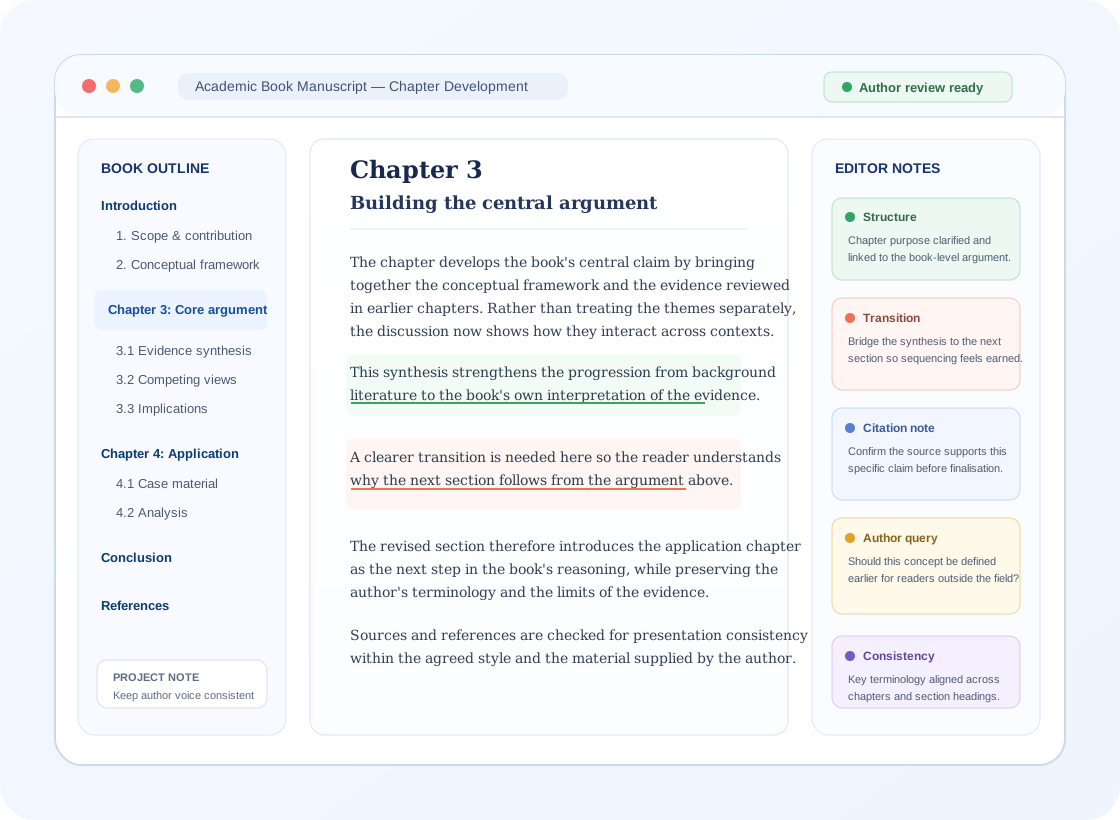
Book writing support goes beyond correcting individual sentences. The example below shows how structure, transition, terminology, citation presentation, and author decisions can be surfaced together during manuscript development.
The same passage can move through three distinct states: the author's working material, a developed version with visible decisions and revisions, and a clean reading copy for the next author review.
Typical issues: purpose not yet defined, weak sequence, limited connection to the book-level contribution.
The clean copy removes markup so the author can review the passage as continuous book prose.
These services solve different problems. Proofreading is a final-stage correction pass; academic book writing support can work at the level of book structure, chapter development, argument progression, and author-led drafting.
| Aspect | Proofreading | Academic Book Writing Support |
|---|---|---|
| Primary focus | Grammar, spelling, punctuation, typographical accuracy | Book scope, chapter architecture, development, scholarly flow, and manuscript coherence |
| Depth | Surface-level corrections | Can include paragraph, section, chapter, and book-level development within scope |
| Structure | Usually preserves existing structure | Can review sequencing, section purpose, chapter balance, and transitions |
| Draft development | Does not normally create or substantially develop new prose | Can develop author-approved notes, outlines, and partial drafts into clearer manuscript text |
| Author queries | Limited to obvious uncertainties | Used where evidence, scope, definitions, positioning, or manuscript decisions require author input |
| Best suited for | Near-final manuscripts needing a careful last language check | Books still being shaped, drafted, reorganised, or made consistent across chapters |
Academic books require consistency across many different content types. Support can be scoped around the sections and supporting materials relevant to your project.
Clarity, scope, positioning, and alignment with the book's focus.
Audience orientation, purpose, contribution, and route through the book.
Chapter purpose, section structure, drafting, transitions, and coherence.
Synthesis, comparison, framing, and connections to the book's argument.
Clarity of approach, sequence, terminology, and boundaries where applicable.
Presentation, comparison, interpretation, and connection to the central claim.
Captions, callouts, labels, numbering, and narrative integration.
Synthesis, contribution, implications, limitations, and a coherent closing arc.
Presentation consistency using the supplied citation or publisher style.
Ordering, labels, cross-references, explanatory text, and consistency.
The workflow keeps book-level decisions visible while allowing chapter-level work to progress in a controlled sequence. Review points can be aligned to the structure of the project rather than treated as one undifferentiated document.
Provide the outline, chapters, notes, research material, audience, requirements, and current manuscript status.
Agree the writing depth, chapter priorities, author responsibilities, citation expectations, deliverables, and review points.
Check whether the outline, chapter sequence, section balance, and narrative progression support the book's purpose.
Work through the agreed chapters or sections, developing prose and structure from author-approved material.
Review terminology, definitions, transitions, headings, recurring concepts, citations, and internal references across the book.
Check the work against the agreed scope for clarity, continuity, consistency, and unresolved author decisions.
Provide the agreed manuscript version with visible changes or notes where author review is required.
Address agreed author feedback and prepare the manuscript for the next publishing, peer-review, or production stage.
The final handoff is defined by the agreed project scope. Depending on how the work is structured, the project can use a combination of review copies, clean reading copies, editorial notes, and clearly identified author-action points.
A review copy showing the developed text, revisions, and visible areas where author decisions or confirmation are needed.
A clean manuscript view after the agreed revisions have been incorporated, ready for the author's next review stage.
Notes that explain important structural choices, unresolved questions, source checks, or places where author judgment is required.
A concise summary of the main project issues, completed work, and author actions that remain before the next manuscript stage.
Project-specific observations on terminology, headings, citations, labels, abbreviations, and recurring concepts where relevant.
When publisher or formatting guidance is supplied and included in scope, manuscript presentation can be checked against those requirements.
Long-form book work is reviewed in layers so structural decisions, chapter development, language consistency, and final presentation are not collapsed into a single pass.
Major interpretive or evidentiary decisions remain visible for author control.
Repeated concepts and overlapping sections are identified where they interrupt the book's progression.
Recurring terminology, headings, abbreviations, citations, and internal references are reviewed together.
Queries remain explicit where source support, scope, definitions, or author judgment is still needed.
Academic book projects vary by discipline, audience, terminology, evidence type, and publishing convention. The project scope is confirmed against the manuscript's subject area and the materials you provide.
Unpublished books can contain original research, sensitive examples, early arguments, and work not yet shared publicly. File handling is therefore treated as part of the project process, not as an afterthought.
Project files are transferred through the agreed submission channel.
Files are limited to the people involved in the agreed work.
Working copies are handled within the editorial process defined for the project.
Versions are checked before handoff so review copies remain identifiable.
Project-specific retention or deletion requirements can be discussed during scope review.
Confidentiality documentation can be discussed where a project requires it.
The service is intended to support the author's manuscript, not replace author ownership. Research claims, interpretations, source choices, permissions, and final publication decisions remain under the author's control.
Academic book projects vary too widely for a responsible one-size-fits-all turnaround claim. Timing is confirmed after the manuscript condition, chapter count, writing depth, supporting research, author-review cycle, and deadline are assessed.
Suitable when the complete draft or working manuscript is available and can be reviewed as one connected book project.
Useful when chapters are at different stages or the author wants review points before later sections are developed.
Where a fixed publishing or review milestone exists, feasibility is assessed against the actual manuscript scope before a commitment is made.
The value of long-form support is not a single grammar pass. It is the ability to keep book-level structure, chapter-level writing, author decisions, and cross-manuscript consistency connected throughout the project.
The project is built around your manuscript state rather than a generic one-size-fits-all package.
Unpublished material is treated as project content that requires controlled access and clear handling.
Queries and revision points are surfaced where scholarly judgment or source confirmation belongs with the author.
Terminology, explanation depth, and evidence presentation are considered in the context of the field and audience.
Long-range checks connect chapter structure, recurring concepts, terminology, citations, and internal references.
These questions explain how the service can be scoped, what kinds of material can be supplied, how author control is maintained, and why final pricing and scheduling are confirmed after manuscript review.
The scope can cover book concept and positioning, chapter architecture, development from author notes or partial drafts, cross-chapter flow, academic language, terminology consistency, citation presentation, revision notes, and final manuscript consistency. The exact scope is confirmed for the individual project.
Yes. A project can begin from an outline, research notes, partial chapters, or a developed manuscript, depending on the agreed scope and the material the author provides.
The service is designed as author-led support. The author retains control of the research, claims, interpretation, voice, source choices, and final manuscript decisions.
Yes. Chapter purpose, sequence, internal headings, transitions, and connections between chapters can be reviewed and developed where they are part of the agreed scope.
Citation and reference presentation can be reviewed for consistency using the material and style requirements supplied by the author. Source selection, factual accuracy, and evidentiary responsibility remain with the author unless separately agreed.
Yes. Cross-chapter checks can focus on tone, terminology, definitions, capitalization, abbreviations, headings, and recurring concepts so the manuscript reads as one coherent book.
No. Proofreading is primarily a final-stage correction pass. Academic book writing support can involve higher-level planning, drafting development, chapter organisation, argument flow, transitions, and author queries in addition to language refinement.
A phased chapter-by-chapter workflow can be used when it suits the project. The delivery sequence and review points are agreed after the manuscript status, chapter count, and deadline are reviewed.
Academic Book Writing Support starts from ₹15,000 for up to 3,000 developed words based on author-approved material. Larger chapters, full-book development, deeper research synthesis, and specialist requirements are quoted by scope.
A specific timeline is confirmed only after the project scope is reviewed. Book length, the condition of existing material, the number of chapters, the depth of writing support, research inputs, and the author-review cycle can all affect scheduling.
Project files are handled within the confidentiality and file-handling process used by Contentxprtz. Access is limited to the people involved in the work, and project-specific confidentiality requirements can be discussed before work begins.
Send the working title or topic, book objective, intended audience, current outline, available chapters or notes, approximate manuscript length, citation or publisher requirements, preferred deadline, and the areas where you need support.
Tell us what you are writing, what material already exists, where the manuscript is getting stuck, and what deadline or publishing milestone you are working toward. The project can then be assessed for scope, writing depth, timeline feasibility, and a custom quote.
Share the topic, central purpose, intended readers, and the contribution you want the book to make.
Tell us whether you have an outline, research notes, partial chapters, or a developed manuscript.
Provide the current word count, expected final length, and number of book chapters or major sections.
Highlight structure, chapter drafting, flow, academic tone, citations, consistency, or other priority areas.
Include any proposal, publisher, series, house-style, citation, or formatting requirements already available.
Share the target date and whether you prefer whole-manuscript or phased chapter review.
Share your contact details and project requirements below so the manuscript can be reviewed for scope, timeline feasibility, and a custom quote.
Start with the material you already have. The scope can be shaped around your outline, chapters, research notes, publishing requirements, and the specific areas where the manuscript needs development.