Executive Communication Statements Service for Clear, Credible Leadership Messages
★★★★★4.8 rating from Researchers, Authors, Students, and Scholars
Shape important executive messages into statements that are clear, purposeful, audience-aware, and consistent with the leader’s intended voice. We help turn approved facts, rough notes, existing drafts, and communication briefs into polished statements for high-visibility moments.
Message architecture built around purpose, audience, channel, and next step
Executive voice, tone, clarity, and stakeholder sensitivity refined together
Drafting support for employee, media, investor, change, issue-response, and event statements
Review-ready copy that keeps approved facts and client ownership of final positions
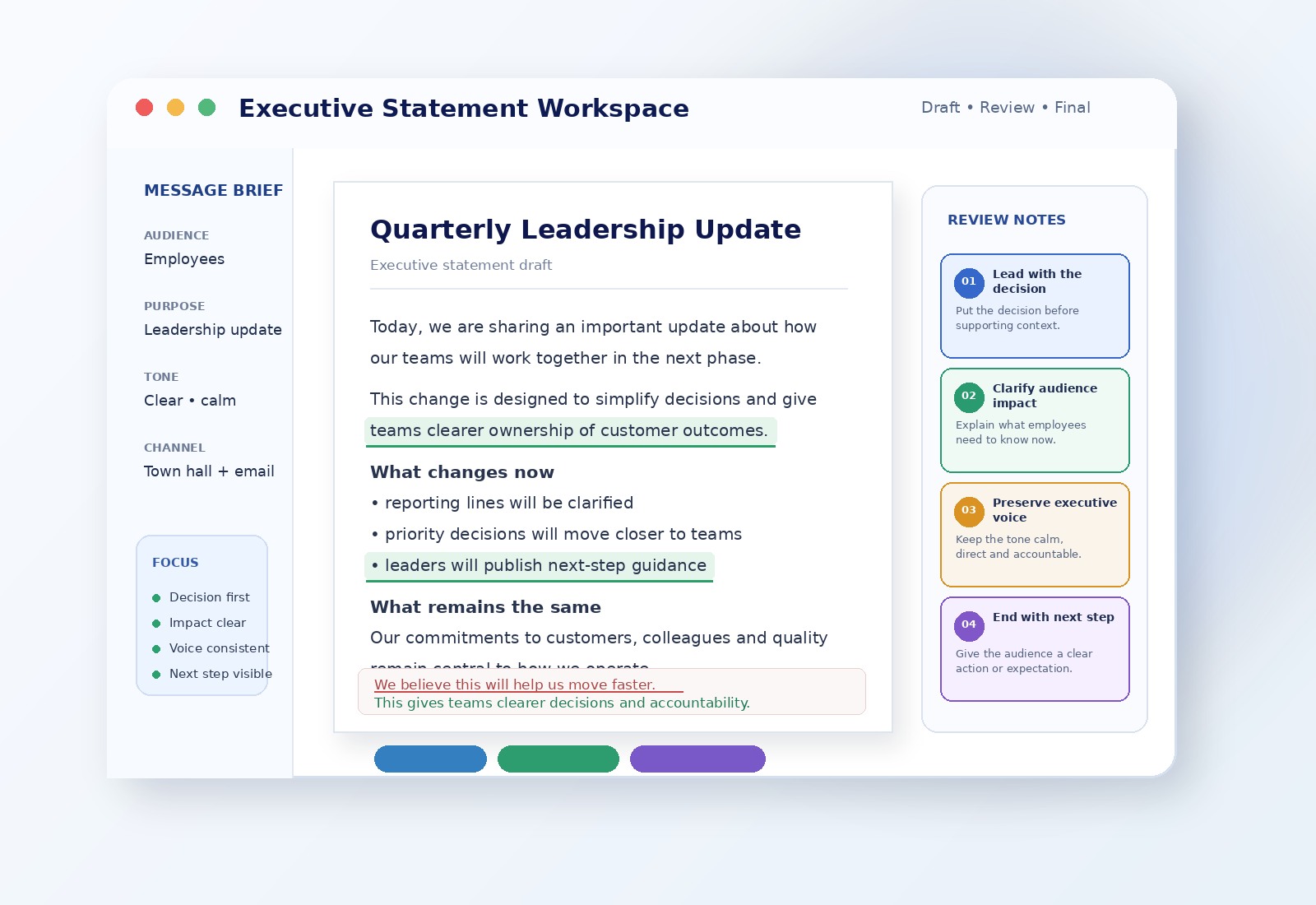
Service output in focusA leadership statement workspace showing message framing, edits, and review notes—not generic stock imagery.
Executive Voice PreservedRefinement supports the intended leadership tone and position.
Audience-Aware FramingMessage emphasis changes with stakeholder needs and context.
Confidential HandlingSensitive drafts and source materials stay within the designated service process.
Review-Ready DeliveryClear drafts, supporting notes, and usable versions for internal approval.
Executive Statement Writing Pricing & Delivery
This pricing covers one focused leadership statement designed for public, stakeholder or internal scrutiny, with the core position, attribution and supporting context kept clear for approval.
From ₹8,000
for one executive statement up to 900 words
Suitable for
Leadership responses, organisational statements, milestone comments and other attributable executive communications.
Statement purpose, audience and source-fact review
Clear executive position and message hierarchy
Quote-ready language aligned to the leader’s stated tone
Context and supporting points drawn only from approved inputs
One shorter derivative version for an agreed secondary use
Two leadership review cycles with a final approved statement
Crisis conditions, multiple executives, extensive research, legal-review coordination, additional formats or urgent same-day response can require a custom scope.
01
Executive Statement Services, Process & Delivery Formats
A structured communication workflow turns source material into an executive statement with a clear purpose, a consistent voice, and wording shaped for the moment and audience.
Executive Communication Statement Services
Support for high-visibility leadership messages where clarity, tone, credibility, and stakeholder context matter.
Leadership Announcements
Statements for major decisions, milestones, appointments, and organisational updates.
Change Communications
Messages that explain what is changing, why it matters, and what audiences should expect.
Media Statements
Concise executive comments, public statements, and approved holding-message drafts.
Investor & Stakeholder Messages
Executive wording that presents approved facts with clear context and message discipline.
Employee Communications
Leadership notes, internal emails, town-hall statements, and people-focused updates.
Speeches & Event Remarks
Opening statements, closing remarks, key-message sections, and speaker-ready executive copy.
Issue-Response Statements
Carefully structured messages for sensitive, fast-moving, or reputation-relevant situations.
Public & Digital Statements
Web, newsroom, social, and public-facing versions adapted from the approved message.
Our 10-Step Executive Statement Process
Each step focuses the statement before it reaches final client review.
01Brief & objective
02Audience & channel
03Approved facts
04Message architecture
05Voice & tone
06First draft
07Clarity review
08Stakeholder lens
09Client revisions
10Final versions
Review-ready executive statement
02
What We Deliver, Where Statements Are Used & Who We Help
Executive communication is most effective when the message, audience, channel, and action are considered together rather than treated as separate writing tasks.
What We Deliver
Practical communication outputs designed for review and authorised use.
Clear message hierarchy and opening position
Leadership tone and executive voice refinement
Audience-specific context and emphasis
Concise wording for complex or sensitive points
Clear next steps, expectations, or calls to action
Channel-ready versions when included in scope
Where Executive Statements Are Used
Common moments where leadership wording needs structure, discipline, and audience awareness.
Leadership Announcements
Transformation & Change
Media & Public Statements
Investor Updates
Employee Messages
Town Halls & Speeches
Issue & Crisis Response
Web & Social Statements
Milestones & Partnerships
Thought Leadership
03
Engagement Models & Communication Channels
The writing approach can be matched to a single leadership moment or a broader stream of executive communication, then adapted to the channels that matter to your audience.
Engagement Models
Flexible ways to organise executive statement support depending on the communication need.
Project-Based
For one defined executive statement, announcement, event, or communication moment.
Retainer-Based
For recurring leadership messages that benefit from continuity of voice and communication context.
Leadership Communication Program
For a series of statements across a campaign, transformation, leadership agenda, or stakeholder program.
Event & Milestone Support
For speeches, launches, results moments, partner announcements, town halls, and other scheduled occasions.
Integrated Executive Communication Channels
A core approved message can be shaped to fit the channel without losing its central meaning.
Town Halls & Speeches
Spoken leadership messages and remarks.
Email & Internal Notes
Employee and stakeholder communications.
Media Statements
External comments and public-facing copy.
Investor Relations
Stakeholder and market-facing messaging.
Web & Newsroom
Published statements and leadership updates.
Social & Digital
Short-form adaptations from approved messages.
04
Communication Impact Funnel, KPIs & Deliverables
Executive statements should make the intended message easier to notice, understand, trust, and act on. Measurement depends on the channel and data available to your organisation.
Executive Communication Impact Funnel
A simple planning lens for moving from visibility to understanding and action.
Awareness
Understanding
Alignment
Confidence
Action & Advocacy
Awareness: make the key message visible and unmistakable.
Understanding: explain the context, impact, and decision in plain language.
Alignment: connect the message to priorities, values, or agreed direction.
Confidence: use credible, accountable, audience-aware wording.
Action: make the next step, behaviour, or expectation clear.
Key Performance Indicators to Track
Choose measures that match the communication channel and the data you can actually observe.
Message comprehension or clarity feedback
Employee or stakeholder engagement
Open, read, view, or attendance signals
Stakeholder sentiment or feedback themes
Media pickup or message consistency
Action or response rates where measurable
Questions raised after communication
Internal approval or revision themes
What You Get
Deliverables are confirmed around the actual statement, audience, channel, and review requirement.
Message brief & architecture +
Purpose, audience, key points, tone, context, and intended next step organised before drafting.
Executive statement draft +
A structured statement written from the approved brief, source material, and intended executive position.
Voice & tone refinement +
Language refined to sound direct, credible, human, and appropriate to the leadership context.
Audience or channel versions +
Adaptations for employee, media, investor, web, social, speech, or other channels when included in scope.
Talking points or Q&A support +
Supporting key points, anticipated questions, or concise speaker guidance when required.
Review notes & clean final copy +
A clear working version for review plus a clean final statement after agreed revisions are completed.
05
Why Clients Choose Contentxprtz for Executive Statements
The strongest executive communication combines writing discipline with audience context, careful review, and respect for the facts and positions the client has approved.
Strategic Message Framing
Start with the decision, purpose, audience, and desired response.
Executive Voice Discipline
Refine language without turning the message into generic corporate copy.
Stakeholder Awareness
Shape emphasis and explanation around what each audience needs to understand.
Review-Ready Structure
Make internal review easier with clear messaging, hierarchy, and supporting notes.
Confidential Handling
Support sensitive drafts through the designated client submission and delivery process.
Usable Final Deliverables
Move from draft to clean copy, speaker notes, and channel versions where required.
06
Executive Statement Scenarios, Rewrite Example & FAQs
Illustrative examples show the type of intervention involved. They are not client case studies, endorsements, or performance claims.
Common Executive Statement Scenarios
Situations where a statement often needs more than a quick copy edit.
Major Leadership Announcement
The facts are approved, but the opening is too indirect and the audience impact is buried.
Transformation Message
The executive needs to explain what changes, what stays the same, and what employees should do next.
Sensitive Media Statement
The message must be concise, careful, aligned to approved facts, and suitable for external scrutiny.
Illustrative Message Refinement
A simple example of moving from generic corporate language to a clearer executive statement without adding unsupported facts.
Before
“As part of our ongoing commitment to continuous improvement, we are making changes to our operating model that will help us better position the organisation for the future.”
After
“We are changing how several teams work together so decisions can be made with clearer ownership. We will explain what changes for each team, what stays the same, and the next steps before the new structure takes effect.”
Why it changed: the revised version leads with the decision, reduces vague phrasing, makes audience impact visible, and ends with a concrete expectation.
What is an Executive Communication Statements Service?+
It is a professional writing and refinement service for leadership statements that need a clear message, credible executive voice, audience awareness, strong structure, and channel-appropriate wording.
What types of executive statements can you help with?+
The service can support leadership announcements, employee updates, change communications, media statements, issue-response or holding statements, investor or stakeholder messages, event remarks, speeches, and other executive-facing communications.
Can you work from rough notes instead of a finished draft?+
Yes. You can provide a brief, source notes, key facts, audience information, required messages, and any wording that must be preserved. The statement can then be structured around those supplied inputs.
Can you refine an existing executive statement?+
Yes. An existing draft can be tightened for clarity, tone, message hierarchy, flow, audience relevance, consistency, and executive voice while preserving the approved facts and intended position.
Can one statement be adapted for different audiences or channels?+
Yes. The same approved message can be adapted into channel-appropriate versions for employees, media, investors, stakeholders, town halls, email, web, or social communication when that is part of the agreed scope.
Will the statement still sound like the executive?+
The service is designed to preserve and strengthen the executive’s intended voice. Supplying previous speeches, messages, tone preferences, or examples can help align the draft more closely to the desired style.
Can you help with sensitive or issue-response statements?+
Yes, the writing can be structured for sensitive moments with careful message hierarchy, tone, audience impact, and approved facts. Any legal, regulatory, policy, or compliance approval remains with the client’s responsible teams.
Do you verify facts, legal positions, or regulatory wording?+
The service works from information and positions supplied or approved by the client. It does not replace legal, regulatory, compliance, financial, or specialist fact verification.
Can you provide talking points or Q&A support with the statement?+
Yes, supporting talking points, likely questions, key-message summaries, or short-form adaptations can be prepared when included in the agreed communication scope.
What information should I provide before drafting starts?+
Helpful inputs include the purpose, audience, communication channel, approved facts, key messages, required tone, timing, executive voice examples, sensitive wording, mandatory inclusions, and any internal approval constraints.
How are pricing and turnaround determined?+
Pricing and delivery timing depend on the statement type, amount of source material, drafting depth, number of audience or channel versions, review requirements, and deadline. The scope is confirmed before work begins.
How is confidential material handled?+
Executive statements, source notes, unpublished announcements, and related client information should be treated as confidential service material through the designated submission and delivery process.
Ready to Shape a Clearer Executive Statement?
Share the communication purpose, audience, approved facts, timing, and any existing draft. The scope can then be aligned to the statement and channel you need.
Tell us what the executive needs to communicate, who must hear it, which facts are approved, and where the statement will be used. Pricing and delivery timing are confirmed after the scope is understood.
Statement Type
Leadership announcement, media comment, change message, speech, investor update, or another executive communication.
Audience
Employees, media, investors, customers, partners, public stakeholders, or a mixed audience.
Approved Facts & Key Messages
Provide source material, positions, wording that must be retained, and points that require careful handling.
Timing & Review Needs
Share the required date, planned communication moment, internal reviewers, and any version requirements.
Executive Voice
Share previous messages, speeches, preferred tone, and phrases that reflect how the executive communicates.
Channels & Versions
Indicate whether the message is for email, web, media, social, town hall, speech, investor communication, or multiple channels.
Helpful to include: the communication objective, intended audience, approved facts, executive name/role, preferred tone, existing draft or notes, sensitive wording, communication channel, required versions, and target date.
Executive Communication Enquiry
Share Your Statement Requirement
Provide enough context to understand the message, audience, source material, and review needs. Do not include information you are not authorised to share.