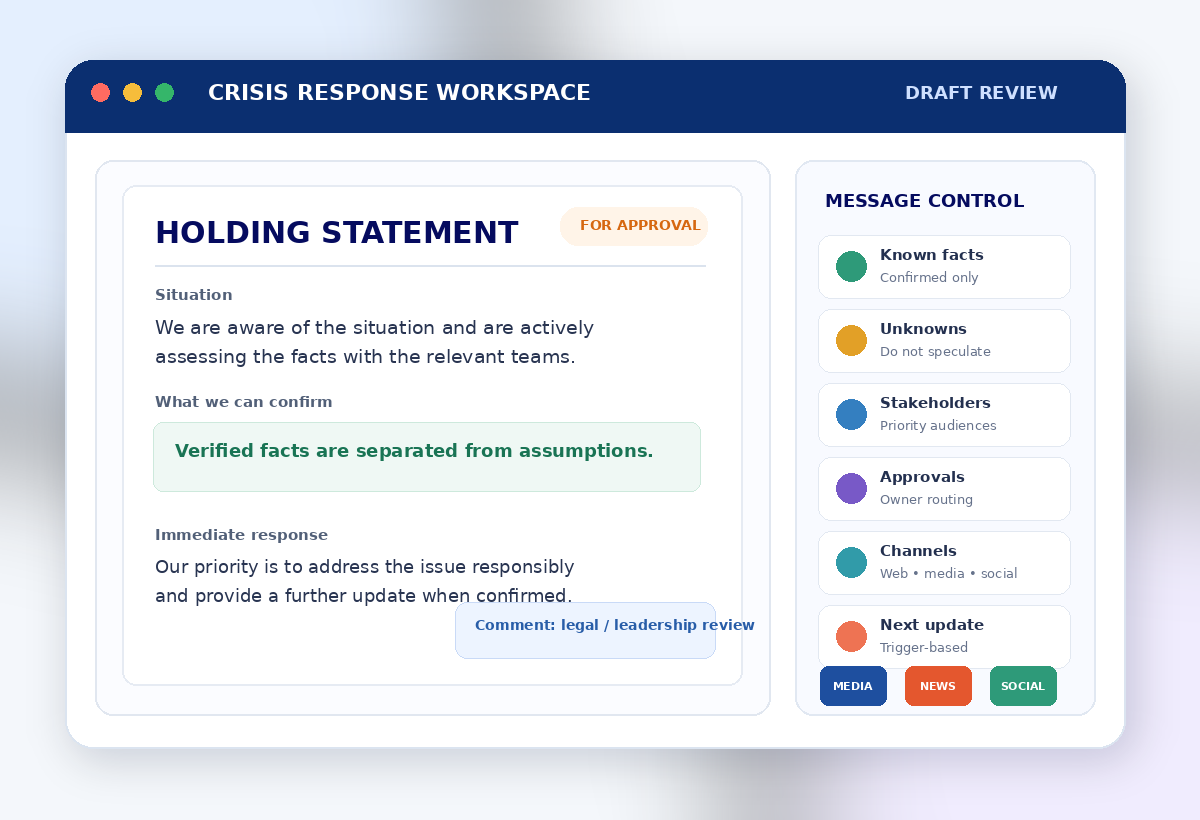
Crisis Communication Holding Statement Service for Clear, Controlled First-Response Messaging
★★★★★4.8 rating from Researchers, Authors, Students, and Scholars
When an issue is moving faster than the facts, a holding statement gives your organisation a disciplined first response. Contentxprtz helps shape concise, fact-led wording that acknowledges the situation, separates confirmed information from unknowns, supports internal approval and can be adapted across priority stakeholder channels.
Fact-first language that avoids speculation and unnecessary detail
Clear separation between what is known, what is being assessed and what comes next
Approval-friendly drafts for legal, compliance, leadership and communication review
Channel-ready variants that keep the core message consistent
Sensitive admissions, legal positions and regulatory wording should be approved by the organisation's authorised reviewers before release.
Holding statement • fact control • approval route
The Power of a Strong Holding Statement
Well-controlled interim messaging helps teams communicate without outrunning verified facts.
Set DirectionGive audiences a clear first position.
Buy Time ResponsiblyAcknowledge the issue while facts develop.
Reduce SpeculationSeparate confirmed facts from unknowns.
Protect ConsistencyKeep the same core message across teams.
Support DecisionsMake review points and owners visible.
Prepare UpdatesPlan how the message evolves with facts.
Fact-Led Drafting
Verified information is clearly distinguished from unknowns.
Stakeholder Aware
Core wording can be adapted for priority audiences.
Approval Friendly
Draft structure supports legal, compliance and leadership review.
Channel Consistent
Media, web, social and internal versions stay aligned.
Crisis Holding Statement Pricing & Delivery
The starting engagement is built for the first controlled response: a concise holding statement grounded in confirmed facts, with practical variants for the immediate communication channels in scope.
From ₹15,000
for one crisis holding-statement package
Suitable for
An organisation that needs a disciplined first-response message while facts are still being confirmed.
Fact and context review from the supplied incident brief
Core holding statement written for the primary public or stakeholder use
Language calibrated to avoid speculation and unsupported conclusions
Up to two short channel variants based on the approved core message
Next-update placeholders or trigger notes where useful
One consolidated revision round after client review
Same-day emergency response, multiple scenarios, multilingual variants, legal-review coordination or a larger crisis message library is quoted according to the required response window.
1
Our Crisis Holding Statement Service
End-to-end message support for the first public or stakeholder-facing response, from fact collection and risk-aware drafting to approval routing, channel adaptation and update planning.
What We Can Support
Focused communication components for a controlled first response.
Holding Statement Draft
Short interim wording built around verified facts.
Media Statement Version
Core message organised for press or newsroom use.
Key Message Set
What to say, what not to overstate and what to confirm.
Channel Variants
Consistent adaptations for web, social or internal use.
Approval Notes
Visible questions, assumptions and reviewer action points.
Update Guidance
Triggers and placeholders for the next confirmed message.
Q&A Preparation
Anticipated questions around the known issue.
Risk-Aware Wording
Neutral, factual language where details are not settled.
Our 10-Step Holding Statement Process
A structured workflow designed to keep facts, wording, approvals and channels aligned.
Approval-Ready Holding Statement
01 • DiscoverClarify the issueContext, audiences and intended use.
02 • VerifyBuild the fact baseKnown facts, unknowns and source owners.
03 • Risk ScanIdentify sensitivitiesLegal, compliance, safety and reputational points.
04 • StrategySet message objectiveAcknowledge, reassure, instruct or update.
05 • DraftWrite the first versionConcise, factual and audience-ready.
06 • AlignCheck key messagesOne core position across stakeholders.
07 • ReviewRoute for approvalsCapture comments and authorised decisions.
08 • AdaptCreate channel variantsMedia, web, social and internal formats.
09 • Release PrepConfirm version controlFinal wording, owner and release channel.
10 • UpdatePlan the next messageTrack fact changes and update triggers.
Inputs We Work From
Clear inputs reduce guesswork and help keep the statement controlled.
Incident briefWhat happened, when and what is currently known.
Verified fact logConfirmed facts, sources and unresolved points.
Stakeholder mapWho needs information and in what order.
Approval matrixLegal, compliance, leadership and communication owners.
Channel planMedia, website, social, employee and direct communication.
Update triggersEvents or confirmed facts that require a revised statement.
2
What We Deliver, Where It Helps and Who It Supports
The service is designed around the practical communication assets and review controls needed when an organisation must respond before every detail is settled.
What We Deliver
Message assets that can move through review efficiently.
✓Concise primary holding statement
✓Verified facts / unknowns separation
✓Key messages and wording guardrails
✓Stakeholder or channel variants where needed
✓Anticipated Q&A points
✓Approval and update notes
Crisis Scenarios
Examples of situations where a holding statement can create a controlled first response.
Service Disruption
Cyber or Data Incident
Executive or People Issue
Operational Incident
Safety or Public Concern
Regulatory or Legal Issue
Supply Chain Disruption
Misinformation or Viral Claim
Product or Service Concern
Event or Facility Issue
Who We Help
Flexible support for organisations of different sizes.
1Startups
2Growth-Stage Companies
3Enterprises
4Agencies
5Public Sector & NGOs
3
Engagement Models and Communication Channels
Holding statement support can sit within a focused assignment or a broader communications relationship, while the core message remains consistent across the channels that matter.
Engagement Models
Flexible ways to structure the communication support.
Project Based
Focused support for a defined issue, scenario or statement pack.
Retainer Based
Ongoing communications support for recurring needs and preparedness.
Dedicated PR Support
Closer collaboration with your internal communication stakeholders.
On-Demand PR Support
Targeted support when a situation or update requires fresh wording.
Integrated Communication Channels
One factual core, adapted appropriately for each audience and format.
Traditional MediaPress statement and media response
A useful holding statement is not just a paragraph. It sits inside a simple response discipline that helps teams verify facts, approve language, release consistently and update when the situation changes.
Crisis Response Funnel
A practical progression from issue visibility to update governance.
Awareness
Verification
Stabilisation
Approval
Release
Update
Key Communication Checks
What matters before the message is approved and released.
✓Verified-fact accuracy and source ownership
✓Message consistency across audiences and channels
✓Clear approval status and named decision owners
✓Appropriate treatment of unknown or developing facts
✓Stakeholder coverage and channel readiness
✓Anticipated questions and spokesperson preparation
✓Version control for every released statement
✓Update trigger and next-message ownership
What You Get
Comprehensive message components for a controlled first response.
Primary Holding Statement +
Short & Extended Versions +
Key Messages & Guardrails +
Stakeholder / Channel Variants +
Anticipated Q&A Notes +
Approval Questions & Comments +
Update Triggers & Next Steps +
Clean Approved-Text Version +
5
Why Clients Choose Contentxprtz for Crisis Messaging
The focus is disciplined communication: understand the issue, control the facts, write clearly, make approvals visible and keep the released message consistent as the situation develops.
Strategic Mindset
Message purpose is defined before wording is polished.
Stakeholder Clarity
Core facts can be adapted without fragmenting the message.
Structured Drafting
Known facts, unknowns and next steps stay distinguishable.
Multi-Channel Thinking
The same position is translated for the right format.
Transparent Review
Comments and approval questions stay visible in the draft.
Update Discipline
The statement is prepared to evolve as facts become confirmed.
6
Illustrative Holding Statement Patterns and FAQs
These examples show the type of controlled structure a holding statement can use. They are illustrative only; real wording must be based on verified facts and authorised internal positions.
Illustrative Crisis Scenarios
Examples of how a fact-led first response can be framed without speculation.
Service disruption
Acknowledge → action → update
Useful when a service interruption is visible but the full cause is still being investigated.
“We are aware of the disruption affecting some users and our teams are working to restore service. We are assessing the cause and will provide a further update when more information is confirmed.”
Data / security issue
Confirm only what is verified
Useful when investigation is active and teams must avoid overstating impact or cause.
“We are investigating a security-related issue and have taken immediate steps to contain the situation. Our review is ongoing, and we will share confirmed information with affected stakeholders as appropriate.”
Core Principle
Good crisis messaging protects clarity before it protects polish.
“
A holding statement should say enough to show that the organisation understands the issue and is responding—without filling factual gaps with assumptions.
Fact-first crisis communication principle
Frequently Asked Questions
Quick answers to common holding-statement questions.
What is a crisis communication holding statement?+
A short interim message used while an issue is developing and not every fact is confirmed. It acknowledges the situation, states what can be verified and indicates what happens next.
When should a holding statement be prepared?+
When an organisation may need to respond before a full investigation or final position is available, or as a preparedness template for foreseeable scenarios.
Can it be adapted for media, web and social?+
Yes. Channel-specific versions can be created while keeping the verified facts and central position consistent.
Can legal or compliance comments be incorporated?+
Yes. The working draft can be revised around comments from the organisation's authorised legal, compliance, leadership or communications reviewers.
Does a holding statement replace a crisis plan?+
No. It is one communication asset within a wider response that may include escalation, monitoring, stakeholder coordination, spokesperson preparation and update governance.
7
Crisis Communication Holding Statement FAQs
More detailed answers about scope, inputs, approvals, versions and the role of a holding statement in a wider crisis response.
What is a crisis communication holding statement?+
A holding statement is a short interim message used when an issue is developing and not every fact is yet confirmed. It acknowledges the situation, states what can be verified, explains the immediate response and sets an expectation for further updates without speculation.
When should a holding statement be prepared?+
A holding statement is useful when an organisation may need to respond before a full investigation or final position is available. It can be prepared in advance for foreseeable scenarios or drafted around a live issue using verified facts.
What information do you need to draft a holding statement?+
Useful inputs include a factual incident summary, what is confirmed and unconfirmed, affected stakeholders, actions already taken, approved spokesperson or owner, legal or compliance constraints, intended channels and any update triggers.
Can the statement be adapted for media, website, social and internal channels?+
Yes. The core message can be organised into channel-appropriate versions while keeping the verified facts and central position consistent.
Will you include unverified details to make the statement sound complete?+
No. The holding-statement approach separates confirmed facts from unknowns and avoids presenting assumptions as established information.
Can legal, compliance or leadership comments be incorporated?+
Yes. Comments and required changes from the organisation's authorised reviewers can be incorporated into the working draft before final approval.
Can you create more than one version for different stakeholders?+
Yes. Where required, the message can be adapted for audiences such as employees, customers, partners, media or other stakeholders while keeping the core facts consistent.
Can a holding statement be prepared before a crisis happens?+
Yes. Scenario-based templates can be prepared around foreseeable issues so the organisation has an approved structure, message principles and placeholders ready for verified facts.
Does a holding statement replace a full crisis communication plan?+
No. A holding statement is one response asset. Wider crisis communication may also require escalation rules, stakeholder mapping, spokesperson preparation, Q&A, monitoring, update governance and channel coordination.
Can the statement include an apology or acceptance of responsibility?+
That depends on the verified facts and the organisation's authorised legal, compliance and leadership position. Sensitive admissions should not be inserted without the relevant internal approval.
How do you keep revisions controlled during a fast-moving issue?+
A practical workflow uses one working version, a clear fact log, named reviewers, visible changes and an approval record so the message does not fragment across teams and channels.
How do I request a crisis communication holding statement?+
Share the issue summary, verified facts, known unknowns, stakeholders, intended channels, required reviewers and any deadline or update requirement through the enquiry form.
Ready to Prepare a Clear First Response Before the Story Moves Faster?
Share the situation, verified facts, stakeholders and review constraints so the holding statement can be structured around what your organisation can responsibly say.
Share enough context to distinguish verified facts from open questions. Include the intended audience, required reviewers and any release or update requirement that could shape the wording.
1
Situation summary
What happened, when it became known and the current status.
2
Verified facts
What has been confirmed and by which internal source or owner.
3
Known unknowns
What is still being investigated or should not yet be stated.
4
Stakeholders
Media, customers, employees, partners or other priority audiences.
5
Required reviewers
Legal, compliance, leadership, security or communication owners.
6
Channels & updates
Where the message may appear and what should trigger the next update.
Crisis Communication Enquiry
Share Your Holding Statement Requirement
Provide the core facts and communication context below. Avoid sending information you are not authorised to share through this form.