Strategy-Led Writing
Content shaped around the issue, audience and desired action.

Turn complex issues, evidence and organisational priorities into focused advocacy content for the people who need to understand, support or act on them. We develop audience-aware messaging across policy, campaign, stakeholder and public-facing formats.
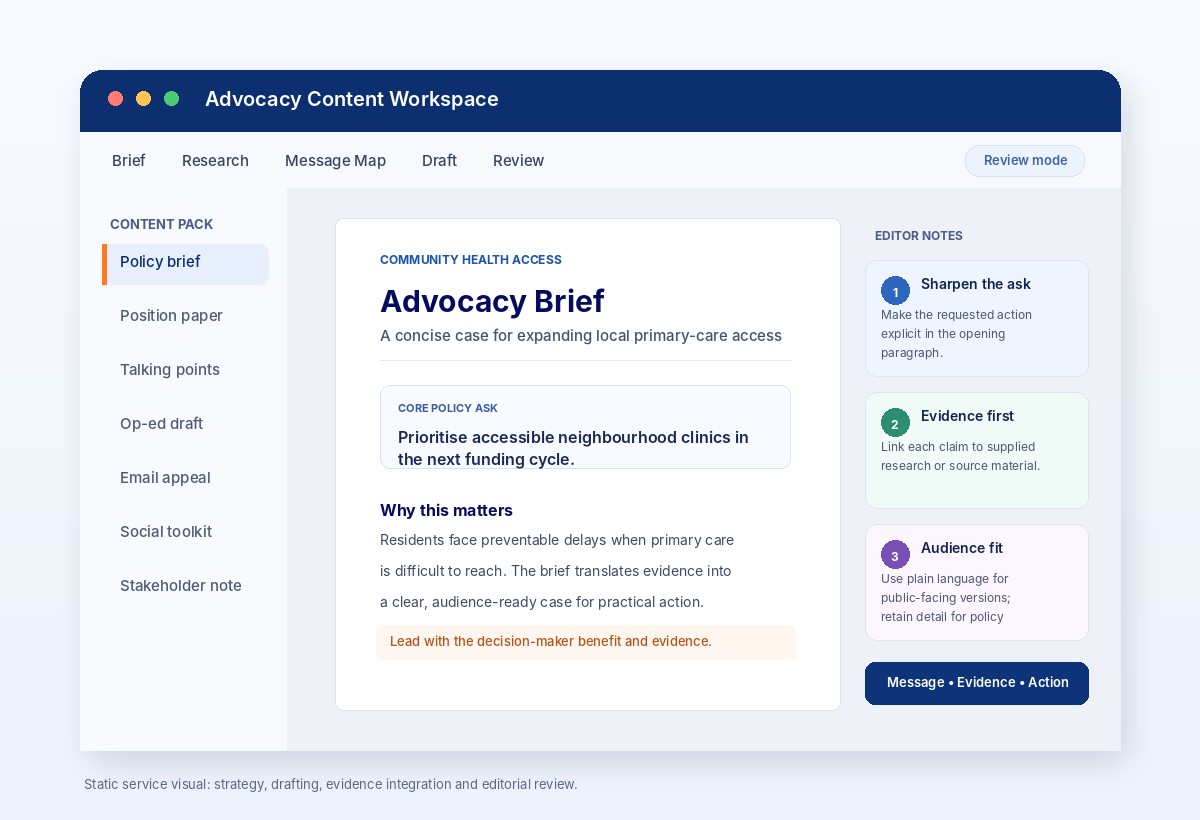
Content shaped around the issue, audience and desired action.
Claims and framing remain connected to the source material supplied.
Language and emphasis adapted for different stakeholder groups and channels.
Clear structure, consistent terminology and practical revision points.
Core asset starting price
Specialist advocacy writing is most understandable when the starting price buys a complete usable asset, not a consultation or a vague “custom quote.”
for one core advocacy asset up to 1,500 words
Best fit: Policy briefs, position pieces, campaign narratives, stakeholder communication or other evidence-led advocacy copy developed from an approved brief and supplied source material.
When the quote changes: Additional assets, deeper original research, technical subject review, multi-channel repurposing and accelerated delivery can be added through a custom scope.
Use the service for a single priority document or for a connected content set. The writing can begin from research, a campaign brief, existing messaging, policy material, interview notes or other supplied source content.
Translate an issue, evidence base and recommended action into a concise, structured document for policy or institutional audiences.
Develop the central message, supporting points, proof themes and action language that keep a campaign coherent across channels.
Shape a clear point of view with a strong opening, evidence-led argument, audience relevance and a purposeful conclusion.
Create concise updates, briefing notes, partner messages and tailored communications for audiences with different information needs.
Build issue pages, campaign landing pages, programme copy and calls to action that make complex work easier to understand and navigate.
Turn programme, research or impact information into readable narrative sections that connect evidence, context and significance.
Adapt the core message into shorter formats for supporter emails, social posts, campaign updates, launch copy and shareable messages.
Prepare structured points, speaker notes, FAQs and campaign toolkits so teams can communicate the same position with confidence.
The workflow keeps strategy, source material, audience needs and review points visible throughout the project.
Clarify the issue, objective, audience, desired action and approval context.
Review supplied evidence, reports, policy material, references and existing messages.
Define the core narrative, argument sequence, proof points and audience emphasis.
Develop the required format with clear structure, voice, messaging and calls to action.
Check logic, consistency, evidence use, terminology and alignment with the brief.
Resolve feedback, strengthen clarity and tighten language without losing the core position.
Where scoped, translate the core message into channel- or audience-specific variants.
Prepare final copy in a review-friendly structure for your next internal or external step.
These are illustrative content combinations, not client case studies. The actual mix should follow the specific brief and available source material.
A connected set could combine a policy brief, landing-page copy, talking points, supporter email and short social messages around one consistent ask.
A technical report can be reframed into a public summary, decision-maker brief, thought-leadership article and stakeholder note without losing the core evidence.
A shared message house can support partner talking points, FAQs, email language and social copy so different organisations communicate the same core position.
Practical questions about scope, source material, audience adaptation, evidence use and project inputs.
Advocacy content writing turns an issue, evidence base and desired action into clear content for specific audiences. It may include policy briefs, position papers, op-eds, talking points, campaign pages, reports, email, social content and stakeholder communication.
The service is suitable for organisations and teams that need structured public-interest or policy-facing communication, including NGOs, nonprofits, coalitions, think tanks, foundations, research teams, associations and CSR or social-impact initiatives.
Yes. Supplied research, policy documents, reports, interview notes, data, previous publications, brand guidance and approved messages can be used as source material for the draft.
Yes. The same core position can be adapted for decision-makers, partners, donors, media, communities or public audiences while keeping the underlying message consistent.
Yes. Policy briefs and position papers can be structured around the issue, evidence, implications, recommended action and supporting references or source material supplied for the project.
Yes. Op-eds and thought-leadership pieces can be developed around a clear point of view, evidence, audience relevance and a strong narrative suitable for the intended publication or platform.
Yes. A campaign content set can include a core message, landing-page copy, email, social posts, talking points, supporter messaging and short-form variations when those items are part of the confirmed brief.
Claims should be tied to the source material provided for the project. Where evidence is incomplete or wording needs qualification, the draft can flag the issue for review instead of presenting an unsupported statement as fact.
Yes. Brand, tone, terminology, messaging, review and approval requirements can be incorporated when they are supplied with the brief.
Helpful inputs include the communication objective, audience, desired action, source documents, must-use facts, approved terminology, examples of existing voice, required content formats and any review or publication constraints.
Contentxprtz advocacy content writing starts from ₹8,000 for one core advocacy asset up to 1,500 words. The starting scope includes source-led drafting, message refinement, two revision rounds and typical delivery in 5–7 business days.
Use the enquiry form below to share the issue, audience, communication objective, content formats, available source material and other requirements for review.
Share the issue you are communicating, who needs to hear it and what you want the audience to understand or do. The more context you provide, the easier it is to assess the appropriate writing scope.
Provide enough information for the writing requirement to be reviewed in context.