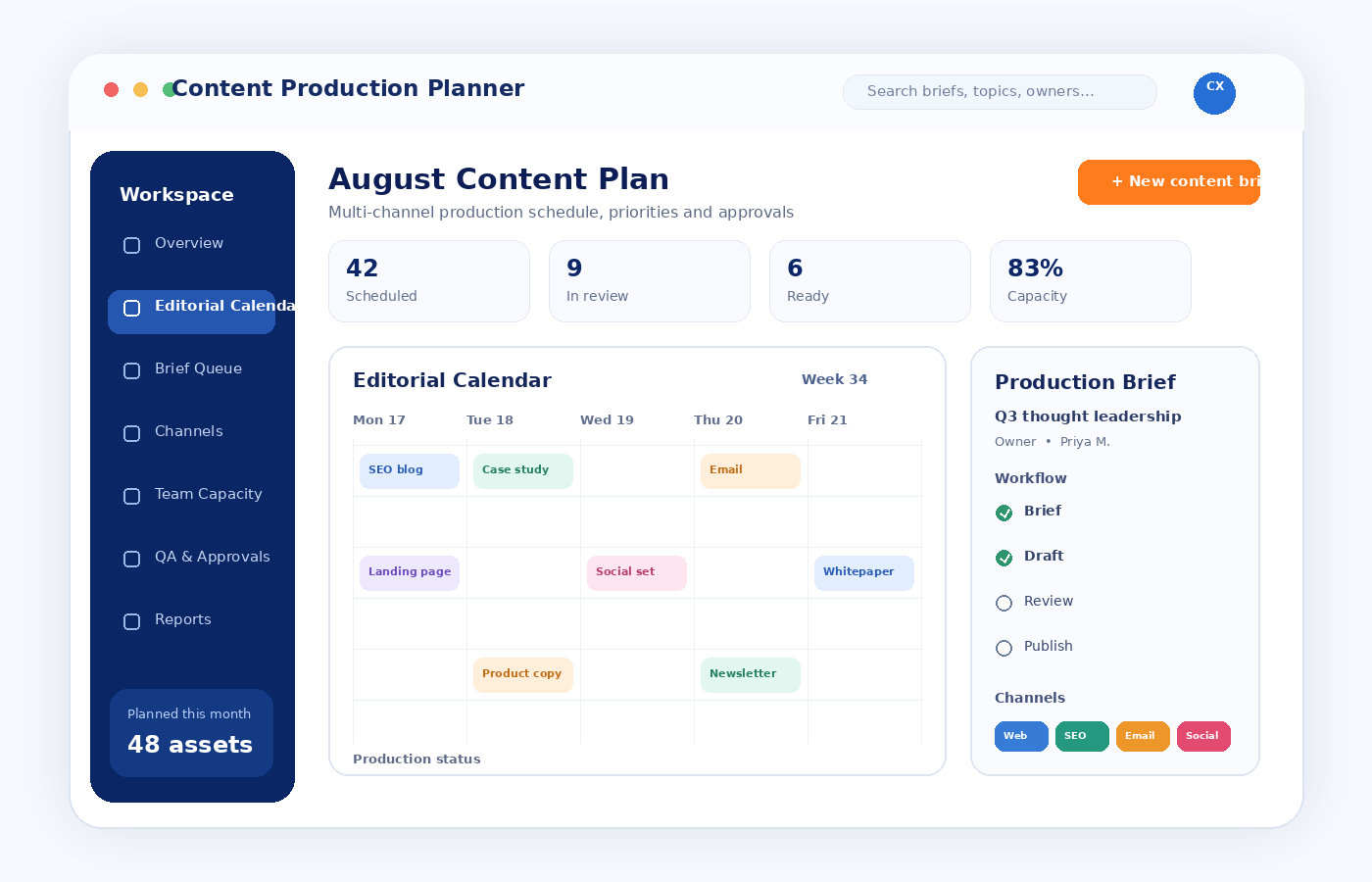
Managed Content Production Planning Service for Consistent Multi-Channel Delivery
★★★★★4.8 rating from Researchers, Authors, Students, and Scholars
Build a clear, production-ready content plan before work reaches writers, designers, editors, and publishers. We organise priorities, briefs, channel requirements, owners, capacity, review gates, and delivery schedules into one manageable workflow.
Editorial calendars aligned to campaigns and business priorities
Clear briefs, owners, dependencies, and approval stages
Channel-specific planning for web, search, social, email, and more
Capacity and workflow planning for scalable content operations
Use this service when the production problem is planning—not simply writing more content. The starting project turns priorities, channels, deadlines, ownership, and review stages into a usable 30-day production plan.
Starting price
₹10,000
per 30-day production plan
Suitable for: Teams that need a coordinated calendar and briefing system before content moves into production.
Priority and audience mapping
30-day editorial or production calendar
Channel and format allocation
Briefs for up to 10 priority content assets
Owner, reviewer, and approval-stage mapping
QA checkpoints and delivery-status structure
DeliveryTypical delivery: 5–7 business days after goals, channels, source inputs, and stakeholder availability are confirmed.
Review allowanceOne consolidated revision round on the planning pack.
Quarterly roadmaps, larger campaign portfolios, multi-market planning, deeper keyword research, or ongoing production management are quoted as expanded engagements.
What We Do
Comprehensive Content Planning Solutions for Every Production Need
Editorial Calendar Planning
Campaign, topic, owner, deadline, status, and publishing schedules in one coordinated view.
Topic & Keyword Roadmaps
Prioritised themes, search opportunities, audience needs, and production sequencing.
Brief & Template Systems
Repeatable brief structures with objectives, messages, sources, SEO, CTA, and acceptance criteria.
Resource & Capacity Planning
Workload visibility for writers, editors, designers, SMEs, approvers, and publishing teams.
Workflow & SLA Design
Defined hand-offs, review stages, dependencies, escalation points, and delivery expectations.
Named reviewers, stage gates, version control, decision rights, and final approval checkpoints.
Repurposing Maps
Plan how core ideas can become articles, pages, emails, social assets, decks, and supporting formats.
Reporting Cadence
Define the status, throughput, backlog, review, and performance information stakeholders need.
Backlog Prioritisation
Rank requests by audience value, campaign relevance, urgency, dependency, and available capacity.
How We Work
A Proven Process for Production-Ready Content Planning
01
Understand
Review your goals, audiences, channels, current workflow, backlog, constraints, and decision makers.
02
Map
Translate priorities into themes, campaigns, formats, deadlines, dependencies, and editorial windows.
03
Prioritise
Sequence work using business value, audience need, search opportunity, urgency, and production capacity.
04
Assign
Set owners, contributors, reviewers, approvers, hand-offs, and realistic production responsibilities.
05
Review
Apply brief, brand, source, SEO, channel, and stakeholder checks before work progresses.
06
Optimise
Use delivery and performance feedback to adjust priorities, cadence, backlog, and future production plans.
1
What the Managed Planning Service Covers
Plan the content operation around the work you actually need to produce, the audiences and channels you need to reach, and the review structure your team must follow.
Why Choose Our Managed Content Planning?
Experienced content planning support
Scalable planning for changing volume
Consolidated calendars and ownership
Defined review and approval controls
Structured priority and backlog management
Secure handling of plans and briefs
Flexible engagement models
Types of Content We Plan
Informational ContentGuides, how-tos, FAQs, explainers, knowledge content, and educational resources.
Commercial ContentProduct descriptions, landing pages, comparison pages, service content, and reviews.
Thought LeadershipIndustry insights, opinion pieces, expert articles, and executive content.
Transactional ContentEmail sequences, lifecycle messages, notifications, and conversion support.
Visual & Interactive ContentInfographics, video scripts, quizzes, decks, and supporting visual assets.
Content Formats
Blog posts & articles
Web pages & landing pages
Social posts
Emails & newsletters
Case studies
Whitepapers & ebooks
Infographics
Video & script content
Channels We Support
Websites & blogs
Search engines
Social media
Email marketing
Mobile apps & internal platforms
Marketplaces
PR & media
Ready to move forward?What the Managed Planning Service Covers.
The planning layer establishes consistent inputs and review points so production teams can work from clearer briefs, priorities, and approval requirements.
Our Quality Assurance Framework
Research & Intake
Strategy & Scope
Brief QA
Fact & Source Controls
SEO & Channel Checks
Final Plan Handoff
Original planning inputsSource-aware briefsBrand & style controlsSEO & channel readiness
The Results We Help Support
Clearer Visibility
See what is planned, queued, blocked, under review, and ready for publishing.
Smoother Hand-offs
Define who owns each stage and what must be complete before work moves forward.
Stronger Consistency
Use common brief, review, governance, and approval standards across content types.
Better Capacity Control
Match planned output to available production resources and stakeholder review bandwidth.
Ready to move forward?Quality Controls and the Results They Support.
Common questions about scope, planning inputs, multi-channel coordination, production briefs, quality controls, engagement models, and confidentiality.
What is a Managed Content Production Planning Service?+
It is a structured planning service that turns content goals, channel requirements, priorities, deadlines, owners, review stages, and production capacity into a practical content production plan. The emphasis is on making the workflow clear before content moves into drafting, design, review, and publishing.
What does the service include?+
The service can include editorial calendar planning, topic and campaign mapping, content brief structures, production sequencing, channel coordination, ownership and capacity planning, review gates, approval workflows, reporting cadence, and backlog prioritisation. The exact scope is confirmed from your requirements.
Is this the same as content writing?+
No. Content production planning focuses on deciding what should be produced, why, for which audience and channel, in what order, by whom, and through which review process. Writing or other production services can be coordinated with the plan when they are part of the agreed engagement.
Can you plan content across multiple channels?+
Yes. A managed plan can coordinate websites and blogs, search-led content, social media, email, mobile or app content, marketplaces, PR or media requirements, and internal platforms so that teams work from one aligned schedule.
Can you work with our existing content team or agency?+
Yes. The planning layer can be designed around an internal team, external agency, specialist freelancers, or a blended delivery model. Roles, hand-offs, deadlines, review points, and ownership are made explicit so contributors know what they are responsible for.
What information do you need to build a content production plan?+
Useful inputs include business goals, target audiences, priority products or services, existing content, campaign dates, target channels, SEO or keyword requirements, internal owners, production capacity, approval stakeholders, brand guidance, and any fixed deadlines.
How do you handle changing priorities?+
The plan can include a prioritised backlog, change-control rules, dependencies, buffer capacity, and defined review checkpoints. This makes it easier to re-sequence work when campaigns, launches, approvals, or business priorities change.
Does the service include SEO planning?+
SEO requirements can be incorporated into the planning workflow through keyword and topic mapping, search-intent alignment, brief requirements, on-page checkpoints, and channel-specific optimisation criteria when those inputs are part of the engagement.
Can you create content briefs as part of the plan?+
Yes. Brief systems can define audience, objective, angle, key messages, required sections, sources, keywords, calls to action, channel specifications, review requirements, and acceptance criteria so production starts with clearer direction.
How is quality built into the planning process?+
Quality is addressed before production through clear briefs, defined owners, review checkpoints, fact and source requirements, brand and style guidance, SEO or channel checks, and final approval criteria. These controls reduce ambiguity and make reviews easier to manage.
Do you provide content planning for ongoing programs as well as one-off projects?+
Yes. The page supports dedicated-team, managed-service, project-based, and hourly-support engagement models. The most suitable model depends on whether you need an ongoing editorial operation, a defined planning project, or periodic planning support.
How do you protect confidential plans and content information?+
The planning workflow can be organised around NDA and data-protection requirements, role-based access, secure file transfer, encrypted communication, IP protection, and controlled access to campaign or unpublished content information.
6
Discuss Your Content Production Planning Requirement
Tell us what you publish, which channels you support, how your team is structured, and where planning or production coordination is creating friction.
What to Share
Build a Planning System Your Team Can Actually Use
We can use your current workflow, campaign calendar, content backlog, team structure, channel mix, and approval process as the starting point for a clearer managed content production plan.
Business goals, audiences, products, campaigns, and priority topics
Content formats, channels, current backlog, and publishing cadence
Internal and external contributors, reviewers, and approvers
Fixed launch dates, capacity constraints, governance, or security requirements
Service Enquiry
Request a Managed Content Planning Discussion
Share enough information for the team to understand your planning environment and the type of support you need.
Let’s Create a Content Plan That Drives Consistent Production
From strategy and briefs to owners, approvals, capacity, and channel schedules, organise the work before production begins.