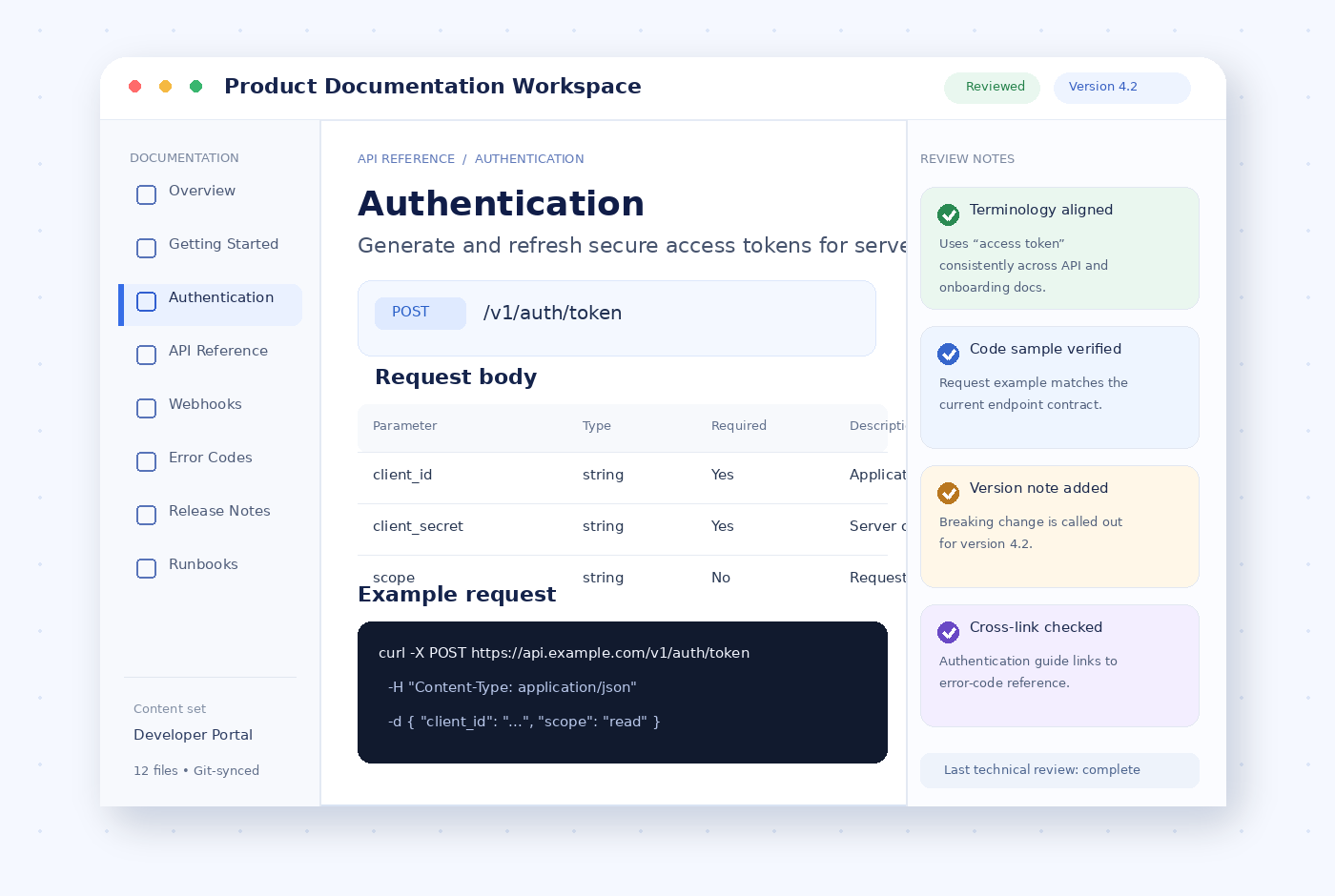
Managed Technical Documentation Service for Clear, Reliable Product Knowledge
★★★★★4.8 rating from Researchers, Authors, Students, and Scholars
Turn complex product, software, API, operational, and support knowledge into documentation people can find, understand, review, and maintain. Contentxprtz can manage the documentation workflow from information architecture and drafting through review, delivery, and ongoing updates.
Technical WritersDocumentation shaped around product, process, and user context.
Scalable DocumentationA managed workflow that can grow with releases and content volume.
Quality ReviewedStructured editorial and technical checks before delivery or publishing.
Version-AwareContent organised for product changes, release cycles, and maintainable updates.
Technical documentation is priced from the complexity of the system and the quality of the available source material. A credible project minimum is more useful than an unsupported per-page promise for API, product, process, or developer-facing documentation.
Project minimum
₹18,000
per scoped technical documentation project
Suitable for: A defined user guide, technical manual, API / developer guide, implementation document, or comparable technical content set.
Requirements, audience, and source review
Information architecture and document outline
Technical drafting or structured rewriting
Terminology, examples, tables, and cross-reference consistency
SME queries and validation checkpoints
Editorial QA and final editable documentation handoff
DeliveryTypical starting project: 10–15 business days after source materials and SME access are confirmed.
Review allowanceTwo review rounds, including one consolidated technical-review pass.
Large API surfaces, code-example testing, product access, diagram production, multiple manuals, or accelerated release schedules are quoted separately.
Information ArchitectureClear structure for complex product knowledge.
SME CollaborationRequirements and technical context captured from the right stakeholders.
Technical ValidationExamples, terminology, steps, and references reviewed against supplied source material.
Lifecycle SupportDocumentation can be planned for new releases and ongoing maintenance.
Confidential HandlingProject information is handled through controlled documentation workflows.
Multi-Format DeliveryContent prepared for web, knowledge-base, repository, and document channels.
1
Comprehensive Technical Documentation, Managed End to End
Build new documentation, reorganise existing knowledge, support a release, or establish an ongoing content operation. The service is structured around the information your users and teams actually need.
What we document
Documentation for Every Technical Journey
Choose the document types that match your product, audience, and operating model.
API Documentation
Endpoint references, authentication guidance, request and response examples, errors, and integration notes.
User & Product Guides
Task-led product guidance that helps users understand features, workflows, and expected outcomes.
SOPs & Runbooks
Operational procedures, escalation steps, troubleshooting sequences, and repeatable technical workflows.
Knowledge Bases
Searchable help content, support articles, internal knowledge, and structured troubleshooting content.
Quick starts, environment setup, SDK or CLI guidance, prerequisites, examples, and first-use journeys.
Admin & System Guides
Configuration, deployment, access, monitoring, maintenance, and administrator-facing procedures.
Technical Tutorials
Step-by-step walkthroughs that connect concepts, commands, code samples, and expected results.
Architecture & Process Docs
System overviews, component relationships, decision records, workflows, and operational context.
Documentation Refresh
Legacy-content review, gap identification, consistency cleanup, restructuring, and update planning.
How we work
A Managed Process for Dependable Documentation
From source discovery to maintenance, each stage keeps technical context, user needs, and review ownership connected.
Managed Documentation
01
Understand
Define users, product scope, source material, owners, and documentation goals.
02
Architect
Plan navigation, page types, terminology, templates, and content relationships.
03
Draft
Create clear technical content, procedures, examples, notes, and supporting context.
04
Review
Route content through editorial and technical review using supplied product knowledge.
05
Validate
Check steps, examples, links, terminology, version references, and content consistency.
06
Publish & Maintain
Prepare approved content for delivery and define the update path for future changes.
2
Documentation Coverage Built Around Your Users and Channels
A managed documentation program works best when the content type, delivery format, audience, and publishing channel are planned together rather than treated as separate writing tasks.
Why Choose Managed Technical Documentation?
Documentation strategy aligned to user journeys
Scalable support for one-off or ongoing documentation
Consistent terminology, structure, and style
Technical review checkpoints built into the workflow
Release-aware content planning and maintenance
Controlled handling of source files and project context
Flexible collaboration with SMEs and product teams
Quality Checks That Keep Documentation Useful and Maintainable
Technical documentation needs more than clean prose. The review flow checks structure, source alignment, terminology, examples, references, and delivery readiness within the agreed project scope.
Documentation Environments, Lifecycle Planning, and Confidentiality
The managed service can adapt to structured authoring, web documentation, repository-based workflows, knowledge-base environments, and controlled internal documentation processes.
Documentation Environments We Can Support
Markdown
HTML / Web
OpenAPI
XML / DITA
Git Workflows
Knowledge Bases
Docs-as-Code
Help Centers
Documentation Lifecycle
PLAN
STRUCTURE
AUTHOR
VALIDATE
PUBLISH
A maintainable documentation set starts with source discovery and structure, then moves through writing, technical validation, publishing, and planned updates.
Security & Confidentiality
NDA & data-protection support
Role-based project access
Controlled file handling
Secure transfer options
IP-sensitive content handling
Need-to-know collaboration
Ready to move forward?Documentation Environments, Lifecycle Planning, and Confidentiality.
Common questions about scope, technical review, source material, API and developer documentation, documentation updates, delivery planning, and confidentiality.
What is a managed technical documentation service?+
A managed technical documentation service coordinates the planning, writing, review, organisation, delivery, and ongoing maintenance of technical content. The exact workflow is scoped around your product, source material, documentation audience, publishing environment, and internal review process.
What types of technical documentation can you support?+
The service can be scoped for API documentation, product and user guides, developer onboarding, SOPs, runbooks, knowledge-base articles, release notes, migration guides, administrator documentation, technical tutorials, architecture overviews, and related documentation sets.
Can you work with subject-matter experts and product teams?+
Yes. A managed workflow can include requirement capture, SME interviews or review rounds, clarification tracking, terminology alignment, and approval checkpoints so writers can convert technical knowledge into usable documentation without separating the content from its product context.
Do you support API and developer documentation?+
Yes. API and developer documentation can include authentication guidance, endpoint explanations, parameters, request and response examples, error information, quick starts, integration workflows, SDK or CLI guidance, troubleshooting, and supporting conceptual content when source material is available.
Can you update existing or outdated documentation?+
Yes. Existing documentation can be reviewed for gaps, duplication, outdated references, inconsistent terminology, weak information architecture, missing cross-links, and version mismatches. The update scope is then agreed before revision work begins.
What do you need from us to start?+
Useful inputs include the current documentation set, product access or approved screenshots where relevant, technical specifications, API definitions, release notes, source repositories or exported content, style guidance, terminology, target users, stakeholder contacts, review owners, and any launch or release deadline.
How do you check technical accuracy?+
Technical accuracy depends on the quality of the supplied source material and review access. The workflow can include source-to-document checks, SME validation, procedural verification, code or example review against supplied specifications, terminology checks, cross-reference checks, and a final documentation QA pass.
Can documentation follow our existing style guide and templates?+
Yes. Existing voice, terminology, templates, page patterns, formatting rules, taxonomy, metadata conventions, and publishing requirements can be incorporated into the documentation brief and applied across the managed content set.
Can you work in a docs-as-code or version-controlled workflow?+
The service can be structured around Markdown, repository-based documentation, review branches, pull-request style feedback, version notes, and release-linked updates when those workflows are part of the agreed project environment.
Do you provide fixed pricing or turnaround for technical documentation?+
Technical documentation projects start from ₹18,000. Final pricing and turnaround vary with document volume, technical complexity, source quality, review access, publishing workflow, and maintenance needs. Share the document set and deadline for a scoped estimate.
Can the service support ongoing product releases?+
Yes. For products with recurring releases, the engagement can be organised around a documentation backlog, release inputs, change reviews, version-specific updates, scheduled maintenance, and ownership rules for content that needs revision after launch.
How is confidential technical information handled?+
Confidentiality requirements can be built into the project setup through controlled access, agreed file-transfer methods, need-to-know collaboration, NDA support where required, and clear handling of proprietary product, process, and technical information.
Build Technical Documentation People Can Actually Use
Share your product, documentation backlog, source material, audience, publishing environment, and review workflow. We can scope a managed documentation approach around what needs to be created, improved, or maintained.
Flexible team support Controlled handling Review checkpoints Maintenance-ready
What we need from you
Request a Technical Documentation Assessment
Give us enough context to understand the documentation set, target users, source quality, technical review process, and delivery environment. Fixed pricing and turnaround are not shown on this page because they depend on the agreed scope.
Product & audience
Describe the product, system, process, API, or platform and who will use the documentation.
Current documentation
Share existing docs, exports, repositories, specifications, tickets, or source material where available.
Documentation scope
Identify new content, updates, migration work, backlog, release documentation, or knowledge-base needs.
Technical reviewers
Tell us who can validate technical details, examples, procedures, terminology, and release changes.
Publishing environment
Note the required format, documentation site, knowledge base, repository, CMS, or delivery channel.
Deadline & release context
Include launch, migration, release, support, or internal rollout dates that affect the documentation plan.
Helpful to include: approximate page or article count, product version, API specification or technical source, target users, required formats, style guide, review owners, and any release deadline.
Technical Documentation Enquiry
Discuss Your Documentation Requirement
Submit your contact details and a short brief. The information will be used to understand scope, source material, review needs, and delivery planning.