Dedicated Technical Content Team Service for Scalable, Accurate Documentation
★★★★★4.8 rating from Researchers, Authors, Students, and Scholars
Build a consistent technical content function without rebuilding the team for every project. Contentxprtz supports research, drafting, technical review, editorial QA, optimization, publishing handoff, and ongoing content operations across documentation and technical marketing content.
Work with technical writers aligned to product and audience context.Human-first, SME-aware content development
Scale technical content output around changing workload and priorities.Dedicated capacity that grows with your roadmap
Use defined editorial and quality checks before delivery.Multi-step editorial and technical review checks
Keep delivery moving through a structured managed workflow.Streamlined workflows with clear service levels
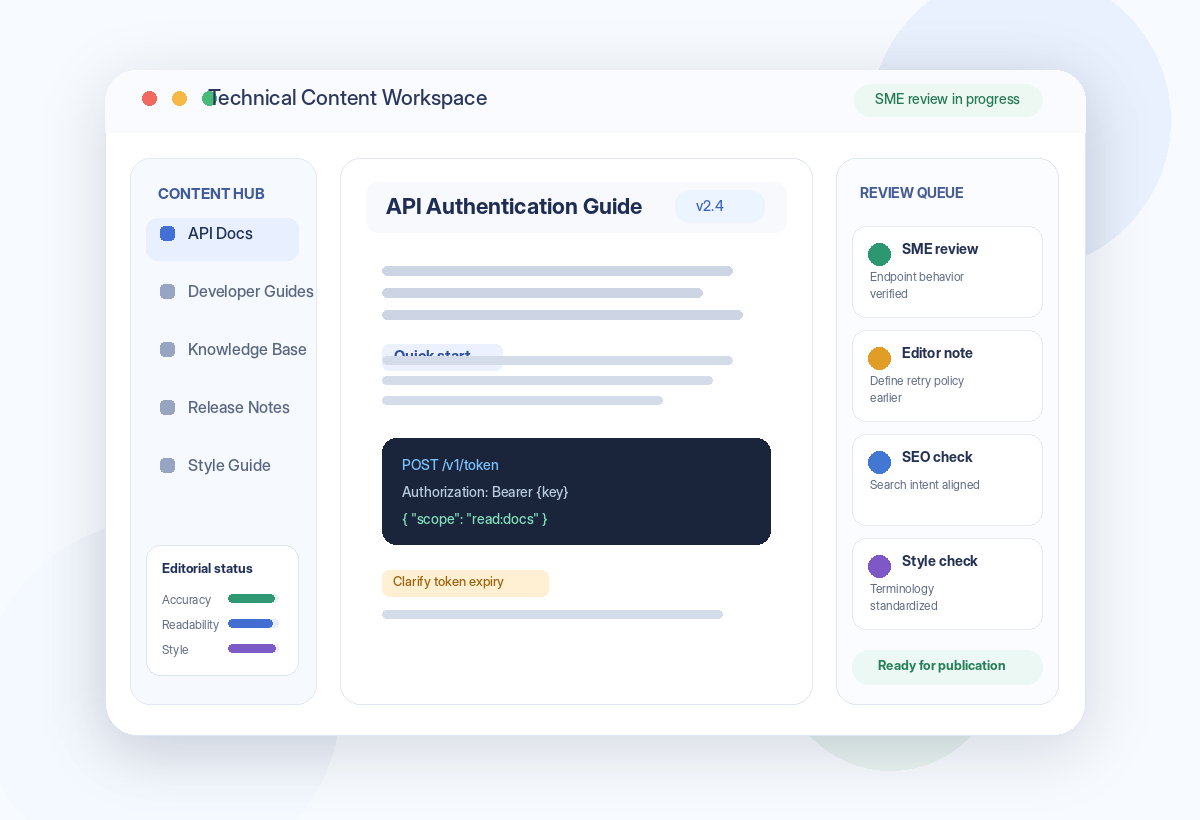
Technical content needs writers and reviewers who can work with product, engineering, and SME inputs. The monthly starting engagement reserves a managed technical-content team and a controlled documentation workflow.
Monthly starting engagement
₹45,000
per month
Suitable for: SaaS, software, engineering, product, or technical teams with recurring documentation and technical-content demand.
Reserved technical writing capacity
Source, SME, and product-input coordination
User, product, process, or developer documentation drafting
Terminology, examples, and cross-reference consistency
Technical review queries and change tracking
Editorial QA and release-ready handoff
DeliveryThe operating cadence is confirmed after tool access, source readiness, document types, and SME review windows are mapped.
Review allowanceTwo review cycles on standard documentation batches, including one technical stakeholder pass.
Attract: Searchable technical content reaches the right audience.Engage: Useful documentation builds understanding and trust.Nurture: Deep content answers technical questions and objections.Convert: Product and solution content supports informed action.Delight: Ongoing guidance helps users succeed after adoption.
Security & Confidentiality
NDA & Data Protection
Role-Based Access
Secure File Transfer
Encrypted Communication
IP Protection
Defined Access & Handover Controls
Ready to move forward?Tools & Technologies We Use.
Practical answers about dedicated technical content teams, scope, collaboration, quality, security, onboarding, and engagement.
What is a dedicated technical content team?+
A dedicated technical content team is an assigned group of writers, editors, and content specialists that works as an extension of your organization on recurring technical content needs, shared standards, workflows, and delivery priorities.
What technical content can the team create?+
The team can support API documentation, developer guides, product documentation, knowledge-base articles, tutorials, technical blogs, whitepapers, case studies, release notes, SOPs, implementation guides, and related technical content when included in the agreed scope.
How is a dedicated team different from a one-off writing project?+
A dedicated-team model is designed for recurring work, retained context, shared processes, and consistent editorial standards. A one-off project is more suitable when the requirement has a defined scope and end point.
Can the team work with our subject-matter experts?+
Yes. The workflow can incorporate briefs, SME interviews, source materials, product notes, engineering input, and review feedback so technical accuracy can be checked before publication.
Can you follow our style guide and terminology?+
Yes. When you provide style, terminology, tone, formatting, and documentation requirements, the team can incorporate them into the working brief and editorial QA process.
Can the team support SEO as well as technical accuracy?+
Yes, where SEO is part of the agreed scope. Technical accuracy, user intent, readability, information structure, metadata, and search optimization can be handled together without replacing necessary subject-matter review.
Can the team scale content output up or down?+
The dedicated-team model is intended to support changing content volumes. Exact staffing, capacity, and schedules are confirmed against the volume, complexity, workflow, and review requirements of your program.
How do you handle technical review and quality assurance?+
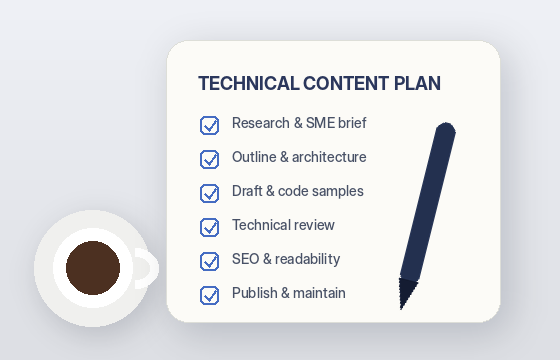
The workflow can include research and briefing, drafting, editorial review, fact and source checks, terminology consistency, SEO and readability review where applicable, and a final quality-control pass before delivery.
Can you work with existing documentation and legacy content?+
Yes. Existing documentation can be reviewed, refreshed, reorganized, standardized, or expanded when that work is included in the confirmed service scope.
How are confidentiality and intellectual property handled?+
The service is designed around controlled access, secure file handling, confidentiality-focused communication, and defined handover practices. Specific legal or security requirements should be shared during scoping.
How long does onboarding take?+
Onboarding depends on the number of content streams, source systems, style requirements, stakeholder reviews, and access needs. A realistic onboarding plan is established after the scope and workflow are understood.
How is a dedicated technical content team priced?+
Pricing depends on team composition, expected output, content complexity, review depth, tools, workflow, and engagement model. Share your requirements so the scope can be assessed before a quote is provided.
Start Your Dedicated Team
Tell Us What Your Technical Content Operation Needs
Share your content types, expected volume, audiences, source materials, review process, current tools, and delivery priorities. We’ll use the information to assess the right team structure and engagement approach.
Content ScopeDocumentation, blogs, whitepapers, support content, or a mixed program
StakeholdersSMEs, product teams, marketing, support, engineering, or operations
Helpful to include: your primary content channels, approximate monthly volume, target audiences, technical complexity, preferred review workflow, source materials, and any launch or release deadlines.
Discuss Your Technical Content Requirement
Build Technical Content That Keeps Up With Your Product
From documentation architecture to recurring production and review, create a dedicated content operation that can support your product, users, and go-to-market teams over time.