Unclear Thesis
The report does not clearly state the research question, core view, or what evidence would support or challenge it.

Turn a research brief, source pack, spreadsheet, model, or early draft into a logically structured investment research report with clearer evidence, financial analysis, peer context, valuation framing, risks, catalysts, assumptions, citations, and report-ready presentation.
Research support and report development are not a guarantee of investment performance and do not replace personalised financial advice.
The page now gives a usable minimum for a focused desk-research assignment while keeping broad sector studies, extensive valuation analysis, and multi-market research outside the entry scope.
Suitable for: Analysts, strategy teams, or investors who need a bounded company, industry, peer, evidence, or source workstream developed for a larger research report.
Primary research, paid database access, regulated recommendations, extensive modelling, or several simultaneous workstreams require a larger engagement.
A strong report has to connect the research question, evidence, financial analysis, assumptions, valuation logic, risks and conclusion. These common gaps can weaken credibility even when the underlying idea is promising.
The report does not clearly state the research question, core view, or what evidence would support or challenge it.
Key claims rely on unclear, inconsistent, stale, or poorly linked evidence, making the analytical chain difficult to verify.
Forecasts or scenarios use assumptions that are not explained, benchmarked, or separated clearly from observed data.
The chosen peer set, valuation method, metric, or comparison period does not align well with the research objective.
The report emphasises upside without equivalent treatment of downside scenarios, monitoring triggers, limitations or uncertainty.
Company context, financial evidence, valuation, catalysts, risks and conclusions appear as disconnected sections rather than one argument.
The exact scope is agreed from your brief. A full report can be developed as a connected research workflow rather than a collection of isolated sections.
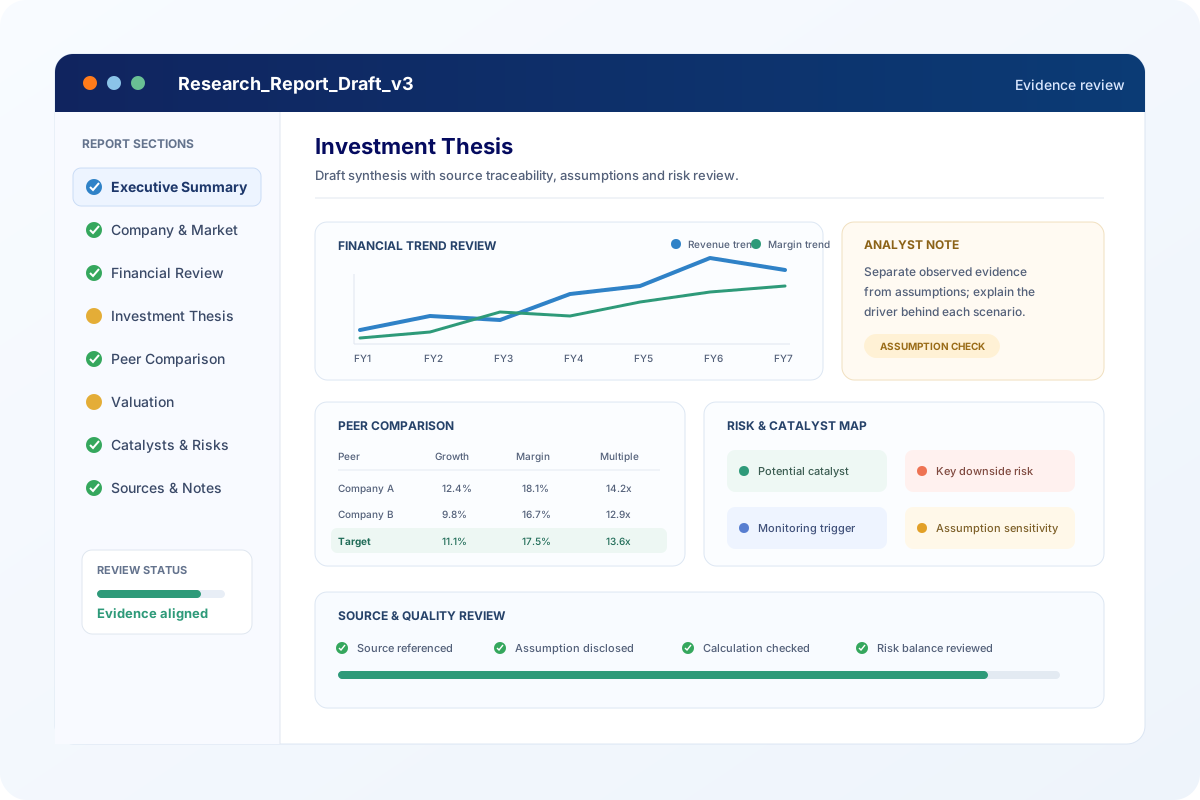
A representative example of how a broad investment idea can be turned into a traceable research narrative with clearer evidence, assumptions, analysis and report structure.
Investment research report development is broader than document cleanup. It connects the research objective, evidence, analytical framework and written report so the final output is coherent end to end.
| Support Dimension | Formatting & Presentation | Language Editing | Full Investment Research Report Research Support |
|---|---|---|---|
| Research objective and scope framing | × | × | ✓ |
| Source strategy and evidence mapping | × | × | ✓ |
| Company, industry and financial analysis | × | × | ✓ |
| Peer comparison and valuation framework | × | × | ✓ |
| Catalyst, risk and scenario development | × | × | ✓ |
| Report logic and section integration | △ | △ | ✓ |
| Academic/professional language clarity | △ | ✓ | ✓ |
| Formatting, tables and references | ✓ | ✓ | ✓ |
| Submission/readiness checklist | △ | △ | ✓ |
| Best for Primary use case | Polishing layout & presentation | Improving language & readability | Complete research report development |
The research framework can be adapted to different report purposes, audiences and coverage depths, subject to the brief, data availability and agreed scope.
A staged workflow keeps the research objective, evidence base, analytical logic, calculations, references and final report aligned from scope definition through delivery.
Share the research objective, source pack, data, model, draft and deadline.
Define coverage, analysis depth, required sections and expected deliverables.
Match the work to the required research and report-development context.
Build the thesis, evidence map, section logic and analysis plan.
Develop company, market, financial, peer, catalyst and risk analysis.
Structure valuation logic, scenarios and assumptions where in scope.
Align charts, tables, citations, labels, numbering and presentation.
Provide the agreed report files, review notes and supporting materials.
Clear inputs make the research scope easier to define and help the final report reflect the intended market, audience, analytical depth and presentation requirements.
The final review focuses on whether the report is coherent, evidence-linked, internally consistent, transparent about assumptions and limitations, and ready for the intended use.
Check thesis, section order and evidence flow.
Check attribution, traceability and evidence fit.
Review figures, tables, units and cross-references.
Separate observed data from assumptions and scenarios.
Check catalysts, downside cases and limitations.
Check readability, references, formatting and deliverables.
The report framework can be adapted to different industries and investment-research contexts when the required data, source material and analytical brief are available.
Your research and ideas remain confidential.
The published starting price above covers the defined entry scope for Investment Research Support. Larger, deeper, or faster-turnaround requirements are quoted after the actual materials and deliverables are reviewed. Scope, delivery timing and the quote are confirmed after the research requirement is reviewed.
Planned delivery for well-defined research and normal project sequencing.
Faster sequencing for a time-sensitive brief, subject to scope and capacity.
Urgent review for feasible assignments after the research depth and inputs are assessed.
Final turnaround depends on coverage breadth, data availability, number of companies or securities, analysis depth, report length, valuation requirements, formatting and the condition of the starting material.
We provide a project-specific quote rather than assigning unsupported pricing to a research brief that may vary substantially in complexity.
Answers to common questions about scope, inputs, analysis, confidentiality, pricing, turnaround and deliverables for the Investment Research & Analysis Service.
The service can cover research scoping, evidence and source planning, company and industry analysis, financial review, peer comparison, valuation framework support, investment-thesis development, catalysts, risks, source notes, report structure, tables and charts, citations, and final quality review depending on the agreed brief.
Yes. Existing notes, source packs, spreadsheets, models, outlines, or partial drafts can be used as starting material when they are supplied and relevant to the agreed scope.
No. The service is research and report-development support. It does not guarantee investment performance, market outcomes, or suitability for a particular investor.
Valuation framing, assumptions, peer comparisons, scenarios, and sensitivity presentation can be incorporated when they are part of the agreed research scope and the required inputs or data are available.
Yes. Source mapping, citation presentation, references, and traceability between evidence and report claims can be included within the agreed brief.
A useful brief normally includes the company, security, sector, or theme; research objective; intended audience; geography; preferred report structure; available data or source material; valuation or modelling requirements; citation style; and deadline.
Turnaround is confirmed after scope review and depends on research depth, number of companies or securities, data availability, analysis requirements, report length, formatting needs, and the requested deadline.
Pricing is provided as a custom quote after the research scope is reviewed. The quote can reflect coverage breadth, analysis depth, available inputs, financial or valuation work, formatting and citation requirements, and turnaround.
Charts, tables, peer-comparison layouts, assumption summaries, risk matrices, and other report-supporting visuals can be prepared when relevant to the agreed scope and supported by available data.
The service page provides for confidential file handling, limited access by the assigned team, and sensitivity to unpublished research material. An NDA can be requested where needed.
Yes. A supplied template, style guide, reporting format, citation requirement, or institutional checklist can be incorporated into the agreed report-development process.
Deliverables depend on the agreed scope and can include an editable research report, a clean final version, research and improvement notes, structured source or reference material, tables or charts, and supporting review notes where applicable.
Share enough context for the team to understand the report purpose, research depth, available data, analytical requirements and deadline before confirming scope, turnaround and a custom quote.
You do not need a finished brief. A concise description of what you are researching and what the report needs to accomplish is enough to start the scope review.
Identify the company, security, sector, market or theme and what the report should help explain.
State whether you need financial review, peer benchmarking, valuation, scenarios, catalysts, risks, or other specific work.
Mention any model, spreadsheet, research notes, source pack, draft, template or house style already available.
Provide the requested delivery date and any interim review date so feasibility can be assessed.
Submit the brief below. Scope, pricing and turnaround are confirmed only after the research requirement is reviewed.
Share your brief, existing analysis and deadline. We will use them to assess the scope and shape a clear, evidence-led research-report workflow.