Unclear Investment Thesis
The core reason to consider the opportunity is not stated in a concise, testable way.

Turn source materials, existing drafts, supplied financial information, transaction details, and review comments into a coherent investment memorandum built for focused internal or external review.
Custom scope • Confidential file handling • No unsupported financial or transaction claims added
The minimum reflects specialist long-form transaction writing and keeps the service commercially distinct from proofreading or editing-only work.
Suitable for: Deal and investment teams with source materials, approved assumptions, and a defined decision context that need those inputs developed into a structured memorandum.
Primary research, legal drafting, financial modelling, valuation opinions, more than 8,000 words, or complex transaction schedules require separate scoping.
Common document issues can slow review even when the underlying opportunity is strong. The writing process should make the investment case easier to test, trace, and discuss.
The core reason to consider the opportunity is not stated in a concise, testable way.
Market, operating, or transaction statements are not clearly linked to supplied source material.
Figures may be supplied, but the written explanation does not clearly connect assumptions, drivers, and implications.
The proposed structure, use of funds, ownership, or decision path is described without enough context.
Risks are missing, repetitive, disconnected from mitigants, or written in a way that makes review harder.
Sources, assumptions, diligence material, and supporting exhibits are not organized for efficient reference.
Coverage is tailored to the brief. Depending on the source material and decision context, support can extend across the main memorandum components below without inventing missing facts or financial data.
A practical writing workflow makes the reasoning visible. Rough notes are structured, unsupported gaps are flagged, and the final version presents the supplied investment case in a coherent sequence.
“Strong business, growing market, attractive opportunity. Revenue has improved and management expects further growth. We are seeking capital for expansion.”
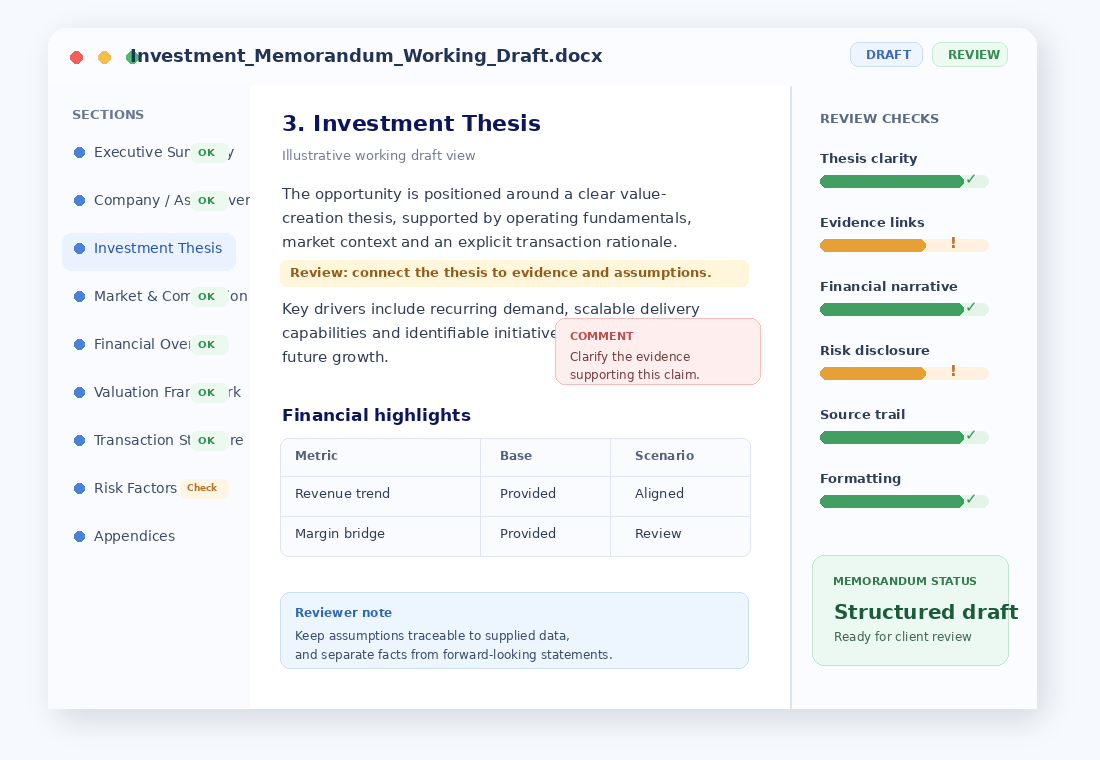
The final structure leads with the investment thesis, then connects the commercial case, supplied financial context, transaction rationale, risks, and supporting evidence in a reviewer-friendly sequence.
The distinction is the level of document development. Formatting review checks presentation; language editing improves wording; full memorandum support works across the investment narrative and document structure.
Where the client provides the relevant transaction facts, data, templates, and decision criteria, the memorandum can be shaped for different investment and financing contexts.
The process starts with the material you already have, then progresses through scope definition, structured drafting, review, and final delivery.
Share the draft, template, source documents, data, and review instructions.
Confirm the intended audience, decision context, sections, and writing depth.
Match the brief to an appropriate writer or reviewer for the agreed scope.
Build the logical flow, headings, section sequence, and evidence map.
Draft, expand, reorganize, and align the investment narrative.
Check thesis, assumptions, transaction logic, risks, and internal consistency.
Review source references, tables, figures, terminology, and presentation.
Provide agreed draft, clean version, review notes, and support files.
Clear source material helps keep the memorandum accurate. The writing team should work from supplied facts and identify missing information rather than fill gaps with invented claims.
A multi-stage review helps reduce contradictions, unclear reasoning, unsupported language, and presentation issues before delivery.
Check section logic, hierarchy, flow, and investment-case coherence.
Improve readability, concision, terminology, and professional tone.
Check that claims remain measured, specific, and aligned to the decision context.
Review supplied financial narrative, assumptions, transaction terms, and repeated facts for internal consistency.
Review source traceability, labels, cross-references, footnotes, and appendix links where supplied.
Check the agreed output for completeness, formatting, and unresolved reviewer notes.
The document structure can be adapted to the client's decision setting, while sensitive files are handled according to the confidentiality requirements agreed for the project.
The published starting price above covers the defined entry scope for Investment Memorandum Writing. Larger, deeper, or faster-turnaround requirements are quoted after the actual materials and deliverables are reviewed. Scope, complexity, source readiness, and deadline determine the quotation and feasible turnaround.
Final timing depends on document length, complexity, source readiness, review rounds, and agreed scope.
A tailored quotation can consider:
These answers explain scope boundaries, source requirements, financial-data responsibilities, confidentiality, and quotation logic.
Support is tailored to the brief and can include document structure, investment-thesis framing, commercial and market narrative, integration of client-supplied financial information, transaction rationale, risk sections, sources and appendices, review comments, and final document refinement.
Yes. An existing draft can be reviewed and reworked for structure, clarity, consistency, section logic, investment narrative, source traceability, and presentation according to the agreed scope.
Yes. Where sufficient source material is supplied, the service can help organize the available information into a structured memorandum draft. Missing or unsupported information is flagged rather than invented.
Not by default. The writing service can organize and explain client-supplied financial information and valuation assumptions, but it does not create unsupported figures, replace financial due diligence, or provide investment advice unless a separate scope explicitly covers specialist work.
The service can check internal consistency and source alignment within the materials provided, but the client remains responsible for factual accuracy, financial data, legal disclosures, and source completeness unless separate verification work is explicitly agreed.
Yes, where the target audience and review criteria are provided. The document can be structured around the expected decision context while preserving the underlying facts and source material.
Where the engagement involves review or refinement of an existing draft, tracked revisions and reviewer comments can be used to show material changes and issues requiring client input.
Yes. Provide the required template, house style, committee format, lender format, or transaction-specific instructions and they can be incorporated into the agreed document structure.
If the investment material is confidential or unpublished, specify any access, NDA, retention, deletion, or other file-handling requirements during scoping so they can be reviewed before sensitive files are shared.
Turnaround depends on the length, condition of the source material, document complexity, financial tables, review cycles, and deadline. Standard, priority, and express options are handled according to feasibility rather than a fixed unsupported timeline.
Pricing is confirmed through a custom quotation. The quote can consider document length, writing or restructuring depth, source-material readiness, complexity, financial tables or charts, formatting and reference needs, turnaround, and appendices.
No. The service supports document development and presentation; it does not guarantee investment approval, lender approval, transaction completion, valuation outcomes, or funding.
Share the type of memorandum, current stage, approximate length, target audience, deadline, and the material already available so the scope can be assessed before quotation.
The clearer the brief, the easier it is to identify whether you need full drafting, restructuring, review, or final refinement.
Tell us whether you have a rough outline, pitch deck, source pack, existing draft, or near-final memorandum.
Specify investment committee, lender, sponsor, board, internal approval, or another target reviewer.
Note what financial tables, assumptions, models, references, diligence files, or supporting exhibits are available.
Share the review date, time zone, expected output format, template, and any internal style requirements.
Highlight issues such as thesis clarity, market narrative, financial explanation, risks, flow, sources, or appendix organization.
Provide enough detail to assess the writing depth, material readiness, deadline feasibility, and quotation basis.
Share the brief and current materials so the document scope, review depth, and quotation can be assessed.