Investor Story Structure
Clear sequence from context to investment case

Turn business information, founder notes, metrics, market evidence, financial context, and an existing pitch deck into a focused investor narrative with logical slide flow and a clearly framed funding ask.
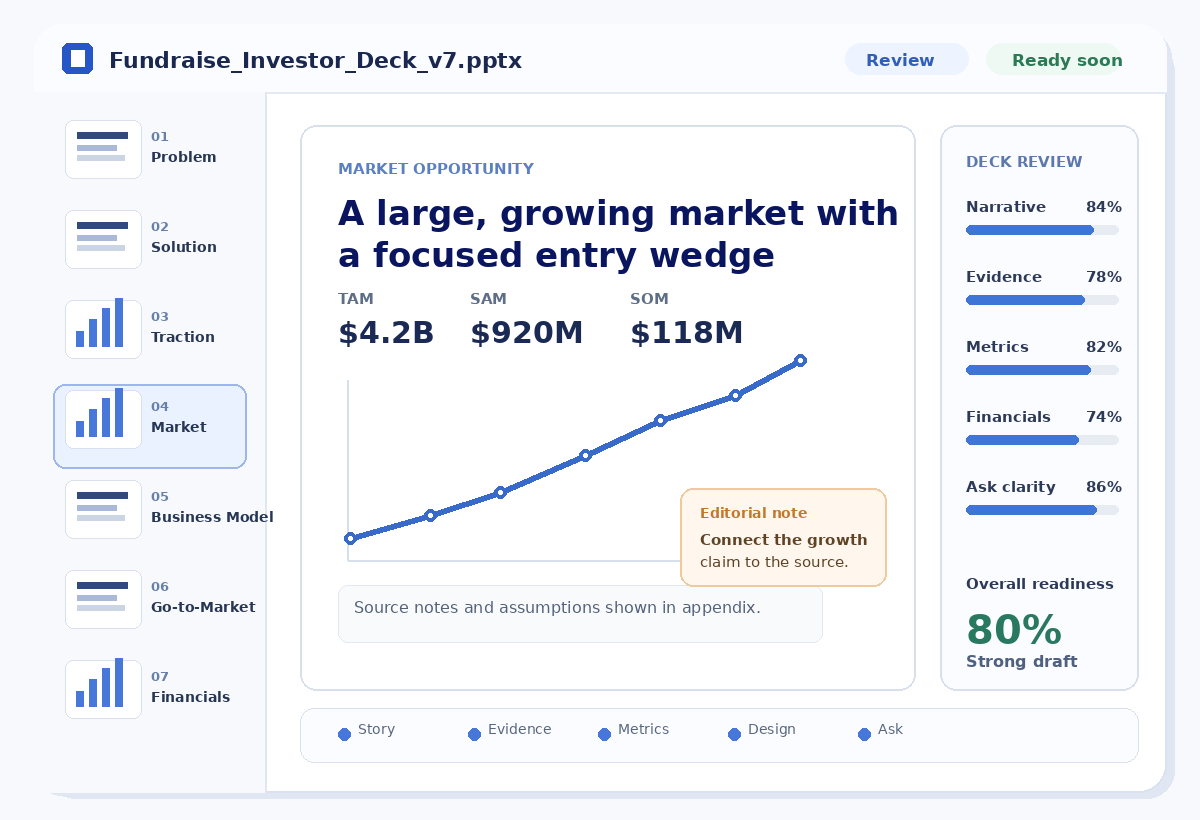
Clear sequence from context to investment case
Business and fundraising materials treated as confidential service information
Claims are tied back to supplied facts and source material
Structured deck copy and review outputs matched to the agreed scope
The starting price is tied to a 12-slide fundraising deck so customers can see what the writing fee buys while larger research or design requirements remain separately scoped.
Suitable for: Founders or finance teams with approved company facts and source material who need concise investor-facing slide copy built around a defined fundraising narrative.
Original primary research, financial modelling, extensive market sizing, more than 12 slides, or multiple tailored investor versions require a larger quote.
A deck can contain strong business information and still feel difficult to assess when the investment story, evidence, slide sequence, or funding ask is unclear.
The deck describes features before investors can see the problem, urgency, and customer value.
Market numbers appear without a clear segment, entry wedge, assumptions, or relevance to the business model.
Metrics are listed without showing what changed, why it matters, or how the evidence supports the investment case.
Revenue mechanics, pricing logic, unit economics, customer acquisition, or scale assumptions are difficult to follow.
The raise, use of funds, milestones, runway logic, and financial story are disconnected or insufficiently explained.
Each slide works alone, but the deck does not build a coherent case from insight to opportunity to funding need.
The exact slide structure depends on your stage, business model, source material, and fundraising context. A typical investor narrative may address the following components.
Immediate company context and investor-facing positioning.
Customer pain, urgency, scale, and why the issue matters now.
How the product or service solves the stated problem.
Core capability, experience, workflow, and value delivered.
Relevant market framing, segment logic, and sourced assumptions.
Supplied growth, usage, customer, commercial, or operational evidence.
How value is monetised and how the economics fit together.
Customer acquisition channels, sales motion, and growth approach.
Alternatives, differentiation, and defensibility based on supplied facts.
Relevant leadership, expertise, and execution context.
Financial context, assumptions, and key figures you provide.
Raise amount and fundraising objective supplied by your team.
How the raise connects to priorities and planned deployment.
What the capital is intended to enable across the agreed planning horizon.
Deeper evidence, assumptions, operating detail, or source notes where useful.
A fundraising deck usually improves in two dimensions at once: the story becomes easier to follow and each slide becomes more disciplined about what it says, what it proves, and why it matters.
“Our market is huge and customers love the product. We want to expand fast, hire more people, enter new cities, and raise funds to grow.”
“The raise is framed around the supplied operating plan, with market scope, traction evidence, use of funds, and milestones presented as one connected investment story.”
Formatting and language polishing improve presentation. Full fundraising-deck writing support works at the story, slide, evidence, and investor-logic level as well.
| Support Dimension | Deck Formatting Review Layout & presentation |
Language Editing Grammar & wording |
Fundraising & Investor Deck Writing End-to-end content architecture |
|---|---|---|---|
| Investor narrative framing | × | × | ✓ |
| Problem / solution logic | × | △ | ✓ |
| Market story & evidence placement | × | × | ✓ |
| Traction and metrics narrative | × | △ | ✓ |
| Business model and go-to-market coherence | × | × | ✓ |
| Financial story, ask & use-of-funds framing | × | × | ✓ |
| Slide flow & sequencing | △ | × | ✓ |
| Grammar, clarity & concise wording | △ | ✓ | ✓ |
| Formatting consistency | ✓ | △ | ✓ |
| Investor-focused refinement notes | × | × | ✓ |
The writing approach can be adapted to the fundraising situation and the materials you already have. The scope is confirmed after the deck and supporting information are reviewed.
The workflow moves from source material and scope through story structure, slide development, evidence checks, and final delivery. The exact depth is agreed before work begins.
Share the current deck, company context, metrics, financial information, and fundraising objective.
We assess content readiness, slide count, missing inputs, writing depth, and delivery requirements.
The investment narrative and slide sequence are organised around the evidence available.
Headlines, supporting copy, transitions, and key messages are drafted or rewritten.
Claims are reviewed against supplied facts, numbers, assumptions, and source material.
The supplied financial story, raise, use of funds, and milestones are checked for alignment.
Terminology, slide structure, labels, headings, and presentation consistency are checked.
The agreed deliverables are prepared with clean copy and review notes where included.
Good investor-deck writing depends on accurate source material. The clearer the inputs, the more precisely the deck can reflect your business rather than relying on assumptions.
A deck is reviewed as a connected investment narrative—not only as individual slides—so story logic, evidence, metrics, financial framing, language, and consistency can be checked together.
Check the investment thesis, sequence, emphasis, and slide-to-slide logic.
Improve headline strength, concision, readability, and message discipline.
Review claims against the metrics, sources, and facts provided by your team.
Check whether supplied figures, assumptions, ask, use of funds, and milestones align.
Check terminology, labels, slide hierarchy, formatting, and repeated statements.
Review the final agreed deliverable for readability and handoff readiness.
The deck should reflect the business you are actually building. Industry terminology, business model, metrics, financial logic, and fundraising context are therefore shaped around your source material rather than generic pitch language.
For the published starting scope, typical delivery is 5–7 business days. The delivery plan is confirmed after reviewing the deck, source-material readiness, writing depth, presentation scope, and deadline.
Because this service does not have an exact service scope price, the quote should reflect the actual project scope rather than a fabricated fixed package.
Share whether you need a new deck, a rewrite of an existing deck, investor-story restructuring, slide copy refinement, evidence and metrics review, or a combination of these.
Common questions about investor-deck scope, source materials, factual claims, financial information, formatting, confidentiality, pricing, turnaround, revisions, and delivery.
The service can structure the investment story across the problem, solution, product, market, traction, business model, go-to-market plan, competitive position, team, financial story, funding ask, use of funds, milestones, and supporting appendix material, based on the information you provide and the scope agreed for the project.
Yes. An existing deck can be reviewed for story logic, slide sequence, message clarity, evidence alignment, repetition, missing context, and consistency before the revised content is developed.
Yes. The workflow can begin from notes, a business overview, existing presentations, product information, market material, metrics, financial information, and other source files. The exact scope is confirmed after those materials are reviewed.
No. Metrics, market figures, financials, customer claims, and other factual statements should come from your supplied information or clearly identified source material. Unsupported numbers are not created to make a slide appear stronger.
Market-sizing content can be structured around the sources, assumptions, calculations, and segmentation logic you provide. If additional research support is required, that requirement should be identified during scoping rather than assumed to be included.
The writing can improve how supplied financial information, assumptions, raise amount, use of funds, and milestones are explained. This page does not promise financial modelling, valuation advice, or investment advice.
The service focuses on content architecture and investor-facing narrative. Presentation formatting can be aligned to the agreed scope, while the quote should reflect the level of visual refinement required.
The published starting price above covers the defined entry scope for Fundraising Deck Writing. Larger, deeper, or faster-turnaround requirements are quoted after the actual materials and deliverables are reviewed. A custom quote and delivery plan are prepared after reviewing the slide count, source-material readiness, writing depth, analysis or research requirements, presentation-formatting scope, revision needs, and deadline.
Your deck, supporting documents, company information, and unpublished materials should be handled as confidential service information through the designated submission and delivery process.
Deliverables are agreed to the project scope and may include revised investor-deck copy, a structured slide flow, review comments or change notes, and a clean version for your final internal review.
No. The service can improve structure, clarity, narrative coherence, evidence presentation, and message discipline, but investor decisions and fundraising outcomes depend on factors outside the writing process.
Send the current deck or founder notes, approximate slide count, fundraising stage and objective, deadline, the main source materials available, and a short explanation of what you want improved. This allows the scope to be assessed without inventing a package price or turnaround.
Share the current state of the deck, approximate slide count, fundraising objective, deadline, and the main areas that need work. The project can then be scoped around the material you actually have.
Tell us whether you have a complete deck, partial slides, founder notes, or only source material, plus the approximate number of slides.
Share the fundraising stage, investor context, raise amount if you want it reflected, and the purpose of the deck.
Describe the metrics, market evidence, product information, financials, customer context, and operating plan available for the writing process.
Include the deadline, time zone, presentation date if relevant, and whether you need a new deck, rewrite, story restructuring, or focused slide refinement.
Provide enough detail to assess narrative depth, source-material readiness, presentation scope, and deadline feasibility.
Share your current deck, founder notes, source material, and fundraising objective so the story, evidence, slide flow, and funding ask can be reviewed as one connected investor narrative.